Best Car Finance Option for Self-Employed Buyers: HP Wins
For most self-employed buyers, hire purchase is the best fit. Use PCP only if your income stays steady enough for a balloon payment, and choose a larger deposit or shorter term if earnings swing month to month. Get that wrong and you can end up with missed payments, a car you cannot keep, or a refinance bill that stings when work slows. This guide compares HP, PCP, and used-car finance for stable, seasonal, newly self-employed, and commission-led incomes.
This guide is part of our Car buying, financing, and selling guide series.
Best car finance option for self-employed buyers: HP usually wins on certainty
Hire purchase is the default pick for self-employed buyers who want fixed payments, no balloon payment, and clear ownership timing. It suits people whose income is steady, and it also suits anyone who cannot afford a nasty surprise at the end of the agreement.
PCP has a place. It can work when lower monthly payments matter more than end-of-term certainty, and when the buyer is comfortable with mileage limits, condition checks, and the option of handing the car back rather than keeping it.
Quick picks by self-employed income pattern
- Stable monthly income: HP is usually the cleaner fit.
- Seasonal income: HP is safer; PCP only makes sense with a stronger deposit and a sensible mileage cap.
- Newly self-employed: HP with a larger deposit is often the lower-risk route.
- Variable commission income: HP is usually better unless monthly cash flow is very strong and predictable.
Why income pattern matters more than product labels
Self-employed income does not arrive in one shape. Some buyers invoice monthly and get paid on time. Others go quiet for weeks, then get a lump sum. A product name tells you almost nothing until it is matched to the way money actually lands in the account.
Lenders look for affordability, consistency over time, and proof that payments can still be met when work slows. That is why two buyers with the same turnover can receive very different outcomes.
What is the best car finance option if I’m self-employed?

For fixed and predictable income, hire purchase is usually the best option because it gives fixed monthly payments, no balloon payment, and ownership after the final payment. For irregular or seasonal income, HP is still safer than PCP. Buyers who change cars often may prefer PCP, but only if they can handle the end-of-term risk.
Best option for fixed and predictable income
Buyers with regular invoices, retained profits, or a salary-and-dividend structure that behaves consistently often do well with HP. The payment is easier to plan around. There is no final lump sum waiting at the end, so the car can be budgeted for like any other fixed business expense.
Best option for irregular or seasonal income
Seasonal earnings are where HP usually pulls ahead. A lower monthly PCP payment can look tempting, but a balloon payment at the end can become awkward if the slow months hit just before the agreement ends. If the work pattern is lumpy, certainty tends to beat flexibility.
Best option for buyers who change cars often
PCP can suit buyers who want to replace cars more often and are content with return, keep, or part-exchange options at the end. That only works well when mileage stays inside the allowance and the buyer is realistic about future cash flow. If the income is variable, the final settlement can be the weak point.

HP vs PCP for self-employed buyers
HP is the simpler structure: fixed monthly payments, no balloon payment at the end, and ownership after the final instalment. PCP usually offers lower monthly payments, but it builds in a balloon payment and adds mileage and condition sensitivity. For self-employed buyers, HP is generally safer when cash flow changes month to month.
HP: fixed monthly payments and ownership after the final instalment
HP works well for buyers who want to know what the car will cost each month. That matters when tax payments, VAT bills, or irregular invoices already make planning harder. The trade-off is higher monthly payments than PCP in many cases, because the debt is paid down across the term rather than pushed into a final lump sum.
PCP: lower monthly payments and a balloon payment at the end
PCP can reduce the monthly burden, which helps if the buyer needs breathing room in the short term. The catch is the balloon payment, also called the optional final payment, which is based on the vehicle’s residual value. If income falls, that lump sum can force a refinance, a part-exchange, or a return of the car.
Mileage limits, condition checks, and end-of-term choices
PCP adds end-of-term choices: return the car, keep it by paying the balloon, or part-exchange it. Those choices are useful, but they are not free of risk. Mileage and condition matter. A high-mileage self-employed driver can find PCP far less forgiving than HP, especially if work use changes year to year.
Can I get car finance if I’m self-employed and only use SA302s?
Yes, many lenders will consider self-employed applicants using SA302s, but SA302s alone are usually only part of the picture. Lenders normally want tax returns or tax year overviews, bank statements, and proof that trading income has been consistent over time.
Which documents lenders usually ask for
SA302s can help show declared income, but lenders may also want to cross-check them with bank statements. If the numbers on paper do not line up with cash arriving in the account, underwriting becomes harder. That is especially true for applicants with variable income or a short trading history.
How tax returns and bank statements support affordability checks
Affordability checks are not just about the headline income figure. They look at actual cash flow, regular commitments, and whether the borrower can keep paying if the business has a slow month. A tax-efficient structure can sometimes make declared income look low even when turnover is healthy, so bank evidence matters.
What to do if your trading history is short
Newly self-employed buyers may still get approved, but the case is often stronger with a larger deposit, a shorter term, and a car that fits the budget without stretching the monthly payment. A clean bank record and proof of consistent trading activity can help offset the short history.
Proof of income checklist for self-employed car finance
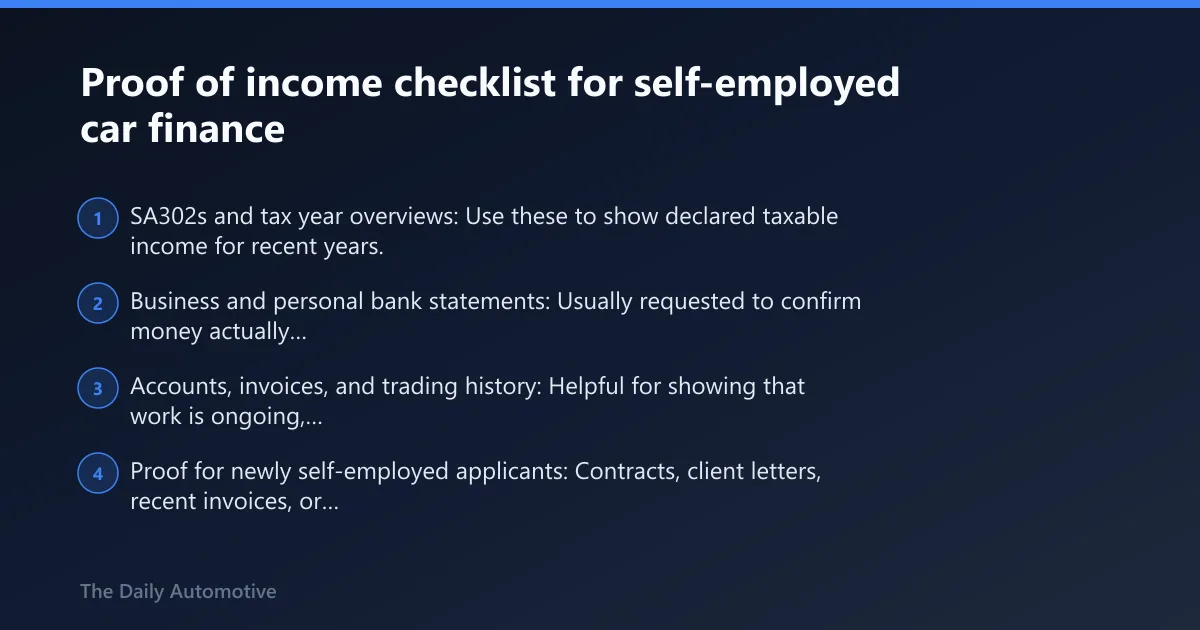
Self-employed finance applications usually go smoother when the documents are organised before the quote request. The exact list varies by lender, but the core aim is the same: show who you are, what you earn, how long you have traded, and whether the income is steady enough to support repayments.
- SA302s and tax year overviews: Use these to show declared taxable income for recent years.
- Business and personal bank statements: Usually requested to confirm money actually arrives and regular commitments are manageable.
- Accounts, invoices, and trading history: Helpful for showing that work is ongoing, especially where income varies.
- Proof for newly self-employed applicants: Contracts, client letters, recent invoices, or accountant-prepared records may help if full-year accounts are not yet available.
How to think about the checklist by scenario
If the buyer is stable and established, the file can be straightforward. If the buyer is seasonal, lenders will want to see whether the quieter months still leave enough room for the payment. If the buyer is newly self-employed, the focus shifts to trading evidence and cash flow discipline.
| Income pattern | Best fit | Deposit idea | Risk level | Key documents |
|---|---|---|---|---|
| Stable monthly income | HP | 0% or moderate deposit | Lower | SA302s, bank statements, tax year overviews |
| Seasonal income | HP, or PCP with caution | Stronger deposit | Medium | SA302s, bank statements, trading history, invoices |
| Newly self-employed | HP | Larger deposit if possible | Medium to higher | Tax returns, bank statements, contracts, accountant records |
| Variable commission income | HP unless cash flow is very strong | Moderate to larger deposit | Higher | SA302s, bank statements, commission records, trading evidence |
How deposit, APR, term, and credit profile change the deal
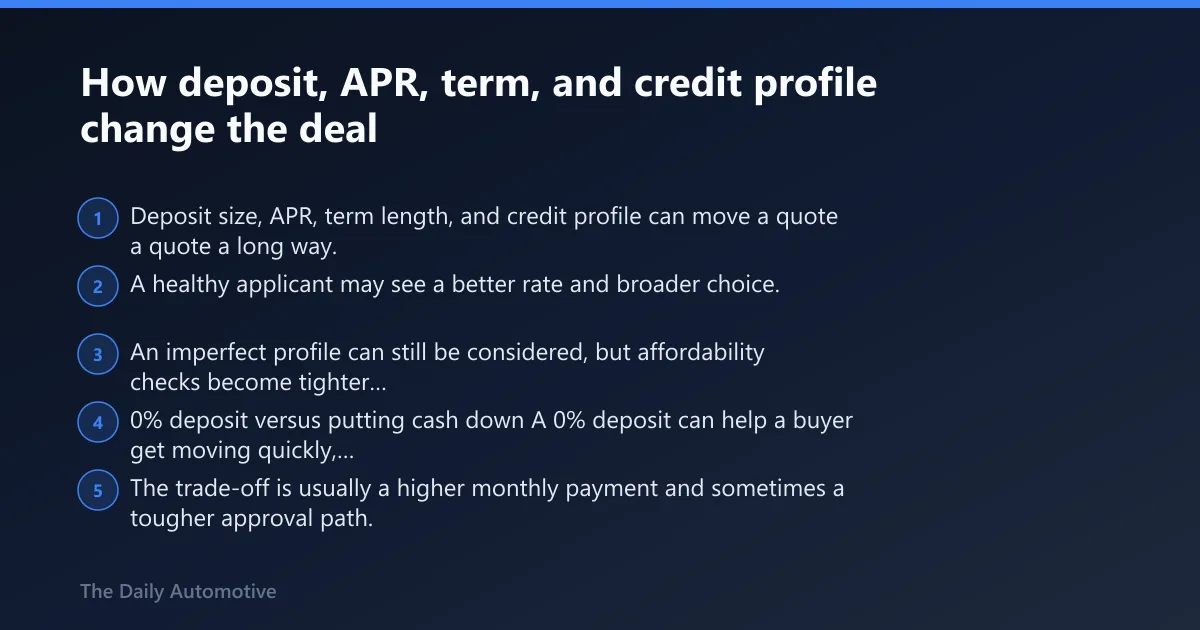
Deposit size, APR, term length, and credit profile can move a quote a long way. A healthy applicant may see a better rate and broader choice. An imperfect profile can still be considered, but affordability checks become tighter and the pricing usually changes.
0% deposit versus putting cash down
A 0% deposit can help a buyer get moving quickly, and the lender example on the site uses £0.00 deposit. The trade-off is usually a higher monthly payment and sometimes a tougher approval path. A deposit can reduce the amount borrowed, which may improve affordability and lower the monthly cost.
Representative APR versus your personalised rate
The representative APR shown is 22.3%, while rates start from 10.9% APR on the lender site. Those figures are not the same thing as the rate offered to every applicant. The personalised rate depends on credit profile, deposit, term, and affordability checks.
36 to 60 month terms and total cost
Loan term matters as much as the payment size. A shorter term usually reduces total interest, but it raises the monthly payment. A longer term spreads the cost and lowers the instalment, but it often increases the total payable. The sample loan example uses £7,000 over 60 months, with a monthly payment of £167 and a total payable of £11,520.
Healthy credit versus imperfect credit
Buyers with healthy credit often have more options and better pricing. Imperfect credit does not automatically stop approval, but it can mean stricter affordability checks, a higher deposit expectation, or a less attractive APR. For self-employed applicants, the lender will usually look at the whole file, not just the score.
How self-employed buyers should choose between HP and PCP
Choose HP if the main goal is certainty. Choose PCP only when lower monthly outlay matters more than owning the car outright without a final payment risk. That split is especially important for self-employed income, because cash flow can change between quote day and month twelve.
If income is steady
HP is still the stronger default, but PCP can be considered if the buyer regularly changes cars and can absorb the end-of-term decision. The key question is not “Which product is cheaper this month?” It is “Which structure will still fit when work slows?”
If income is seasonal or irregular
HP is generally safer. If PCP is chosen, the buyer should keep mileage realistic, keep some cash reserve for the final payment, and avoid assuming that refinance will be available on favourable terms. A balloon payment is manageable only when the end date is unlikely to collide with a weak cash-flow period.
If the buyer is newly self-employed
HP with a stronger deposit is usually the cleaner route. The shorter the trading history, the more important it is to show steady bank activity and a payment that fits comfortably inside the business budget. A big annual income figure means little if the money lands unevenly.
If commission drives the income
Commission-led buyers should be cautious. HP often makes more sense unless the monthly inflow is genuinely strong and predictable. A low monthly PCP figure can hide the risk sitting at the end of the agreement, and that risk becomes sharper when income depends on sales performance.
How to get a quote and compare deals
The quote process is usually straightforward. The site says the application is a simple 2 minute application, a decision can be made in 60 seconds, and the lender panel compares quotes and deals without affecting credit score. The lender also says it has 1000s of available vehicles.
That speed is useful, but it should not replace the document check. A quick quote is only the start. The right deal still depends on whether the income profile fits the product.
Frequently asked questions
Is PCP or HP better for self-employed buyers?
HP is usually better when income can vary, because the payment is fixed and there is no balloon payment. PCP is better only when lower monthly payments matter more than end-of-term certainty, and when the buyer can stay inside the mileage and condition limits.
Do I need two years of accounts for self-employed car finance?
Not always. Some lenders may ask for two years of accounts, but this is not always required. Newer businesses can still be considered if there is enough evidence of trading, bank activity, and affordability. The lender’s approach depends on credit profile, deposit, and income stability.
Can a self-employed person get car finance with no deposit?
Yes, some applicants can be considered with a 0% deposit, but it is not guaranteed and usually means a higher monthly payment. Approval still depends on affordability, credit profile, and the documents provided. A deposit can improve the shape of the deal.
Is balloon payment finance risky if my income changes?
Yes. A balloon payment is the main risk point in PCP if income drops before the end of the term. If the final amount cannot be paid, the buyer may need to refinance, part-exchange, or return the car. That is why HP is often safer for variable-income buyers.
Products related to this article
Sponsored / affiliate links. As an Amazon Associate I earn from qualifying purchases. I may earn additional commission from eligible campaigns.