Best Car Finance Option for Bad Credit: Compare Costs
The cheapest workable bad-credit auto finance is usually a credit-union or online preapproval for a short-term used-car loan; if that fails, a small subprime loan with a larger down payment beats rolling negative equity into a long contract. Pick the wrong structure, and you can add thousands in interest, stretch the payment past your budget, or stay upside down for years. This guide compares approval odds, monthly payment, and total cost so you can choose the least expensive setup before you apply.
This guide is part of our Car buying, financing, and selling guide series.
Can I get car finance with bad credit?

Yes. Bad credit is often treated as a score below the low-600s, though some lenders use different cutoffs, and a few may not set a strict minimum score at all. Approval depends less on the label and more on steady income, identity checks, vehicle age and mileage, and how much you ask the lender to cover.
What lenders usually mean by bad credit
For auto finance, bad credit is not a single wall. It is a pricing tier, and bad-credit borrowers often land near the top of that tier. That means the same car can feel manageable or punishing depending on the APR, term, fees, and down payment.
Bad-credit loans commonly come with shorter approval windows, tighter vehicle rules, and more manual review. Lenders want proof that the monthly payment fits your income after rent, insurance, and existing debt are counted.
What approval checks matter most
- Income stability: pay stubs, bank deposits, or benefits records.
- Identity and residence: driver’s license, proof of address, and sometimes a utility bill.
- Vehicle fit: age, mileage, book value, and whether the loan amount is too far above the car’s worth.
- Payment-to-income ratio: the lender wants room for taxes, insurance, and fuel.
- Down payment: more cash up front usually lowers the lender’s risk.
When a thin file is easier to finance than recent delinquencies
A thin file can be easier than a messy one. No history means less evidence of trouble, while recent charge-offs, collections, repossessions, or bankruptcy tell a lender exactly what went wrong. A short file with steady income often gets a better response than a longer file with fresh misses.
According to Best Loans for Bad Credit of September 2026 – NerdWallet — NerdWallet defines bad credit in this context as below 630.
Which bad-credit finance path is cheapest in practice?
The cheapest path is usually the one with the lowest all-in borrowing cost, not the lowest advertised APR. Credit unions often price lower than subprime online lenders, banks may beat both for stronger borrowers, and online marketplaces are useful when you need to compare offers fast. Co-signers and secured loans can improve approval odds, but they also change the risk.
Credit union versus bank versus online marketplace
Credit unions are often the first stop because membership rules are usually manageable, and local underwriting can look beyond a raw score. Banks are stricter, especially on score and income, and dealer-arranged financing can include markup that raises the rate. Online marketplaces are strongest for speed and comparison.
NerdWallet highlights soft-credit prequalification as a useful feature. That matters because you can compare rates without turning a bad file into a pile of hard inquiries. The same source reports bad-credit borrowers pre-qualified over the last 30 days received an average rate of 27.27%.
Where a co-signer helps most
A co-signer helps most when the main issue is thin credit or a moderate score problem and the co-signer has strong income and cleaner credit. The lender gets another person legally responsible for the debt, which can improve approval odds and sometimes the rate. The tradeoff is shared liability, not shared inconvenience.
When a secured loan is the smarter choice
A secured loan can make sense when the borrower needs a rate reduction and has collateral that the lender will accept. The vehicle itself already backs most auto loans, but a separate secured structure may come with tighter collateral rules or added protections for the lender. Miss payments, and repossession risk rises fast.
That structure is usually best for borrowers who have steady cash flow but a damaged file. It is a poor fit for someone already stretched thin, because collateral turns a payment problem into an asset-loss problem.
Decision table: compare approval odds, APR, fees, and risk
Use this table as a starting point, not a final quote. The real decision comes from the combination of approval odds, expected APR band, fee load, and how much collateral or liability you are willing to put on the line.
| Option | Approval odds | Expected APR band | Fees | Risk level |
|---|---|---|---|---|
| Credit union | Good for thin files and mild bad credit if membership fits | Usually lower than subprime online offers | Often lighter fee load | Moderate |
| Bank | Best for stronger income and cleaner credit; weaker for subprime | Can be competitive for better borrowers | May be lower on direct loans; dealer-arranged loans can be marked up | Moderate |
| Online marketplace | Good for comparison and wider lender access | Wide spread, often higher for bad credit | May include origination fees with some lenders | Moderate to high |
| Co-signed loan | Higher if the co-signer is strong | Often better than solo bad-credit pricing | Depends on lender; extra paperwork is common | High for the co-signer |
| Secured loan | Higher if collateral and income support the deal | Can improve versus unsecured bad-credit pricing | Collateral-related costs can apply | High if payments slip |
Worked example on the same vehicle price
Assume a used car around $20,000 and a down payment around $3,000, leaving about $17,000 financed. A 60-month loan at a high bad-credit rate can cost far more than a shorter loan at a lower rate, even when the payment looks manageable at first glance.
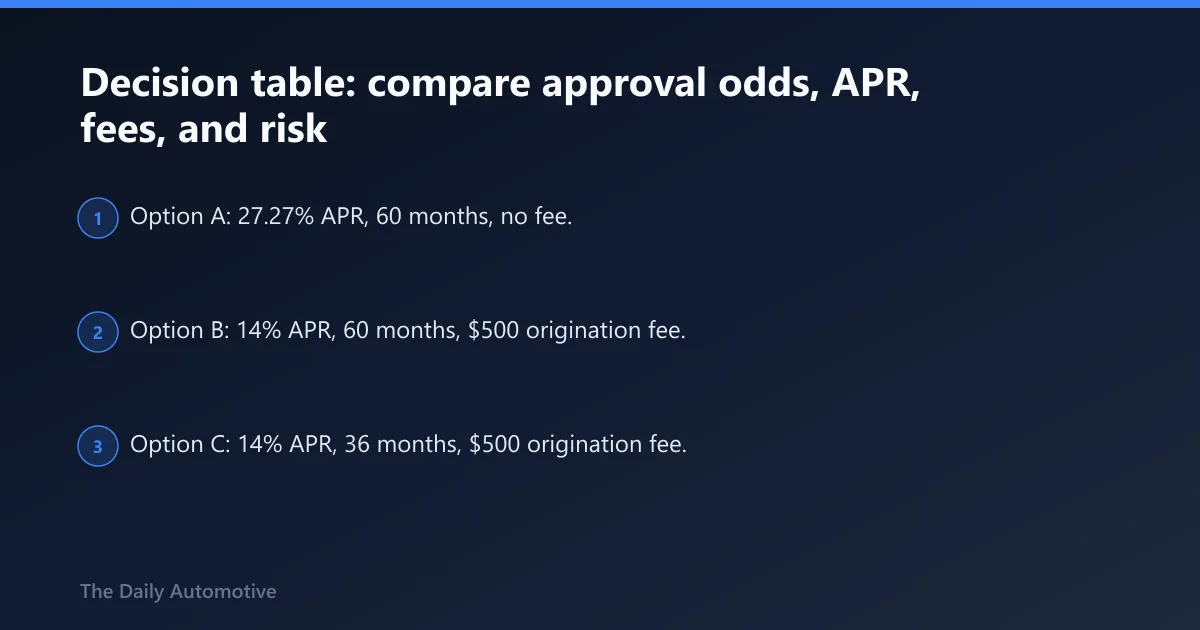
- Option A: 27.27% APR, 60 months, no fee. Monthly payment is roughly in the mid-$400s, and total interest is around $10,800.
- Option B: 14% APR, 60 months, $500 origination fee. Monthly payment is roughly $395, but the fee raises the effective cost.
- Option C: 14% APR, 36 months, $500 origination fee. Monthly payment jumps to roughly $581, but total interest falls sharply versus the 60-month version.
That is the trap. A lower stated APR with a fee can still lose to a cleaner loan if the fee is large relative to the amount borrowed. The right comparison is total outlay, not just the monthly payment.
How to read the table for your credit tier
If your score is below 630 and your file is thin, start with a credit union and an online marketplace. If your file has fresh late payments or collections, a co-signer or larger down payment may matter more than shopping for the absolute lowest rate. If you have a bankruptcy or repossession, expect a narrower lender set and more fee pressure.
How do APR and loan term change the real cost?
APR controls the interest bill, and term length controls how long interest keeps piling up. A shorter term raises the payment but cuts total interest. A longer term lowers the monthly hit, yet it often makes the loan far more expensive overall and can keep you upside down longer.
Payment size versus total interest
Borrowers often choose the lowest payment they can find, but that can be the most expensive contract. Stretching a loan from 36 months to 72 months may make the monthly number easier to live with, yet it usually increases total interest and raises the chance that the car needs repairs before the loan is finished.
Loan terms often run from a couple of years to several years. For bad-credit buyers, the longer end may be available because the lender wants the payment to fit, but affordability is not the same as value.
Why dealer markup changes the math
Dealer-arranged financing can look convenient, especially when the payment fits the budget. The problem is markup. If the dealer adds rate spread to the lender’s buy rate, the borrower may never see the cheaper offer that was originally available. Ask for the raw rate and compare it against direct offers.
What hidden costs make bad-credit car finance expensive?
Hidden costs often do more damage than the rate headline. Origination fees, document fees, add-on products, and negative equity can make a loan look affordable while quietly raising the true cost. The worst deals often combine a long term, a fee-heavy contract, and a weak down payment.
Origination fees and document fees
Origination fee is a common cost with some online lenders, especially unsecured ones. It reduces the net proceeds of the loan, so the borrower pays interest on money that never reaches the car deal. That can make a lower APR less competitive than it appears.
Optional add-ons that do not help approval
Gap coverage, service contracts, and cosmetic add-ons do not improve approval odds. They only raise the amount financed. If the lender already sees too much risk, extra products can push the deal over the limit or increase the payment beyond what the budget can carry.
Down payment gaps and negative equity risk
Small down payments leave little cushion if the car loses value quickly. If the trade-in is upside down, rolling that balance into a fresh loan makes the next loan larger and riskier. That is how borrowers end up paying for the old car long after it is gone.
How can you improve approval odds before you apply?
Fixing approval odds means reducing lender risk before the application hits. Check for reporting errors, lower revolving balances, document income cleanly, and avoid adding new debt right before shopping. If the file is weak, a co-applicant or a larger down payment can change the decision more than chasing a slightly lower APR.
- Pull your credit reports and dispute obvious errors.
- Pay down revolving balances if possible.
- Gather proof of income, residence, and insurance.
- Get prequalified with soft pulls before a hard application.
- Compare the same vehicle price, term, and down payment across lenders.
- Bring a co-applicant only if that person understands the liability.
How to shop multiple lenders without a hard-pull mess
Use soft-pull prequalification where available, then compare APR, fees, term, and loan amount side by side. NerdWallet notes soft-credit prequalification as useful, and that is especially true here because a bad-credit borrower cannot afford to collect hard inquiries from every lender in town.
When to bring a co-applicant or more down payment
Bring a co-applicant when the issue is approval, not affordability. Bring more down payment when the issue is the amount financed or the loan-to-value ratio. If the car is expensive, older, or already near the top of the lender’s age limit, cash up front may matter more than a second signature.
What should you choose: bank, credit union, or online lender?
Choose the lender type that fits your file. Credit unions are usually best first-stop options for mild bad credit and thin files. Banks fit borrowers with steadier income and cleaner histories. Online lenders are best when you need speed, comparison, or a wider approval net for weaker credit.
Best fit for thin-file borrowers
Start with a credit union if membership is available. Relationship-based underwriting can help where a traditional score cut-off would not, and rates are often better than the subprime online crowd. If that fails, use an online marketplace to widen the search without starting over from scratch.
Best fit for borrowers with prior delinquencies
Recent delinquencies, collections, or a prior repossession usually push the borrower toward online lenders, a co-signer, or a larger down payment. Banks are less forgiving here. Credit unions may still work, but only if the rest of the file is stable enough to offset the damage.
Best fit for borrowers who need speed
Online marketplaces win on speed because they can prequalify against multiple lenders at once. That is useful when a seller is waiting and the borrower needs a fast answer. Speed still costs money if the borrower accepts the first offer without checking fees and term length.
Frequently asked questions
which car finance is best for bad credit
The best choice is usually a credit-union preapproval for a short-term used-car loan. If that fails, an online marketplace can widen the search. A co-signed or secured loan can help if approval is the main barrier, but those structures add risk that should be priced in before signing.
how to get car finance with low credit score
Get prequalified with soft pulls, gather proof of income and residence, and target a lower-priced used car with a solid down payment. Then compare credit unions, banks, and online lenders on the same loan amount and term. Approval is easier when the requested amount matches your repayment capacity.
What credit score do I need for car finance with bad credit?
There is no single minimum. NerdWallet defines bad credit in this context as below 630, and some lenders require 600 or lower, or no minimum score. The score matters, but lenders also weigh income stability, vehicle value, and the size of the down payment.
Should I use a bank, credit union, or online lender for bad credit?
Use a credit union first if you qualify for membership, because pricing is often better. Use a bank if your income and credit are stronger than average bad-credit files. Use an online lender or marketplace if you need broader approval odds, soft-pull shopping, or a faster decision.
How can I improve approval odds for a car loan with bad credit?
Fix report errors, reduce revolving balances, and document steady income before applying. Use soft-pull prequalification to compare lenders without extra hard inquiries. If needed, add a co-applicant or more down payment. Those changes often do more for approval than chasing a slightly lower advertised APR.
Products related to this article
Sponsored / affiliate links. As an Amazon Associate I earn from qualifying purchases. I may earn additional commission from eligible campaigns.