Best Car Charger for iPhone: Fast, Reliable Picks
For most iPhone drivers, the best car charger is a 30W USB-C PD charger paired with an MFi-certified Lightning cable for iPhone 14 and earlier, or a Qi2/MagSafe mount for iPhone 12 and later. Poor chargers waste time, stress cables, and trickle-charge on short drives. This guide matches charger type to commute length, family use, rideshare needs, and iPhone generation.
Quick picks


| Best for | Charger type | Key spec to look for | Why it fits |
|---|---|---|---|
| Most drivers with iPhone 15 or 16 | USB-C PD car charger | 20W or higher, USB-C to USB-C cable | Fast wired charging with the right cable and minimal fuss |
| iPhone 12 through 14 owners | USB-C PD car charger | 20W or higher, MFi-certified USB-C to Lightning cable | Fast charging without relying on wireless alignment |
| Drivers who want easy placement | Qi2 magnetic wireless charger | Up to 15W, magnetic mount or bracket | Snap-on convenience for iPhone 12 and newer |
| Two-device households | Dual-port car charger | 40W total or more, power split across ports | Charges a phone plus a second device at once |
| Older Lightning iPhones | USB-C PD charger with MFi cable | MFi-certified cable, 20W to 30W charger | Best path to fast charging on older models |
Best overall wired pick
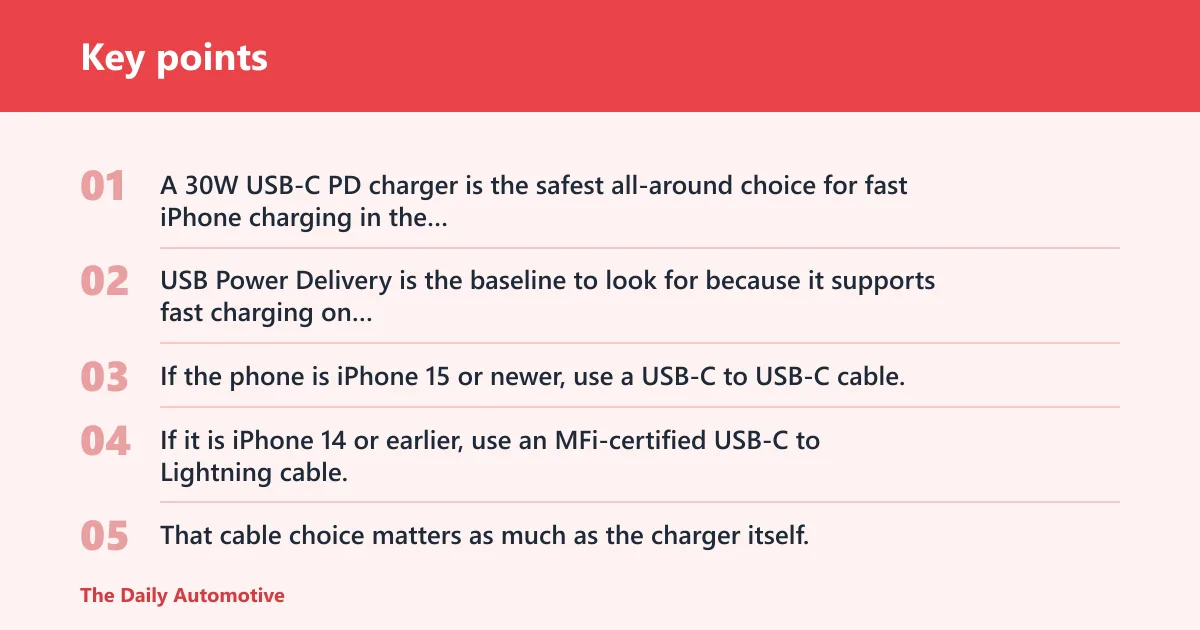
A 30W USB-C PD charger is the safest all-around choice for fast iPhone charging in the car. USB Power Delivery is the baseline to look for because it supports fast charging on iPhone 8 and newer with the proper cable, and 20W or higher is the practical floor for quick top-ups.
If the phone is iPhone 15 or newer, use a USB-C to USB-C cable. If it is iPhone 14 or earlier, use an MFi-certified USB-C to Lightning cable. That cable choice matters as much as the charger itself.
Best wireless Qi2 pick
Choose a Qi2 magnetic car charger if you want one-handed placement and your iPhone is 12 or newer. Qi2 delivers up to 15W wireless charging with MagSafe-style magnetic alignment, which is enough for daily driving even if it is usually slower than wired USB-C PD.
For rough roads, choose a model with a magnetic mount or bracket that lets you adjust the angle or rotate 360°. That keeps the phone visible and reduces slips when the car shakes.
Best dual-port pick
Pick a dual-port car charger if you routinely charge a phone plus earbuds, a second phone, or a passenger’s device. A dual-port charger can use USB-C + USB-A or dual USB-C, but the watts are shared, so the single-device speed you get from one port may drop when both are active.
Anker PowerDrive 2 provides 24W with two USB ports and uses two USB-A ports for simultaneous charging. That fits light two-device use, but it is not the same as a high-output USB-C PD charger for one fast-charging iPhone.
Best for older Lightning iPhones
If the car still serves an iPhone 12, 13, or 14, a USB-C PD charger plus an MFi-certified USB-C to Lightning cable is the cleanest answer. Syncwire’s 24W iPhone car charger is MFi certified, includes an attached Lightning cable and a USB port, and comes with a 3-year warranty.
That setup avoids the slow, low-power USB-A path that many older car chargers still use. It also gives the phone a better chance to pull the charging speed it can actually accept.
Car charger decision table
| Use case | iPhone 12-14 Lightning | iPhone 15-16 USB-C | Solo commuter | Two-device car | Family road trip | MagSafe/Qi2 preference |
|---|---|---|---|---|---|---|
| Recommended charger type | USB-C PD charger with MFi cable | USB-C PD charger | Single-port wired charger or Qi2 mount | Dual-port charger | High-output multi-port charger | Qi2 magnetic wireless charger |
| Cable | MFi-certified USB-C to Lightning | USB-C to USB-C | Matched to charger type | One cable per device | Mix of USB-C and USB-A as needed | No cable for wireless charging |
| Minimum wattage | 20W | 20W | 20W to 30W | 40W total or more | 45W total or higher | 15W wireless |
| Must-have safety features | Temperature protection and certified cable | Temperature protection | Heat control, stable plug fit | Temperature protection and power split awareness | Temperature protection, stable 12V fit | Temperature protection, magnetic mount/bracket |
| Best fit note | Older Lightning models need MFi focus | Newer phones should go USB-C | Short commutes favor wired speed | Watch port sharing across devices | Higher total wattage helps phones plus tablets | Best for easy snap-on use on iPhone 12 and newer |
What is the fastest iPhone car charger?
The fastest practical iPhone car charger is usually a wired USB-C PD charger with the right cable. For iPhone 8 and newer, 20W or higher is a common baseline for fast charging in the car, and a stronger charger may help sustain speed when the phone is being used for navigation.
Why cable quality changes speed
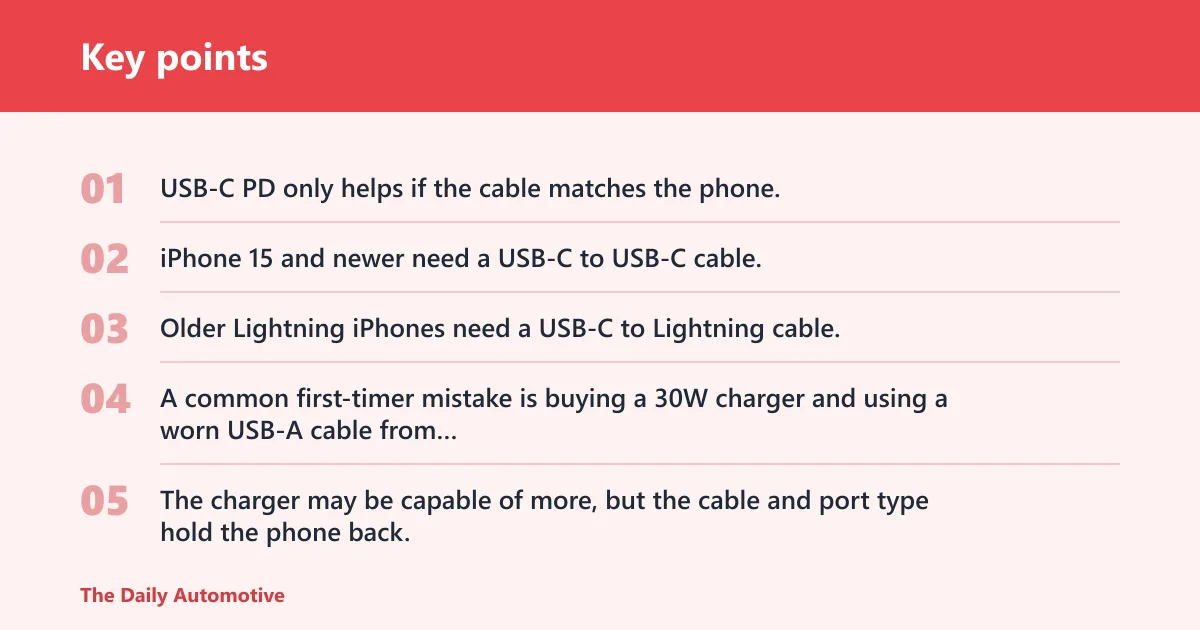
USB-C PD only helps if the cable matches the phone. iPhone 15 and newer need a USB-C to USB-C cable. Older Lightning iPhones need a USB-C to Lightning cable, and that cable should be MFi certified to avoid compatibility problems and weak charging behavior.
A common first-timer mistake is buying a 30W charger and using a worn USB-A cable from an old kit. The charger may be capable of more, but the cable and port type hold the phone back.
When 20W is enough and when it is not
For a 10- to 20-minute commute, 20W to 30W is often a practical sweet spot. It is enough to add meaningful battery on a short drive without paying for extra output you will not use.
For road trips, passengers, or a phone that is also powering navigation, 30W to 45W is a better target. That gives more breathing room when the phone is hot, the screen is on, and the charger has to keep up.
Do you need MFi certification?
You need MFi certification when the setup involves a Lightning iPhone or a Lightning cable. It is not a universal requirement for every iPhone charger, but it matters for iPhone 12 through 14 and earlier when you use a USB-C to Lightning cable or a wired Lightning-based car charger.
Older Lightning iPhones
For iPhone models that still use Lightning, MFi is the safe choice because it signals Apple accessory certification for that cable or charger path. It helps reduce compatibility problems that can show up as intermittent charging or a phone that only charges at a slow rate.
Veetone’s car charger delivers 38W, has dual USB ports, and is MFi certified. That makes it a stronger fit for older Lightning iPhones that still need fast wired charging in a shared-car setup.
USB-C to Lightning cables
USB-C to Lightning cables should be MFi certified if you are buying one for car use. The certification matters more than flashy packaging, because this is the piece that links the charger’s USB-C PD output to the older iPhone’s Lightning port.
When MFi does not apply
MFi does not apply in the same way to iPhone 15 and newer because those phones use USB-C. For those models, the key checks are charger output, cable quality, and whether the charger includes temperature protection for hot cabins and long drives.
USB-C or USB-A: which is better?
USB-C is the safer buy now for iPhone charging in the car. It supports USB Power Delivery, which is the path to fast charging on modern iPhones, while USB-A is mainly useful for older cables, budget dual-port chargers, or keeping a second device alive at a slower pace.
Why USB-C is the better default
USB-C gives you access to 20W or higher fast charging with the right cable. It also fits iPhone 15 and newer directly, so there is one less adapter chain to think about.
Where USB-A still fits
USB-A still makes sense on some dual-port chargers, especially if the second device is an older accessory or a passenger’s phone that does not need maximum speed. Anker PowerDrive 2 uses two USB-A ports for simultaneous charging, but its 24W total output is better viewed as modest shared charging, not high-speed single-device output.
Two-device port splits
Dual-port chargers divide power between ports. That means a charger advertised with a higher total wattage does not give full output to both ports at once unless the spec sheet says so. On a two-device car, a higher total rating matters because it reduces the chance that one phone slows to a crawl when the second device plugs in.
Which charger type fits your drive?
Short commutes favor wired USB-C PD because you want the highest charging rate in the smallest amount of time. Rideshare and delivery work often favor a mount-style Qi2 charger because the phone stays visible for maps, while families usually do better with a multi-port charger that can feed more than one screen at once.
Short commute
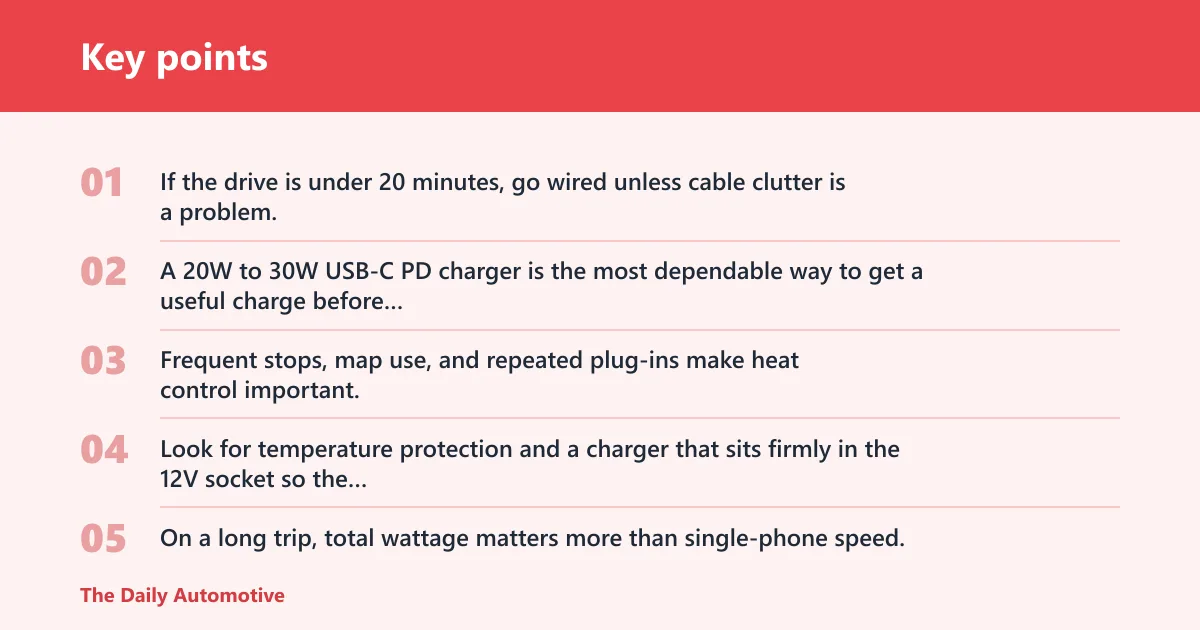
If the drive is under 20 minutes, go wired unless cable clutter is a problem. A 20W to 30W USB-C PD charger is the most dependable way to get a useful charge before the next stop.
Rideshare or delivery work
Frequent stops, map use, and repeated plug-ins make heat control important. Look for temperature protection and a charger that sits firmly in the 12V socket so the plug does not loosen with vibration.
Family road trips
On a long trip, total wattage matters more than single-phone speed. A high-output multi-port charger, such as Anker Nano Car Charger with 167.5W total output across three ports, gives more headroom for phones, tablets, or a laptop charger.
Suppose one child is streaming video on a tablet while the driver’s iPhone is navigating. A low-output two-port charger may split power so far that neither device charges well. A higher-total-output unit avoids that tradeoff.
Bumpy roads and mount stability
Wireless chargers need a stable mount or bracket so the phone does not slide off center on rough pavement. Anker Qi2 Magnetic Car Wireless Charger offers up to 15W wireless charging and has 360° rotation and 45° tilt, which helps keep the screen visible and the phone aligned.
How many watts should you buy?
For one iPhone, 20W to 30W is usually enough. For two devices, aim for at least 40W total, and for family use or mixed-device charging, 45W or more is the better target. The higher the total wattage, the more likely the charger can support a phone plus another power-hungry device at the same time.
20W to 30W for single phones
This is the sweet spot for commuters. It gives fast charging without pushing you into bulky high-output hardware that you do not need for a single iPhone.
45W for mixed-device use
If the car regularly charges a phone and another device, 45W gives more flexibility. It is a better fit for passengers, navigation-heavy driving, and long days where the phone starts low and needs a meaningful refill.
Why total wattage matters on dual-port models
A dual-port charger can look strong on paper and still disappoint if the power is divided too aggressively. The total wattage tells you how much power the unit can provide across all active ports, not how much each port gets all the time.
Hussell’s car charger adapter outputs 30W and uses dual USB ports with Qualcomm Quick Charge 3.0 technology. That works for basic two-device use, but it is still a shared-output design, so speed drops when both ports are active.
How do I know if a car charger will overheat or charge slowly?
Look for temperature protection, a firm 12V socket fit, and the right cable for your iPhone model. Slow charging often comes from the wrong port type, a weak cable, or a charger that cannot hold output under cabin heat and back-to-back use.
Heat clues to watch
If a charger feels very hot to the touch, resets after a long drive, or changes speed when the cabin gets warm, that is a warning sign. Hot cabins matter because heat can reduce charging consistency and make cheaper hardware work harder than it should.
Slow-charging clues to watch
If the phone shows charging but the battery hardly moves, check the cable first. Then check whether the charger uses USB-C PD, whether the port is shared with another device, and whether the cable is MFi certified when Lightning is involved.
Which cable do I need for an iPhone car charger?
Use a USB-C to USB-C cable for iPhone 15 and newer. Use an MFi-certified USB-C to Lightning cable for iPhone 14 and earlier when the charger is USB-C. If the car charger includes an attached Lightning cable, make sure the product itself is MFi certified.
Best cable match for each phone era
- iPhone 12-14 Lightning: MFi-certified USB-C to Lightning cable
- iPhone 15-16 USB-C: USB-C to USB-C cable
- Qi2 wireless use: no charging cable, but a stable mount still matters
- Dual-device setup: one correct cable per device, matched to each port
Simple buying rule
Buy the charger and the cable as a pair, not as separate afterthoughts. That is the easiest way to avoid a fast charger paired with a weak cable, which is one of the most common reasons iPhone charging in the car feels slower than expected.
How to choose
- Match the charger to the iPhone port first: Lightning for iPhone 14 and earlier, USB-C for iPhone 15 and newer.
- Choose wired USB-C PD if speed matters most; choose Qi2 if easy placement matters most.
- Use 20W or higher for fast charging, and step up to 30W or 45W if the car also powers another device.
- For Lightning, require MFi on the cable or the wired charger path.
- For two-device charging, check the total wattage and whether the power is shared across ports.
- For long drives and hot cabins, pick temperature protection and a secure 12V socket fit.
- For wireless use, confirm magnetic alignment and a mount that holds the phone steady on rough roads.
A good car charger should fit the drive, not just the phone. The right match is usually simple: wired USB-C PD for speed, Qi2 for convenience, and a dual-port unit when the car has more than one device to feed.
Frequently asked questions
What is the best car charger for iPhone with fast charging?
A 30W USB-C PD charger is the best all-around fast-charging choice for most iPhone drivers. Pair it with an MFi-certified USB-C to Lightning cable for iPhone 14 and earlier, or a USB-C to USB-C cable for iPhone 15 and newer. That setup gives the most dependable speed in the car.
Do I need an MFi certified car charger for iPhone?
You need MFi certification mainly when the setup involves Lightning, especially on iPhone 14 and earlier. It is most important for USB-C to Lightning cables and some wired car chargers. For iPhone 15 and newer, MFi is not the main buying filter because those phones use USB-C.
Is USB-C or USB-A better for charging an iPhone in the car?
USB-C is better for most buyers because it supports USB Power Delivery and faster charging with the right cable. USB-A still works for some older accessories and basic dual-port chargers, but it is usually the weaker choice if your goal is the fastest possible iPhone charge.
How many watts should a car charger have for iPhone?
For one iPhone, aim for 20W to 30W. For two devices, look for at least 40W total. If you are charging phones plus tablets or a laptop on the road, a higher total rating such as 45W or more gives more useful headroom.
Can I use a MagSafe or Qi2 car charger with iPhone 15 and 16?
Yes. Qi2 wireless charging works with iPhone 12 and newer, including iPhone 15 and 16. It offers up to 15W with MagSafe-style magnetic alignment, which makes it a good choice when you want easy snap-on placement instead of a cable.
What car charger is best if I charge two devices at once?
Choose a dual-port car charger with enough total wattage for both devices, and remember that the watts are shared. A unit like Anker PowerDrive 2 works for simple two-device charging, while higher-output models are better when both devices need meaningful speed.
Products related to this article
Sponsored / affiliate links. As an Amazon Associate I earn from qualifying purchases. I may earn additional commission from eligible campaigns.