Best Car Jump Starters for Emergencies: NOCO vs. TREKURE (2026)
The NOCO Boost GB40 is the best all-around car jump starter for most gas engines up to 6.0L — but trucks and diesels need at least 2,000 peak amps. AAA responds to roughly 7 million dead-battery calls a year, and an undersized jump starter simply won’t crank a bigger engine. This guide compares 4 real picks by amp rating, safety features, and price, plus the exact 4-step process for using one safely.
How Many Peak Amps Do You Need? (By Vehicle Type)
Peak amps — not price or brand — is what actually determines whether a jump starter can crank your engine. Undersizing it is the most common mistake buyers make. If you’ve never jumped a car with a portable unit before, our full guide to jumping your car covers the basics before you buy.
| Vehicle Type | Typical Engine Size | Recommended Peak Amps | Pick From This Guide |
|---|---|---|---|
| Compact car / sedan | Up to 2.0L gas | 800–1,200A | NOCO Boost GB40 (1,000A) |
| Mid-size car / SUV | 2.0L–4.0L gas | 1,200–2,000A | Powrun P-ONE (2,000A) |
| Full-size truck / van | Gas V8 or diesel up to 6.0L | 2,000–3,000A | NOCO Boost GB70 (2,000A) |
| Heavy truck + tire duty | 8.0L+ gas / 8.0L+ diesel | 3,000A+ | TREKURE (7,000A + air compressor) |
Cold weather and an aging battery both raise the power an engine needs to start — by 20–50% in freezing conditions — so if you live somewhere cold or your battery is more than 3 years old, size up a tier from what the table above shows.
Our Top Picks at a Glance
Here’s the short version. Full reviews with pros and cons for each pick are below.
Best Car Jump Starter Pick
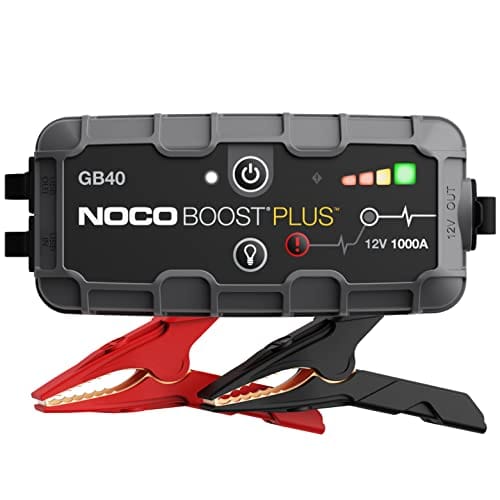
NOCO Boost GB40 12V 1000A UltraSafe Jump Starter
A compact 2.5 lb lithium jump starter built for compact and mid-size gas engines, with spark-proof reverse-polarity protection.
- Best for: Compact and mid-size cars, sedans, and SUVs up to 6.0L gas or 3.0L diesel
- Why we picked it: 1,000 peak amps in a 2.5 lb body, with UltraSafe spark-proof protection that prevents the most common beginner mistake
- Main drawback: Not rated for big trucks or larger diesel engines — size up for those
Compare more jump starter options
 Option 1 Powrun P-ONE 2000A Jump Starter
|
 Option 2 TREKURE Jump Starter + Air Compressor
|
 Option 3 NOCO Boost GB70 2000A Jump Starter
|
As an Amazon Associate we earn from qualifying purchases.
NOCO Boost GB40 — Best Overall Pick
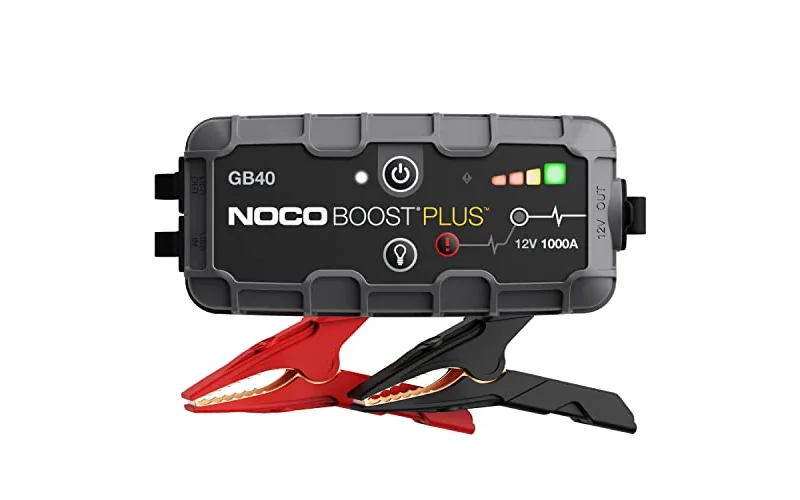
The NOCO Boost GB40 is a 12V lithium jump starter built for gas engines up to 6.0L and diesels up to 3.0L, which covers most sedans, compact SUVs, and four- or six-cylinder engines. NOCO rates it for up to 20 starts per charge, and its UltraSafe circuitry is spark-proof and reverse-polarity protected, so connecting a clamp backward triggers a warning instead of a spark.
Pros:
- Compact and lightweight at about 2.5 lbs, easy to store in a glove box or trunk pocket.
- 1,000 peak amps, enough for most 4- and 6-cylinder engines.
- UltraSafe spark-proof technology with reverse-polarity protection.
- Built-in 100-lumen LED flashlight with 7 modes, including SOS.
- USB-C power bank for charging a phone or tablet in an emergency.
Cons:
- Priced higher than basic no-name jump starters.
- Not rated for large trucks or bigger diesel engines — see the amp chart above.
- Battery capacity drops faster than average in very cold weather, like most lithium packs.
For the price, the GB40’s main advantage is the safety circuitry: NOCO’s spark-proof design is the same reason it’s the pick most independent reviewers recommend for drivers who’ve never jump-started a car themselves. If your vehicle has a larger engine, the NOCO Boost GB70 further down this list uses the same safety technology at 2,000 peak amps.
Powrun P-ONE — Best Budget Pick for Trucks and SUVs
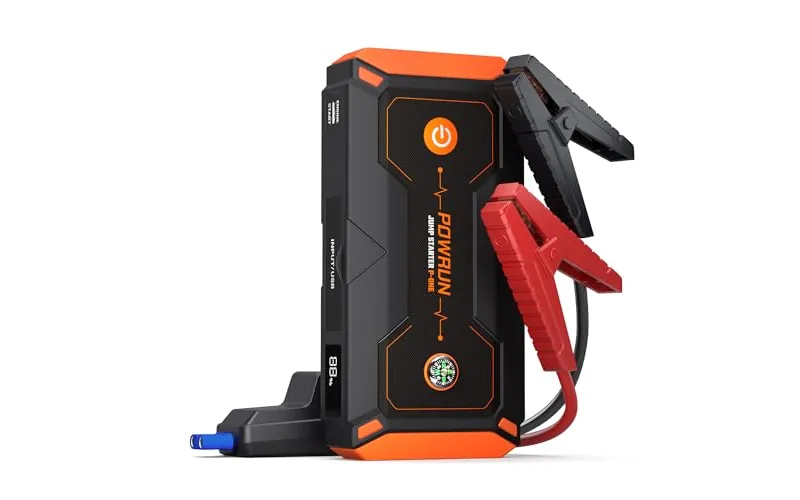
The Powrun P-ONE is a 2,000-peak-amp jump starter rated for engines up to 8.0L gas or 6.5L diesel, which puts it in range for most trucks, SUVs, and RVs. Powrun rates it for up to 25 starts per charge and up to 8 layers of protection circuitry, and it’s built to work in temperatures from -4°F to 140°F.
Pros:
- 2,000 peak amps for larger engines than the GB40 covers.
- Compatible with up to 8.0L gas and 6.5L diesel engines.
- Compact for its power class: about 7.3 in. long, 3.4 in. wide, 1.6 in. tall.
- Includes a carry case and a Quick Charge 3.0 USB port plus USB-C input.
Cons:
- Powrun is a newer brand with less of a track record than NOCO or DeWalt.
- Like all of these units, it’s only rated for standard 12V starting systems.
Powrun’s main selling point is amp-per-dollar — it delivers double the peak current of the GB40 at a lower price, which is why it’s our pick for truck and SUV owners on a budget. The trade-off is brand recognition, not build quality: the unit itself carries the same reverse-polarity and short-circuit protections NOCO and other established brands use.
TREKURE Jump Starter with Air Compressor — Best All-in-One Pick
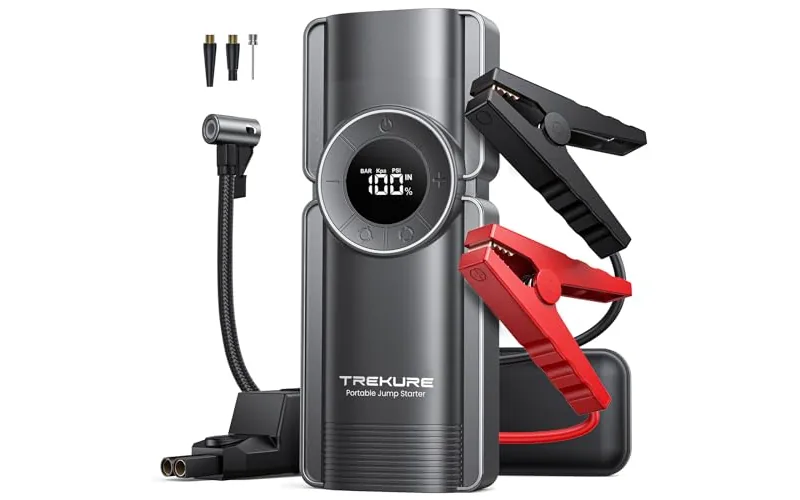
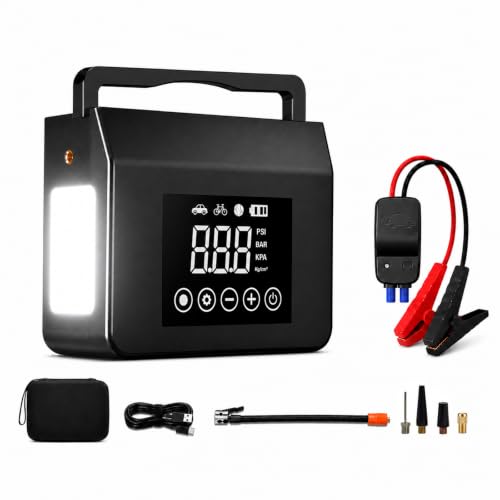
The TREKURE Portable Car Jump Starter pairs a jump-starting circuit rated up to 9L gas or 8L diesel with a built-in 150PSI air compressor, so it doubles as a flat-tire fix. TREKURE lists the unit at 7,000 peak amps — up from the 3,000A rating on an earlier version of this same product line — with over 1,000 rated recharge cycles and 10 built-in safety protections.
Pros:
- Compact considering it packs two tools into one device.
- High peak-amp rating for large trucks and diesel engines.
- Built-in 150PSI air compressor with auto shut-off for tire inflation.
- Digital display for battery level and tire pressure readouts.
- Integrated emergency light rated for up to 48 hours of runtime.
Cons:
- Heavier and bulkier than a jump-starter-only pack like the GB40 or P-ONE.
- Two functions in one unit means more to check on before a long trip — both the jump-start charge and the air compressor need to be topped off.
If you’d rather carry one device than two, the TREKURE is the practical choice: a dead battery and a low tire are two of the most common reasons drivers call for roadside help, and this unit covers both. The trade-off is size — it’s noticeably heavier than a jump-starter-only pack, so it suits a trunk more than a glove box.
How to Use a Portable Jump Starter Safely (4 Steps)
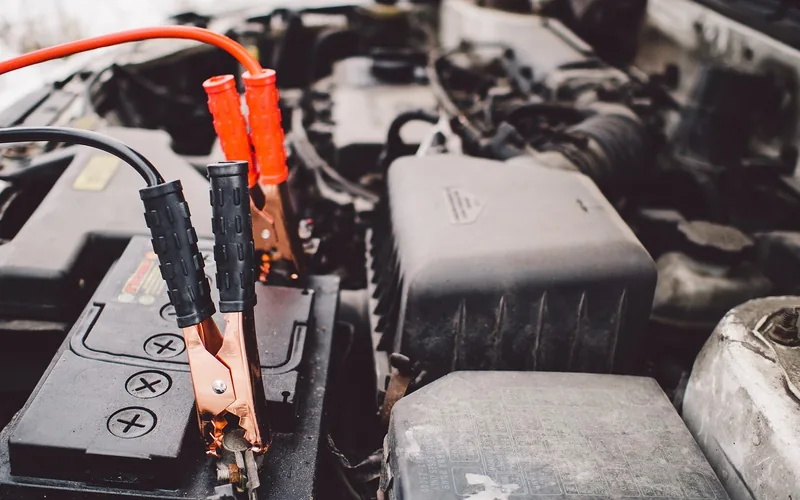
- Connect the clamps: Attach the red (positive) clamp to the battery’s positive terminal first, then attach the black (negative) clamp to an unpainted metal chassis point or engine bolt — not the battery itself — to keep any spark away from the battery.
- Power on and wait for the ready signal: Turn on the jump starter and wait for its LED indicator to confirm a safe connection before trying to start the engine.
- Start the vehicle: Turn the key or press the start button normally. If the engine doesn’t fire within about 5 seconds, stop, wait 30 seconds, and try again rather than cranking repeatedly.
- Disconnect in reverse order: Power off the jump starter, then remove the black (negative) clamp first, followed by the red (positive) clamp.
Never let the two clamps touch each other while either one is connected — that’s how sparks happen. Most manufacturers also cap consecutive jump attempts at around 5 within a 15-minute window to avoid overheating the pack, so if your car hasn’t started after a few tries, the problem is likely bigger than the battery.
“Never let the positive and negative clamps touch while connected to the battery — connect the black clamp to a chassis ground, an unpainted metal surface or bolt on the engine block, away from the battery and fuel lines, not the battery itself.”
Portable Jump Starter vs. Jumper Cables: Which Should You Carry?
A portable jump starter and a set of jumper cables solve the same problem differently. Jumper cables need a second running vehicle to work at all; a jump starter doesn’t, which matters most if you drive alone or park somewhere isolated. This applies to manual and automatic cars alike — if you drive a stick shift, a jump starter works the same way, though our guide to starting a manual car with a dead battery covers push-starting as a backup option too.
| Factor | Portable Jump Starter | Jumper Cables | Best For |
|---|---|---|---|
| Needs a second vehicle | No | Yes | Jump starter — solo drivers |
| Built-in safety protection | Yes on most models (reverse-polarity, spark-proof) | No — you match polarity by hand | Jump starter — new drivers |
| Typical upfront cost | $60–$200 | $15–$40 | Jumper cables — tight budgets |
| Needs periodic charging | Yes | No — store and forget | Jumper cables — rarely-used backup |
📊 AAA responds to roughly 7 million dead-battery roadside calls a year, out of more than 27 million total service calls (2024). Source: AAA Mobile Battery Service, 2024
Keep in mind a jump starter itself needs to be charged every few months to stay ready — our guide to keeping a jump starter in your car covers how often and where to store one so it’s not dead when you need it.
Frequently Asked Questions
How does the NOCO Boost GB40 work?
The NOCO Boost GB40 delivers up to 1,000 peak amps to start engines up to 6.0L gasoline or 3.0L diesel. Connect the red clamp to the positive battery terminal, the black clamp to a metal chassis point, power the unit on, and start your vehicle once the LED confirms a safe connection.
What vehicles can the Powrun P-ONE jump start?
The Powrun P-ONE can jump start vehicles with engines up to 8.0L gas or 6.5L diesel, delivering 2,000 peak amps. That covers most cars, trucks, SUVs, and motorcycles, making it a versatile pick for larger engines than a compact unit like the GB40 can handle.
Does the TREKURE jump starter include an air compressor?
Yes. The TREKURE includes a built-in 150PSI air compressor for inflating tires, alongside a jump-starting circuit rated up to 7,000 peak amps for engines up to 9L gas or 8L diesel. It’s a multifunctional pick for both dead batteries and flat tires.
Are these car jump starters easy to use?
Yes. All three are designed for one-person operation: connect the clamps in the correct order, power the unit on, and start the vehicle once it signals a safe connection. Built-in safety circuitry on each model is designed to prevent the most common beginner mistakes.
Can these jump starters charge other devices?
Yes. All three include USB ports that double as a power bank for phones, tablets, and other USB devices, so you can stay charged even if your vehicle’s battery is dead and you’re waiting on repairs or help.
Do these jump starters have safety features?
Yes. Each model includes multiple protections — typically reverse-polarity, over-current, over-voltage, and short-circuit protection — so an incorrect clamp connection triggers a warning instead of a spark, making them safer for less experienced users than bare jumper cables.
How many peak amps do I need for my car’s jump starter?
Most compact and mid-size cars need 800–2,000 peak amps, which covers the NOCO Boost GB40 and Powrun P-ONE in this guide. Trucks, SUVs, and diesel engines need at least 2,000–3,000+ peak amps, since cold weather and an older battery can raise the power required by 20–50%. When in doubt, size up rather than down.
Conclusion
The right jump starter comes down to your engine size, not the lowest price. The NOCO Boost GB40 covers most cars and compact SUVs at 1,000 peak amps. Step up to the Powrun P-ONE or NOCO Boost GB70 at 2,000 peak amps for trucks and larger engines, or the TREKURE if you also want a built-in air compressor for flat tires. Whichever you choose, match it to your engine size using the amp chart above, and recharge it every few months so it’s ready the next time a battery dies.
Products related to this article
Sponsored / affiliate links. As an Amazon Associate I earn from qualifying purchases. I may earn additional commission from eligible campaigns.