
Best Car Rental Reviews for Family Road Trips
For family road trips, the best rental is usually a midsize SUV or minivan with unlimited miles, a free extra-driver policy, and full-size cargo space; skip the cheapest compact if luggage or car seats matter. A low headline rate can turn into mileage charges, extra-driver fees, and a cramped cabin that makes long drives harder. This guide compares family-friendly rental picks by comfort, cargo room, mileage rules, and fee traps.
Top pick for family road trips
A minivan is the least stressful choice for most parents because it usually gives you easy child-seat access, a low step-in height, sliding doors, and cargo room that still works after you install two car seats. A midsize SUV is the better compromise if you want better fuel economy or a smaller footprint for city pickups.
Why this choice fits parents first
Choose a minivan first when you are carrying two or more children, a stroller, and bags for a week or longer. The wide rear doors help during quick stops, and the third row is easier to reach than in many SUVs. If your trip is all highway miles, a midsize SUV can still be a sensible swap.
When a different rental type makes more sense
Pick a full-size sedan only when luggage is light and you have one child seat or a very small family. Sedans can be cheaper and may use less fuel, but trunk opening height, rear-seat space, and child-seat installation tend to be less forgiving on long trips.
Quick picks
- Best for large families: Minivan. Best rear access, strongest cargo flexibility, and the easiest child-seat loading.
- Best for one-way trips: Midsize SUV from a company that allows one-way drop-off without a separate mileage surcharge.
- Best for lower fees: Full-size sedan from an off-airport branch with unlimited miles and no young-driver fee.
- Best for airport pickup: Midsize SUV or minivan from a major airport location with on-site pickup, if you value speed over the airport surcharge.
Best rental options by family size
Small family: full-size sedan
A full-size sedan can work for two adults and one child when you pack light and keep the trip short. Look for a trunk that will accept a stroller without folding it in half, rear-seat LATCH or ISOFIX anchors, and enough rear legroom that the front seat does not have to be pushed far forward.
Mid-size family: SUV
A midsize SUV is the most flexible middle ground for a family of four or five. It usually balances cargo room, seat height, and highway comfort better than a sedan, and many models have split-fold seats that help when a booster seat and large suitcase need to fit together.
Large family or heavy luggage: minivan
When you need three child seats, a stroller, and several suitcases, a minivan is usually the safer booking. Sliding doors, a wider cargo opening, and a usable third row reduce the chance that somebody has to climb over a car seat to buckle in.
Rental family decision table
| Vehicle class | Seating capacity | Cargo practicality | Mileage policy | One-way flexibility | Deposit risk | Fee transparency | Child-seat friendliness | Best for use case |
|---|---|---|---|---|---|---|---|---|
| Full-size sedan | 4 to 5 | Best for light luggage; trunk space can tighten with a stroller | Often unlimited, but check location limits | Sometimes available; may carry higher drop-off fees | Often lower than larger classes, but varies by location | Usually clearer base rate, though add-ons still raise total | Good for one seat; tighter for two rear-facing seats | Short trips, light packing, lowest total price |
| Midsize SUV | 5 to 7 | Strong balance of cargo room and rear-seat access | Often unlimited on standard rentals | Usually workable for one-way itineraries | Can be moderate to high, especially at airports | Moderate; watch for airport surcharge and insurance add-ons | Usually good, with easier access than many sedans | Most families on weeklong or multi-state drives |
| Minivan | 7 to 8 | Best for strollers, coolers, and bulky luggage | Often unlimited on standard bookings | Often available, but one-way pricing can be steep | Often higher than a sedan, sometimes tied to vehicle class | Can be less transparent if the airport branch adds fees | Usually the easiest for multiple car seats | Large families, long trips, and heavy cargo |
Are SUVs or minivans better for family road trips?
Minivans are usually better for families with multiple children because they often make child-seat access, cargo loading, and rear-row entry easier. SUVs can be better if you want a smaller footprint, slightly better fuel economy in some trims, or a vehicle that feels easier to park in city locations.
Cargo room and third-row seating
Third rows help only when the cargo area still works after the seats are up. In many SUVs, the third row steals luggage space fast. Minivans usually keep more usable room behind the back row, and split-fold seats help when one side needs to stay open for a stroller or cooler.
Child-seat fit and rear-seat access
Look for LATCH or ISOFIX anchors in the positions you need, plus rear doors that make buckling less awkward. A common first-timer mistake is choosing a vehicle by headline size and ignoring door opening width; two rear-facing seats can make an SUV feel smaller than expected.
Fuel economy and long-drive comfort
Sedans usually use less fuel than minivans, and some SUVs do better than people expect on highways. Still, comfort matters more over a full day of driving. Rear-seat legroom, easy climate controls, and USB ports are worth more than a small fuel savings if children will be in the back for hours.
How do you compare fees, mileage, and deposits?
Start with the base rate, then add airport surcharge, extra-driver fees, young-driver fees, insurance add-ons, and the deposit or card hold. The cheapest daily rate often loses once those extras appear. Unlimited mileage is usually the safest choice for a family road trip, especially once the route stretches beyond a single city.
Base rate versus add-on costs
Some bookings look cheap until the branch adds airport access fees or a second-driver charge. A family booking can swing by a meaningful amount if you need a booster seat, a young driver on the contract, or extra coverage at the counter. Check the final payment screen, not only the headline rate.
Unlimited mileage versus per-mile pricing
Unlimited mileage is the easiest option for long weekend trips that might expand, weeklong trips with detours, and cross-state itineraries. Per-mile pricing can look fine for a short in-town rental, but it becomes a poor fit once you are planning 300 miles or more across several days.
Deposit holds and young driver charges
A large deposit hold can tie up a credit card limit right when you need it for gas, hotels, and food. Young driver fees also raise the total fast, and some companies add them by age band rather than by vehicle class. If the main driver is under 25, verify the charge before you book.
- Compare the total price. Add the base rate, taxes, airport surcharge, extra-driver fee, insurance, and deposit hold before you decide. The true total tells you whether a higher class vehicle is actually worth the difference.
- Check mileage language. Look for unlimited miles, any per-mile rate, and whether the policy changes for one-way or regional rentals. Some branches limit use by state or territory, which can matter on a multi-state drive.
- Read the driver rules. Confirm age thresholds, additional-driver charges, and whether a spouse can be added free. That detail can matter more than a small discount code.
Is airport pickup cheaper than off-airport?
Off-airport rentals are often cheaper because airport locations add fees, but the savings can disappear once you factor in taxi, rideshare, or shuttle time. Airport pickup is simpler for families arriving with children and bags, while neighborhood branches can win on price if their hours fit your arrival and return plan.
Airport surcharge and shuttle time
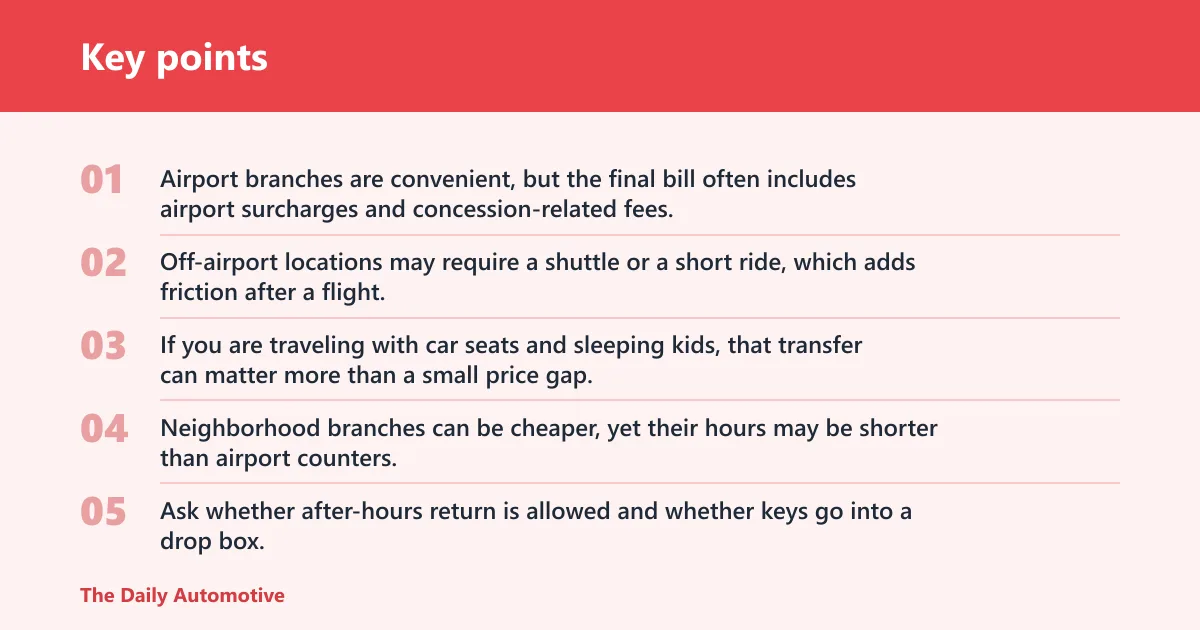
Airport branches are convenient, but the final bill often includes airport surcharges and concession-related fees. Off-airport locations may require a shuttle or a short ride, which adds friction after a flight. If you are traveling with car seats and sleeping kids, that transfer can matter more than a small price gap.
Neighborhood branch hours and after-hours return
Neighborhood branches can be cheaper, yet their hours may be shorter than airport counters. Ask whether after-hours return is allowed and whether keys go into a drop box. If you land late or leave before sunrise, a branch with restricted hours can create more stress than it saves money.
One-way drop-off rules
One-way trips need extra care because some branches restrict drop-offs by city, state, or region. A one-way fee may be separate from mileage rules, so check both. If you are planning a cross-country itinerary, confirm where the car can be returned before you pay the deposit.
Suppose you book a minivan for a week and the counter adds an airport surcharge plus a second-driver fee. The low headline price may no longer beat an off-airport SUV with unlimited miles, especially if the family will drive about 500 miles or more.
How to choose the right rental for your trip length
The right rental changes with mileage, luggage, and branch logistics. A long weekend can tolerate a smaller cabin. A weeklong road trip usually needs more cargo room and fewer surprise fees. Multi-state and cross-country plans should usually prioritize unlimited miles and a one-way policy that matches the return city.
Long weekend trips
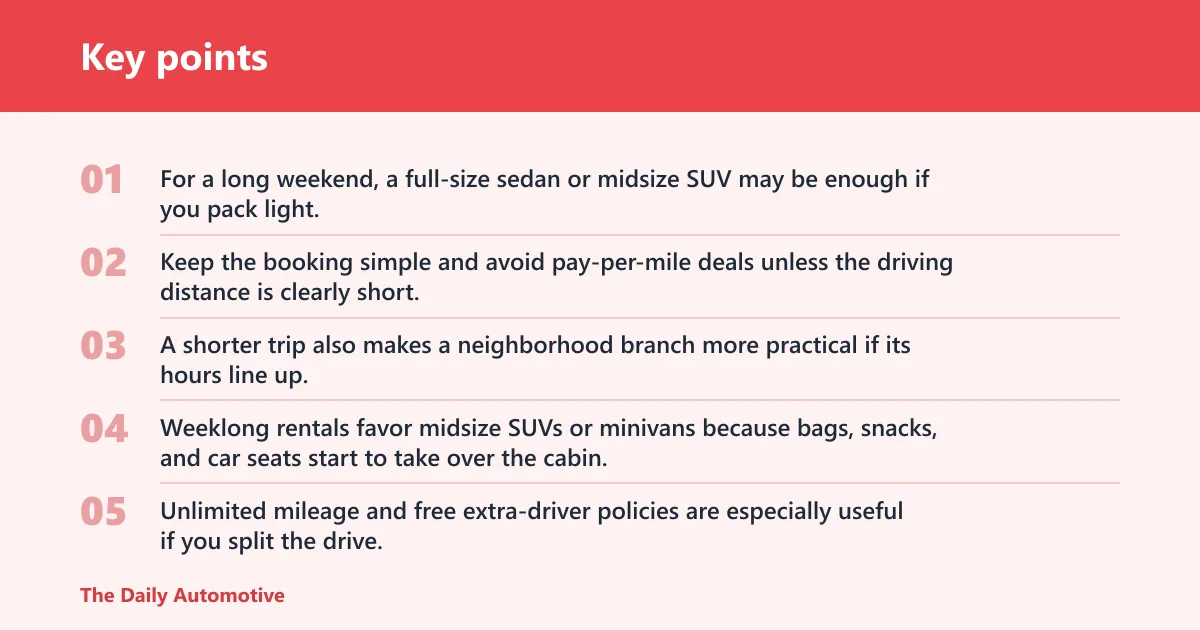
For a long weekend, a full-size sedan or midsize SUV may be enough if you pack light. Keep the booking simple and avoid pay-per-mile deals unless the driving distance is clearly short. A shorter trip also makes a neighborhood branch more practical if its hours line up.
Weeklong road trips
Weeklong rentals favor midsize SUVs or minivans because bags, snacks, and car seats start to take over the cabin. This is the point where luggage space matters more than headline price. Unlimited mileage and free extra-driver policies are especially useful if you split the drive.
Multi-state drives
Multi-state itineraries raise the chance that a regional limit or one-way restriction will matter. Check whether the rental can leave the state or whether it must stay inside a defined area. A company with a clean mileage policy can save more than a cheaper base rate with hidden limits.
Cross-country itineraries
Cross-country plans need the most flexibility, so focus on unlimited miles, one-way drop-off, and a comfortable rear seat. The right vehicle should keep children comfortable for long hours and still leave room for luggage. A minivan is often the most forgiving choice when the route stretches far beyond a single state.
Frequently asked questions
What is the best car rental for a family road trip?
The best choice is usually a midsize SUV or minivan with unlimited miles, enough cargo room for luggage and a stroller, and a clear fee policy. If you expect long hours in the car, choose comfort and rear-seat access over the lowest advertised daily rate.
Which rental car company is best for road trips with kids?
There is no single best company at every location. The better choice is the one with unlimited mileage, a free or low-cost extra-driver policy, a convenient pickup point, and a vehicle class that fits your child-seat count. Compare the total cost, not just the brand name.
What size car should I rent for a family road trip?
Small families can manage with a full-size sedan if luggage is light. Most families do better with a midsize SUV, and large families or anyone carrying multiple car seats should look at a minivan. Cargo room and child-seat access matter more than exterior size alone.
Are SUVs or minivans better for a road trip rental?
Minivans are usually better for families with several children, big bags, or frequent stops. SUVs can work well for smaller families who want a simpler parking footprint or better highway manners. If the third row kills cargo space, the SUV loses much of its family advantage.
Which car rental company has the best unlimited mileage for road trips?
The best unlimited mileage deal is the one that stays unlimited for your route, not just on the quote page. Verify state limits, one-way restrictions, and whether airport or neighborhood location rules change the mileage policy. A clean unlimited plan is more useful than a slightly lower daily rate.
How do I avoid hidden fees on a road trip rental?
Check the airport surcharge, young driver fee, extra-driver charge, insurance add-ons, and deposit hold before you book. Also confirm whether one-way returns cost extra and whether the branch charges for fuel or after-hours drop-off. The final payment screen should match the policy page.
Is it cheaper to rent at the airport or off-airport for a family trip?
Off-airport is often cheaper on paper, but the savings can shrink if you need a shuttle or a rideshare. Airport pickup usually costs more because of fees, yet it can be easier with children and luggage. Compare the full trip cost, not the daily rate alone.
What rental company is best for one-way family road trips?
The best one-way rental is the company that allows your pickup and drop-off cities without a steep return penalty and still offers unlimited miles. For family trips, that usually means choosing a vehicle with enough cargo room and a branch network that makes pickup and return straightforward.
Products related to this article
Sponsored / affiliate links. As an Amazon Associate I earn from qualifying purchases. I may earn additional commission from eligible campaigns.