New Car vs Used Car Financing: Which Costs Less Overall?
New-car financing usually costs less in interest for well-qualified buyers, while used-car financing can win on total cost if you plan to keep the vehicle longer and avoid rapid depreciation. Compare both by total ownership cost, not payment alone. Focusing only on the monthly payment can leave you paying more in depreciation, interest, and repairs. This guide shows how new vs. used loans differ by rate, term, down payment, credit tier, and ownership horizon.
This guide is part of our Car buying, financing, and selling guide series.
New car vs used car financing: the real cost trade-off
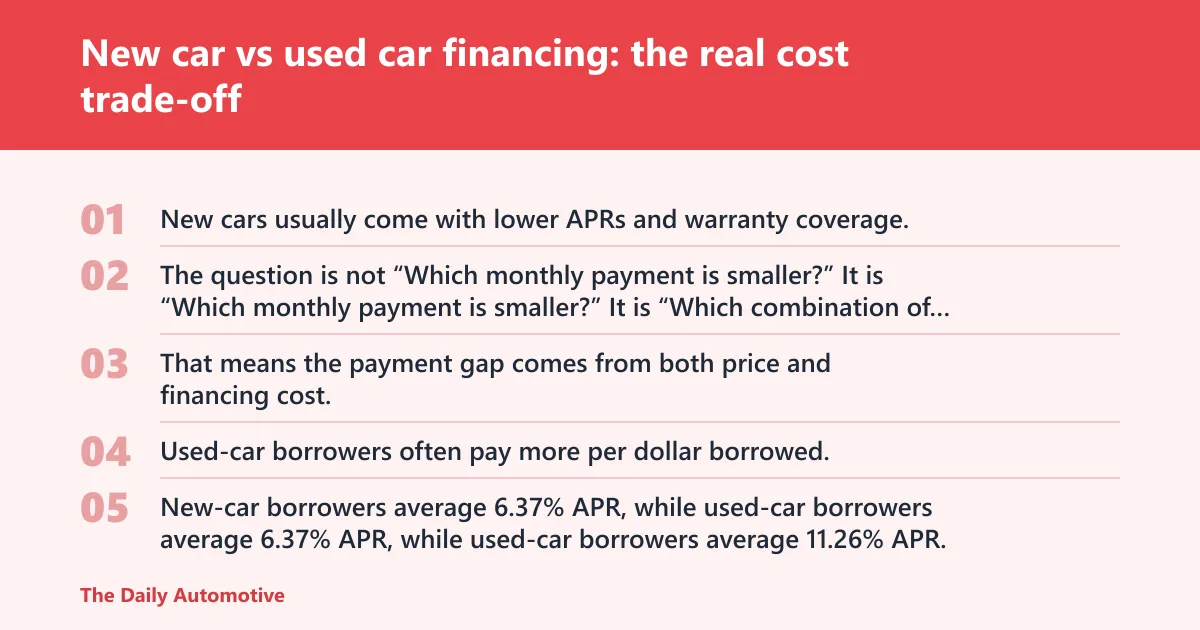
The trade-off looks simple. The result is not. New cars usually come with lower APRs and warranty coverage, while used cars usually start with a lower purchase price and lower insurance costs, which can make them cheaper over the full ownership period if the loan is structured well.
The question is not “Which monthly payment is smaller?” It is “Which combination of price, APR, depreciation, insurance, and term leaves you with the lower total cost of ownership?”
| Decision factor | New Car | Used Car Financing | Winner |
|---|---|---|---|
| Typical market payment | $767 average monthly payment | $537 average monthly payment | Used Car Financing |
| Typical APR | 6.37% | 11.26% | New Car |
| Loan amount | $43,582 average loan amount | $27,528 average loan amount | Used Car Financing |
| Depreciation exposure | 20% or more value loss in the first year | Lower first-year hit, less underwater risk | Used Car Financing |
| Insurance cost pressure | Higher, because replacement value is higher | Usually lower | Used Car Financing |
| Warranty and risk coverage | Typically 3 years or 36,000 miles | Depends on age; CPO can narrow the gap | New Car |
Typical payment and rate do not point the same way
The average new-car payment is $767 versus $537 for used cars, but the loan balance on a new car is also larger at $43,582 versus $27,528. That means the payment gap comes from both price and financing cost.
Used-car borrowers often pay more per dollar borrowed. New-car borrowers average 6.37% APR, while used-car borrowers average 11.26% APR. That rate gap can erase part of the sticker-price advantage on a used car if you stretch the term.
Depreciation changes the scoreboard
New cars can lose 20% or more of their value in the first year. That matters because the loan balance falls more slowly than the asset value when the down payment is small or the term is long.
Used cars start farther down the depreciation curve. A buyer who keeps the car for several years can avoid the steepest early value drop, which often matters more than saving a little on the monthly payment.
Warranty and insurance tilt the decision
New cars are typically warrantied for three years or 36,000 miles, which reduces repair uncertainty early in ownership. Used cars can be cheaper to insure, but the gap is not always enough to offset higher financing costs or repair exposure on an older vehicle.
When replacement value is higher, comprehensive and collision premiums usually rise. That is one reason a new car can look affordable on paper and still cost more to own month after month.
📊 The average new vehicle price reached $49,191 in January 2026. Source: Used Car vs. New Car: Which Should You Buy?.
Side-by-side financing comparison by buyer profile
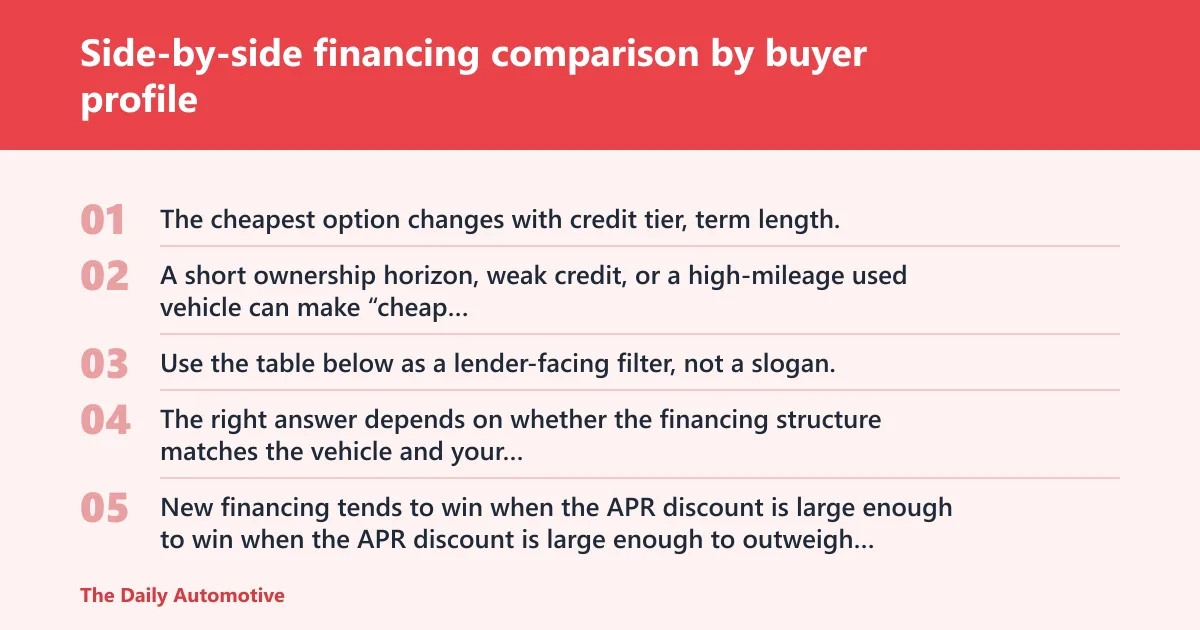
The cheapest option changes with credit tier, term length, and how long you keep the vehicle. A short ownership horizon, weak credit, or a high-mileage used vehicle can make “cheap used” more expensive than a discounted new-car deal with promotional APR.
Use the table below as a lender-facing filter, not a slogan. The right answer depends on whether the financing structure matches the vehicle and your exit timeline.
| Buyer scenario | Credit tier | Target term | Expected APR spread | Depreciation risk | Insurance delta | Likely cheapest option |
|---|---|---|---|---|---|---|
| Strong-credit buyer, keeps car 5+ years | Prime | 60 months | New rates usually lower by several points | New car higher | Used lower | Used Car Financing |
| Buyer wants lowest payment and plans to trade in quickly | Near-prime | 72 months | Used rate premium often widens | New car highest if sold early | Used lower | New Car, if promotional APR is available |
| Buyer with thin credit and limited cash down | Subprime/near-prime | 48 to 60 months | Used financing can rise sharply | Both risky; used can be safer on price | Used lower | Depends on lender caps; often Used Car Financing or CPO |
| Buyer rolling negative equity from current loan | Prime or near-prime | 72 months | New may price better than used | High on both, worse on new with long term | Used lower | Used Car Financing, unless new APR incentive offsets equity risk |
| Buyer choosing a 2- to 4-year-old vehicle with low miles | Prime | 60 months | Used spread narrows | Moderate | Lower than new | Certified Pre-Owned |
How to read the table
New financing tends to win when the APR discount is large enough to outweigh depreciation or when a promotional rate is materially below the market rate. Used financing tends to win when the vehicle has already taken its biggest value hit and the buyer plans to keep it long enough to benefit from that lower basis.
Why new car loans are often cheaper
New-car loans are often cheaper because lenders see newer collateral, lower mechanical risk, and stronger resale predictability. New-car buyers also tend to have stronger credit: the average credit score for new-car borrowers is 753, compared with 689 for used-car borrowers.
Manufacturer financing can also reduce the rate directly. Promotional APR offers may beat a cash rebate on total cost for some buyers, but only if you qualify and only on the models and trim levels included in the incentive.
Typical APR range and manufacturer incentives
New-car APRs average 6.37%, and used-car APRs average 11.26%. That spread is a market average, not a quote; your actual rate depends on score, loan amount, term, and the lender’s view of the vehicle.
Manufacturer APR offers can cut financing cost before the first payment is due. But a cash rebate can still win if the promoted APR is not low enough, or if taking the rebate lowers your loan balance enough to reduce interest more than the rate cut would.
Wider lender appetite for new collateral
Lenders generally prefer newer vehicles because they hold value better and come with less immediate repair risk. That is why new-car financing is often easier to qualify for at a better rate, especially for buyers with prime credit and a solid down payment.
That does not mean every new-car offer is cheaper. A high MSRP, a long term, and a small down payment can push total interest up fast.
Warranty coverage and risk pricing
New cars are typically warrantied for three years or 36,000 miles. That warranty reduces the lender’s and buyer’s exposure to early repair surprises, which helps explain the lower pricing on many new loans.
If a buyer plans to keep the car beyond the warranty window, the advantage narrows. At that point, maintenance and depreciation matter more than the first loan rate alone.
Why used car loans usually cost more to finance
Used-car loans usually cost more because lenders face more uncertainty. Older vehicles have higher mileage, more wear, and more variation in value, so the lender prices that risk into the APR. The average used-car APR is 11.26%, versus 6.37% for new cars.
Used financing also comes with more eligibility rules. Many lenders cap vehicle age, mileage, or both, and they may require an inspection or clean history report before approving the loan.
Typical APR range and why it runs higher
A used loan rate can be several points above a new-car rate, especially in weaker credit tiers. That spread matters because even a cheaper vehicle can generate more interest over time if the APR is high enough and the term is long enough.
Loan amount matters too. Interest is calculated on the balance you actually borrow, so a lower used-car principal can offset some rate pain, but not always all of it.
Age and mileage limits that affect approval
Used-car lenders often impose maximum age and mileage thresholds. A car that is too old, too far driven, or too hard to price can trigger a higher rate, a shorter term, or a denial.
That is where the cheapest sticker price can mislead you. A high-mileage used car with limited collateral value may be harder to finance than a newer certified pre-owned car at a slightly higher sale price.
Inspection and history report checks buyers should want
A used-car buyer should want a clean title, a vehicle history report, and a pre-purchase inspection. Those checks do not just reduce repair risk; they also support lender confidence and help keep the deal financeable.
If the car has been in a major collision, shows odometer issues, or has maintenance gaps, the lender may price it as a weaker asset even if the monthly payment looks manageable.
How loan term changes the answer
Loan term changes the answer because it trades payment relief for interest cost and equity risk. Debt.org says car loan terms can range from 24 to 84 months, but the longer end of that range usually raises total interest and increases the odds that you owe more than the vehicle is worth.
As a rule, shorter terms usually cost less overall. Longer terms lower the payment, but they can make a depreciating car more expensive in total.
48-month and 60-month terms
A 48-month loan usually has the strongest interest savings because you pay the balance down quickly. A 60-month loan keeps the payment more manageable while still limiting total interest compared with longer terms.
These terms are often the cleanest choice if your budget can handle them. They are especially useful when comparing a new car with a promotional APR against a used car with a higher rate.
72-month and 84-month terms
A 72-month term lowers the monthly payment, but it increases the time interest accrues and raises negative-equity risk. An 84-month loan pushes that problem further, especially on a new car that loses value quickly in the first year.
These terms can make sense only when the alternative is unaffordable. Even then, you should compare the full interest charge, the resale value at your likely exit point, and the size of your down payment.
Payment relief versus total interest and equity risk
Longer terms usually win the payment contest and lose the cost contest. If you finance a car for longer than you keep it, you can end up selling or trading it while still underwater.
That risk is highest on new cars with small down payments, because the first-year depreciation hit is steep and the loan balance falls more slowly than the asset value.
How depreciation and insurance change the total cost
Depreciation and insurance often decide the winner after the rate quote. New cars can lose 20% or more of their value in the first year, while used cars start from a lower base and often retain value more predictably over the next several years.
Insurance follows a similar pattern. New cars usually cost more to insure because replacement value is higher, which raises the insurer’s exposure in a total-loss claim.
First-year depreciation and underwater loan risk
A new-car buyer who makes a small down payment can become underwater quickly. That matters if the car is totaled or if you want to trade it early, because the payoff may exceed the vehicle’s market value.
Used-car financing reduces that risk by starting closer to the vehicle’s actual market value. The result is often better equity position even when the APR is higher.
Replacement value and insurance premium differences
Insurance premiums often track replacement cost, not just age. Because new cars cost more to replace, the policy price usually rises with the vehicle’s value and equipment level.
Used cars often benefit from lower premiums, but that savings should be measured against higher maintenance risk and, in some cases, higher financing rates. The cheapest insurance quote does not always create the cheapest ownership profile.
Choose New Car if… / Choose Used Car Financing if…
Choose new-car financing if you qualify for a strong APR, want warranty protection, plan to keep the car several years, and can make a down payment close to 20%. Choose used-car financing if you want a lower principal, lower insurance costs, and a vehicle that has already absorbed the steepest depreciation. CPO financing fits between them when you want a newer used vehicle with warranty support.
Choose new car if…
- You qualify for promotional APR or a clearly better new-car rate.
- You plan to keep the vehicle through the warranty period or longer.
- You can put down about 20% and avoid being underwater.
- You value lower early repair risk more than the lowest possible sticker price.
Choose used car financing if…
- You want the lowest likely total purchase cost over a moderate or long holding period.
- You can find a clean, well-maintained vehicle that passes inspection and has a solid history report.
- You want lower insurance costs and less depreciation exposure.
- You cannot justify the higher purchase price of a new car, even with a lower APR.
Where certified pre-owned financing fits
Certified pre-owned financing is the middle ground when you want some of the reassurance of a new car without paying new-car depreciation. A strong CPO program typically includes a manufacturer-backed inspection, an extended warranty, and roadside assistance, which reduces some of the risk pricing that normally pushes used rates higher.
CPO is often the cleanest answer for buyers who want a late-model car, intend to finance it, and care about reducing repair surprises without paying for brand-new depreciation.
Should I buy a car in full or finance it?
Paying in full usually reduces total cost because you avoid interest, but financing can still be the better move if it preserves your cash for emergencies, earns a stronger dealer incentive, or keeps you from draining savings on one purchase. The right answer depends on the interest rate, your available cash, and whether the loan improves or worsens your overall financial flexibility.
If the APR is high, cash usually looks better. If a promotional rate is low and the down payment is strong, financing may be worth keeping cash available for other obligations.
Is it better to buy a new car cash or finance?
Buying a new car cash is usually cheaper in pure interest terms, but financing can be smarter if the manufacturer offers a low promotional APR or if keeping cash on hand has real value to you. New cars depreciate quickly, so a large cash purchase avoids negative equity risk, yet it also puts more money into an asset that starts losing value immediately.
If you finance, make the down payment large enough to stay ahead of depreciation. If you pay cash, make sure you are not sacrificing liquidity just to avoid interest that a promotional rate could have reduced materially.
Frequently asked questions
Is it better to finance a new or used car?
Neither option wins automatically. New-car financing usually gives you a lower APR, while used-car financing usually gives you a lower principal and lower insurance. The better deal is the one with the lower total ownership cost over your actual holding period, not the lower monthly payment.
Why are new car loans cheaper than used?
New-car loans are cheaper because lenders see less collateral risk, more predictable resale value, and stronger borrower profiles on average. New cars also come with warranty coverage, and manufacturers sometimes subsidize the APR to move inventory, which can beat market-rate used financing.
How much higher are used car loan rates than new car loan rates?
Using the averages provided here, used-car APR is 11.26% versus 6.37% for new cars, a difference of 4.89 percentage points. That gap can shrink or widen based on credit tier, term length, vehicle age, mileage, and lender policy.
Which is better, a car loan or financing with a longer term?
A longer term usually lowers the monthly payment, but it raises total interest and increases the chance of negative equity. A shorter term is usually cheaper overall if the payment fits your budget, especially when comparing 48 or 60 months against 72 or 84 months.
What credit score is needed for the best new car loan rates?
There is no single cutoff, but the average credit score for new-car borrowers is 753, which signals that top-tier pricing usually goes to buyers with strong credit. The best rates generally go to prime borrowers, while lower scores face higher APRs and fewer promotional offers.
How do depreciation and insurance change the real cost of new vs used financing?
Depreciation hits new cars hardest, especially in the first year, while insurance usually costs more on a new vehicle because replacement value is higher. Used cars often save money on those two fronts, which can more than offset a higher APR if you keep the vehicle long enough.
Products related to this article
Sponsored / affiliate links. As an Amazon Associate I earn from qualifying purchases. I may earn additional commission from eligible campaigns.