Car Tint Ticket Cost: How Much It Really Is, State by State?
A tint ticket often runs in the range of about $50 to $250 in fines, and the total cost can go over $500 once removal, inspection, and court fees are added; a fix-it ticket is usually cheaper if you correct the tint quickly. Ignore it and you can pay more than the tint is worth, plus face repeat citations. This guide compares ticket costs, removal prices, and legal tint options by vehicle type.
Tint ticket cost matrix
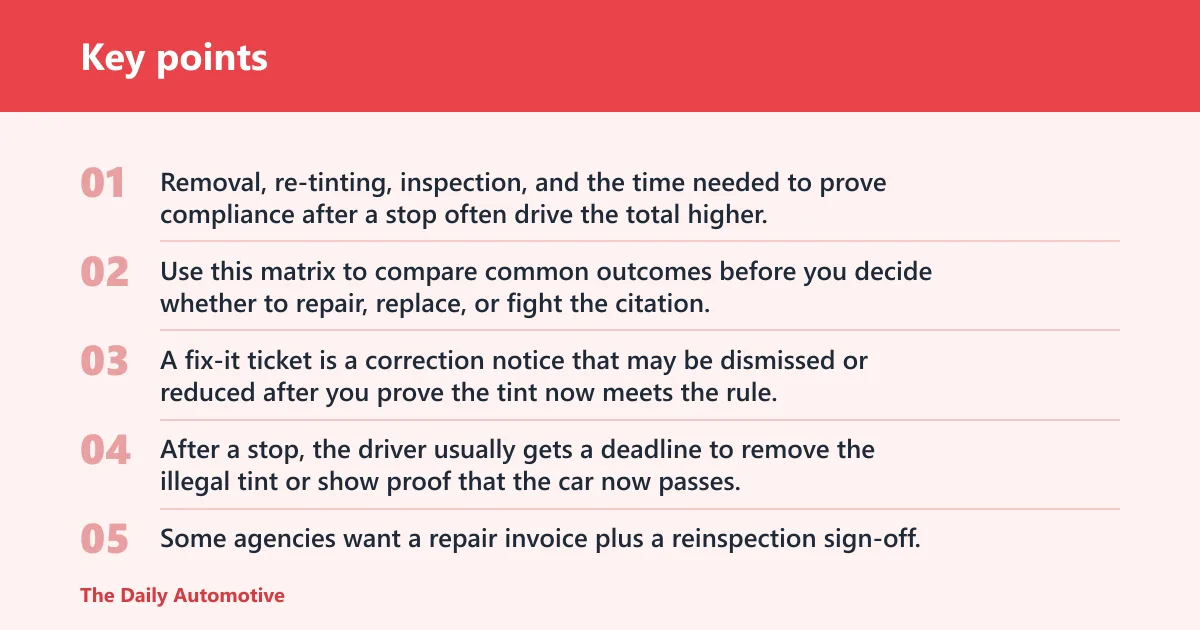


The ticket itself is only one line item. Removal, re-tinting, inspection, and the time needed to prove compliance after a stop often drive the total higher. Use this matrix to compare common outcomes before you decide whether to repair, replace, or fight the citation.
| Scenario | Likely enforcement outcome | Typical remediation steps | Low-to-high cost range |
|---|---|---|---|
| Front-side tint too dark | Usually a citation or fix-it ticket if the meter reads below the legal VLT threshold | Remove the film, reinstall legal tint, return for proof of correction | $75-$250 removal; $100-$300 re-tint; $0-$50 reinspection |
| Windshield strip too dark | Commonly stopped first because windshield rules are stricter and easier to spot | Trim or replace the strip with a legal clear or light film, then document the change | $50-$150 removal; $75-$200 replacement; $0-$50 reinspection |
| Mixed front and rear violations | Often a citation with a correction order if both front and rear sections miss local limits | Replace only the illegal panels or redo the whole package if the tint is mismatched | $125-$350 removal; $150-$400 re-tint; $0-$75 reinspection |
| Expired or unsafe aftermarket tint | Can trigger a fix-it ticket or a standard citation if peeling, bubbling, or obscuring vision | Strip degraded film, clean adhesive, install compliant film | $100-$300 removal; $150-$450 re-tint; $0-$75 reinspection |
| Post-ticket correction | Usually accepted if the shop invoice and vehicle inspection match the cited problem | Submit proof, show the corrected vehicle, and close the case before the deadline | $0-$50 paperwork; $75-$400 service cost depending on what had to change |
Fine versus fix-it ticket
A standard tint citation is a direct fine. A fix-it ticket is a correction notice that may be dismissed or reduced after you prove the tint now meets the rule. The difference matters because a fix-it ticket can shift the cost from punishment to repair, especially when the film is otherwise in good shape.
Enforcement checks three things: visible light transmission, film condition, and whether the tint location breaks the local rule. Officers and inspectors often use a window tint meter to read the installed VLT on the glass itself, not the marketing claim on the film box. That means a film sold as “light” can still fail if the final installed result is too dark.
What happens after a citation
After a stop, the driver usually gets a deadline to remove the illegal tint or show proof that the car now passes. Some agencies want a repair invoice plus a reinspection sign-off. Others want the officer’s checklist or a court clerk’s proof-of-correction form. Miss the deadline, and the case can turn into a larger fine or a repeat stop.
Say your sedan has dark front-side tint and gets a fix-it ticket. If you remove the film, reinstall a legal film, and return with documentation within the deadline, the total cost may stay near the repair bill and a small reinspection fee. If you wait, the ticket can stack with another citation.
How do tint laws and VLT limits work?
Window tint laws use VLT, or visible light transmission, which is the percentage of light that passes through the glass and film together. The rule is window-specific: front-side glass often faces the tightest limit, rear glass may allow darker film, and windshield rules are usually narrower still. The exact threshold changes by state and sometimes by enforcement agency.
Front side windows
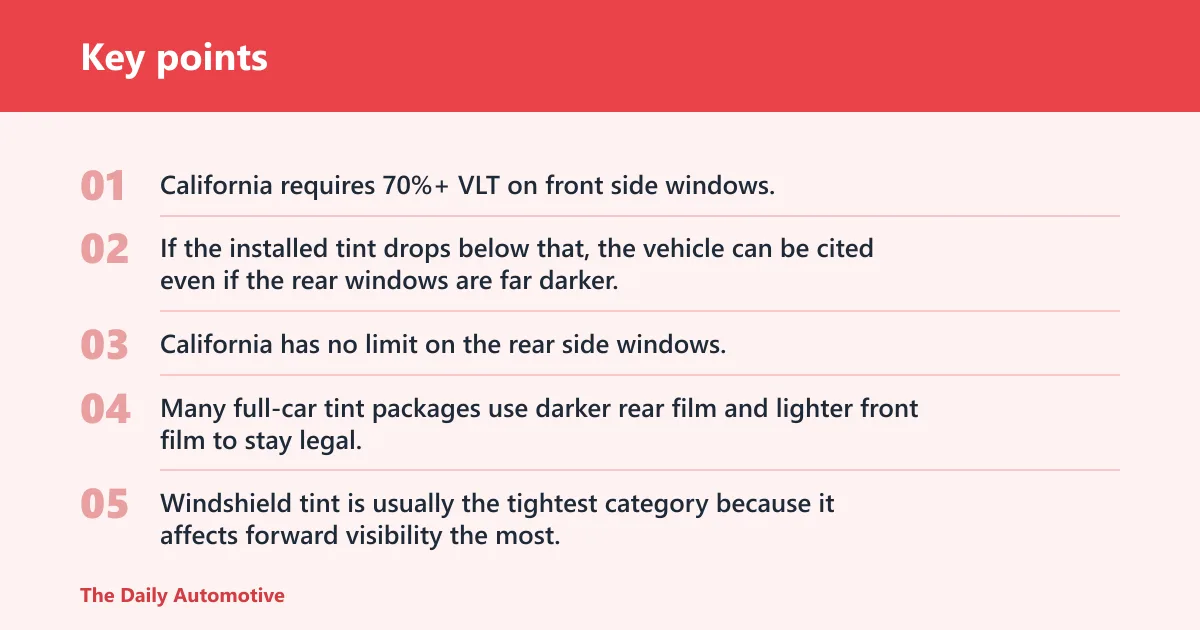
Front-side windows are where most tickets start because many states set a higher minimum VLT there than on the rear glass. California requires 70%+ VLT on front side windows. If the installed tint drops below that, the vehicle can be cited even if the rear windows are far darker.
That split is why a legal rear package does not automatically make the front legal. A meter reading on the front door glass is what matters during a stop, and the installed number can differ from the film label because the glass itself already blocks some light.
Rear windows and rear windshield
Rear tint rules are often more forgiving. California has no limit on the rear side windows. That gives drivers more privacy and heat control in the back half of the vehicle, but it also raises rearward visibility tradeoffs, especially at night and in rain.
Many full-car tint packages use darker rear film and lighter front film to stay legal. That is a common compliance strategy because it lets you keep heat rejection and privacy where the law is looser while staying within the stricter front-door limit.
Windshield restrictions
Windshield tint is usually the tightest category because it affects forward visibility the most. Clear ceramic film or a narrow legal strip at the top edge is the common solution. Full windshield tint can cost more than side-window tint because it uses more material, more labor, and a wider sheet of film.
F1 matters here: a Tesla Cybertruck windshield can cost more because it needs specialty wide-format film. Big glass panels increase waste and handling time, which pushes the price up even before the legal requirements are considered.
Why state rules differ
States set different VLT thresholds because they balance visibility, enforcement ease, and privacy differently. Some states also treat medical exemptions, mirror reflectivity, and rear-window rules differently. The result is simple: a film that passes in one state can fail in another, even on the same car.
What does legal tint cost compared with a ticket?
Legal tint can cost less than a citation once removal and reinspection enter the picture, but it depends on how much film has to come off and how large the vehicle is. Dyed film is usually the lower-cost tier. Ceramic film costs more, but it brings stronger heat rejection and UV protection, and it avoids signal interference risk.
Dyed film versus ceramic film
Dyed car window tint film is usually the cheapest way to darken glass and add privacy. Ceramic tint sits at the premium end because it is built for heat rejection and UV blocking, and it is less likely to interfere with radio, GPS, or phone signals. That premium comes with a higher install bill.
Elite Tint OKC says it offers a lifetime warranty on automotive tinting. It also claims 98% infrared heat rejection for XPEL ceramic tint and 99% UV protection. Those claims show why ceramic often costs more: buyers are paying for performance, not only darkness.
Windshield-safe options
Windshield-safe film usually costs more than side-window film because the glass is larger and the legal margin is narrower. Electric Auto Films prices windshield tint starting at $250. A clear ceramic option can make sense if the goal is heat reduction without turning the windshield into a visibility problem.
Removal and reinstallation labor
Removal and reinstallation labor can turn a minor ticket into a larger project. Electric Auto Films offers free removal and replacement for a window tint fix-it ticket, which matters because some shops charge separately for stripping adhesive and redoing the entire panel. Shop policy varies, so ask whether removal is included before you pay twice.
- Measure the installed VLT. Ask for a meter reading on the exact windows you plan to keep. That tells you whether you need only a correction or a full strip-and-replace job.
- Compare the quote to the citation. Get the ticket amount, the removal price, and the reinstall price in writing. If the repair is close to the fine, fix the film anyway so the car is legal going forward.
- Choose the lightest legal film. If the car is a daily driver, a legal front film with better heat rejection often beats a darker noncompliant film that risks another stop.
- Keep proof of correction. Save the invoice, the date, and any reinspection paperwork. That is what closes the ticket in many jurisdictions.
How do shops measure and verify compliance?
Shops verify compliance with a window tint meter that reads the installed VLT on the finished glass. That reading is what matters for a stop, not the package name or the film’s advertised darkness. Proof-of-correction usually depends on a fresh measurement and a paper trail showing the old film was removed or replaced.
Proof-of-correction paperwork
Most jurisdictions want some version of a repair invoice, a post-install inspection note, or a signed form from the officer or court. The point is to show the illegal tint is gone and the car now meets the rule. If the tint only gets trimmed or patched, the paperwork should say so clearly.
Reinspection and sign-off
Some agencies require a follow-up check before dismissing the citation. Others accept a shop certificate and a photo of the corrected vehicle. Deadlines vary, so the safe approach is to complete the repair quickly and keep copies of every document tied to the case.
A common first-timer mistake is replacing only the rear tint because it looks darker, then leaving a front window below the legal VLT threshold. That still triggers a stop if the front meter reading fails, even when the back glass looks compliant by eye.
How to avoid getting cited for illegal tint
The best way to avoid a tint citation is to verify the local rule before installation, then choose film by window position instead of by appearance alone. Measure the front-side windows first, use rear privacy where allowed, and keep the shop paperwork in the glove box. That prevents a legal-looking setup from failing on the meter.
- Check local VLT rules. Confirm the front-side, rear-side, and windshield limits before you book the install. State rules can differ enough that the same package is legal in one place and illegal in another.
- Match film to each window. Use a lighter film on the front and a darker or equal film on the rear only if the local law allows it. That keeps the meter reading within range where enforcement is strictest.
- Save the install documents. Keep the invoice, warranty card, and any compliance sheet from the shop. If you get stopped, those papers help show the film was installed intentionally, not by mistake.
Car tint pricing by vehicle type
Vehicle type changes tint cost because it changes window count, glass area, shape, and labor time. A compact or mid-size sedan tint install is described as about 3 hours. A mid-size SUV tint install adds about 30 minutes versus a sedan. A large SUV tint install runs about 4 hours.
Sedan pricing
Sedans usually cost less because they have smaller rear glass and fewer large panels. Electric Auto Films prices two front side windows starting at $200, and five windows starting at $449. That gives a practical floor for partial work and a better baseline than guessing from the full-car price.
For a sedan, a front-only repair can be the cheapest legal fix after a citation. If the front tint is the problem and the rear tint is already legal, you may only need two windows instead of a full strip.
SUV pricing
SUVs usually cost more because the glass is larger and there is more of it. That pushes both material use and labor time higher. A mid-size SUV takes longer than a sedan, and a large SUV takes longer still, so the price gap often reflects both film area and shop time.
Truck and crossover pricing
Trucks and crossovers sit between sedans and large SUVs, but the price depends on cab size and rear glass shape. Hard-to-fit quarter windows and sloped rear glass can increase waste. The more unusual the window shape, the more likely the final quote moves upward.
Two-window and five-window packages
Two-window packages usually cover the front doors only. Five-window packages often cover the front doors plus rear side glass and the rear windshield, though package definitions vary by shop. Electric Auto Films prices five windows starting at $449, which is a useful benchmark for common coverage on a mid-size vehicle.
Picture a crossover with legal rear tint but illegal front doors. A two-window correction may be enough, so the customer pays for removal and legal reinstallation only where needed. If the whole car is over the limit, a five-window package can be cheaper than piecemeal fixes after multiple stops.
Frequently asked questions
How much is a window tint ticket?
A window tint ticket often falls in the $50 to $250 range, but that is only the fine. If the state requires removal, inspection, or court handling, the full bill can move past $500. Fix-it tickets are usually less expensive if you correct the film quickly.
How much is a tint ticket in my state?
It depends on state law, local court fees, and whether the officer writes a fine or a correction notice. Some places focus on removal and proof of compliance, while others add a fixed penalty. Check the front-side VLT rule first, since that is the most common trigger point.
Can I get a fix-it ticket for tint instead of a fine?
Yes, in many areas the officer can issue a correction notice instead of a straight penalty. That usually means you remove or replace the illegal tint, then show proof by the deadline. Whether the case is dismissed after correction depends on the agency and the paperwork.
What happens if I get a window tint ticket?
You may need to remove the illegal film, pay the fine or correction fee, and return with proof that the car now passes. If you miss the deadline, the citation can grow into a larger bill or another stop. The safest move is to repair the film before the deadline expires.
How dark can front windows legally be?
That depends on the state. California requires 70%+ VLT on front side windows, while other states set different thresholds. The meter reads the installed result, so the film label alone does not decide compliance. Front windows are usually the strictest area.
How much does tinting your car cost compared with a ticket?
Basic tint work can cost less than a citation once removal and court fees are added, especially if you only need a correction on two windows. A full legal re-tint is more expensive up front, but it can be cheaper than paying a fine and then paying again to fix the film.
Products related to this article
Sponsored / affiliate links. As an Amazon Associate I earn from qualifying purchases. I may earn additional commission from eligible campaigns.