Best Car Sun Visors for Glare (2026): Research Shows
Choose a visor extender if glare hits your eyes from the side or above; choose a windshield sun shade if the cabin heats up or low-angle front glare is the main problem. Ignore it and you risk squinting, slower reactions, and a hotter cabin on every drive. Below, the best car sun visors for glare are matched to the route, windshield, and driving time.
Quick comparison
| Product | Badge | Best for | Price | ||
|---|---|---|---|---|---|
 |
Veharvim Sun Visor Extender for Car (Polarized, UV400, PCVeharvim | Our pick | Polarized · 2 Pack · Visor Extender | $39.91
Price as of 16 Oct 2026
|
View |
 |
Magnelex Car Windshield Sunshade – Double-Layer Design forMagnelex | Also great | Large · Double-Layer · Foldable Shade | $17.99
Price as of 16 Oct 2026
|
View |
This comparison starts with the glare source. That matters because a side-window extender and a windshield shade fix different problems, and the wrong fit can work against you.
How we chose
We compared each option on glare control, UV coverage, fit risk, visibility at night, and storage convenience. Material quality also mattered, because a stiffer lens or denser shade usually lasts longer, even if it adds bulk.
The goal was not to pick a single winner for every driver. The right choice changes with sun angle, mirror placement, visor thickness, and whether you need help while driving or parked.
| Sun direction | Vehicle fit risk | Daytime and nighttime visibility concerns | Storage convenience | Best product category |
|---|---|---|---|---|
| Low front glare at sunrise or sunset | Medium if the visor is thick or the mirror sits close to the mount | Can help daytime glare; avoid any tinted coverage that blocks too much at dusk | High if you want a small clip-on piece | Polarized visor extender |
| Side glare on commutes or highway lanes | Medium if the visor shape is curved or the side mirror blocks clamp placement | Check that the added panel does not crowd the edge of your view | High for compact extenders; moderate for wider shields | Visor extender with side shade |
| Full windshield heat and parked-car exposure | High on curved or oversized windshields | Can reduce front visibility if left in place while driving | Moderate to high, depending on fold size | Windshield sun shade |
| Wide SUV or truck windshield | Lower if the shade size matches the opening | Best for parked use, not active driving | Moderate; foldable or umbrella designs store better | Large windshield sun shade |
| Quick daily setup with limited cabin space | Low if the clip clears the visor and mirror area | Useful for daytime glare without permanently darkening the cabin | Very high if it folds flat or clips off fast | Compact clip-on visor extender |
JOYTUTUS Sun Visor Extender for Cars: best overall visor extender
JOYTUTUS is the best fit for drivers who want a compact anti-glare fix for direct sun, not a parked-car shade. Its polarized lens reduces glare, and the UV400 protection adds a useful layer for bright commutes and low-angle sun. At 0.039 inches high, 6.3 inches wide, and 12.6 inches long, it stays small enough for everyday storage.
The universal fit and clip-on installation make it a practical first pick for many cars. It is also the cleanest answer for drivers who want a visor extender rather than a windshield shade, because it targets what reaches the eyes while the car is moving.
The main drawback is fit risk. A universal clip does not guarantee a perfect hold on thick visors, visors with a bulky seam, or vehicles where the rearview mirror sits too close to the mounting area. If the clamp has to fight the visor, daily use gets annoying fast.
Best use case: morning and evening drivers who want a small, removable shield against direct glare without giving up cabin visibility when the sun drops.
Veharvim visors: best for side glare
Side glare calls for a different shape than front glare. The Veharvim Polarized Sun Visor for Car is the better answer when the sun comes in from the driver-side window, because its polycarbonate lens and side sunshade are built for lateral coverage, not just a narrow frontal strip.
The Veharvim Sun Visor Extender for Cars is the more flexible choice if you want a clip-on design with adjustable coverage and UV400 protection. That combination matters when sun angle changes during a commute, or when one car serves different drivers with different seat positions.
Both options are universal fit products, which helps on paper but does not erase real-world issues. A curved visor edge, a thick factory visor, or mirror interference can still limit where the clip sits and how far the shade can swing.
Use the polycarbonate-lens model if you want a sturdier feel and side-sun coverage. Use the adjustable extender if you want a smaller daily carry and a little more control over where glare lands.
Why polarized extenders actually work
Polarized visor extenders work best when glare is coming from a bright, directional source such as morning sun, low-angle highway light, or reflection off wet pavement. The polarizing lens cuts the harsh brightness that forces squinting, which can make eye strain feel lower on longer drives.
They help less when the problem is cabin heat or broad windshield exposure. In that case, a windshield shade blocks more area and handles parked-car baking better than any clip-on visor piece.
Windshield shades: best for heat and parked-car protection
Windshield shades are the right tool when the problem is heat, front glass coverage, or a car that sits in the sun between trips. EcoNour, Magnelex, and Nmoiss all solve that parked-car problem better than a visor extender can.
That said, they are not interchangeable with visor extenders. A shade belongs on the windshield when the vehicle is parked. A visor extender belongs near your face when the car is moving.
EcoNour Car Windshield Sun Shade for wide coverage and 99% heat blocking
EcoNour is the pick when you want broad windshield coverage and maximum heat control. It is commonly reported to block most heat, uses an overlapping design, and fits windshields up to about 64 x 32 inches. The 240T polyester construction and included storage pouch make it practical for regular use.
This is a stronger choice for drivers of larger vehicles or anyone parking in full sun for long stretches. The overlap helps with coverage, which is useful when the windshield shape leaves gaps near the corners.
The drawback is simple: it is a parked-car product, not a driving accessory. It can also be awkward on vehicles with unusual windshield curves, because the edges may not sit as cleanly as they do on a flatter opening.
Magnelex Car Windshield Sunshade for foldable storage and No-Light-Pass Technology
Magnelex is the better pick if you want a windshield shade that packs away neatly and aims to reduce light leakage. Its No-Light-Pass Technology, foldable design, and 240T reflective polyester are geared toward full front coverage, and its 63 x 33.8 inches size suits many cars, trucks, and SUVs.
The included storage bag matters more than it sounds. A shade that folds fast is much easier to keep in daily rotation, especially when you are opening and closing it several times a week.
The tradeoff is visibility. Like any reflective windshield shade, it is for parked use, not driving use. If you leave it in place while moving, it blocks too much of the forward view.
Nmoiss Windshield Sun Shade Umbrella for quick setup and 2025 upgrade materials
Nmoiss is the most convenient windshield shade here for drivers who want quick deployment. It is labeled a 2025 upgrade, uses 240T high-density fabric, and measures 56 x 31 inches. The spring-supported structure is the main reason it stands out for fast setup and takedown.
The ice crystal cooling material is aimed at cabin comfort in hot weather, which makes it a stronger pick for short stops, repeated errands, and drivers who dislike folding large panels. Smaller size can also help when storage space is tight.
The drawback is coverage. Because it measures 56 x 31 inches, it is not the widest option in this group, so larger windshields may expose more glass than a bigger shade would.
Which product fits your glare problem?
If your glare problem changes with the sun’s direction, match the product to the route first. Morning and evening commuters usually need a visor extender; parked-car heat and all-day sun exposure usually call for a windshield shade.
Low sun on morning and evening commutes
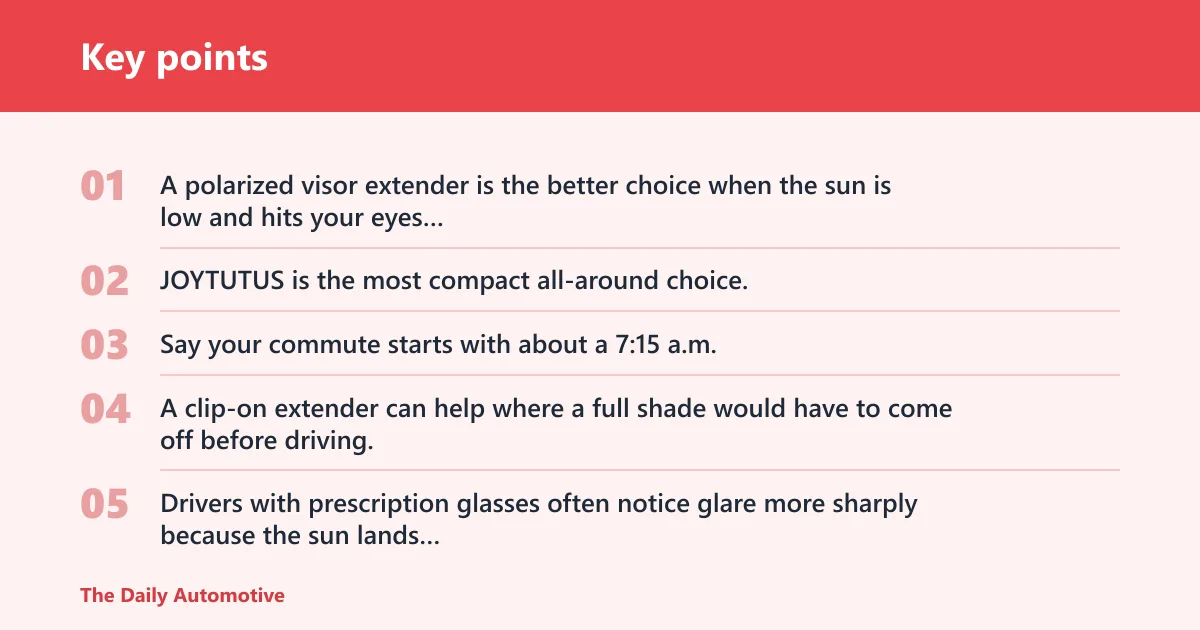
A polarized visor extender is the better choice when the sun is low and hits your eyes directly through the windshield or side glass. JOYTUTUS is the most compact all-around choice, while the Veharvim extenders make sense if you need more side coverage or a slightly different fit approach.
Say your commute starts with about a 7:15 a.m. left turn into low sun. A clip-on extender can help where a full shade would have to come off before driving, which makes it impractical for that route.
Highway driving and prescription glasses
Drivers with prescription glasses often notice glare more sharply because the sun lands right in the line of sight for longer stretches. A polarized visor extender usually helps more than a windshield shade while driving, because it cuts brightness without covering the whole glass.
If you wear glasses and the glare is mostly from the front, start with JOYTUTUS. If the problem is sliding in from the side window on open highway lanes, the Veharvim polarized side-sunshade model is the better match.
Curved windshields, thick visors, and mirror interference
This is where fit failure shows up. Thick visors can stop a clip from closing securely, curved windshields can leave gaps in a shade, and mirror interference can limit how far a visor extender can swing without touching the mirror housing.
Picture a sedan with a wide mirror mount and a padded sun visor. A universal clip-on may still work, but only if the clamp clears the edge and the extender does not block the mirror stem.
For these cases, check the space before buying. If the visor is bulky, a windshield shade may be the safer bet for parked use; if the windshield curve is the issue, a compact visor extender avoids the shape problem entirely.
When to choose a visor extender versus a windshield shade
Choose a visor extender if you want glare reduction while driving, especially for side or low-angle sun. Choose a windshield shade if your main goal is heat blocking, parked-car comfort, or reducing the sun load on the dash and steering wheel.
That split matters because the two products do different jobs. One follows your line of sight. The other protects the cabin when the car is still.
What to look for in an anti-glare visor
The best anti-glare visor balances optical performance with fit and daily convenience. Polarized lenses help with directional glare, UV400 protection helps with sun exposure, and a clip that actually fits your visor determines whether you will keep using it.
Polarized lens versus reflective shade
A polarized visor extender reduces glare you see while driving. A reflective windshield shade blocks sunlight and heat when parked. If the complaint is eye strain at the wheel, start with polarization; if the complaint is cabin temperature after parking, start with a shade.
UV400 protection and tint visibility
UV400 protection matters because glare and UV exposure are not the same problem. JOYTUTUS and the Veharvim Sun Visor Extender list UV400 protection, which makes them stronger choices for drivers who want both glare reduction and sun filtering.
Just keep visibility in view. Darker or more reflective products can be less comfortable at dusk, and anything that blocks too much light should stay out of the driving position when the sun is gone.
Adjustability, clip strength, and storage size
Adjustability helps when the sun shifts during the day. Clip strength matters when the visor is thick or the mirror sits close. Storage size matters if you want a product you can remove in seconds and stash without fighting it later.
A common first-timer mistake is buying a wide shade for a sedan without checking the opening first. Another is choosing a visor extender that looks universal, then finding the clip lands exactly where the mirror housing gets in the way.
Durability and build materials
Material choice gives a good clue about durability. Polycarbonate, used in the Veharvim Polarized Sun Visor, tends to imply a tougher lens feel. 240T polyester, used in EcoNour, Magnelex, and Nmoiss, points to denser shade fabric and stronger light blocking.
That does not make one category better in every case. It only means the material should match the job: a hard lens for driving glare, a dense shade for parked heat.
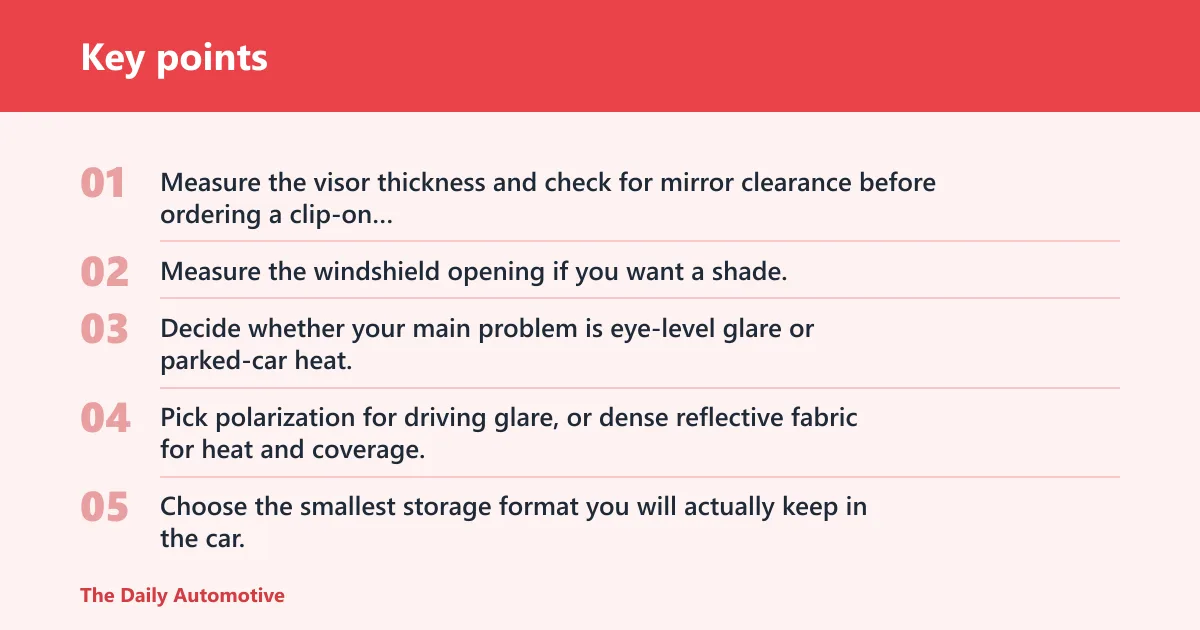
- Measure the visor thickness and check for mirror clearance before ordering a clip-on extender.
- Measure the windshield opening if you want a shade, and compare that to the product’s listed size.
- Decide whether your main problem is eye-level glare or parked-car heat.
- Pick polarization for driving glare, or dense reflective fabric for heat and coverage.
- Choose the smallest storage format you will actually keep in the car.
Frequently asked questions
What is the best car sun visor for glare?
For most drivers, JOYTUTUS is the strongest all-around visor extender because it combines a polarized lens, UV400 protection, a compact footprint, and a clip-on design. If your main issue is side glare, the Veharvim side-sunshade model may fit better. If your main issue is heat, choose a windshield shade instead.
Do polarized sun visor extenders actually work?
Yes, when glare is coming from a direct light source and the lens is positioned in the line of sight. Polarized extenders help most with low sun, road reflection, and bright side light. They do less for cabin heat, which is where a windshield shade performs better.
Will a universal sun visor extender fit my car?
Universal fit is a good starting point, not a guarantee. Thick visors, curved visor frames, and rearview mirror interference can prevent a secure clamp or limit movement. Check the visor depth, mounting space, and mirror clearance before assuming a universal extender will fit cleanly.
What’s the difference between a sun visor extender and a windshield sun shade?
A visor extender is for driving. It blocks glare near your eyes and can stay useful while the car is moving. A windshield sun shade is for parked use. It blocks heat and sunlight before you start driving, but it should come out of the windshield before the car moves.
Which sun visor blocks UV rays as well as glare?
JOYTUTUS and the Veharvim Sun Visor Extender both list UV400 protection, so they address UV exposure along with glare reduction. EcoNour, Magnelex, and Nmoiss are better choices for parked-car heat and coverage, but they are windshield shades rather than visor extenders.
Are clip-on visor extenders easy to install?
Usually, yes. Clip-on extenders are meant for quick attachment and removal, which is why they are popular for daily commuting. The catch is fit: if the visor is thick, the shape is awkward, or the mirror is too close, easy installation can turn into a repeated hassle.
Products related to this article
Sponsored / affiliate links. As an Amazon Associate I earn from qualifying purchases. I may earn additional commission from eligible campaigns.
 Yidcidu Car Windshield Sun Strip Tint, PET Anti-Glare Windshield Window Tint Film, 51.2" x 8.27" Cuttable Sun Visor Decorative Decals, for Cars Trucks SUVs (Black)
 Tunrisy 51.18"× 7.87" Car Windshield Sun Strip Tint, Waterproof Matte Front Windshield Banner Tint Strip, Vehicle Sun Visor Film Decals, Universal for Cars Trucks SUVs (Black)