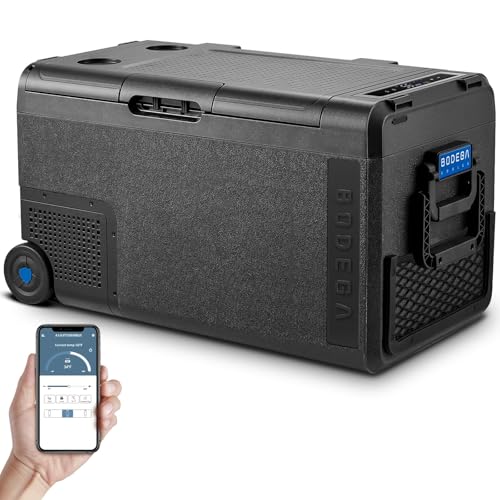
Plug in Coolers for Car: Tested & Reviewed (3 Picks)
A 12V compressor cooler in the roughly 20 to 35 quart range is often a practical choice for many cars. Choose thermoelectric only for short drives, and pick a compressor if you need real refrigeration. Pick the wrong type and you waste space, drain the battery, or arrive with warm food and spoiled drinks. This guide ranks three plug-in coolers by trip type, then explains which cooling technology, capacity, and power draw fit your car and route.
Best plug-in car cooler overall


The BougeRV CR22 is the best overall fit for most drivers because it pairs true compressor cooling with a practical 23-quart size, fast pull-down to 32°F in about 15 minutes, and a 3-level battery protection system. It is the safest default choice if you need real refrigeration without stepping up to a large dual-zone box.
Why this pick fits most drivers
Use this cooler if you want one unit that can handle drinks, lunch, and overnight perishables without ice. It cools from 77°F to 32°F in about 15 minutes and can freeze to -8°F, so it handles chilled storage and frozen items.
At 45W in ECO mode and 45dB, it sits in the middle of the pack for power and noise. That makes it easier to live with than many budget thermoelectric coolers, while still staying compact enough for smaller cargo areas.
What it does better than cheaper thermoelectric coolers
Compressor cooling matters in warm weather and on longer trips. A thermoelectric cooler can move heat, but it cannot match true fridge performance when ambient temperatures rise or when the load starts warm. The CR22 is built for actual cold storage, not just drink chilling.
The 3-level battery protection is also a real advantage for parked use. It helps prevent a dead starter battery by letting you set a cutoff before the vehicle battery gets too low.
📊 Car and Driver updated its electric cooler article in July 2026. Source: Caranddriver.
Quick picks by trip type

- Best for weekend road trips: BougeRV CR22, because it balances size, cooling speed, and battery protection.
- Best for sleeping in a van or tent: EUHOMY CFC-18, because its 42dB operation is the quietest of the three listed here.
- Best for family hauls and longer travel: EUHOMY CF-55, because 55 liters, or 59 quarts, gives you real storage depth.
BougeRV CR22 review
The CR22 is the best choice for drivers who want a compact compressor cooler that can handle actual refrigeration, not just cool drinks. Its 23-quart size is large enough for a couple’s road trip or a solo camping run, but small enough to fit where a bigger box would crowd luggage.
Who should buy the 23-quart size?
This size works best in hatchbacks, sedans with limited trunk room, and SUVs where you still need space for bags. It is also a good behind-seat option if you want fast access while keeping the cargo floor clear.
Cooling speed, freezer use, and battery protection
The CR22 cools from 77°F to 32°F in about 15 minutes and freezes to -8°F. That makes it the only one of these three with clearly stated freezer capability. If you plan to carry frozen meals, gel packs, or meat for a longer leg, that matters more than a lower sticker price.
Its 45W ECO mode is efficient for a compressor unit, and the 3-level battery protection adds a useful safety layer for overnight parking. Use the lowest cutoff that still leaves enough reserve for your vehicle to start, then adjust upward if you park for long stretches or drive a vehicle with an older 12V battery.
Noise and power draw in overnight use
At 45dB, the CR22 is not silent, but it is reasonable for sleeping in a van if the cooler is placed away from your pillow and the compressor cycles instead of running constantly. It is a better overnight option than most thermoelectric models in hot weather, because it does not have to work as hard to hold temperature.
A common first-timer mistake is loading warm food into a cooler right before departure. If the cooler and the food are both pre-chilled, the compressor spends less time at high output and the battery load is easier to manage.
EUHOMY CFC-18 review
The CFC-18 is the compact pick for front-seat or tight rear-seat installs. Its 19-quart capacity suits solo drivers, light packers, and anyone who wants a small cooler that is easier to lift, stow, and reach while seated.
Why the compact 19-quart size matters
At this size, you are buying convenience and placement flexibility more than bulk storage. It fits better when the vehicle already carries luggage, pets, or gear, and it is easier to keep within arm’s reach for snacks and drinks on the move.
App control, reversible door, and lid sealing
The CFC-18 may offer Bluetooth app control, a magnetic-seal lid, and relatively quiet operation, and it can cool to 32°F in about 15 minutes. It also has a reversible door, which helps when you need the lid to open toward the passenger side, the center console, or a rear cargo opening.
Those features matter more than they sound. A better seal helps reduce cycling, and a reversible door can keep the cooler usable in a sedan trunk, a rear-seat gap, or a narrow hatch opening where a fixed hinge would be awkward.
Best fit for front-seat, rear-seat, and small-cargo installs
Choose this model if you need a cooler that can live near the front seat, between captain’s chairs, or in a small cargo bay. It is the easiest of the three to place where cable routing and opening clearance are tight.
EUHOMY CF-55 review
The CF-55 is the pick for families, long trips, and anyone carrying both fresh food and frozen items. Its 55-liter, or 59-quart, capacity is far larger than the other two models, so it is the clear choice when storage volume matters more than portability.
When a dual-zone cooler makes sense
Dual-zone storage is useful when you want to separate drinks from food, or chilled items from frozen ones. That setup becomes valuable on multi-day travel, especially when several passengers share the same cooler and you need a cleaner way to sort contents.
What the removable divider changes
The removable divider lets you reconfigure the box as your load changes. Use the divider when you need two temperature areas or better organization, then remove it when one large compartment is more practical for bulky containers.
The CF-55 also uses app control and has a 45W average draw. That makes it a strong longer-trip option, but the larger box will usually be harder to place in a sedan trunk and may be better suited to an SUV cargo area or a van.
Car cooler decision matrix
This matrix turns trip length, passenger count, and food type into a fit rule. If your use case lands in the “skip thermoelectric” column, a compressor cooler is the safer choice.
| Trip length | Passengers | Food type | Recommended capacity | Preferred cooling tech | Expected noise | Power-risk level | When to skip thermoelectric |
|---|---|---|---|---|---|---|---|
| 2 to 6 hours | 1 to 2 | Drinks, snacks, lunch | 18 to 25 quarts | Thermoelectric or small compressor | Low to moderate | Low if engine runs; moderate if parked | Skip if the car sits in hot sun or the load starts warm |
| Day trip to overnight | 2 to 3 | Perishables, leftovers, milk | 23 to 35 quarts | Compressor | About 42dB to 45dB | Moderate | Skip if ambient heat is high or the cooler must stay cold while parked |
| Weekend or longer | 3 to 5 | Meals, frozen items, mixed loads | 40 quarts and up | Compressor | About 42dB to 45dB | Moderate to higher | Skip if you need stable cold storage in warm weather or want freezer capability |
| Multi-day family travel | 4+ | Groceries, packed meals, frozen food | 55 liters / 59 quarts | Dual-zone compressor | About 45dB | Moderate to higher | Skip thermoelectric altogether |
If you drive a sedan with a small trunk and only need cold drinks for a long day out, a compact 19-quart cooler is the better fit than a bigger box that steals luggage space and is harder to reach.
If you load an SUV with two adults, two kids, and groceries for a weekend cabin run, that is the case where the 55-liter dual-zone box earns its size, because volume and separation matter more than portability.
How do you choose a plug-in cooler?
Start with the cooling technology, then match capacity to trip length and vehicle layout. A 12V compressor cooler is the right choice for real refrigeration, warm climates, longer parking, or any trip where you need stable cold food instead of casual drink cooling.
Compressor vs thermoelectric
A compressor cooler gives true fridge and freezer performance, faster cooldown, and better efficiency over long runs. A thermoelectric cooler is usually lower-cost and may cool or warm, but it is less effective in hot weather and often has less insulation. That tradeoff works for short drives, not for serious food storage.
If you need frozen food, steady cold in summer, or overnight use, choose compressor. If you only need a light-duty cooler for a short commute or a few drinks, thermoelectric can work.
12V outlet power, battery drain, and cutoff settings
Plug-in coolers run from a vehicle’s 12V outlet, so 12V DC compatibility matters before you buy. Power draw depends on the model and temperature target, but any 12V cooler can drain a battery if it runs too long while the engine is off.
Use the battery protection system as a safeguard, not a guarantee. Set the cutoff higher if you park overnight, have an older battery, or use a smaller car with less reserve. Set it lower only when you are confident the engine will restart soon.
Size, insulation, and vehicle fit
Size should follow the vehicle layout. Hatchbacks often favor compact compressors in the 20 to 25 quart range. Sedans do better with smaller boxes that leave trunk depth and lid clearance. SUVs can handle larger coolers, and behind-seat installs work best with narrower units that do not block seat movement.
Insulation matters because a well-sealed box spends less time trying to recover temperature after opening. If the load is pre-chilled and the ambient heat is moderate, a smaller compressor can do more than a bigger thermoelectric unit that is fighting the weather.
Noise, warranty, and maintenance costs
Noise ratings around 42dB to 45dB matter if you sleep in a van or tent. Those figures are not silent, but they are in the range where placement and compressor cycling determine how noticeable the cooler feels at night.
Ownership costs go beyond the sticker. Compressor units often have higher replacement risk if the electronics fail, but they also deliver better food protection. Thermoelectric units may cost less up front, yet their weaker performance can make them a false economy for longer travel. Manual defrost is another cost of ownership to expect with compressor coolers after freezer use, because frost buildup is normal.
Field checklist before you buy
- Check where the 12V outlet sits and whether the cord reaches the planned location.
- Estimate how long the cooler will stay powered with the engine off.
- Note the hottest ambient temperatures your trip is likely to face.
- Look at insulation and lid sealing, not only advertised capacity.
- Pre-chill food and drinks when possible.
- Confirm the cooler fits your hatchback, sedan trunk, SUV cargo area, or behind-seat space.
- Decide whether battery protection settings match your parking habits.
Frequently asked questions
What is the best plug-in cooler for a car?
The best plug-in cooler for most cars is a 12V compressor model in the 20 to 35 quart range. For this group, the BougeRV CR22 is the best overall pick because it combines real refrigeration, compact size, fast cooling, and 3-level battery protection. Choose larger only when the trip length or passenger count justifies it.
Do plug-in car coolers really keep food cold?
Yes, but only the right type does it well. Compressor coolers keep food cold in a way that is much closer to a household fridge, while thermoelectric coolers are weaker in hot weather and better suited to short trips. If the food must stay cold overnight, compressor is the safer choice.
What is the difference between a compressor cooler and a thermoelectric cooler?
A compressor cooler can chill quickly, hold lower temperatures, and freeze food. A thermoelectric cooler is simpler and often cheaper, and some can warm as well as cool, but they are less effective when the outside temperature climbs. That makes thermoelectric better for short, light-duty use.
How much power does a 12V car cooler use?
Power draw varies by model and temperature setting. The BougeRV CR22 uses 45W in ECO mode, and the EUHOMY CF-55 has a 45W average draw. Actual battery impact depends on ambient heat, how often the lid opens, and whether the engine is running.
Will a plug-in cooler drain my car battery?
It can, especially if you leave it running while parked. That is why a battery protection system matters. The BougeRV CR22’s 3-level battery protection is useful for overnight parking, but you still need to match the cutoff to your battery condition, parking time, and vehicle type.
Are plug-in coolers quiet enough to sleep next to?
Some are close enough, but not silent. The EUHOMY CFC-18 runs at 42dB, and the BougeRV CR22 runs at 45dB. Those levels are workable for many sleepers in a van or tent if the cooler is placed away from your head and the compressor is not cycling constantly.
Products related to this article
Sponsored / affiliate links. As an Amazon Associate I earn from qualifying purchases. I may earn additional commission from eligible campaigns.