Best Car Tire Pressure Gauges for Accuracy (2026): We Compared
For cars, the most accurate tire gauge is the one built for passenger-car pressure ranges and backed by the strongest calibration claim you can verify, usually a stated ANSI standard and a tight accuracy spec. Range fit matters because a gauge near the middle of its scale is easier to read consistently, and consistency matters as much as the number on the screen.
Which tire gauge is most accurate for cars?
For most passenger cars, that usually points to a 0-75 PSI gauge with a clear calibration claim, or a digital gauge in the 100 PSI class if you want extra range headroom. The best choice is not the highest PSI ceiling; it is the gauge that reads the car’s normal inflation pressure cleanly, seals well on the valve stem, and repeats the same value check after check.
Quick answer: For precision on cars, start with a gauge that advertises a real calibration standard, then pick the PSI range that fits your vehicle. On that basis, the ETENWOLF’s ANSI B40.1 Grade A claim is a strong benchmark for passenger cars, while the JACO ElitePro is the better fit if you want a digital readout and a wider ceiling.
Quick comparison
| Product | Badge | Best for | Price | ||
|---|---|---|---|---|---|
 |
JACO ElitePro Digital Tire Pressure Gauge – ProfessionalJACO Superior Products | Our pick | Digital · 100 PSI · JACO ElitePro | $29.90
Price as of 16 Oct 2026
|
View |
 |
LUMITECO 12” Dual Head Tire Pressure Gauge, Heavy DutyLUMITECO | Budget pick | 12” · 10-150PSI · LUMITECO Dual Head | $9.99
Price as of 16 Oct 2026
|
View |
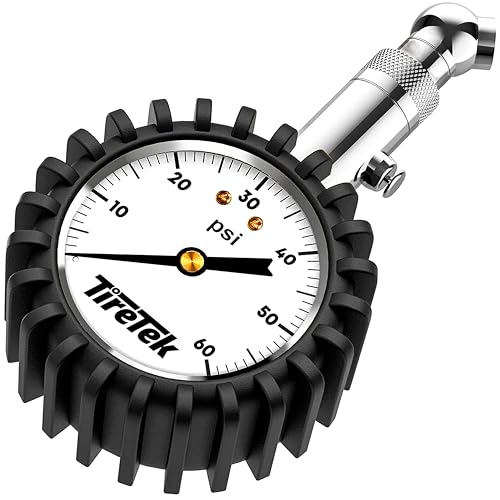 |
Tire Pressure Gauge for Cars, ANSI Certified 60 PSI AnalogTIRETEK | Also great | Analog · 60 PSI · TIRETEK ANSI | $9.98
Price as of 16 Oct 2026
|
View |
The comparison below should be read as a precision screen, not a feature wishlist. The feature that matters most is the calibration claim, because a good seal and the right PSI range cannot rescue a gauge that is not aligned to a known standard.
How we chose
We compared gauges on four things that affect accuracy in real use: stated calibration standard, PSI range fit, readout visibility, and battery dependence. We also weighed how likely each design is to stay repeatable when you check the same tire more than once.
The goal is simple. You need a gauge that fits your vehicle, reads cleanly in the conditions you actually face, and does not add error through poor sealing, awkward viewing angles, or a fading battery.
Comparison table
| Gauge | Stated PSI range | Calibration standard / claim | Readout type | Low-light usability | Battery dependence | Likely use case |
|---|---|---|---|---|---|---|
| JACO ElitePro Digital Tire Pressure Gauge | 100 PSI | Professional accuracy; published details describe ANSI 2A accuracy standards | Digital display | Good when the display is lit, but depends on screen visibility | Yes | Cars and SUVs; 100 PSI gives extra headroom for mixed use |
| JACO ElitePro Digital Tire Pressure Gauge | 200 PSI | Professional accuracy; published details describe ANSI 2A accuracy standards | Digital display | Good when the display is lit, but depends on screen visibility | Yes | Trucks, higher-pressure applications, and owners who want range margin |
| ETENWOLF Tire Pressure Gauge | 0-75 PSI | ANSI B40.1 Grade A; accuracy within plus-minus 1% | Large glow dial | Strong | No | Passenger cars and many SUVs; battery-free everyday checks |
| LUMITECO 12” Dual Head Tire Pressure Gauge | 10-150PSI | No specific calibration standard stated in the product details provided | Analog dual-head gauge | Depends on ambient light and dial size | No | Trucks, RVs, and awkward valve locations |
| TIRETEK 60 PSI Analog Dial Gauge | 60 PSI | ANSI B40.1 Grade B calibrated | Glow-in-the-dark analog dial | Strong | No | Cars and light-duty vehicles that stay under 60 PSI |
Note: For precision, the calibration claim matters most because it tells you whether the reading was built around a recognized standard. PSI range comes next, since a gauge that lives near the top or bottom of its scale is harder to read consistently.
JACO ElitePro Digital Tire Pressure Gauge: best for precision-focused drivers
- Calibrated to professional ANSI 2A accuracy standards.
- Readings lock-on until reset for reliable checks.
- Solid brass and steel construction shielded by gear.
Choose the JACO ElitePro Digital Tire Pressure Gauge if you want a digital readout and a model described as offering professional accuracy. The 100 PSI version suits most cars and SUVs, while the 200 PSI version gives more ceiling for trucks or mixed vehicle fleets.
The compact design and durable construction help it work as a carry-anywhere tool, and the lock-on reading feature is useful when you want to capture a value before resetting. That matters because a stable displayed number makes repeat checks easier to compare.
The drawback is straightforward: it is battery dependent, so dead or weak batteries become part of the maintenance burden. A digital gauge can be very readable, but its precision is only as useful as the display and power behind it.
Pros and cons
- Pros: professional accuracy claim; lock-on readings; compact and durable construction; 100 PSI and 200 PSI options.
- Cons: battery dependence; digital visibility can suffer if the screen is hard to read in bright glare or low power.
Who it’s for
This suits drivers who want a precision-first digital gauge, especially if they check more than one vehicle and want a wider ceiling than a basic car-only tool. It is less appealing if you want a battery-free gauge that stays ready in a glove box for long stretches.
ETENWOLF Tire Pressure Gauge: best for battery-free use
The ETENWOLF gauge is the cleanest pick for buyers who want a manual gauge with a strong calibration claim and no battery to manage. Its 0-75 PSI range fits passenger cars and many SUVs, and the large glow dial is helpful when you are checking pressures in dim parking lots or early mornings.
Its standout detail is the ANSI B40.1 Grade A calibration, paired with an accuracy claim within plus-minus 1%. That is the kind of specification shoppers should look for when they care about precision rather than just a readable number.
The tradeoff is that 75 PSI is not enough for some truck or specialty applications. If your vehicles live above that ceiling, the gauge is still precise, but it is no longer the right size for the job.
Pros and cons: pros: ANSI B40.1 Grade
- Pros: ANSI B40.1 Grade A calibration; plus-minus 1% accuracy claim; 0-75 PSI fit for passenger cars; large glow dial; manual operation.
- Cons: lower PSI ceiling than truck-focused gauges; analog dial reading still depends on your viewing angle.
LUMITECO 12” Dual Head Tire Pressure Gauge: best for hard-to-reach valves
- Integrated straight foot air chuck for extended reach.
- Solid brass core with matte texture steel body.
- Dual-head design allows for reverse angle reading.
The LUMITECO gauge makes sense if you need reach more than you need a precision-forward spec sheet. The 12-inch length, straight foot air chuck, and dual-head layout are aimed at awkward valve access on trucks, RVs, motorcycles, and cars.
Its 10-150PSI range is broader than a passenger-car-only tool, which helps if you maintain mixed vehicles. The limitation is that the provided details do not state a calibration standard, so it is harder to rank as the most exacting pick for accuracy-first car owners.
In practice, that means this is a utility choice, not the benchmark choice. It can solve a fit problem that a short gauge cannot, but range and reach are not the same thing as verified precision.
Pros and cons: pros: extended reach; dual-head design
- Pros: extended reach; dual-head design for reverse-angle reading; 10-150PSI range; brass core and steel body.
- Cons: no stated calibration standard in the supplied details; less directly focused on precision than the gauges above.
What PSI range should your gauge have?
Pick the PSI range by vehicle type, not by marketing claims.
Range matters because gauges are easiest to read when your normal tire pressure sits in a comfortable part of the scale. Say your sedan runs around 35 PSI; a 0-75 PSI gauge is squarely in the usable middle, while a truck tire near the top of a small-scale gauge can be harder to read repeatably.
Suppose you maintain a sedan and a light-duty pickup. A 100 PSI model makes more sense than a 60 PSI gauge because it covers both jobs without pushing the pickup into the top end of the scale.
Vehicle fit by range
- 0-75 PSI: passenger cars and many SUVs.
- 100 PSI: mixed vehicle use and most general-purpose drivers who want extra headroom.
- 200 PSI: trucks, higher-pressure applications, and buyers who need the widest ceiling.
How do you check gauge accuracy?
Start with a known calibration claim such as ANSI B40.1 Grade A or an equivalent published standard, then check repeatability on the same valve stem. If a gauge gives noticeably different readings over several tries, the seal, the chuck angle, or the tool itself may be introducing error.
Readings can drift when the chuck is tilted, when the stem leaks air during attachment, or when a hot tire is checked right after driving. Temperature changes matter because tire pressure rises as the tire heats up, so the same tire can show different numbers before and after a drive.
A common first-timer mistake is snapping the chuck on crooked and assuming the lower number is the real one. A better method is to seat the chuck firmly, read it twice, and compare both values before deciding the tire needs air.
Accuracy check steps
- Check the same tire twice without changing inflation.
- Hold the chuck straight and seat it firmly on the valve stem.
- Compare the two readings for repeatability.
- Recheck when the tire is cold if you want the most stable number.
- If the gauge drifts or the seal feels inconsistent, compare it against a known standard or replace it.
For most drivers, a recheck is sensible anytime the gauge starts giving inconsistent results, after a drop, or when the display or dial becomes hard to trust. If a battery-powered gauge starts acting erratically, the battery is the first thing to suspect.
What features matter most in a precision tire pressure gauge?
The most important features are the calibration claim, the PSI range, the seal at the valve stem, and whether the reading can be repeated without guessing. Readout type matters next: digital gauges are easy to read, while glow-dial analog gauges are simpler and avoid battery dependence.
For low light, a glow dial has a real edge because it remains legible without waking a screen or checking a battery. For pure portability, a compact digital gauge is attractive, but only if you accept that power management is part of ownership.
Durability matters too. A gauge that keeps its alignment and resists wear is more likely to stay consistent after repeated checks, which is the real point of buying a precision tool in the first place.
Which one should you buy?
Choose the JACO ElitePro Digital if you want a digital display, compact size, and a PSI ceiling that covers cars, SUVs, and truck use in the 200 PSI version. Choose the ETENWOLF if you want a battery-free car gauge with a strong ANSI B40.1 Grade A claim and an easy-to-read glow dial.
If you drive mostly passenger cars, the ETENWOLF is the cleaner accuracy-first fit because its 0-75 PSI range matches the job and its calibration claim is explicit. If you manage mixed vehicles or want a digital lock-on reading, the JACO ElitePro is the better precision-focused pick, with the 200 PSI version reserved for higher-pressure needs.
If your main issue is awkward valve access rather than exacting precision, the LUMITECO’s longer reach makes sense. But if the goal is the most trustworthy number for a car tire, calibration claim and range fit should outrank reach alone.
Frequently asked questions
What tire pressure gauge is most accurate for cars?
The most accurate choice for cars is a gauge with a clear calibration claim, a range that fits passenger-car pressures, and a reading that repeats the same number on the same valve stem. For many buyers, that points to a 0-75 PSI manual gauge with a strong standard claim or a digital model with professional accuracy claims.
Are digital tire pressure gauges more accurate than analog?
Not automatically. Digital gauges are easier to read, but analog gauges can be highly precise when they are calibrated well and used with a good seal. Accuracy depends more on calibration, repeatability, and fit on the valve than on whether the gauge shows numbers on a screen or a dial.
What PSI range should a car tire gauge have?
For most passenger cars, 0-75 PSI is the most practical range because it covers normal inflation without crowding the upper end of the scale. If you also check SUVs or light trucks, a 100 PSI gauge gives more flexibility. A 200 PSI gauge is mainly for trucks and higher-pressure applications.
How do I know if a tire pressure gauge is calibrated correctly?
Look for a stated calibration standard, then compare repeated readings on the same tire without changing pressure. A gauge that drifts, needs an awkward angle to read, or behaves differently after a battery weakens is a warning sign. If possible, compare it against a known reference or replace it.
What is ANSI B40.1 Grade A on a tire gauge?
It is a calibration standard used as a precision benchmark for pressure gauges, and a gauge claiming ANSI B40.1 Grade A is signaling tighter accuracy expectations. In shopping terms, it helps separate a precision-focused gauge from a generic one, especially when the claim is paired with a published plus-minus 1% accuracy figure.
How often should I check my tire pressure?
Check it regularly, and always before long trips or when temperatures swing sharply. Monthly checks are a sensible baseline for many drivers, but the best schedule is the one you can repeat consistently. If the gauge starts producing inconsistent readings, recheck the tool itself before trusting the tires.
Products related to this article
Sponsored / affiliate links. As an Amazon Associate I earn from qualifying purchases. I may earn additional commission from eligible campaigns.