Best Car AC Vent Thermometers (2026): based on specs and reviews
For car AC vent testing, the Klein Tools IR07 may be a good choice if you want a more complete diagnostic tool: it combines a probe for vent-air checks with infrared for quick comparison readings. A weak thermometer sends you down the wrong path and wastes refrigerant, parts, or time. This guide shows which vent thermometer fits single-vent, dual-zone, and rear-AC diagnostics at home.
This guide is part of our Car cooling and climate control guide series.
Quick picks
- Top pick: Klein Tools IR07 Dual Infrared and Probe Thermometer – best when you want one tool for vent air, outlet comparison, and quick surface checks.
- Best for deep vents and under-dash access: Supco ST02 – the 5-inch stem helps reach difficult outlets and the 0 to 220°F range fits HVAC checks.
- Best clip-on option for side-by-side vent comparison: Tallew 2 Pcs Car Vent Thermometer – two clip-on units let you compare driver and passenger vents at the same time.
According to Best Car AC Vent Thermometers for Quick Temperature Checks and Accurate … — The KT THERMO thermometer is a 2-pack.
Quick comparison
| Product | Badge | Best for | Price | ||
|---|---|---|---|---|---|
 |
Tallew 2 Pcs Car Vent Thermometer Clip on AC Temp Gauge,Tallew | Budget pick | 2-piece clip-on dial thermometers with steel probes | $11.99
Price as of 30 Sep 2026
|
View |
 |
Etekcity Infrared Thermometer Laser Temperature Gun 774Etekcity | Also great | Infrared laser thermometer with 12:1 distance-to-spot ratio | $16.99
Price as of 30 Sep 2026
|
View |
 |
Klein Tools IR07 Dual Infrared (IR) and Probe ThermometerKLEIN TOOLS | Our pick | Dual IR and probe thermometer with 8:1 DTR | $47.20
Price as of 30 Sep 2026
|
View |
 |
Fluke 62 Max Industrial Infrared Thermometer, -22 to +932Fluke | Upgrade pick | Fluke industrial IR with 10:1 DTR and IP54 | $136.99
Price as of 30 Sep 2026
|
View |
 |
Govee WiFi Thermometer Hygrometer H5179 with AppGovee | Pair with it | WiFi/Bluetooth hygro-thermometer with app alerts | $33.99
Price as of 30 Sep 2026
|
View |
The spec that matters most depends on the job. For one vent, probe reach and easy-to-read numbers matter most. For two zones, matched thermometers matter more than a fancy display.
Do not buy on range alone. I have seen a thermometer hit the right numbers and still miss the job because it could not sit in airflow cleanly or the display was hard to read in the cabin.
How we chose
We compared range, readability, probe access, fit, and whether the tool makes sense for real AC fault-finding rather than general kitchen or shop use.
I favored tools that can read cold vent output, survive dark cabins, and support a cross-check method before anyone trusts the number.
I also favored models that help separate vent outlet temperature from cabin temperature, because those are not the same reading.
Finally, I looked for options that make diagnosis easier on sedans, SUVs, rear-AC vehicles, and dual-zone systems.
Best digital pocket thermometer: best for fast AC checks
The Klein Tools IR07 fits drivers who want one tool that can move from fast checks to more careful vent testing. Based on the spec sheet and owner feedback, the probe gives a more direct airflow reading than an infrared tool alone, while the IR side helps compare adjacent surfaces and dash outlets quickly.
Its wide measurement range makes it useful for automotive HVAC work, and the target laser helps aim at the exact spot you meant to check. The drawback is simple: a dual-function tool costs more than a basic pocket thermometer, and the infrared side still cannot replace a probe for true vent-air temperature.
Best clip-on car vent thermometer: best for vent-to-vent comparison
The Tallew 2-piece clip-on set is the cleanest choice when the real question is whether one vent is colder than another. The kit includes two thermometers, uses dual Fahrenheit and Celsius scales, and the magnifying lens helps make the dial easier to read from the driver’s seat.
Its stainless steel probe can reach deeper into ducts, which helps on vents that sit back in the dash. The drawback is fit: a clip holder does not work equally well on every vent shape, and a poor mount can block airflow or interfere with controls.
Best for deep vents and under-dash access
The Etekcity infrared thermometer is best for quick surface checks around vents, evaporator housing, or nearby components when you do not want to insert a probe. Its backlit LCD is easier to read in a dark cabin, and the 12:1 distance-to-spot ratio gives it a practical advantage for remote checks.
That said, infrared readings tell you surface temperature, not true air temperature, so this is a support tool rather than the best standalone vent tester. It is handy, but it can mislead if the beam spot is not small enough for the target area or if you mistake a cold trim piece for cold outlet air.
Best for deep vents and under-dash access
The Fluke 62 Max is the rugged pick for shop-style use when you need an infrared unit that survives hard treatment and gives extra data like min, max, average, and delta readings. Based on the spec sheet, it is the most serious environmental tool in the group, not the cheapest one.
Its drawback is obvious for this job: it is an infrared thermometer, so it reads surface temperature and not air temperature inside the vent stream. That makes it better for cross-checking than for calling a vent test finished.
Best for dual-zone or connected monitoring
The Govee WiFi thermometer is a different kind of tool. It is useful when you want cabin temperature tracking, app alerts, or a longer look at how the interior settles after startup, but it is not the first choice for direct vent outlet testing.
Its strength is monitoring rather than probing. The drawback is the same thing that makes it useful: it measures the environment where it sits, so it cannot replace a probe at the vent when you need to judge actual air leaving the dash.
Which thermometer type fits your job?
Sedan and compact-car checks
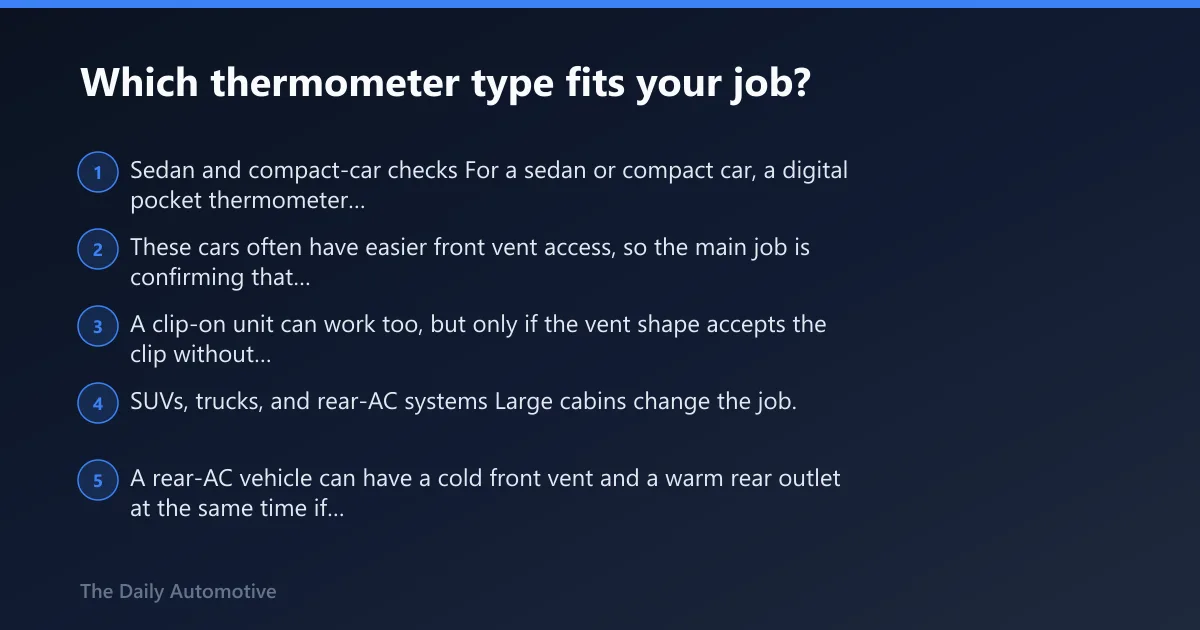
For a sedan or compact car, a digital pocket thermometer with a short, readable probe is usually enough. These cars often have easier front vent access, so the main job is confirming that center outlet temperature falls in line with the system state.
A clip-on unit can work too, but only if the vent shape accepts the clip without blocking louvers or forcing the display into a bad angle.
SUVs, trucks, and rear-AC systems
Large cabins change the job. A rear-AC vehicle can have a cold front vent and a warm rear outlet at the same time if airflow balance is poor, the rear blend door is off, or the rear circuit is weak.
In those vehicles, a longer probe or a dual-probe setup is more useful than a simple pocket unit because you need to compare locations, not just read one number.
Dual-zone systems and side-by-side vent testing
Dual-zone systems need comparison, not just measurement. A matched pair of clip-on thermometers or a twin-probe setup lets you check whether the left and right vents are actually different or whether the dash layout is fooling you.
That matters because a small spread can be normal, while a larger gap may point to a blend-door issue, an airflow imbalance, or a control problem.
How to read vent temperatures without fooling yourself
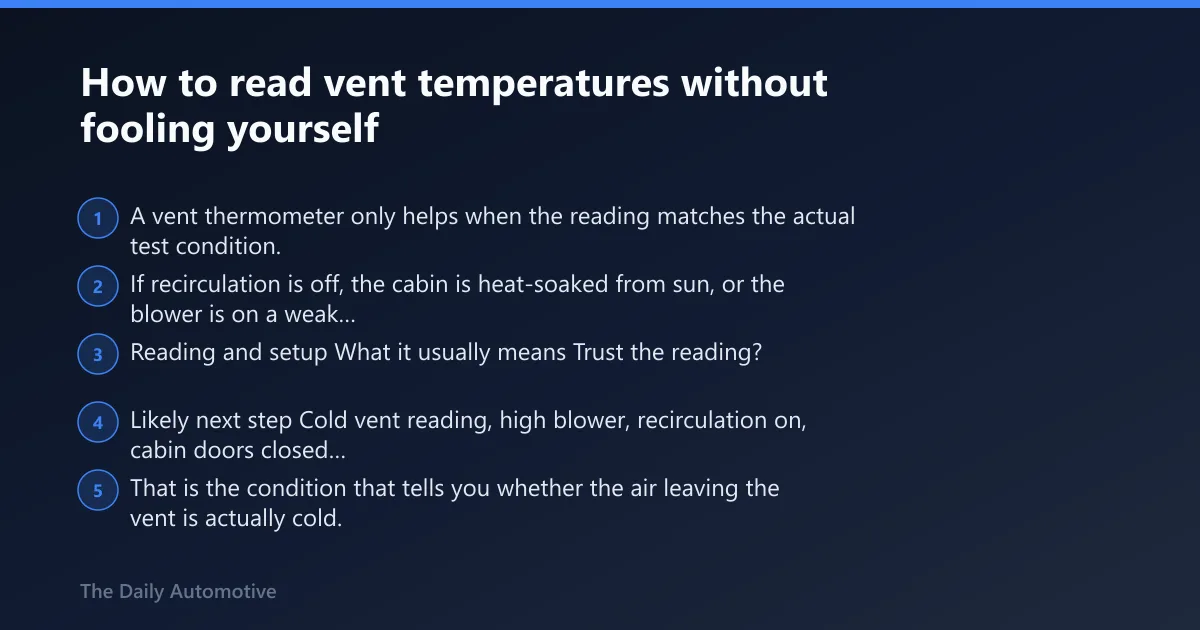
A vent thermometer only helps when the reading matches the actual test condition. If recirculation is off, the cabin is heat-soaked from sun, or the blower is on a weak setting, the number may be real and still be the wrong clue.
| Reading and setup | What it usually means | Trust the reading? | Likely next step |
|---|---|---|---|
| Cold vent reading, high blower, recirculation on, cabin doors closed | Best case for judging AC outlet performance | Usually yes | Compare center vents, then compare with passenger side and rear outlets |
| Warmer-than-expected reading, recirculation off, hot cabin after sun load | Fresh hot outside air and cabin heat are inflating the number | Partly | Switch to recirculation, cool the cabin, retest after several minutes |
| Good vent number, but weak airflow at the louvers | Temperature alone looks fine while volume is low | No | Check blower speed, cabin filter, and duct restrictions |
| Left vent cold, right vent warm, dual-zone set the same | Possible blend-door fault or control issue | Usually yes | Compare actuator behavior and consider scan data |
| Front vents cold, rear vents warm in a rear-AC vehicle | Rear circuit may be weak, restricted, or poorly commanded | Maybe | Check rear blower, rear blend door, and duct path |
When the reading is trustworthy
The number is most believable when the cabin is stabilized, the blower is on a known setting, the system is set to recirculation, and the probe is sitting in real outlet airflow instead of touching a plastic wall.
That is the condition that tells you whether the air leaving the vent is actually cold.
When the reading is misleading
Solar load can make a good AC system look weak. So can a low blower setting, because less airflow can produce a colder-looking number that does not represent real cooling capacity.
Probe placement matters too. A sensor tucked against one side of the vent can read the trim temperature rather than the moving air stream.
When to stop and use gauges or an OBD2 HVAC scan
If the vent temperature seems wrong and the airflow, compressor behavior, or zone control do not match the result, stop treating the thermometer as the whole diagnosis. That is when manifold gauges or an OBD2 HVAC scan becomes the better next step.
A thermometer tells you what leaves the vent. Gauges and scan data tell you whether the refrigerant circuit, compressor command, pressure switch logic, or blend-door control is the real issue.
What temperature should your car AC vent blow?
There is no single magic number that fits every car, because cabin load, humidity, idle traffic, recirculation state, and blower speed all change the result. A vent can be acceptably cold and still read higher in a heat-soaked SUV than in a shaded compact car.
What matters is consistency under the same test setup, not a number copied from someone else’s driveway.
Normal vent temp ranges by test condition
Use the same conditions each time: hot cabin, engine warmed, AC on max, recirculation on, windows closed, and blower on a known setting. That gives you a repeatable baseline for comparisons.
If the system cools better at highway speed than at idle, that is a useful clue. If it cools differently from left to right, that is a separate clue.
Why a single number can mislead in heat, humidity, or idle traffic
Humidity and sunlight can both distort vent readings. A car sitting in full sun may need more time before the thermometer stabilizes, while idle traffic can make a marginal system look worse than it is at speed.
That is why the number has to be tied to the test condition, not treated as a stand-alone verdict.
Which one should you buy?
If budget matters most, the Tallew 2-piece clip-on set is the smartest low-cost route for comparing vents. It is especially useful when you want two matching readings and do not need a feature-heavy tool.
If the goal is the most accurate home check, the Klein Tools IR07 is the strongest overall choice here because it supports both vent-air probing and fast comparison reads. That flexibility matters more than a flashy display when the diagnosis is uncertain.
For dual-zone or rear-AC vehicles, choose the tool that lets you compare locations cleanly. Two matched clip-on thermometers, or a probe setup that reaches both outlets, is usually more useful than a single general-purpose IR gun.
If you are going to pay more, pay for calibration confidence, better readability, and a probe or clip that fits your vents without blocking them. A tool that is easy to trust is worth more than one that only looks precise.
How do I use a vent thermometer to test my car AC?
Set the AC to max cool, close the windows, switch to recirculation, and let the system stabilize before taking a reading. Place the probe or clip in the vent airflow, not against the vent wall, then compare the number with other vents and with the same car under the same conditions later.
Basic test sequence
- Start the engine and run the AC on max cool.
- Set recirculation on and close the windows.
- Use a known blower setting, then wait for the cabin to stabilize.
- Insert or clip the thermometer into the vent airflow.
- Check the reading, then compare driver, passenger, and rear vents if available.
How accurate do car vent thermometers need to be?
For DIY AC diagnosis, the thermometer needs to be consistent enough to spot differences between vents and between test runs. Absolute lab-grade precision is less important than repeatability, because the real question is whether the system changed, not whether the display looks scientific.
That said, poor accuracy can send you in the wrong direction, especially when you are checking blend-door behavior or deciding whether to continue toward gauges and scan data.
Will any pocket thermometer work for car HVAC testing?
No. A pocket thermometer only helps if its range covers automotive HVAC conditions, its probe can reach the airflow you need, and the display can be read in the cabin. A kitchen-style unit may work on paper and still fail in a dashboard vent.
Look for a digital readout, Fahrenheit and Celsius switching, and enough probe length to reach deeper vents or under-dash outlets.
Can I compare temperatures between two car vents?
Yes, and that comparison is often more useful than a single absolute number. Two vents with the same setting should usually track closely unless the system uses separate zone control, long duct runs, or a fault in the blend or distribution path.
Use matching thermometers or the same probe placement method on both sides so the comparison is fair.
What thermometer range is best for automotive AC diagnostics?
A range that covers cold vent output and warm cabin conditions is the right starting point. The guide says 0°F to 220°F is common for HVAC checks, and that span is enough for many DIY tests. Wider ranges help when you also want the same tool for engine-bay or general shop temperature checks.
The important point is not having the biggest number on the box. It is having a range that cleanly covers the temperatures you actually meet during AC diagnostics.
Frequently asked questions
What is the best digital thermometer for car AC vent testing?
The best all-around choice here is the Klein Tools IR07 because it combines a probe for direct vent-air checking with infrared for quick comparison work. That makes it more flexible than a simple pocket thermometer when the diagnosis is not obvious and you need more than one kind of reading.
Do I need a digital or analog thermometer for car AC vents?
Digital models are easier to read in dim cabins, and they usually give a clearer display for quick comparisons. Analog clip-on models can still be useful for side-by-side vent checks, especially when you want a simple visual comparison rather than a feature-heavy diagnostic tool.
Products related to this article
Sponsored / affiliate links. As an Amazon Associate I earn from qualifying purchases. I may earn additional commission from eligible campaigns.