Total Climate Control Solutions Review
Total Climate Control is worth a quote only if the proposal spells out the equipment model, SEER or AFUE, labor, permits, warranty terms, and post-install commissioning in writing. That paperwork matters more than loose praise, because incomplete HVAC quotes can hide extra charges, sizing mistakes, and weak recourse after the job.
The company says it works in residential and commercial spaces, and one review page says its coverage includes installation experience and service quality. That context helps, but it is not enough on its own. You still need to see how the company sizes the system, what it documents after installation, and what happens if something fails later.
Verdict on total climate control
Pros and cons
Pros
- It covers residential and small commercial work, which matters if you need a replacement, repair, or maintenance visit in one place.
- One review page points buyers toward SEER-rated equipment, which is the right kind of efficiency detail to see in a quote.
- Maintenance plans may include seasonal inspections and filter replacements.
- A Manual J load calculation before installation, which is the right sizing standard to ask about.
Cons
- Customer feedback alone cannot tell you whether the installer sized the system correctly or documented commissioning properly.
- If a quote leaves out labor lines, permit handling, or exclusions, the lowest bid can be the most expensive one later.
- Without written warranty terms, you may not know whether parts, labor, or transferability are covered.
- Bad ductwork or poor airflow setup can undermine a good equipment choice, and many bids bury that work inside a single total price.
Who it’s for
This is a better fit for homeowners replacing aging HVAC equipment, buyers comparing multiple bids, and small business owners who want a written paper trail before approving a project. It is a weaker fit for anyone who wants a quick yes/no verdict from reviews alone, because HVAC value depends on proposal quality as much as reputation.
Say your 3-ton system has hot-and-cold rooms after a previous swap. A careful proposal should show how the contractor will size the new equipment, inspect ductwork, and verify airflow after install instead of just repeating the old tonnage.
Suppose you are upgrading a heat pump and the quote mentions a smart thermostat. That can be a real value add if it includes remote control, app integration, and energy-use optimization, but only if the thermostat is matched to the system and not used to mask poor setup.
Climate control quote audit
Use the proposal itself as the filter. A strong bid should identify the equipment, show how sizing was determined, list the setup steps after installation, and spell out what the warranty and maintenance terms actually cover. If those items are implied instead of written, ask for a revised quote before you sign.
| Line item | What should be included | Red flags | Follow-up question |
|---|---|---|---|
| Equipment model | Brand, model number, and whether the quote covers the indoor and outdoor units or the furnace and coil together | “Equivalent model,” “builder grade,” or no model number at all | Which exact model numbers are included, and are there substitutions if inventory changes? |
| SEER or AFUE | Written efficiency ratings for the proposed equipment, stated next to the model | Only a marketing claim like “high efficiency” with no rating | What SEER rating is listed for cooling, and what AFUE rating is listed for the furnace if included? |
| Manual J sizing proof | A load calculation or written sizing basis tied to the home or building, not just the old system size | Same tonnage copied from the previous unit with no calculation | Can you provide the Manual J summary or sizing worksheet used for this recommendation? |
| Commissioning steps | A commissioning checklist with airflow, refrigerant setup, controls verification, thermostat setup, and operating checks written out | “System tested” with no details | Will commissioning be documented in writing, and what does the checklist cover? |
| Ductwork work | Inspection notes, sealing, repairs, balancing, or replacement scope if duct issues are found | Duct problems mentioned verbally but not priced or described | What ductwork will be inspected, and what repair work is included if leakage or airflow problems are found? |
| Warranty terms | Parts and labor coverage, duration, transferability, registration requirements, and exclusions tied to maintenance | Only a vague “manufacturer warranty” note | What is covered, for how long, and does improper maintenance void any coverage? |
| Maintenance plan | Seasonal inspections, filter replacement terms, priority scheduling, and discounted service rates if offered | A plan name with no list of services | What exactly is included in the maintenance plan, and how often are visits scheduled? |
| Permits | Who pulls them, who pays for them, and whether permit costs are included | “Permits if needed” with no owner named | Will you handle the permit process, and is that fee included in the quoted total? |
| Labor | Line-item labor for install, startup, electrical or gas hookup if applicable, and any return visit terms | Labor wrapped into a single total with no scope | What labor is included, and what counts as extra work? |
| Exclusions | Items the quote does not cover, such as duct modifications, drywall repair, code upgrades, or electrical work | No exclusions section | What is excluded from the price, and what could change the final total? |
What services does Total Climate Control offer?
The available information points to installation, repair, and maintenance for residential and commercial spaces. That is the service mix you would expect from an HVAC contractor, but the important question is how the company scopes each job in writing, especially when ductwork, controls, or permit work is involved.
Look for add-ons that change both comfort and cost. A smart thermostat can improve remote control and app integration, while also helping with energy-use optimization. Ductwork-related items matter too, because a clean equipment swap can still underperform if the ducts leak, restrict airflow, or need balancing.
What should a good quote include?
A good quote should show how the contractor got from the home’s load to the equipment recommendation, not just the final price. For cooling, check the SEER rating in the proposal. For heating, check the AFUE rating if a furnace is part of the job. If either rating is missing, ask for the written model details before you compare bids.
One review page specifically recommends a Manual J load calculation before installation. That matters because proper sizing affects comfort, runtime, humidity control, and efficiency. A quote that matches the old system size without any calculation is a warning sign, especially in older homes or in small commercial spaces with uneven occupancy.
Commissioning should also appear in writing. The checklist should document airflow, performance, and setup steps after the system is installed. If the proposal says only that the unit will be “checked,” press for a more specific list of what will be verified and who signs off on it.
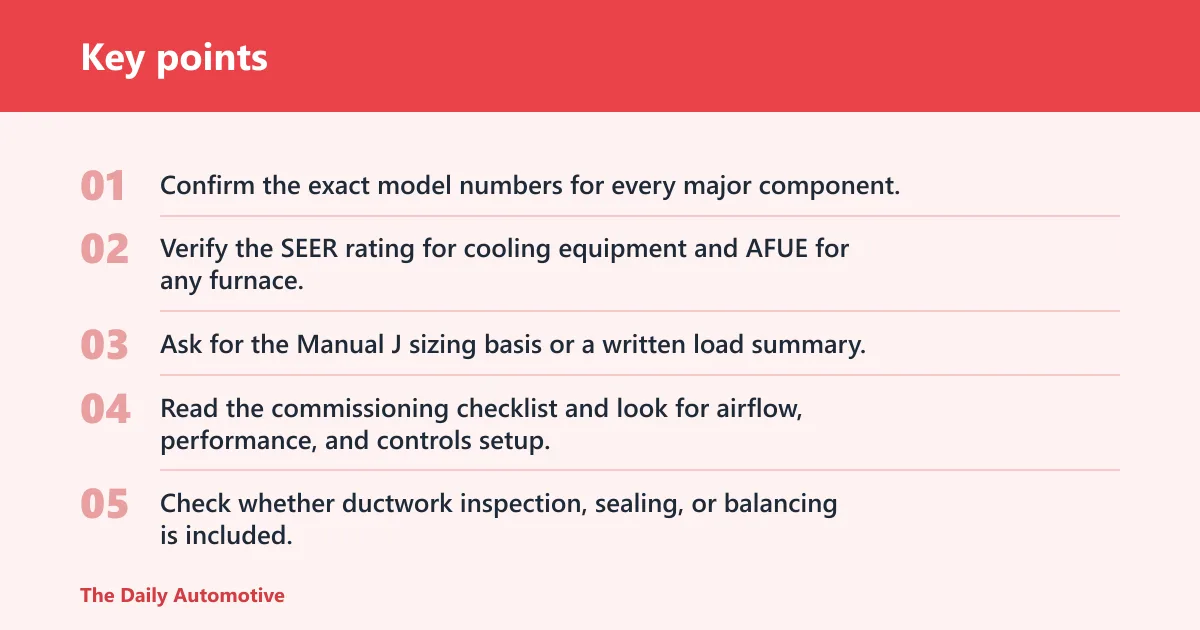
- Confirm the exact model numbers for every major component.
- Verify the SEER rating for cooling equipment and AFUE for any furnace.
- Ask for the Manual J sizing basis or a written load summary.
- Read the commissioning checklist and look for airflow, performance, and controls setup.
- Check whether ductwork inspection, sealing, or balancing is included.
- Review warranty terms, maintenance coverage, permit handling, labor, and exclusions.
How do you judge value and aftercare?
Value is not the lowest number on the bottom line. A better measure is how much risk the quote removes. Clear labor terms, documented commissioning, and a solid warranty usually matter more than shaving a small amount off the upfront price, because they tell you what happens after the crew leaves.
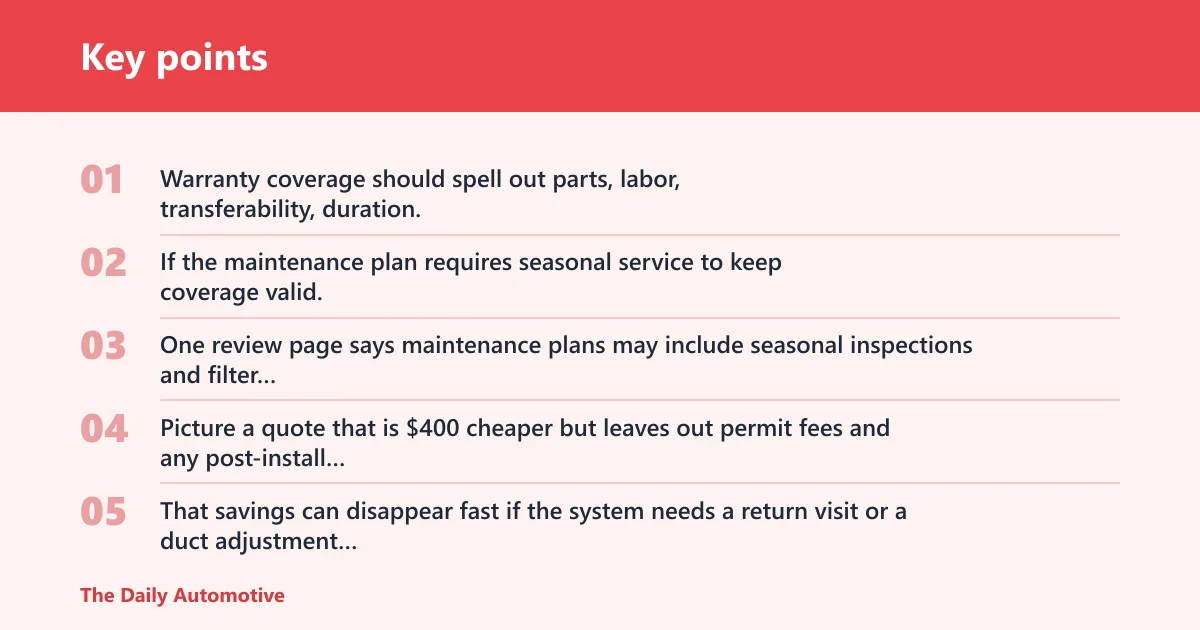
Warranty coverage should spell out parts, labor, transferability, duration, and exclusions for improper maintenance. If the maintenance plan requires seasonal service to keep coverage valid, that should be written down too. Maintenance plans may include seasonal inspections and filter replacements, which is useful only if the frequency and service limits are clear.
Picture a quote that is $400 cheaper but leaves out permit fees and any post-install airflow corrections. That savings can disappear fast if the system needs a return visit or a duct adjustment to perform correctly. The better bid is the one that names the work instead of hiding it.
Customer feedback and performance in 2026 should be considered alongside installation experience and service quality. That is a fair reminder, but the paperwork still matters more than the wording of reviews. A strong aftercare package should be visible in the contract, not assumed from reputation.
How much does Total Climate Control cost?
Pricing varies by equipment, ductwork condition, permit requirements, and whether the job is a straight replacement or a more complicated retrofit. Without an itemized quote, you cannot tell whether a low number excludes labor, start-up work, or corrections that become necessary after installation.
If you are comparing bids, ask each contractor to separate equipment, labor, permits, duct modifications, thermostat work, and exclusions. That makes the totals comparable. It also shows whether one quote is truly cheaper or simply less complete.
How do you compare Total Climate Control quotes with other HVAC companies?
Compare the same line items in every bid: model numbers, efficiency ratings, sizing proof, commissioning, ductwork, warranties, maintenance terms, permits, labor, and exclusions. If one contractor writes those items out and another hides them in a lump sum, the more detailed quote is usually the better basis for a decision.
For installation quality, pay more attention to documentation than to broad praise. One review page covers installation experience and service quality, which is helpful, but it does not replace proof that the system was sized properly and commissioned correctly. A contractor can have good customer feedback and still give you a thin proposal.
What separates equipment quality from installer quality? The equipment spec tells you what is being installed. The proposal and aftercare tell you whether it will be installed correctly and supported later. That distinction matters for homeowners, and it matters even more in small commercial buildings where downtime is expensive.
Frequently asked questions
Is Total Climate Control legit and worth hiring?
It is worth hiring if the company gives you a written proposal with model numbers, efficiency ratings, labor scope, permit handling, and warranty terms. That is the practical test. Reviews can help you screen for service quality, but they do not replace a clear bid or prove the installation will be done correctly.
What do Total Climate Control reviews say about installation quality?
Its analysis covers installation experience and service quality. That suggests installation quality is part of the conversation, but it is not enough to judge a specific job. For that, the quote should include Manual J sizing, ductwork notes, and a commissioning checklist after the install.
Does Total Climate Control offer maintenance plans or warranties?
Maintenance plans may include seasonal inspections and filter replacements. Warranty coverage should still be checked line by line for parts, labor, duration, transferability, and exclusions tied to maintenance. If those terms are missing, ask for them before you approve the work.
How energy efficient are Total Climate Control systems?
Efficiency depends on the exact model quoted, not on the company name. SEER-rated equipment, and buyers should ask about SEER and AFUE in writing. Higher SEER numbers generally indicate better cooling efficiency, while AFUE helps compare heating efficiency and long-term operating cost.
What should I ask before hiring Total Climate Control?
Ask for the exact equipment model, SEER or AFUE rating, Manual J sizing proof, commissioning steps, ductwork scope, permit handling, labor terms, warranty details, and exclusions. Also ask whether a smart thermostat is included and what the maintenance plan covers if one is offered.
Products related to this article
Sponsored / affiliate links. As an Amazon Associate I earn from qualifying purchases. I may earn additional commission from eligible campaigns.