3 Best Car AC Leak Detectors for Home Use (2026): we compared
For most home DIY car AC checks, I reach for a UV dye kit for slow leaks, an electronic sniffer for reachable small leaks, and a vacuum or nitrogen test when the system is empty or the leak keeps hiding. Guess wrong, and you burn refrigerant, then pay for the same fault twice. This guide matches detector type to leak size, refrigerant, and access point, then compares the best tools for home use.
This guide is part of our Car cooling and climate control guide series.
Quick comparison
| Product | Badge | Best for | Price | ||
|---|---|---|---|---|---|
 |
Leak Detector Kit, Fluorescent Protective Glasses AirTookie | Budget pick | 3-in-1 UV fluorescent kit with glasses | $12.99
Price as of 26 Sep 2026
|
View |
 |
365nm Black Light UV Flashlight Rechargeable with FilterGoreit | Also great | 365nm UV flashlight with filter lens | $32.99
Price as of 26 Sep 2026
|
View |
 |
Elitech Freon Leak Detector Halogen Refrigerant Gas LeakElitech | Our pick | Elitech WJL-6000S halogen gas sniffer | $23.99
Price as of 26 Sep 2026
|
View |
 |
Aprvtio ALD-200 Refrigerant Leak DetectorAprvtio | Upgrade pick | Aprvtio ALD-200 professional heat sensor | $109.99
Price as of 26 Sep 2026
|
View |
For home use, the best tool depends on the symptom, not the sticker price. A sniffer is strongest on tiny accessible leaks, UV dye is strongest when the leak leaves residue, and vacuum or nitrogen is the better confirmation step when the system is empty or the result needs proof.
How we chose
The main filter was leak size and access. A tool that can sniff a Schrader valve in a driveway is useful; a tool that only works on a bench is not.
Refrigerant compatibility mattered next. R-134a and R-1234yf use different service fittings, and detectors may not react the same way to both refrigerants.
We also weighed setup time, warm-up behavior, probe reach, hose length, battery needs, and the risk of false confidence from oil, cleaner residue, wind, or an undercharged system.
Finally, value was judged by what a home owner actually needs to buy. A cheap tool that cannot confirm a leak costs more than a mid-priced kit that gets the diagnosis right the first time.
Electronic refrigerant leak detector: best for tiny leaks
An electronic refrigerant leak detector is the best all-around first buy for most DIYers because it can find small leaks without opening the system. The Elitech WJL-6000S is aimed at accessible leaks in R-134a and R-1234yf-type work, with a long flexible probe that helps at hoses, service ports, compressor seals, and evaporator drain areas.
Based on the spec sheet and owner feedback, the strengths are the 7 adjustable sensitivity levels, the reported detection floor around 0.21 oz./yr, and the 7.9-inch probe for tight spots. That matters when the leak is too small to leave obvious dye, or when the system still has enough charge that a pressure test is inconclusive.
The drawback is the usual one for sniffers: they can false-trigger on contamination, refrigerant residue, or air movement, and they need careful warm-up and a slow probe sweep. If the probe is rushed across a fitting, the meter can miss a small leak or sound off near a clean part that has old residue on it.
When a sniffer earns its keep
Use a sniffer when the leak is tiny, the system still has some refrigerant, and the suspected point is reachable. It is strongest on fittings, Schrader valves, condenser edges, hose crimps, and compressor shaft seals.
It is weaker on hidden evaporator leaks unless the detector can sample from the drain tube or cabin vents. It also struggles if someone has sprayed cleaner around the suspect area and left residue behind.
UV dye kit: best for visible leaks and repeat checks
A UV dye kit is the easiest choice when the leak leaves oil or dye where you can inspect it later. The Tookie kit is the simplest option here, with fluorescent oil, a light, and protective glasses in one package, which makes it practical for quick checks around hose joints and fittings.
UV dye works best when the system still circulates refrigerant and oil, because the dye rides with the oil to the leak point. On older R-134a systems, that often means compressor seals, condenser seams, service ports, and hose crimps will show a trace that a flashlight can pick up.
The drawback is delay and ambiguity. Dye can take time to appear, and old residue can look like a fresh leak if the area was not cleaned first. Single-use dye is simpler for a one-time diagnosis, while refillable dye makes more sense when multiple checks are likely.
Why wavelength matters
In practice, a UV flashlight around 365 nm is often preferable to a basic 395 nm light because it can make tracer dye stand out with less visible purple spill. Protective glasses help, especially in low light under the car or behind the radiator support.
A beam with decent throw helps at condenser corners and underbody fittings. A filter lens is useful because it cuts glare and makes the fluorescent trace easier to separate from ordinary oil sheen.
Vacuum pump and gauge set: best for confirmation testing
A vacuum pump and manifold gauge set do not find every leak by themselves, but they are the best confirmation tools when the system has been repaired or is empty. A vacuum pump with a real ultimate vacuum rating and enough CFM can pull the system down before a hold test, while a manifold set shows high-side and low-side behavior during service.
The drawback is false confidence. A system can hold vacuum and still leak under positive pressure, so a vacuum check is a screen, not a final verdict. Gauge sets also need the right hose lengths, the correct R-134a or R-1234yf quick-connect fittings, and enough familiarity to read pressures without guessing.
What the gauges actually tell you
Low-side and high-side readings help confirm charge condition, compressor response, and whether a system is behaving like a leak-prone empty system or a restricted one. A short hose set can be awkward in a driveway; longer hoses and the right port fittings reduce accidental venting and make connections less stressful.
For home use, the best setup is one that matches the refrigerant service port standard on the vehicle. R-134a and R-1234yf are not just different labels; they use different fittings, and buying the wrong manifold ends the job before it starts.
How do you find a car AC leak at home?
Start with a visual check, then choose the detector based on symptom and access. Look for oil at fittings, a wet compressor nose, cracked hoses, or fluorescent residue; then use a sniffer for tiny accessible leaks, dye for slow visible leaks, and pressure or vacuum confirmation when the system has been opened or recharged.
The common mistake is skipping straight to a recharge. That can hide the leak for a short time and leave the actual failure point untouched. A better sequence is inspection, detection, confirmation, then repair.
Step-by-step home sequence
- Inspect the compressor, condenser corners, hose crimps, service ports, and any oily dirt buildup.
- Check the refrigerant type on the vehicle label or service port before choosing tools.
- Use a sniffer on accessible joints with the cabin off, doors open, and airflow minimized.
- If dye is already in the system, inspect with a UV light in a dim space and look for fresh fluorescent traces.
- After repair, use a vacuum hold test or nitrogen test to confirm the system is tight before charging.
Fail-safe checks matter. Oil residue can fake a leak, wind can dilute a sniffer reading, and old dye can stain a part long after the leak is gone. Clean the area if needed, then retest the same spot from the same angle.
Nitrogen test kit: best for static leak checks
A nitrogen test kit is the cleanest way to check a static leak when the system is empty or has already been recovered. Dry nitrogen is safe for the system, and with a regulated pressure source, a gauge, and the correct adapter fittings, it can reveal leaks that a vacuum test may miss.
Its advantage is pressure testing without refrigerant loss. The drawback is setup: the gauge range must be appropriate, the regulator must be controlled, and the adapter must match the vehicle ports. Too much pressure is not the goal; a sensible regulated test is.
When nitrogen beats vacuum
Nitrogen is better when you want to pressurize the system and listen or sniff for a leak at fittings, evaporator connections, or a condenser seam. It is also useful after a repair because it gives a static check before the first refrigerant charge goes in.
Vacuum can show a gross leak, but it does not always duplicate operating conditions. Nitrogen is the more direct test when the system is empty and the goal is to find a leak rather than simply confirm that the pump pulled a vacuum.
Are UV dye leak detectors safe for car AC systems?
UV dye leak detectors are generally safe when the dye is made for automotive AC use and the amount added matches the system guidance. The important part is compatibility: use dye intended for the refrigerant and oil in the vehicle, then inspect with the right light and glasses instead of flooding the system with extra dye.
The risk is not the flashlight; it is misuse. Too much dye can complicate future service, and residue from old leaks can be mistaken for a fresh fault. A small, compatible dose used once is far better than repeated over-treatment.
Reading residue correctly
Fresh leak points tend to look wet and concentrated at a seam, valve core, or crimp. Old residue usually spreads wider, collects dust, and looks dull rather than bright. Clean the area before a second check if the first pass is unclear.
Can I use a refrigerant leak detector on R-134a and R-1234yf?
Yes, but only if the detector is rated for the refrigerant you are actually working on. R-134a is common on older vehicles, while R-1234yf is used on many newer ones, and the service fittings are different enough that buying the wrong tool or adapter is a common DIY mistake.
Some electronic sniffers respond to halogen refrigerants in general, but the sensitivity and practical use can vary. Check the label and the service port before buying, because detector compatibility is only half the job; the manifold, hoses, and couplers also need to match.
Legacy versus modern systems
R-134a systems are widespread on older cars and are usually easier for DIY work because parts and fittings are familiar. R-1234yf systems are newer, more sensitive to compatibility mistakes, and often demand more care with service equipment selection.
For home buyers, the biggest pitfall is assuming any AC tool fits any car. It often does not.
What tools do I need to check for a car AC leak?
At minimum, most home checks need a visual-light source, a leak detector matched to the symptom, and safety gear. A practical kit may include a sniffer, a UV dye setup with glasses, a manifold gauge set, and either a vacuum pump or nitrogen kit for confirmation after repair.
If the system is empty, a pressure-based confirmation tool matters more than a refill. If the system still has charge, a sniffer or dye kit is often the first move because it can find the leak without tearing the whole circuit apart.
Tools by job
- Sniffer: best for small accessible leaks at fittings and valves.
- UV dye kit: best for slow leaks that leave an oil trail.
- Manifold gauge set: best for service and pressure checks.
- Vacuum pump: best for pull-down and hold testing after repair.
- Nitrogen kit: best for static pressure testing on an empty system.
- UV flashlight: best for finding dye in dim light, especially with a filter lens.
How accurate are electronic refrigerant leak detectors?
Electronic refrigerant leak detectors can be very useful, but accuracy depends on warm-up, calibration, probe movement, air movement, and contamination around the leak point. They are excellent at finding small leaks when used slowly and close to the suspect area, and much less reliable when swept quickly or used near residue.
That is why a sniffer should be treated as a detector, not a verdict. If it alarms at a joint, clean and retest the spot, then confirm with dye or pressure testing before declaring the repair finished.
Common false-positive causes
Oil film, old cleaner residue, recent refrigerant service, and strong airflow can all trigger a reading that looks more certain than it is. Warm-up time matters too; a detector that is rushed into service may read poorly or drift.
Probe length matters as well. A short probe can miss an evaporator drain leak or a rear-line fitting, while a longer flexible probe reaches into the places where home checks usually need help.
Can a smoke test find an AC leak in a car?
A smoke test can find some leaks in a car AC system if the equipment and adapters are appropriate, but it is not the first tool most home users should buy. It can reveal an open leak path, yet it does not replace refrigerant-specific detection or a pressure confirmation step.
Smoke is useful when the system is accessible and a visible plume can escape at a fitting, hose, or condenser seam. It is less convincing on tiny leaks, and it can be misleading if the setup itself leaks at the adapter or hose connection.
Where smoke helps and where it doesn’t
Smoke can be a good visual aid for gross leaks. It is not the cleanest answer for a tiny seep, and it should not be used as the only proof that a repaired AC circuit is sound under real operating pressure.
How much does a car AC leak detector cost?
Home-use cost varies by tool type. A basic UV dye kit can be inexpensive, a decent electronic sniffer usually costs more, and confirmation tools like a vacuum pump, manifold gauge set, or nitrogen kit raise the total because they require additional parts and adapters.
For most DIYers, the right spend is the amount needed to get one reliable detection method and one confirmation method. A cheap detector with no matching fittings, no glasses, or weak probe reach often costs more in wasted time than a better kit.
What to expect to spend
Budget around the detector you need for the symptom, not for the cheapest box on the shelf. A tiny suspected seep needs a sniffer; a greasy, visible stain may be solved faster with dye; an empty system needs pressure or vacuum confirmation.
Safety gear and correct adapters are not optional extras. They are part of the real cost of doing the job correctly at home.
Which one should you buy?
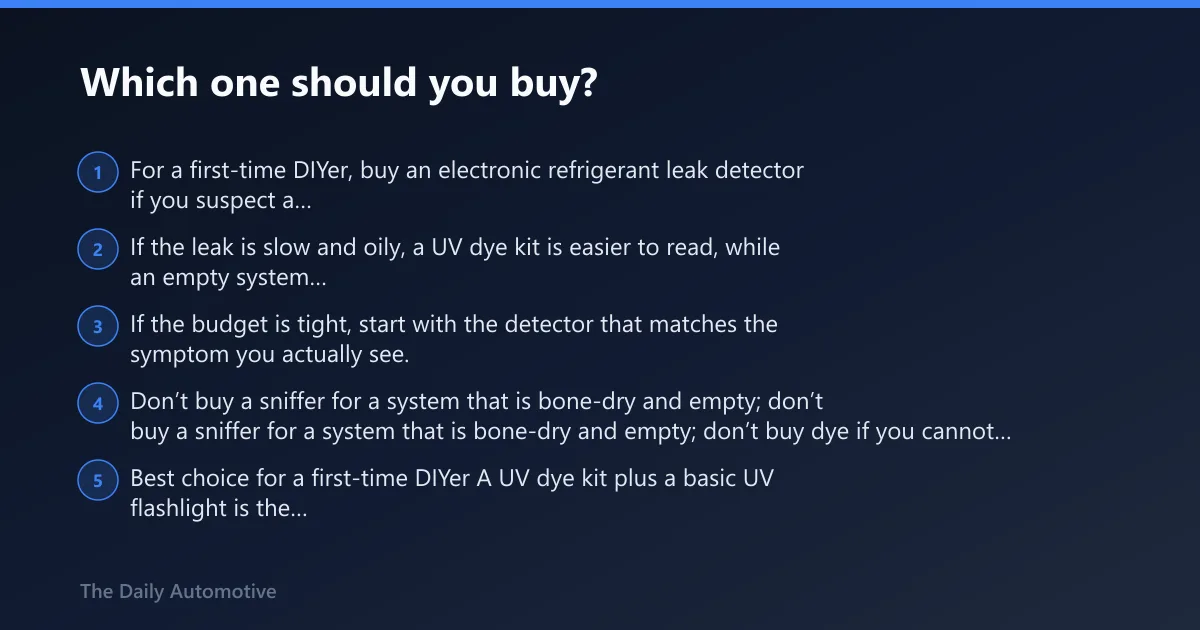
For a first-time DIYer, buy an electronic refrigerant leak detector if you suspect a small accessible leak and want one tool that can work before teardown. If the leak is slow and oily, a UV dye kit is easier to read, while an empty system points you toward a vacuum pump or nitrogen kit for confirmation.
If the budget is tight, start with the detector that matches the symptom you actually see. Don’t buy a sniffer for a system that is bone-dry and empty; don’t buy dye if you cannot wait for circulation; don’t buy a gauge set and assume it will identify the leak on its own.
Best choice for a first-time DIYer
A UV dye kit plus a basic UV flashlight is the easiest starting point for many beginners, especially on cars that already show oily residue or have a history of slow loss. It is simple to inspect and easy to repeat after a repair.
Best choice if the leak is tiny
An electronic refrigerant leak detector is the better first buy when the leak is hard to see, the system still has charge, and the suspected point is a fitting, valve, or hose crimp. Choose one with a flexible probe and a real warm-up routine.
Best choice if the system is empty
A nitrogen test kit or a vacuum pump is the smarter buy when nothing is left in the system. Those tools help confirm the repair before recharge, which is the point where many home jobs go wrong.
Best choice on a tighter budget
Start with the simplest UV dye kit that includes glasses and a workable light, then add a sniffer later if the leak remains uncertain. That order gives a visual result first and avoids spending on a more complex tool that may not match the symptom.
Frequently asked questions
What is the best car AC leak detector for home use?
For most home users, an electronic refrigerant leak detector is the best all-around choice because it can find small leaks without opening the system. UV dye is better for slow, visible leaks, while vacuum or nitrogen testing is better when the system is empty or the repair needs confirmation.
Products related to this article
Sponsored / affiliate links. As an Amazon Associate I earn from qualifying purchases. I may earn additional commission from eligible campaigns.
Leak Detector Kit, Fluorescent Protective Glasses Air Conditioning Accurate Leak Detector Kit Tools, Car Accessories Replacement Easy to Use Eco Friendly UV Dye(Random) Elitech Refrigerant Leak Detector, Freon Leak Detector, Freon Sniffer Automotive Halogen Gas Leak Detector for R134A R410A R1234YF R600a R290 CFCs HCFCs HFCs HCs HFOs, ELD-270 with Alarm