How Many Types of Car Services Are There? 3 Main Types
There are usually three common car service types: interim, full, and major, though the manufacturer schedule may take priority when mileage, age, or powertrain needs call for something different. Ignore the right service and you risk avoidable wear, missed warranty coverage, and repairs that cost far more than maintenance. This guide explains what each service includes, how to choose by mileage and vehicle type, and when to follow the factory schedule instead.
How many types of car services are there?
There are often three main service tiers: interim, full, and major. That answer helps, but it is not the whole picture. Some garages use different labels, and the manufacturer service schedule can require earlier or extra work outside those generic tiers.
Dictionary.com defines many as “a large or considerable number of persons or things,” and also as a determiner meaning “a large number of.” Wikipedia describes many as “an English quantifier used with count nouns” and says it is “grammatically plural in number.” In plain terms, car service types are not endless, but they are not one-size-fits-all either.
Why garages may label them differently
An automobile repair shop may sell a “basic,” “interim,” or “minor” service that sounds similar but does not match another shop’s package line by line. The label matters less than the checklist. Compare the included checks, the fluids covered, and the wear items replaced.
A generic package can also miss model-specific work. A turbo petrol engine, a diesel with a particulate filter, a hybrid with regenerative braking, and a battery electric vehicle do not share the same maintenance needs.
Where manufacturer schedules fit in
The manufacturer service schedule is the OEM-specified list of intervals and tasks for your exact make, model, engine, and mileage. It can differ from garage tiers and may call for items sooner than a full service would suggest. If the schedule says replace a part or fluid, that instruction wins.
What are the main types of car service?
The main types are interim, full, and major. Interim service is the lightest routine option, full service is broader, and major service is the most comprehensive routine package. Which one fits depends on annual mileage, vehicle age, powertrain, and whether the car is still within warranty.
Interim service
An interim service is a basic inspection and top-up package with a shorter mileage or time interval than a full service. It suits higher-mileage drivers because oil, filters, and general wear need attention sooner when the car is used more often.
Full service
A full service adds more checks and replacements than an interim service. It is often booked about once a year or around 12,000 miles, though the exact interval can vary. It usually includes broader checks and may cover wear items and safety items that are not always part of an interim visit.
Major service
A major service is the most comprehensive routine service. It normally includes more consumables and deeper inspection points than a full service. On many schedules, it arrives at a longer interval than a full service and becomes more important as the car ages and accumulates mileage.
What is included in an interim service?
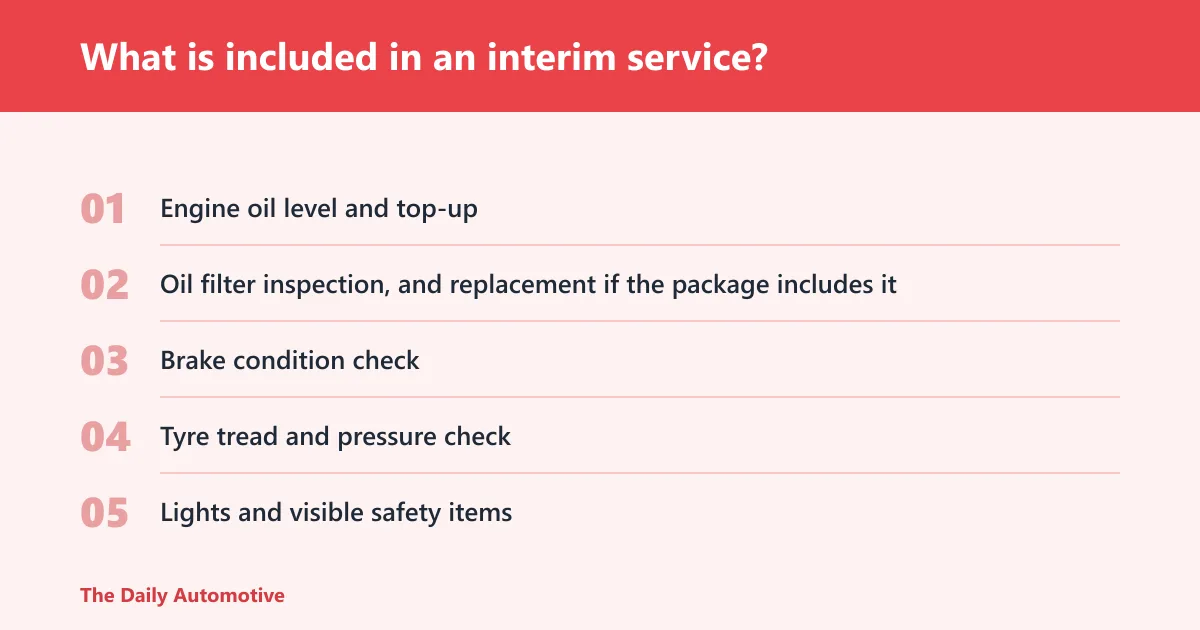
An interim service typically covers basic inspection points and fluid top-up checks. Think of it as the lighter maintenance tier for cars that clock up miles quickly or spend a lot of time in stop-start use. It is not a full maintenance reset, but it helps catch obvious wear early.
Typical checks in an interim service
- Engine oil level and top-up
- Oil filter inspection, and replacement if the package includes it
- Brake condition check
- Tyre tread and pressure check
- Lights and visible safety items
- Fluid level checks for items such as coolant and screen wash
Why it suits high-mileage drivers
Higher-mileage drivers put more load on oil, tyres, brakes, and filters in less time. A common first-timer mistake is waiting for an annual date even after 6,000 miles of hard use. In that case, the car may need attention sooner than a calendar-only plan suggests.
Picture a 2.0-litre diesel used for a 50-mile motorway commute each weekday. The mileage climbs quickly, so an interim service can be the sensible middle step between full services, especially if the manufacturer allows it.
What is included in a full car service?
A full car service includes more checks than an interim service and is often scheduled every 12 months or about 12,000 miles. It usually covers the core wear items and safety checks that keep a vehicle dependable, while still stopping short of the deepest major-service work.
Common items checked or replaced
- Oil and oil filter
- Air filter
- Cabin filter
- Brake condition and brake fluid check
- Spark plugs, where the schedule calls for them
- Belts, hoses, suspension components, and steering joints
- Tyres, lights, wipers, and levels
Wear items and why they matter
Wear items such as the oil filter, air filter, spark plugs, brake fluid, and cabin filter age at different rates. The replacement cadence depends on the service level and the model schedule. Missing them can affect reliability, emissions, cabin air quality, and in some cases starting or braking performance.
Suppose a small petrol hatchback reaches 12,000 miles in a year and the service book also calls for new spark plugs at that mileage. A full service should include that work if the schedule requires it, even if the garage’s standard checklist would not.
What is included in a major service?
A major service is the most comprehensive routine service tier. It usually includes everything in a full service, plus more consumables and more detailed inspection points. The exact package varies, but the aim is to reset a larger share of routine wear items at once.
Why service depth rises with age and mileage
As cars age and accumulate miles, fluids degrade, rubber hardens, and more components approach replacement intervals. A major service addresses that wider pattern of wear. Older cars, higher-mileage cars, and vehicles used in severe conditions are more likely to need it sooner.
Typical major-service additions
- Additional filter changes, depending on the vehicle
- Brake fluid replacement if due
- More detailed underbody and suspension checks
- Replacement of scheduled consumables the full service does not cover
- Model-specific tasks from the manufacturer schedule
Use this table to pick the right service
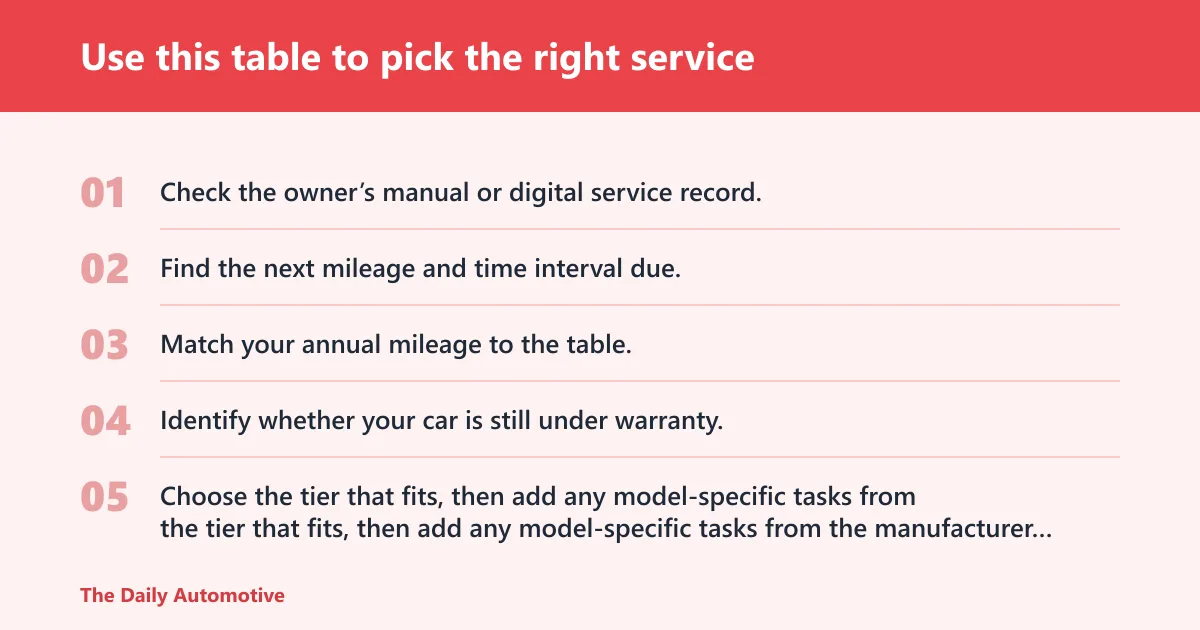
Start with mileage, then check age, powertrain, and warranty status. The table below is a practical rule of thumb, not a substitute for the owner’s manual. If the manufacturer schedule asks for earlier work, follow that instead of a generic garage package.
| Annual mileage | Vehicle age / warranty | Powertrain | Best starting tier | Watch-outs |
|---|---|---|---|---|
| Under 6,000 miles | Newer car, especially under warranty | Petrol, diesel, hybrid, or EV | Time-based full service or manufacturer schedule | Low mileage does not stop fluid ageing; check 6-month or 12-month intervals in the handbook. |
| 6,000 to 12,000 miles | Any age | Petrol or hybrid | Interim if use is heavy; full if the annual date is due | High city use may justify earlier brake and oil checks. |
| 12,000 to 24,000 miles | Older or out of warranty | Diesel or high-mileage petrol | Full, with major due at longer manufacturer intervals | Diesel engines may need extra attention to filters and emissions hardware. |
| Over 24,000 miles | Any age, severe use | Any powertrain | Interim plus scheduled full or major work as required | Check whether the maker sets shorter intervals for taxis, towing, or constant motorway use. |
| Any mileage | Within warranty | Any powertrain | Manufacturer schedule first, then tiered service if it matches | Warranty terms may require specific parts, fluids, and proof of service records. |
How to use the table
- Check the owner’s manual or digital service record.
- Find the next mileage and time interval due.
- Match your annual mileage to the table.
- Identify whether your car is still under warranty.
- Choose the tier that fits, then add any model-specific tasks from the manufacturer schedule.
How are servicing and the MOT different?
An MOT test is a legal roadworthiness check in the UK. It checks safety and emissions at a point in time. A service is maintenance. A car can pass an MOT and still need oil, filters, brakes, or other scheduled work.
Why a pass does not mean the car is fully maintained
The MOT does not replace routine servicing. It is not designed to refresh fluids, change filters, or reset wear items on the maintenance schedule. A pass only means the car met the legal test on that day.
Why a service does not replace the MOT
A service does not certify roadworthiness for legal use in the same way. The two jobs are different. One is maintenance. The other is compliance testing. You often need both, and one does not cancel the need for the other.
How often should you service a car?
Service timing is usually measured in miles, months, or both. Common mileage thresholds can be around 6,000, 12,000, or 24,000 miles, but the right interval depends on the car and how it is used. Low-mileage vehicles still need time-based servicing because oil, brake fluid, rubber parts, and filters age even when the odometer barely moves.
Mileage intervals
Many manufacturers use mileage intervals for routine servicing. High-mileage drivers often need interim attention between full services, while some cars only need a full service every year if the mileage stays modest.
Time intervals
Service intervals often fall around 6 months or 12 months. That matters for cars used sparingly, because age affects fluids and seals even when mileage remains low. If the handbook sets a calendar limit, do not ignore it just because the car has not travelled far.
When the owner’s manual overrides generic advice
The manufacturer schedule overrides generic garage tiers when it demands a specific fluid, part, or inspection at a certain age or mileage. That matters for turbocharged engines, direct-injection engines, diesels with emissions systems, and newer hybrids or EVs with dedicated maintenance requirements.
What is a manufacturer scheduled service?
A manufacturer scheduled service is the OEM’s own maintenance plan for a specific vehicle. It can differ from generic interim, full, and major packages. The schedule may call for earlier replacement of brake fluid, plugs, filters, or other consumables depending on the make, model, engine, and mileage.
Dealer servicing, independent garages, and the factory schedule
Dealer servicing, independent garage servicing, and manufacturer-specified servicing are not identical. A dealer may be easiest for warranty records and exact parts, while an independent garage may follow the factory schedule with equivalent approved parts. The key is matching the required work, not the sign over the door.
Why this matters for warranty and records
Many warranties depend on proof that the car was maintained on schedule. Keep invoices and service records. If the schedule calls for a specific oil grade, fluid spec, or replacement interval, make sure the paperwork shows it.
How many types of vehicles are there?
There are many ways to group vehicles, but for servicing the useful split is petrol, diesel, hybrid, and EV. Those categories matter because the maintenance plan changes with the powertrain. A battery electric vehicle has no engine oil changes, while a diesel may have emissions-system checks a petrol car does not.
How service needs differ by powertrain
- Petrol: regular oil, filters, plugs where due, and general wear checks.
- Diesel: oil and filters plus attention to emissions hardware and fuel system items.
- Hybrid: engine servicing still matters, but braking and battery-related checks also matter.
- EV: fewer routine fluid changes, but tyres, brakes, coolant loops, and software-related checks can still apply.
Dictionary.com lists many as an adjective meaning “more, most,” and Wikipedia notes that many is used with count nouns. That fits vehicle servicing well: there are many vehicle types, but only a few service tiers that most owners need to compare first.
What is the difference between a minor and major service?
A minor service is usually another name for an interim or light service package. A major service is the deeper package. The difference is scope: minor servicing covers basic checks and limited consumables, while major servicing includes more replacements and a broader inspection list.
Practical way to think about it
If the service is mainly about topping up, checking, and replacing a short list of wear items, it is minor. If it includes a wider set of filters, fluids, and inspections, it is major. Always compare the actual checklist rather than relying on the label alone.
Frequently asked questions
What is included in an interim car service?
An interim service is a lighter package with basic inspection and fluid top-up checks. It often includes oil-level attention, brake and tyre checks, and a look at lights and visible safety items. It suits drivers who cover more miles between annual services and need earlier checks.
How often should a car be serviced?
Service intervals vary by manufacturer, mileage, and time. Common patterns include 6,000 miles for an interim check, 12,000 miles or 12 months for a full service, and longer intervals for major items. Low-mileage cars still need time-based servicing because fluids and rubber age on the calendar.
Are car services different from MOT tests?
Yes. An MOT is a legal roadworthiness test in the UK. A service is scheduled maintenance. A car can pass an MOT and still need oil, filters, brake fluid, or other work. A service also does not replace the legal need for an MOT when the test is due.
Products related to this article
Sponsored / affiliate links. As an Amazon Associate I earn from qualifying purchases. I may earn additional commission from eligible campaigns.