Best GPS Trackers for Cars: Top Hidden Devices for Anti-Theft
For hidden anti-theft use, pick a hardwired GPS tracker for daily drivers, a battery tracker for temporary stealth, and LTE coverage plus geofencing if recovery speed matters; choose one with a low monthly fee only if it still reports every 30–60 seconds. Poor placement or weak signal can leave you paying for a device that cannot help after a theft. This guide compares hidden tracker types by parking environment, concealment, recovery urgency, coverage, and subscription cost.
Quick comparison
| Product | Badge | Best for | Price | ||
|---|---|---|---|---|---|
 |
Spytec GPS Tracker for Vehicles, OBD Plug-in Car, Real-TimeSpy Tec | Our pick | OBD Plug-in · Real-Time · Anti-Theft | $14.95
Price as of 22 Oct 2026
|
View |
 |
JNLIK GPS Tracker for Vehicles,Magnetic Waterproof CarJNLIK | Budget pick | Magnetic Waterproof · Mini Portable · No Fees | $13.99
Price as of 22 Oct 2026
|
View |
The core trade-off is simple: the better hidden the tracker, the easier it is to place without drawing attention, but the more upkeep you usually take on. Plug-in units are easier to power and maintain. Battery or magnetic units are harder to spot, yet they depend more on charge level and placement discipline.
📊 Car and Driver lists Bouncie at $9.65 per month. Source: Best Car GPS Trackers for 2026, Tested.
How we chose
This comparison centers on four practical filters: concealment and removal risk, power source and upkeep, live-tracking coverage, and the cost of keeping alerts active. It also separates true cellular GPS trackers from Bluetooth crowd-network devices, because those solve different problems.
When a listing mentioned battery life, the useful question was not just the headline number. It was how often the tracker updates, whether it needs a recharge, and whether live tracking depends on a monthly or annual plan.
Coverage matters too. A tracker that loses signal in a concrete garage or tunnel may still be useful, but it will not help much during the first minutes after a theft. Geofence alerts and reconnection speed matter most there.
Hidden magnetic GPS tracker: best for stealth parking
This is the better fit when concealment matters more than convenience. A hidden magnetic GPS tracker uses a compact form factor, a magnetic case or mount, and battery-powered operation, so it can sit under the vehicle or on another concealed metal surface instead of plugging into the OBD-II port.
That stealth comes with a real tradeoff. Battery trackers usually need periodic charging or replacement, and the more often they report, the faster the battery drops. Many hidden magnetic units also require a subscription for live tracking, geofence alerts, and map-based location updates.
For anti-theft use, that subscription is not a minor detail. Cellular GPS tracking depends on network service to send live location data, so a tracker that claims real-time recovery without a SIM or similar service should be treated carefully. The advantage is that a well-placed magnetic unit is less obvious to a thief than a plug-in device.
Honest drawback: this type is easier to hide than an OBD unit, but it can be harder to maintain, and careless mounting can make it easier to remove once found. It is also a weaker fit if you want the simplest setup on a daily commuter.
Where magnetic placement helps most
Use a magnetic tracker where the goal is to reduce discovery risk, not to avoid maintenance. Apartment street parking, airport parking, and high-theft urban blocks are the most natural fits, because the device can stay out of sight while still supporting theft recovery if it keeps a cellular signal.
Suppose your car sits on a public street overnight and you want a tracker that is harder to spot than an OBD dongle. A magnetic unit under the chassis is a better concealment play. If the car is parked in a concrete garage, the same unit may still work, but the first location fix after exit may be delayed if signal is blocked indoors.
What the subscription usually covers
For hidden cellular trackers, the plan often controls live tracking, alert frequency, map refresh rate, and sometimes historical routes. Lower-cost plans may update less often, while higher tiers may offer faster pings or broader coverage. That matters because about a 30-second delay is different from a multi-minute delay when a vehicle is moving.
Brickhouse Security says one tracker can last up to 140 days, and the Walmart listing says it requires a subscription. That pairing is a good reminder that long battery life does not remove recurring service cost. It only reduces how often you recharge or replace the unit.
OBD-II GPS tracker: best for easy setup
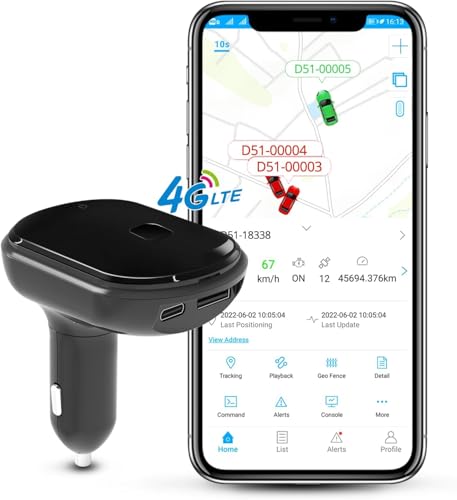
An OBD-II GPS tracker is the simplest choice when you want powered tracking with less maintenance. It plugs into the diagnostic port, draws from the vehicle battery, and reports while the ignition is on. Car and Driver lists Bouncie as Best Overall, says it uses the OBD-II port, and lists it at $9.65 per month.
That convenience cuts both ways. The port is easy to find, so the device is easier to discover and remove than a hidden magnetic tracker. For anti-theft use, it is not the stealthiest option, but it is one of the easiest to install and manage for a driver who wants persistent tracking without recharging a battery pack.
Spy Tec’s listing also points to 4G LTE worldwide service, real-time tracking, geofence alerts, and fast 2-second update speed. Those are the kinds of features that matter when recovery speed is the goal. Still, a visible OBD device is a weaker concealment choice than a hidden underbody unit.
Honest drawback: the device is only as hidden as the port allows, which means a thief who knows where to look can find it quickly. It is best for convenience and live tracking, not for maximum concealment.
Where plug-in power makes sense
Choose OBD power when you want fewer charging chores and consistent operation during daily use. Fleet vehicles are a natural fit because the device can stay powered and send location data during normal operation. It also suits drivers who want rapid setup without opening panels or mounting a separate battery pack.
That said, it is less appealing if the parking threat includes quick vehicle searches. A thief who checks the cabin and the diagnostic port may remove it fast. For that reason, OBD trackers work better as visible convenience tools than as deeply concealed anti-theft hardware.
What live tracking depends
Because OBD devices draw vehicle power, battery life is not the main constraint. Coverage, update interval, and subscription terms matter more. If the tracker stops reporting when ignition is off, that may be fine for fleet monitoring, but it can be a problem for a parked theft scenario.
Car and Driver says Tracki can track in up to 190 countries and has up to 30 days in battery-save mode. That illustrates the difference between a broad-network tracker and a plug-in unit: one may travel better off-vehicle, while the OBD model is built for installed use. (Caranddriver)
Apple AirTag: best for low-cost backup
An Apple AirTag is not a true GPS tracker, but it can still be a useful low-cost backup in the right ecosystem. It uses the Find My network, does not appear to require a subscription, and is commonly described as best as a secondary locator for iPhone users who want an extra layer of visibility.
Its limits are significant. AirTag does not provide the same live GPS map, geofence control, or update discipline as a dedicated cellular tracker. It is better for finding a lost item or a parked car in a crowded area than for real-time theft recovery.
Honest drawback: AirTag depends on nearby Apple devices and the Find My network, so it is less predictable than a cellular tracker when you need live anti-theft tracking. It also belongs to the iOS ecosystem, which makes it a poor match for some owners.
When a backup makes sense
Use AirTag as a secondary locator, not as your only anti-theft tool, when you want no monthly fee and can accept weaker tracking features. It can help with recovery after a theft or a misparked vehicle, but it should not be treated as a substitute for LTE GPS in high-risk theft areas.
Car tracker decision matrix
The right tracker changes with the parking environment. A quiet garage problem is not the same as an airport lot problem, and fleet use has different demands from long-term storage. The table below converts that into a practical decision rule.
| Scenario | Stealth | Power source | Recovery speed | Garage reliability | Subscription burden | Hidden-removal risk | Final recommendation |
|---|---|---|---|---|---|---|---|
| Street parking | High if magnetic | Battery or hidden wiring | High with LTE and fast updates | Moderate | Moderate to high | Low to moderate | Hidden magnetic GPS tracker |
| Apartment garage | High if concealed underbody | Battery preferred for stealth | Moderate until signal returns | Lower in concrete structures | Moderate | Low if well hidden | Hidden magnetic GPS tracker with strong LTE coverage |
| Airport parking | High | Battery or hidden wiring | High if geofence alerts are enabled | Moderate | Moderate to high | Low | Hidden magnetic GPS tracker |
| Fleet use | Lower concern | Vehicle-powered | High | High | Moderate | Higher if visible | OBD-II GPS tracker |
| Long-term storage | High | Battery with low drain | Moderate | Moderate | Low to moderate | Low | Battery tracker with long standby life |
| High-theft urban use | Very high | Battery or hidden wiring | High | Moderate | Moderate to high | Low if concealed well | Hidden magnetic GPS tracker plus visible deterrent |
Street parking
Street parking rewards concealment and fast alerting. A hidden magnetic unit is usually the better fit because it avoids the obvious OBD port, and a thief is less likely to spot it during a quick search. Geofence alerts help most when they arrive soon after the car leaves a safe zone.
Apartment garage
Garage parking adds a signal problem. Underground structures, concrete walls, and long ramps can reduce accuracy or delay updates until the vehicle regains open-sky coverage. That is why a tracker with reliable LTE service and sensible update frequency matters more than a flashy app feature set.
Airport parking
Airport parking favors long standby time and a strong geofence. You may not need frequent map refreshes while the car sits still, but you do want a departure alert if the vehicle moves unexpectedly. A hidden battery tracker is a better match than a visible plug-in unit here.
Fleet use
Fleet use is where the OBD tracker earns its keep. Power is stable, install time is low, and daily visibility is usually less of a problem than for a personal car. If the goal is driver accountability and route logging, the OBD form factor can be a practical choice.
Long-term storage
For storage, battery life matters more than fast live refresh. A tracker with a low-power mode, low-battery notifications, and a long standby window can sit quietly until the vehicle moves. This is where a quoted battery claim can help, but only if the tracker can still wake and reconnect after sitting idle.
The same source says one model can last up to 140 days. Spytec Mini GPS Smart Tracker is listed with up to 14 day battery life. Those figures show how much setup and upkeep can vary by device class.
High-theft urban use
High-theft urban use needs two layers. A hidden GPS tracker handles recovery, and a visible deterrent like a steering wheel lock adds a low-cost physical barrier. The lock does not replace tracking. It buys time and makes the vehicle look harder to steal at all.
Choose hidden magnetic GPS tracker if… / Choose OBD-II GPS tracker if…
Choose a hidden magnetic GPS tracker if your priority is concealment, if your car sits in public parking, or if you want a tracker that is harder to spot than a port-mounted device. It is also the better fit when you want to reduce removal risk and accept battery upkeep.
Choose an OBD-II GPS tracker if you want the simplest install, vehicle-powered operation, and easier daily upkeep. It is the stronger fit for fleet vehicles and for drivers who value constant power more than concealment. If the car is searched often, the visible port mount is the weak point.
Say your car lives on a downtown street and you want theft recovery more than maintenance-free operation. A hidden magnetic tracker fits that job better than a plug-in unit. Suppose your company van needs route visibility every weekday. The OBD tracker becomes the practical choice.
Which one should you buy?
If concealment risk is your top concern, buy the hidden magnetic GPS tracker. It is the better anti-theft fit because it is harder to notice and easier to place out of sight. The tradeoff is battery management and the need to keep the subscription active if live tracking is required.
If you want the easiest upkeep, buy the OBD-II GPS tracker. It is the cleaner daily-use option because it pulls power from the vehicle and supports fast setup. Car and Driver’s $9.65 per month figure for Bouncie is a useful reference point for the kind of recurring cost a plug-in tracker can bring.
If you want the cheapest backup, use Apple AirTag only as a secondary locator. It has no subscription required, but it is not a substitute for cellular GPS. It is best for iPhone users who want a low-cost extra layer rather than a full recovery tool.
A steering wheel lock is worth adding in any scenario where theft risk is real. It is not flashy, and that is the point. It gives the car one more obstacle before the tracker even has to do its job.
Frequently asked questions
What is the best GPS tracker for a car theft recovery?
The best choice for theft recovery is usually a hidden cellular GPS tracker with LTE support, geofence alerts, and frequent updates. A magnetic battery unit works well if concealment matters most. If recovery speed is the priority, avoid trackers that depend on crowd networks alone.
Which hidden GPS trackers for cars have the longest battery life?
Among the sourced claims here, Brickhouse Security says one tracker lasts up to 140 days, while Spytec Mini GPS Smart Tracker is listed with up to 14 day battery life. Longer battery life usually comes with slower updates or more conservative reporting, so check that tradeoff before buying.
Do car GPS trackers require a monthly subscription?
Many cellular GPS trackers do. The Walmart listing explicitly says the Brickhouse tracker requires a subscription, and Car and Driver lists Bouncie at $9.65 per month. Apple AirTag is the major exception in this comparison because it has no subscription required, but it is not a full GPS tracker.
Can I hide a GPS tracker in my car without using the OBD-II port?
Yes. A hidden magnetic GPS tracker is the common alternative because it can be placed under the vehicle or in another concealed spot. That approach improves stealth and lowers removal risk, but it usually shifts the burden to battery upkeep and subscription-based live tracking.
Are magnetic GPS trackers better than plug-in OBD trackers?
They are better for stealth, not always for convenience. Magnetic trackers are harder to spot and remove, which helps anti-theft recovery. OBD trackers are easier to set up and power, but the diagnostic port makes them more visible and easier to disable.
Will a GPS tracker still work in underground parking garages?
Sometimes, but not always. Underground garages and tunnels can reduce signal quality and delay updates until the vehicle reaches better coverage. A tracker with strong LTE service and good reconnect behavior is still useful, but you should not expect perfect accuracy in concrete structures.
What features should I look for in a hidden car tracker
Focus on LTE coverage, geofence alerts, battery life, low-battery notifications, and a subscription plan that matches how often you want updates. Also look at the mount or case, because concealment and removal risk matter as much as map accuracy when theft is the concern.
Is it legal to put a GPS tracker on my own car?
Usually yes, when you are tracking your own vehicle, but local laws still matter. Rules can vary by jurisdiction, especially if someone else regularly uses the car. Check privacy, consent, and vehicle ownership rules before installation so the tracker is used only within the law.
Products related to this article
Sponsored / affiliate links. As an Amazon Associate I earn from qualifying purchases. I may earn additional commission from eligible campaigns.