Is Telematics Car Insurance Worth It?
Telematics car insurance makes sense only if you drive few miles or your habits stay calm. Otherwise, the privacy tradeoff can wipe out a small discount. This guide compares black box, app-based, and pay-per-mile plans so you can judge them by driving pattern, privacy tolerance, and discount runway.
What telematics insurance actually tracks
Usage-based insurance is the umbrella category for telematics and pay-per-mile programs. Insurers use driving data to price the policy, then usually review that data for about 3 to 6 months before final pricing is set. The core question is simple: does your driving pattern look better than the insurer’s average risk?
Driving-behavior metrics insurers score
Telematics car insurance can monitor vehicle location, performance, and driver behavior. In practice, that often means speed, braking, miles driven, time of day, phone use while driving, and location data. Some systems may also collect engine light information and G-force from a built-in accelerometer.
Those signals matter because they point to specific risk patterns. Hard braking, fast acceleration, sharp cornering, late-night driving, and frequent phone use are all common red flags. A short burst of risky driving can matter more than many drivers expect if the program scores every trip.
OBD-II plug-in device, black box, and smartphone app
Marketing terms can blur together, but they are not identical. A telematics device is also called a black box, and it may plug into the OBD II or CAN-BUS port. One common method is a plug-in OBD-II device under the steering wheel.
A smartphone telematics app is different. It uses phone sensors and GPS instead of a plug-in unit, which means it is device-free but depends on battery life and consistent connectivity. Insurance telematics lets owners share verified driving data with insurers, and the data can be transmitted continuously and in real time.
How much can you really save?
Telematics discounts are often advertised in broad terms, but the real answer is narrower. A typical discount range is about 5% to 30%, and that is only the starting point. The final outcome can be smaller than expected if the review period shows risky driving, if fees apply, or if the renewal price moves against you.
Why savings change at renewal
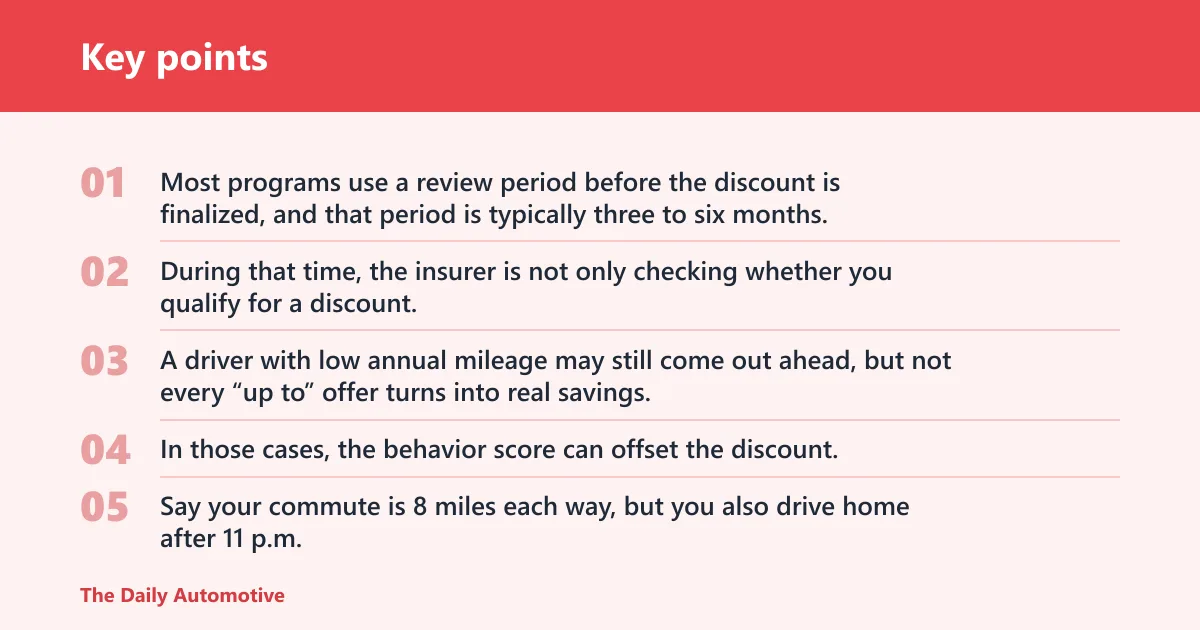
Most programs use a review period before the discount is finalized, and that period is typically three to six months. During that time, the insurer is not only checking whether you qualify for a discount. It is also building a profile of your driving habits for future pricing decisions.
That means a good-looking discount offer can still turn into a modest win. If the score improves only slightly, or if the insurer re-rates the policy after the trial period, the headline savings may shrink. A driver with low annual mileage may still come out ahead, but not every “up to” offer turns into real savings.
When fees or risk-based pricing shrink the win
Some programs are a bad fit if you drive hard at night, brake sharply in city traffic, or share the car with another driver who has a different style. In those cases, the behavior score can offset the discount. That is especially true if the policy also charges a participation fee or applies a higher renewal rate after poor telematics results.
Say your commute is 8 miles each way, but you also drive home after 11 p.m. four nights a week. A 15% headline discount may look attractive. If the insurer penalizes the late driving pattern, the net result can be far less appealing than the ad suggests.
Telematics savings decision table
| Driver type | Expected savings potential | Data likely penalized | Privacy sensitivity | Verdict |
|---|---|---|---|---|
| Low-mileage commuter | High if trips are short and steady | Miles driven, time of day, hard braking | Medium | Worth it |
| Night-shift driver | Low to mixed | Late-night driving, route regularity, fatigue-related braking | Medium to high | Maybe |
| Teen driver | Moderate if habits are clean | Speed, acceleration, phone use, late trips | Low to medium | Worth it |
| Urban stop-and-go driver | Low | Hard braking, acceleration, congestion patterns | Medium | Skip |
| Highway-only driver | Moderate to high | Speed, mileage, trip timing | Medium | Maybe |
| Shared household vehicle | Mixed | Different braking, speed, and phone-use habits | High | Skip |
Who benefits most from telematics?
Telematics may be worth it for drivers whose habits are steady, predictable, and easy to score well. Low-mileage drivers, careful teens, and some highway commuters are the clearest candidates. The more your pattern resembles clean, routine driving, the more likely the discount runway works in your favor.
Low-mileage commuters and highway drivers
Low annual mileage often helps because fewer miles usually mean fewer chances to trigger a negative score. Highway driving can also be easier for telematics systems than dense city traffic, as long as the driver keeps speed in check and avoids abrupt lane changes or heavy braking. The best fit is a calm route with limited surprises.
Teens and households with careful driving habits
Teens can be a strong match if the household wants feedback and can reinforce better habits. The projected discount dashboard or app view can show score trends, estimated savings, and feedback during the review period. That makes it easier to correct speeding, phone use, or sharp acceleration before the policy renews.
Households with one main driver and one parked car are easier to score than households where several adults share the same vehicle. Mixed driving styles create mixed results, and mixed results often weaken the discount.
Shared vehicles and mixed-use cars
Shared vehicles are a frequent weak spot. If one driver is smooth and another is aggressive, the program may score the car as a whole, not the best driver in the family. That can make the policy harder to predict and easier to disappoint.
When telematics is a bad fit
Telematics is a poor match when the insurer is likely to see risk signals more often than clean ones. Night-shift schedules, dense urban traffic, frequent hard braking, and regular phone use while driving all raise the chance that the system will rate you worse than expected. In those cases, the savings runway is short.
Night-shift schedules and late driving
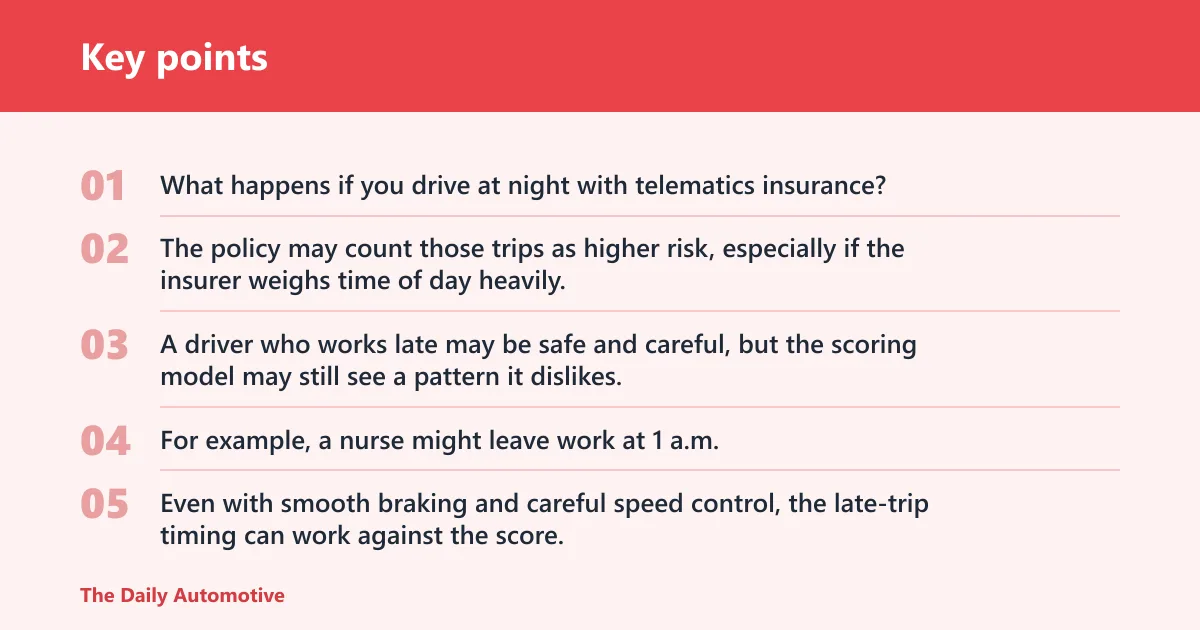
What happens if you drive at night with telematics insurance? The policy may count those trips as higher risk, especially if the insurer weighs time of day heavily. A driver who works late may be safe and careful, but the scoring model may still see a pattern it dislikes.
For example, a nurse might leave work at 1 a.m. three nights a week. Even with smooth braking and careful speed control, the late-trip timing can work against the score. This is where advertised savings can miss the real use case.
Urban stop-and-go traffic
City driving is hard on telematics scores because it can produce repeated braking, short bursts of acceleration, and more congested routes. A driver who is careful in traffic may still look aggressive to the software if the route itself forces frequent stops.
Frequent hard braking or phone use
Frequent hard braking is one of the most common ways to lose a discount, especially if the car is driven in dense traffic. Phone use while driving is another clear risk signal. If a program scores distraction, the insurance company may conclude that the driver is less careful than the headline savings promised.
Plug-in device vs. smartphone app

How do plug-in and app-based telematics programs differ? A plug-in device is usually better for battery concerns and may feel more stable, while a smartphone app is easier to start but can be more intrusive on privacy and phone resources. Both can track driving behavior, but the tradeoffs are not the same.
What an OBD-II device changes
An OBD-II plug-in device typically sits under the steering wheel and draws from the vehicle rather than the phone. That means no battery drain from the app and less dependence on whether a phone is charged or connected. It can also be simpler for drivers who do not want the insurer tied to their personal device.
The downside is that the hardware stays with the vehicle and may still transmit data through the cellular network. Telematics systems may use a SIM card and modem for that communication, so the privacy concern does not disappear just because the unit is not on your phone.
What an app collects
A smartphone telematics app usually uses GPS, motion sensors, and trip detection to score driving. It can be convenient, but it also depends on location permissions, battery life, and consistent connectivity. If the phone dies during a drive, the trip may be incomplete or misread.
A common first-timer mistake is assuming an app only tracks driving when it is open. In many programs, the app keeps monitoring in the background. That is why permission settings matter before enrollment.
Privacy, battery, and connectivity tradeoffs
App-based systems may feel more invasive because they live on a personal device and can capture more context around phone use. Plug-in systems are less dependent on battery but still raise privacy questions because the insurer can receive location and driving data. The right choice depends on which tradeoff bothers you more.
What to check before you enroll
Before you enroll, confirm exactly what the insurer can collect, how it is scored, and how long it is retained. Do not rely on the headline discount alone. The better question is whether the data rules, pricing rules, and review period fit your driving life.
-
Read the data permission list. Look for speed, braking, mileage, time of day, location, phone use, and any mention of engine diagnostics or accelerometer data. If the list is vague, ask for a written summary before you agree.
-
Check retention and sharing rules. Confirm how long trip data is stored and whether it can be used after the review period. Also ask whether the insurer shares it with affiliates, third-party vendors, or future underwriting systems.
-
Review the scoring window. Find out whether the program uses a three- to six-month trial and whether one bad month can drag down the whole result. A short score window can help careful drivers, but it can also punish one messy season.
-
Open the dashboard first. Ask how the projected discount dashboard works and whether it shows live feedback, score trends, and estimated savings. If you cannot see what the program is doing, it is harder to improve the score before renewal.
Telematics can be a good deal for low-mileage, steady drivers who do not mind data collection. It is less attractive for drivers with night shifts, mixed household use, or frequent urban braking. Judge the policy by your own route and schedule, not by the largest discount number in the ad.
Frequently asked questions
Is telematics car insurance worth it?
It is worth it when your driving pattern is steady, your mileage is low, and you are comfortable with ongoing tracking. If your schedule is irregular or you dislike location and behavior monitoring, the savings may be too small to justify the data tradeoff.
Is black box car insurance worth it?
Black box car insurance can be worth it for careful drivers who want a discount tied to real driving behavior. It is less compelling for drivers with late-night trips, shared vehicles, or lots of braking in traffic, because those habits can cut into the savings.
What data does telematics car insurance collect
Telematics programs commonly collect speed, braking, miles driven, time of day, and location data. Some also track acceleration, cornering, phone use while driving, and engine diagnostics. The exact list depends on the insurer, so confirm the permissions before you enroll.
Can telematics car insurance raise your premium?
Yes. A poor driving score can lead to a smaller discount, a worse renewal outcome, or a higher price than you expected. The risk is greatest when the program heavily weights night driving, hard braking, speed, or repeated phone use.
How do plug-in and app-based telematics programs differ?
Plug-in programs use an OBD-II device under the steering wheel and do not depend on phone battery life. App-based programs use phone sensors and GPS, which is easier to start but depends on battery and connectivity. The privacy tradeoff also differs because the app lives on your personal device.
Who benefits most from usage-based insurance
Drivers with low mileage, steady commutes, cautious teens, and highway routes with clean habits are the best candidates. Drivers with mixed schedules, shared cars, or frequent stop-and-go traffic are less likely to get enough benefit from the program to make it worthwhile.
Products related to this article
Sponsored / affiliate links. As an Amazon Associate I earn from qualifying purchases. I may earn additional commission from eligible campaigns.