Car Alarm vs GPS Tracker
A car alarm deters theft with a loud siren, impact sensing, and clear tamper warnings. A GPS tracker is built to recover the vehicle after it moves. If you can fit only one, choose the tracker for theft recovery, or both for parked cars worth protecting. Skip the wrong setup and you can miss the theft window, lose the vehicle, or pay more to replace it.
| Factor | Car Alarm | GPS Tracker | Winner |
|---|---|---|---|
| Deterrence | Loud siren, impact alerts, and visible warning stickers can scare off casual theft attempts. | Hidden by design, so it usually does little to stop the first move. | Car Alarm |
| Immediate notification | Real-time disturbance alerts when the vehicle is hit, opened, or moved. | Real-time location updates and movement alerts, plus geofencing if the tracker is online. | Tie |
| Recovery ability | Limited unless the alarm also includes GPS location support. | Built for live location, route history, and recovery after theft. | GPS Tracker |
| Installation and upkeep | Usually more involved to add cleanly; maintenance depends on the system and its power source. | OBD-II units are tool-free, battery models are portable, and solar units can reduce charging chores. | GPS Tracker |
| Monthly cost and privacy risk | Some systems have no monthly fee; privacy risk is usually lower unless the system includes GPS or voice features. | Many live trackers need a SIM card and data plan, and voice features can add legal and privacy risk. | Car Alarm |
| Tamper resistance | Can be defeated if a thief disconnects power or works around the sensor set. | Hidden units help, but discovery, dead batteries, and lost cellular coverage still matter. | Tie |
Which stage of a theft each device handles?
The split is simple. A car alarm tries to stop the thief at the car. A GPS tracker tries to find the car after it moves, while also recording route history and alerts.
That makes the two tools useful at different stages of a theft. Deterrence belongs to the alarm. Recovery belongs to the tracker. Detection sits in the middle, and either device can help there if it sends an alert fast enough.
What each device is meant to do
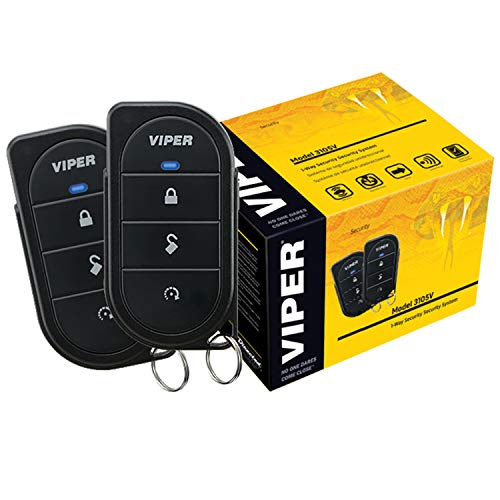
A car alarm reacts to impact, door opening, motion, or other disturbances. Many systems send a real-time alert to an app or remote. Some car-protection devices also include GPS location support, but that does not make them full live trackers.
A GPS tracker uses satellite positioning and a mobile network or SIM data to send the vehicle’s location to an app. It can also log route history and trigger geofencing alerts when the vehicle crosses a set boundary.
Where the trade-off starts
The trade-off starts when you ask what matters more: stopping the theft attempt or finding the car after it leaves. A loud alarm can make a thief leave quickly. A hidden tracker can keep working after the car is gone.
Say your SUV is left in a dim apartment complex lot while you travel for the weekend. An alarm may draw attention fast, but a tracker gives you a map, direction of travel, and a better chance of recovery if the car is moved anyway.
Alarm tracker decision matrix
This decision matrix keeps the jobs separate. It compares deterrence, immediate notification, recovery, installation, monthly cost, tamper resistance, and privacy risk, then points to the better fit for each common parking situation.
| Scenario | Deterrence | Immediate notification | Recovery ability | Installation and upkeep | Monthly cost | Tamper resistance | Privacy risk | Pick |
|---|---|---|---|---|---|---|---|---|
| Street parking | Car Alarm | Tie | GPS Tracker | GPS Tracker | Car Alarm | GPS Tracker | Car Alarm | GPS Tracker |
| Apartment garage | Car Alarm | Car Alarm | GPS Tracker | Tie | Car Alarm | GPS Tracker | Car Alarm | GPS Tracker |
| Fleet vehicles | GPS Tracker | GPS Tracker | GPS Tracker | GPS Tracker | Tie | GPS Tracker | Car Alarm | GPS Tracker |
| Weekend car | Car Alarm | Car Alarm | GPS Tracker | GPS Tracker | Car Alarm | Tie | Car Alarm | GPS Tracker |
Street parking
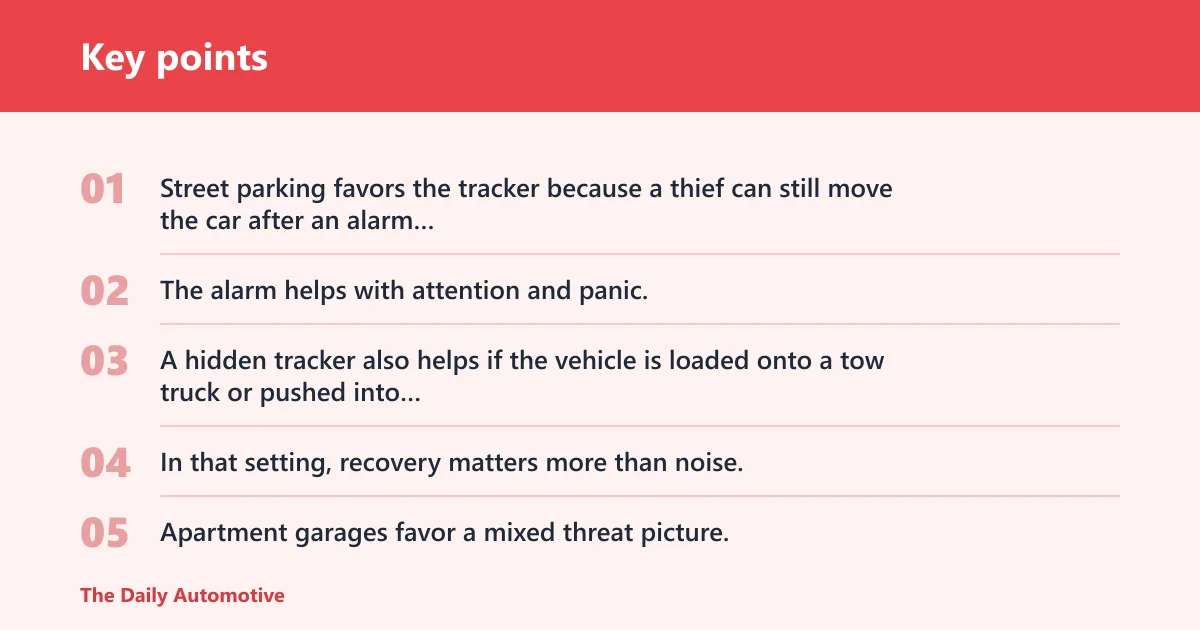
Street parking favors the tracker because a thief can still move the car after an alarm sounds. The alarm helps with attention and panic, but the tracker helps with location once the car is gone.
A hidden tracker also helps if the vehicle is loaded onto a tow truck or pushed into another block. In that setting, recovery matters more than noise.
Apartment garages
Apartment garages favor a mixed threat picture. Door opening alerts matter, but false alerts also become a nuisance if the system is too sensitive. A tracker helps if someone steals the car quietly or after disabling the alarm.
Geofencing is useful here. A perimeter alert can tell you the car moved out of its usual zone before you notice the missing keys or broken glass.
Fleet vehicles
Fleet use usually pushes the choice toward the tracker. Route history, speed records, and live location updates matter when you need to manage vehicles, vans, trailers, or work machines across multiple drivers.
A tracker also helps if a unit leaves an approved area. That makes the device useful for theft and for unauthorized movement.
Weekend cars
Weekend cars often sit for long stretches, which makes recovery planning important. A tracker is the better single device when the vehicle may be parked away from you for days or weeks at a time.
If the car is also visible from the street or a shared lot, pairing a tracker with an alarm gives both deterrence and recovery. That is the strongest setup for a car you want to keep, not merely find later.
How do car alarms work?
A car alarm watches for impacts, door openings, and other disturbances, then sounds a siren or sends a real-time alert. It is meant to interrupt a theft attempt and draw attention before the thief finishes the job.
Some alarms also pair with an app or remote monitoring system. A few include GPS location support, but that feature alone does not turn the alarm into a full recovery tracker.
Impact and door sensors
Impact sensors react to bumps, glass breaks, or hard contact. Door sensors react when a door is opened without the expected signal path. Some systems also watch for motion or tilt, which helps if the vehicle is being lifted or towed.
Those inputs are good at catching tampering early. They are less useful once the car is already out of sight.
App or remote alerts
Modern alarms can push alerts to a phone, key fob, or app. That matters if the car is parked far away, because you can respond without hearing a siren from inside the building.
False alerts are part of the trade-off. A sensitive system can notify you about harmless bumps, heavy wind, or a passerby brushing the vehicle.
When GPS location support matters
GPS location support matters when you want the alarm to do more than warn you. It helps after the vehicle moves, especially if the alarm only tells you that a disturbance happened but not where the car went.
That said, a true tracker still does the location job better. Alarm location support is useful, but it is usually a secondary feature.
How do GPS trackers work on cars?
A GPS tracker typically uses satellites to determine position, then uses mobile data through a SIM card to send that position to an app. That is how it can show live location, route history, speed, and alerts.
If the tracker has no SIM card or no data service, it cannot do full real-time online tracking. It may still store data locally, but you lose the live feed that most buyers want.
GPS positioning plus cellular data
Satellite positioning tells the tracker where it is. The cellular side sends that location to your phone or web account. Coverage and roaming matter because a tracker can only report live if its network connection is available.
Some trackers also use SIM voice support when they include listening or voice monitoring. That feature carries extra legal and privacy risk, and it is not present on all trackers.
Route history and geofencing
Route history shows where the car has been. That is useful for theft recovery, fleet logs, or checking whether a vehicle was used outside the usual area.
Geofencing adds a virtual boundary. If the vehicle crosses that boundary, the app can send a perimeter alert. That is useful for theft, unauthorized movement, and off-hours use.
Why a SIM card matters
The SIM card is what gives the tracker a data connection in most live systems. Without it, the device may still know its position, but it cannot reliably push updates to your app.
Plan for service cost, coverage, and roaming before you buy. A cheap device with weak service can fail at the exact moment you need it.
Tracker types you can buy
Trackers come in different power and installation styles. The right type depends on whether you want tool-free setup, long battery life, or a hidden install in a parked vehicle or piece of equipment.
OBD-II port trackers
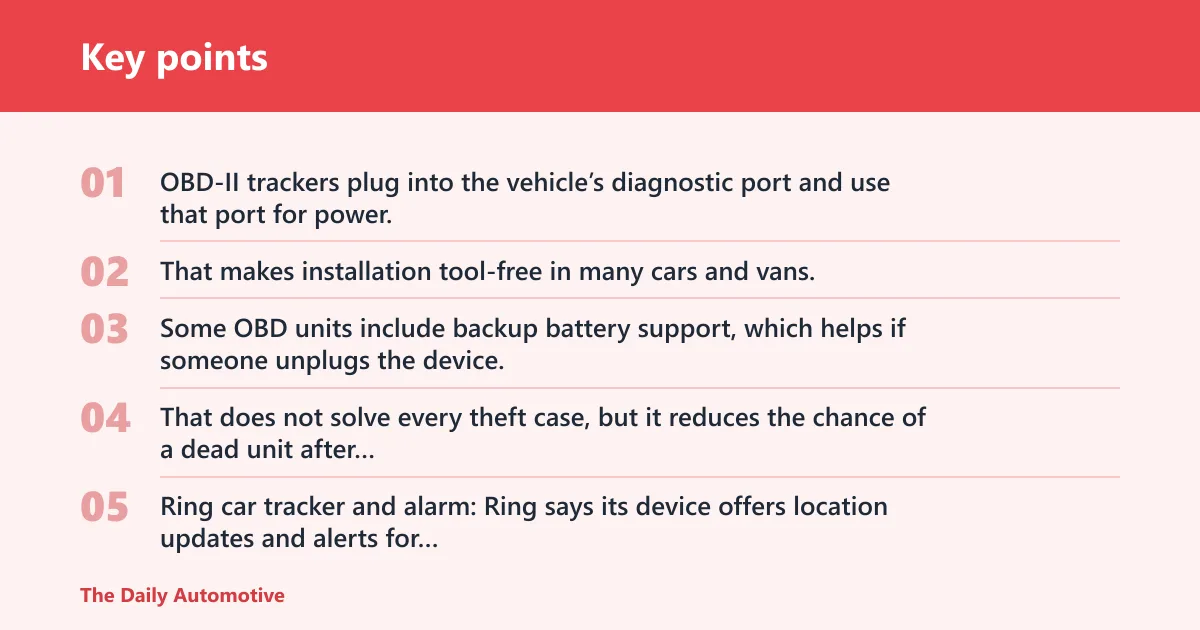
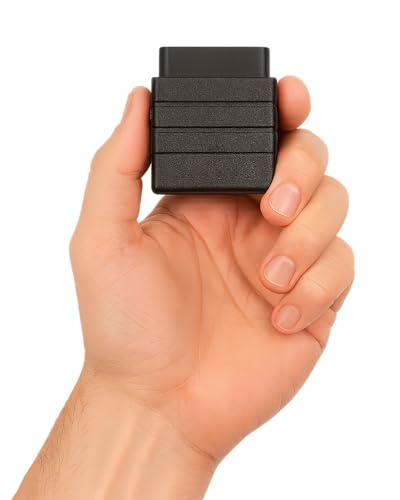
OBD-II trackers plug into the vehicle’s diagnostic port and use that port for power. That makes installation tool-free in many cars and vans, but compatibility still depends on the vehicle.
Some OBD units include backup battery support, which helps if someone unplugs the device. That does not solve every theft case, but it reduces the chance of a dead unit after tampering.
Ring car tracker and alarm: Ring says its device offers location updates and alerts for car protection, detects impacts, door openings, and other disturbances, uses the OBD-II port for power, has no monthly fees, includes backup battery life of up to seven days, and operates from -4°F to 176°F.
Battery-powered magnet trackers
Battery-powered magnet trackers are portable and can be placed on cars, vans, caravans, trailers, and work machines. The battery life depends on the update interval, because more frequent pings use more power.
That flexibility makes them useful when there is no easy power source or when the tracker needs to move between assets. The trade-off is battery upkeep.
MALA tracker: MALA offers a one-month free service period, then charges 199 Kč monthly, lists battery life up to 216 days in power-saving mode, and updates position every 10 seconds.
Solar GPS trackers
Solar GPS trackers add solar-assisted charging. They are often used for outdoor-stored vehicles and equipment, where light exposure can help extend runtime.
Endurance still depends on sunlight. Shade, indoor storage, or winter conditions can reduce the benefit, so the solar panel should be treated as assistance, not a guarantee.
Hidden charger-style trackers
Some trackers hide in charger-sized or other small form factors. They are appealing because they are easy to overlook, but they still need power, signal, and app service to do their job.
A hidden device can help after theft, yet it can also be found by a thief who knows where to look. Small size is not the same as invisibility.
Choose Car Alarm if… / Choose GPS Tracker if…
Choose Car Alarm if your main goal is to make theft noisy, visible, and uncomfortable for the person trying it. It is the better pick for visible deterrence, fast tamper alerts, and lower privacy concern.
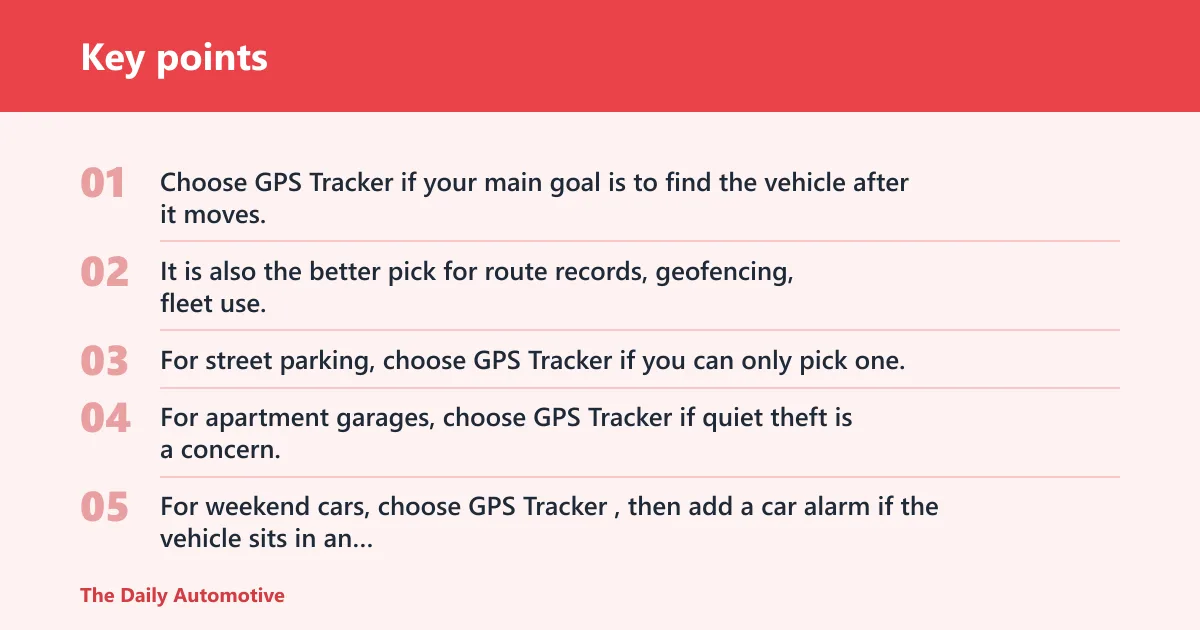
Choose GPS Tracker if your main goal is to find the vehicle after it moves. It is also the better pick for route records, geofencing, fleet use, and any case where recovery matters more than scaring the thief.
For street parking, choose GPS Tracker if you can only pick one. For apartment garages, choose GPS Tracker if quiet theft is a concern. For fleet vehicles, choose GPS Tracker. For weekend cars, choose GPS Tracker, then add a car alarm if the vehicle sits in an easy-to-see spot.
Picture a sedan left in a shared apartment garage for three nights. A loud alarm may get ignored if the sound does not carry well. A tracker can still send a geofence alert and a live location if the car leaves the garage.
Can a tracker replace a car alarm?
A tracker can replace some alert functions, but it cannot replace deterrence. If the thief is willing to take the car anyway, the tracker helps you recover it, but it does little to stop the first seconds of the theft.
That is why many parked cars justify both devices. The alarm tries to interrupt the theft, and the tracker backs up recovery if the car leaves anyway.
What a tracker cannot stop
A tracker cannot stop a dead battery, an unplugged OBD unit, or a thief who finds and removes the device. It also cannot report live if the car loses cellular coverage or the SIM service fails.
That means a tracker is strong for recovery but weaker as a stand-alone defense.
When both devices make sense
Both make sense when the car is parked outside often, carries high replacement cost, or stays in the same place for long periods. The alarm handles the first minute. The tracker handles the next hour.
That combination is especially useful for cars worth protecting, company vehicles, caravans, trailers, and work machines stored in open lots.
False alerts, coverage gaps, and dead batteries
False alerts can make alarm users ignore real warnings. Coverage gaps can make tracker users miss the live window. Dead batteries can disable either device if the power path is poor or the backup cell is exhausted.
Those failure modes are why the best choice depends on the parking pattern, not just the sticker price.
How to check GPS tracker in car
Check the places a tracker is commonly installed: the OBD-II port under the dash, the lower dash trim, under seats, near the rear cargo area, and any charger or accessory-looking device plugged into a power source. Hidden trackers often depend on small size and a forgotten power source.
Use the vehicle manual before removing trim, and do not pry around airbags, curtain modules, or other safety equipment. If you are not sure where a module belongs, check the manufacturer’s layout for your model.
What to look
Look for unfamiliar wiring, a device with a SIM slot, or a magnetic box attached to a metal surface. A tracker may also have a blinking indicator or an app pairing label hidden from plain view.
If the vehicle was recently bought used, an old tracker may still be active. That is a privacy issue as well as a security one.
How to detect GPS tracker on car
Detection starts with a visual search and ends with careful inspection. Check the cabin, trunk, underbody edges you can safely reach, and the OBD-II port. If the car is not yours, get the owner’s consent before you search.
Use a legal, non-destructive approach. A hidden tracker can sit for months without being noticed, especially if it is battery-powered or tucked into a charger-like housing.
Practical steps
- Inspect the OBD-II port for anything plugged in that you do not recognize.
- Scan for small magnetic boxes under the vehicle only where you can do so safely.
- Check the cargo area, spare tire well, glove box, and under-seat spaces.
- Look for charger-style devices that seem out of place.
- Confirm any suspicious device with the owner or a qualified technician before removal.
A common first-timer mistake is checking only the dashboard and forgetting to look at the car’s exterior location data. Many trackers are hidden where a hurried search will miss them, especially if the installer expected the device to survive a quick glance and a short drive.
How to track a car without GPS
You can track a car without GPS only in limited ways. A door sensor alarm, a smart dashcam, a cellular safety system, or a connected vehicle service may tell you that something happened, but they do not reliably give you live vehicle location the way GPS does.
Without GPS, you can still collect evidence, get alerts, or confirm a disturbance. You cannot get true location tracking unless another location source is built in.
What the alternatives can and cannot do
An alarm can tell you about a break-in or tow attempt. A connected app can sometimes share the vehicle’s status. Neither one replaces live location updates, route history, and geofencing from a GPS tracker.
If recovery is the goal, a real tracker is the cleaner answer.
Frequently asked questions
Car alarm vs GPS tracker: which is better?
If you want to stop or scare off a thief, the car alarm is better. If you want to recover the vehicle after it moves, the GPS tracker is better. For parked cars exposed to theft, both devices together are the stronger choice.
What is the difference between a car alarm and a GPS tracker
A car alarm reacts to disturbance with a siren or alert. A GPS tracker reports location, route history, and geofencing data through satellites and a mobile connection. One is about interruption. The other is about finding the car.
Do cars have GPS trackers?
Some cars do, but many do not. Factory telematics, fleet systems, or dealer-added services may include tracking, while older or basic vehicles usually do not. Check the vehicle’s service menu, paperwork, or connected-app setup before assuming one is present.
Is a hidden GPS tracker legal to use on a car?
Legality depends on ownership, consent, and local law. A hidden tracker on your own vehicle is usually treated differently from one placed on someone else’s car. Listening or voice monitoring adds extra privacy risk and should be checked against local rules before use.
Products related to this article
Sponsored / affiliate links. As an Amazon Associate I earn from qualifying purchases. I may earn additional commission from eligible campaigns.