Car Dash Cam with Parking Mode Review: Is It Worth It?
A car dash cam with parking mode is worth it when your car sits unattended for hours, or in lots where theft and damage happen often; skip it for short, low-risk parking and tight battery budgets. Without it, hit-and-runs, break-ins, and door-ding disputes often turn into expensive he-said-she-said claims. This guide breaks down when parking mode pays off, what it costs in battery and installation, and which setups fit your parking pattern.
Verdict

Based on the manufacturer specs, published product details, and buyer feedback, parking mode is a risk-management upgrade, not a checkbox. The best value comes when the camera keeps evidence rolling after impact, the vehicle battery can tolerate the load, and the parking environment justifies the extra wiring.
Specs at a glance
| Topic | What matters |
|---|---|
| Parking mode | Records video while the engine is off and can help document hit-and-runs and vandalism. |
| Buffered parking mode | Saves footage before and after the trigger, so you get the moments leading into an impact. |
| Time-lapse parking mode | Can capture one frame per second and stretch coverage while using less storage. |
| Radar parking mode | Uses radar detection, is presented as the newest and most advanced parking mode, and is offered on limited models. |
| Power options | A hardwire kit enables parked recording; a battery pack gives you a separate power source for parked recording. |
| Storage | MicroSD card capacity affects retention, and loop recording only helps if the card is compatible and sized for your clip length. |
Who it
Parking mode is for drivers who leave a car on the street, in shared lots, or in places where door dings, sideswipes, and vandalism can happen. It is also for anyone who wants evidence after a parked impact, especially when nobody leaves a note.
If your car spends most of its time at home in a low-risk driveway, the return is smaller. The cost only makes sense when the chance of a claim is high enough to justify extra wiring, added power load, and more attention to battery health.
Best parking environments
A busy curb, apartment lot, public garage, or workplace parking row makes parking mode more defensible. These locations raise the odds of a low-speed impact, a scrape, or a hit-and-run that a normal driving camera would miss.
Say your sedan sits on a street where other drivers park bumper-to-bumper and trucks swing wide near the corner. Buffered recording can be the difference between “someone hit it” and a clip that shows the approach, contact, and escape.
Best parking patterns
Long sits matter more than short stops. If the car regularly sits for eight hours or overnight, parking mode has more chances to catch an incident, but it also has more time to draw on the battery, which makes cutoff protection or a battery pack more important.
Short errands are different. BlackboxMyCar says short parking periods may not need a dedicated battery pack, while longer parking or frequent cutoff can make one worthwhile. That is the right way to think about the upgrade: exposure first, gear second.
What works
Parking mode works best when it captures enough context to show what happened, not just that something happened. It records while the engine is off, which is the whole point for hit-and-runs, vandalism, and door-ding disputes.
Buffered parking mode is especially useful because it saves footage before and after the trigger. That pre-roll can show the car approaching, the bumper contact, or a hand reaching for a mirror before the alarm event starts.
Hit-and-run evidence
For a parking incident, the clearest footage is the kind that shows the vehicle arriving, the moment of contact, and the escape path. Buffered mode usually captures seconds before and after the trigger, so it improves the odds that the clip shows the full chain.
G-sensors are the baseline trigger. They detect impact and start event recording, but they are not a full solution by themselves. Without a good parking mode and a compatible power setup, the camera may wake too late or stop too soon.
Vandalism and door-ding coverage
Door dings and vandalism are often short, close-range events. A camera that only starts after motion can miss the critical frame if the person is already out of view. Buffered or radar-triggered parking modes are better at preserving the lead-in.
Picture a hatchback parked in a garage aisle where shoppers brush past it. Motion detection may wake on every passing cart and fill the card fast, while buffered recording gives a tighter event clip that is easier to review later.
Buffered recording and wake-up timing
Wake-up delay is a real failure case. If a camera sleeps too deeply or takes too long to start recording, the damage may already be done by the time it captures video. Buffered systems reduce that gap by keeping short clips in memory.
Radar parking mode can help here because it uses radar detection and is presented as the newest and most advanced parking mode. It can also draw less power than buffered recording, although it is still limited to certain brands and models.
What does not?
Parking mode is useful, but it is not magic. Busy-street false triggers can fill a card with routine movement, motion-only modes can miss the important frame, and a hardwire setup can still leave you with weak-start risk if the cutoff is set too low or the battery is already tired.
It also cannot guarantee readable plates. Low bit rate mode is described as not recommended for plate readability, so “more coverage” is not the same as “better evidence.”
False triggers in busy areas
Motion detection can waste storage or power in a high-traffic lot because every passing pedestrian, car light, or swaying object can trigger a clip. That creates more review work and may shorten retention on the microSD card.
Time-lapse parking mode is a better fit when the goal is broad coverage with lower storage use. It captures about one frame per second, so it stretches recording time, but it gives up detail that may matter for faces, plates, or fast contact events.
Battery-drain and weak-start risk
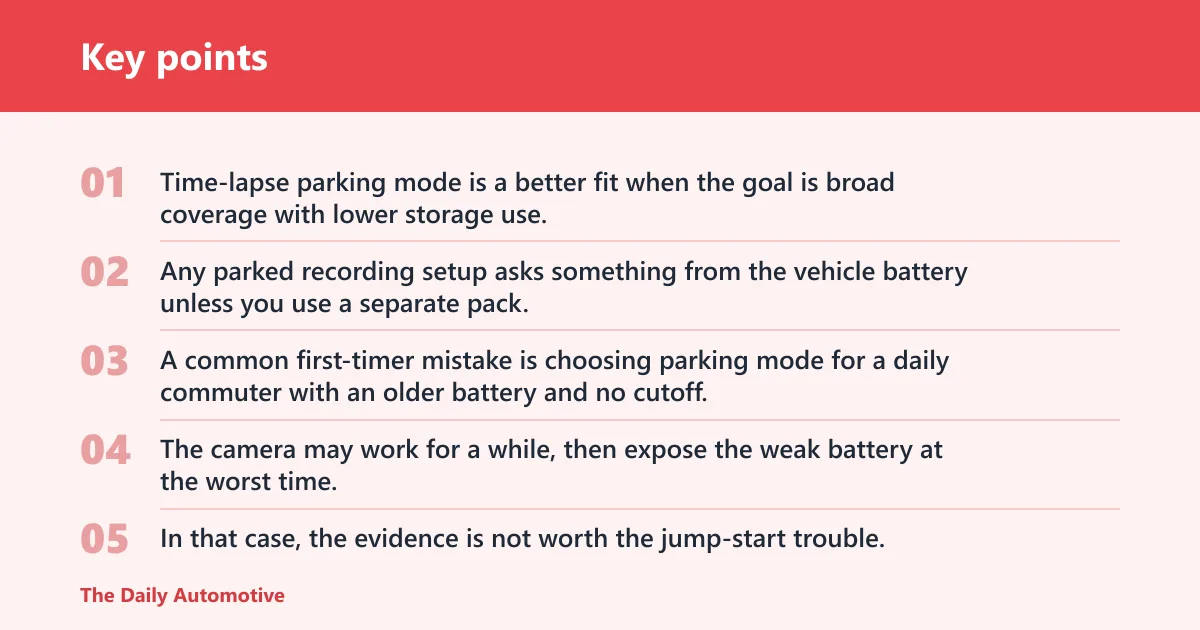
Any parked recording setup asks something from the vehicle battery unless you use a separate pack. The hardwire kit must include low-voltage cutoff protection, and it must match the camera connector type and vehicle setup. That is what keeps parked recording from turning into a no-start morning.
A common first-timer mistake is choosing parking mode for a daily commuter with an older battery and no cutoff. The camera may work for a while, then expose the weak battery at the worst time. In that case, the evidence is not worth the jump-start trouble.
Limits of motion-only recording
Motion-only recording sounds efficient, but it is weak against quick impact events. A bump, scrape, or deliberate vandalism action can happen before the camera finishes waking and writing video. That is why buffered mode is the safer baseline for evidence quality.
Radar parking mode improves the detection side, but it does not remove the need to think about install quality, power draw, and whether your parking situation is actually risky enough to justify it.
Parking mode decision matrix
This matrix turns the feature into a buying decision. Match your parking pattern, battery condition, and camera setup to the lightest option that still protects the car.
| Parking duration | Commute length | Vehicle battery age | Parking location | Channel count | Action | Reason |
|---|---|---|---|---|---|---|
| Under 2 hours | Long daily drive | Newer battery | Low-risk driveway | 1 channel | No upgrade | The exposure is short and the risk is low, so the setup cost is hard to justify. |
| 2 to 8 hours | Moderate commute | Healthy battery | Garage or quiet lot | 2 channels | Hardwire only | You gain parked evidence without the extra cost of a separate pack when battery health is good. |
| 8 to 12 hours | Short commute | Battery older than 3 to 4 years | Street parking or shared lot | 2 or 3 channels | Hardwire plus cutoff | Longer sits and an older battery raise weak-start risk, so cutoff protection matters. |
| Overnight or repeated all-day parking | Short commute | Older or uncertain battery | Theft-prone lot or street parking | 3 channels | Dedicated battery pack | Frequent parked recording and higher incident risk make a separate power source the safer call. |
Should you buy it?
Buy parking mode if the car spends real time unattended and the parking environment makes evidence valuable. Skip the upgrade if the car rarely sits, the battery is already marginal, or the car lives in a low-risk space where the odds of an incident are small.
For most buyers, the decision is between a hardwire kit with cutoff and a dedicated battery pack. The hardwire setup is cheaper and works for moderate risk, while the pack makes more sense when parked recording is frequent, the battery is older, or the car is expected to sit for long stretches.
Hardwire kit only
A hardwire kit is the right starting point when you want parking mode without a separate power source. It enables parked recording, but it must include low-voltage cutoff protection and match the camera connector and vehicle setup.
- Check the vehicle battery. If the battery is older, slow to crank, or already sensitive in cold weather, do not treat hardwiring as a free add-on. The cutoff setting matters because it determines how much battery reserve is left for starting.
- Confirm connector compatibility. The kit has to match the camera and vehicle setup. A mismatch can make the install awkward or impossible without the right adapter.
Hardwire plus cutoff
This is the best middle ground for drivers who park for long work shifts, live with shared-lot risk, and still need to protect the starter battery. The cutoff keeps parked recording from draining the car past a safe point.
It is the sensible choice when parking mode matters but the car is not sitting long enough to justify a separate battery pack. That is where the value usually sits.
Dedicated battery pack
A battery pack makes sense when parked recording is frequent, the car battery is older, or the vehicle is expected to sit for a long time. The same source says a dedicated battery can be worthwhile for longer parking or frequent cutoff.
It reduces load on the starter battery, but it adds cost, installation work, and charging time. It also needs compatible installation, so this is a planning decision, not an impulse buy.
Alternatives

The VIOFO A229 Pro is the better pick if you want a buffered parking-mode setup at a lower listed price of $279.99 and you are comfortable choosing the right channel count for your car. Its dual STARVIS 2 sensors, HDR, and three parking modes make it a practical middle ground, but the exact install details still depend on your vehicle and camera connector.
One honest drawback is that it is not the cheapest path into parking mode, and buyers still need to sort out power wiring for full parked recording. The published details point to strong parking coverage, but they do not remove the battery-management question.
The THINKWARE U3000 PRO is the better choice if radar parking mode and cloud-oriented features matter more than price. It is listed at $549.99 and includes dual radar parking mode, LTE compatibility, and 4K front and 2K rear coverage with STARVIS 2 sensors.
The tradeoff is cost and setup complexity. Remote cloud use adds a power-load consideration, and the listing makes clear that you should check the installation path for your vehicle before buying. For buyers who want radar as the parked-recording backbone, this is the more premium route.
Frequently asked questions
Is a dash cam with parking mode worth it?
It is worth it when your car spends hours unattended in places where minor collisions, vandalism, or theft are plausible. If parking is short and low risk, the added wiring and battery planning may not pay back. The decision is really about evidence value versus installation and power tradeoffs.
Do I need a hardwire kit for parking mode?
For full parking recording, yes, most setups need a hardwire kit. Mashtips says 24-hour parking mode requires hardwiring to the car battery. The key detail is that the kit must include low-voltage cutoff protection and match the camera connector and vehicle setup.
Will parking mode drain my car battery?
It can. Any parked recording setup draws power unless you use a separate battery pack, and the risk rises with longer sits, older batteries, and multi-channel cameras. That is why cutoff protection matters so much, especially for drivers who park overnight or in cold weather.
What is the difference between buffered and simple parking mode?
Buffered mode saves footage before and after the trigger, while simple event-activated modes start after motion or impact is detected. Buffered recording usually gives better evidence because it captures the moments leading into the event, not only the aftermath. That can be decisive in a hit-and-run.
How long can a dash cam record while parked?
The answer depends on the power source, battery health, camera channel count, and storage setup. Time-lapse mode can stretch coverage by capturing one frame per second, while a dedicated battery pack can extend parked recording without leaning as hard on the starter battery. There is no single universal runtime.
Is radar parking mode better than motion detection?
Radar parking mode is usually better than basic motion detection for parked-event awareness because it uses radar detection and can draw less power than buffered recording. It is also presented as the newest and most advanced parking mode. The catch is availability: only certain brands and models offer it.
Products related to this article
Sponsored / affiliate links. As an Amazon Associate I earn from qualifying purchases. I may earn additional commission from eligible campaigns.