ABS vs Electronic Stability Control
ABS stops a wheel from locking during hard braking. Electronic stability control corrects skids by braking individual wheels and cutting engine power; if the wrong light stays on, you can lose anti-lock braking or skid correction. Ignore the difference and you may get longer stops, weaker steering, or a hidden brake fault. This guide explains what each system fixes, what you feel at the pedal, and which warning signs point to ABS or ESC trouble.
| Decision factor | ABS | Electronic Stability Control | Winner |
|---|---|---|---|
| What it corrects | Wheel lock-up during braking | Loss of directional control, oversteer, understeer, and skids | Electronic Stability Control |
| Driver feel | Pulsing pedal, chattering, and preserved steering under hard stops | Brake tug on one corner, flashing stability light, possible power reduction | Tie |
| Main inputs | Wheel speed sensors | Wheel speed, steering angle, yaw rate, and lateral acceleration sensors | ABS |
| Control action | Modulates hydraulic pressure to keep a wheel rolling | Brakes individual wheels and may reduce engine torque | Electronic Stability Control |
| Best-fit use case | Emergency straight-line braking on slippery pavement or split-friction surfaces | Cornering, lane changes, evasive maneuvers, and slide correction | Electronic Stability Control |
| Fault impact | Usually affects braking feel and anti-lock function first | Usually affects stability correction first, but can share hardware with ABS | Tie |
ABS vs ESC: the core trade-off
ABS keeps a wheel from locking while you brake hard. Electronic stability control checks whether the vehicle is going where you pointed it, then trims a skid by braking individual wheels and, on many vehicles, cutting engine torque.
That difference matters because the driver symptom changes. ABS problems show up at the pedal and in straight-line stops, while ESC problems show up when the vehicle starts to rotate, drift wide, or step sideways in a turn.
Modern vehicles often share the same hydraulic control unit, pump, and valves for both systems, so one fault can light multiple warnings. The control logic is still separate.
Why ABS focuses on braking grip
ABS commonly uses wheel speed sensors, an ABS control module, and a hydraulic modulator to help prevent wheel lock-up during braking. Its job is to preserve steering control under hard braking, especially when one wheel starts to slow faster than the others.
Why ESC focuses on path control
Electronic Stability Control typically compares the intended path with the actual path using inputs such as steering angle, yaw rate, and lateral acceleration. If the car is rotating too much or too little, ESC can brake one wheel at a time and may reduce engine power.
Where they overlap on modern vehicles
Many vehicles use the same hydraulic control unit for ABS and ESC. The HCU usually contains the pump motor, accumulator, solenoid valves, and isolation valves, so one module can manage pressure changes for both braking control and stability correction.
How ABS works when you brake hard?
When ABS activates, the pedal often pulses and the brake system may make a rapid chattering or buzzing sound. That is the control module opening and closing hydraulic valves to keep a wheel from locking while still letting you steer around the obstacle.
ABS watches wheel speed sensors for a sudden drop in one wheel’s rotation. If a wheel is about to lock, the ABS control module commands the hydraulic modulator to release and restore pressure in quick cycles.
What you feel at the pedal
The strongest clue is a pulsing pedal during a hard stop. On some vehicles the pedal pushes back slightly, and the car may feel louder than a normal stop because the pump motor and solenoids are cycling.
What ABS can and cannot do on ice, gravel, and split-friction pavement
ABS helps preserve steering control, but it does not create grip. On loose gravel or deep snow, it may lengthen stopping distance because the system keeps the wheels rolling rather than letting them dig in. On split-friction pavement, where one side has much more grip than the other, ABS helps prevent one wheel from locking before the other.
Picture a right-front tire on wet paint and the left-front tire on dry pavement. A hard stop can make the car pull sharply to one side if the loose wheel locks. ABS keeps both front wheels turning so you can keep the wheel pointed straight.
How ESC works when the car starts to slide?
ESC steps in when the vehicle’s actual motion does not match the driver’s steering input. It reads steering angle, yaw rate, and lateral acceleration, then decides whether the car is understeering, oversteering, or losing traction enough to need correction.
It does not wait for a full spin. ESC can intervene during cornering or an evasive maneuver by braking a single wheel and, if needed, reducing engine torque to bring the vehicle back toward the intended path. (Wikipedia)
Oversteer versus understeer correction
In oversteer, the rear of the vehicle rotates more than requested. In understeer, the vehicle pushes wide and fails to turn as much as the steering wheel suggests. ESC uses those sensor inputs to pick a wheel and a pressure change that pushes the vehicle back toward the driver’s path.
What the driver feels during ESC intervention
You may feel a brief tug through the chassis, a flashing stability light, and sometimes less engine response if torque is cut. The steering wheel itself often feels normal, but the vehicle may stop sliding before the driver can correct it manually.
Say your crossover enters a wet cloverleaf too fast and the nose drifts wide even though the wheel is turned. ESC may brake an inside rear wheel and trim engine power so the vehicle tucks back into the lane instead of continuing outward.
What warning lights point to each system?
The lamp pattern matters as much as the lamp itself. An ABS light alone usually points to an anti-lock fault, while an ESC or traction-control light can mean the stability system has been disabled or is temporarily unavailable. When both lights appear together, shared hardware or shared sensor data may need attention.
ABS light only
An ABS warning light by itself usually means the anti-lock function is off, but normal base braking still works. The likely starting points are a wheel speed sensor, sensor wiring, or the ABS control module.
ESC or traction-control light only
If the ESC or traction-control light stays on without the ABS lamp, the car may still have normal braking but no skid correction. A steering angle sensor, yaw rate sensor, lateral acceleration sensor, or a calibration issue is a common suspect.
ABS plus ESC lights together
When both lights are on, check the shared system first. The fault may live in the hydraulic control unit, a wheel speed sensor that both systems need, low battery voltage, or a control-module fault that disables both functions at once.
Safe driveway checks without a scan tool
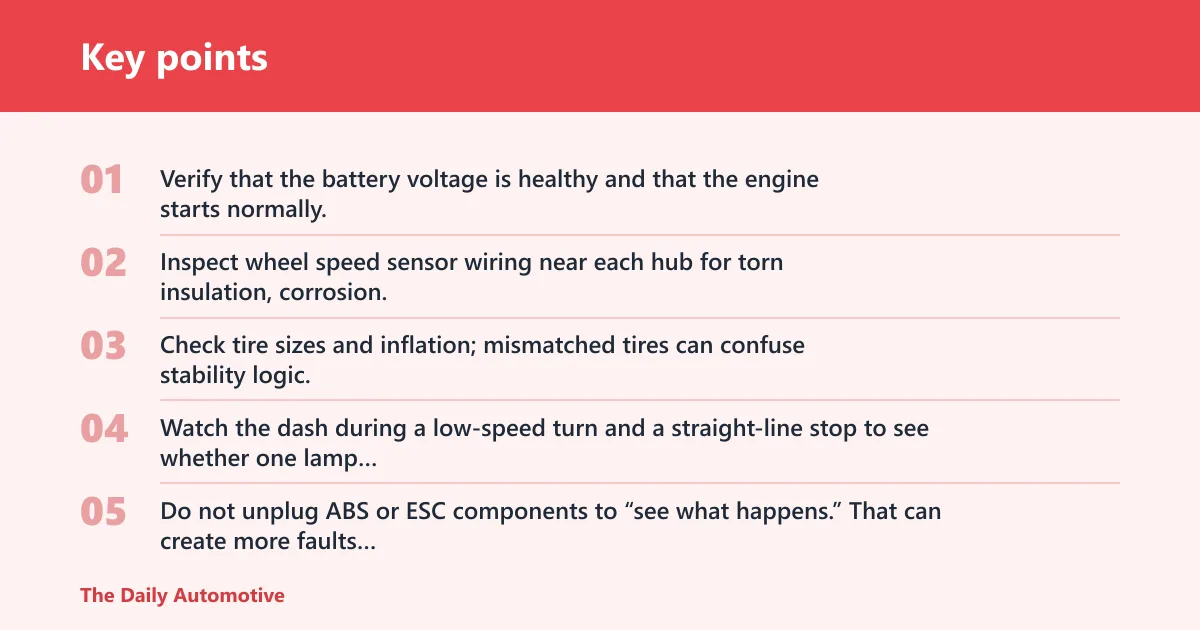
- Verify that the battery voltage is healthy and that the engine starts normally.
- Inspect wheel speed sensor wiring near each hub for torn insulation, corrosion, or a loose connector.
- Check tire sizes and inflation; mismatched tires can confuse stability logic.
- Watch the dash during a low-speed turn and a straight-line stop to see whether one lamp flashes or stays steady.
- Do not unplug ABS or ESC components to “see what happens.” That can create more faults and may disable both systems.
ABS ESC symptom matrix
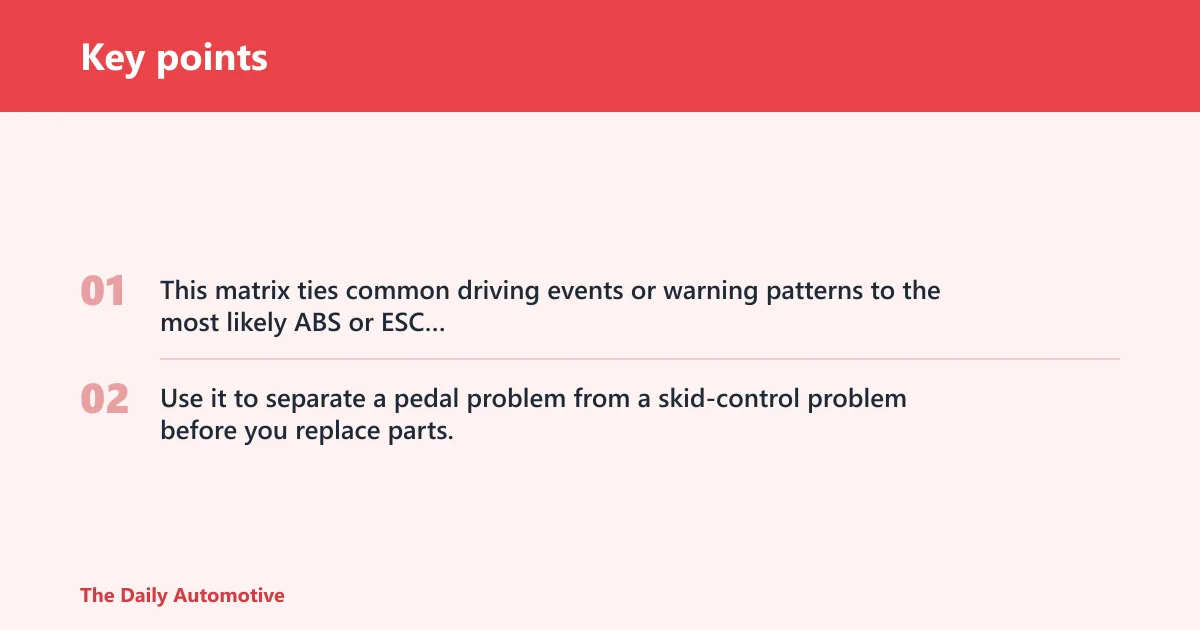
This matrix ties common driving events or warning patterns to the most likely ABS or ESC involvement, the first part that often fails, and whether the issue affects braking, stability, or both. Use it to separate a pedal problem from a skid-control problem before you replace parts.
| Driving event or warning | Most likely ABS or ESC involvement | Likely sensor/module at fault | Primary effect |
|---|---|---|---|
| Pedal pulses hard during a panic stop on wet pavement | ABS | Normal operation, not a fault | Braking |
| ABS light on after a wheel bearing or hub replacement | ABS | Wheel speed sensor gap, damaged sensor ring, or connector issue | Braking |
| ESC light flashes in a fast corner, then goes out | ESC | Normal intervention | Stability |
| ESC light stays on, ABS light stays off | ESC | Steering angle sensor, yaw rate sensor, or lateral acceleration sensor | Stability |
| ABS and ESC lights come on together after a low battery event | Both | Control-module voltage fault or lost calibration | Both |
| Brake warning lamp plus ABS light | ABS and hydraulic system | Hydraulic control unit, low brake fluid, or pressure fault | Braking |
| Car pulls on split-friction braking but no ABS pulse | ABS | Wheel speed sensor input missing from one side | Braking |
| Throttle cuts during a hill start and stability lamp flashes | ESC | Wheel speed sensor mismatch or traction-control logic fault | Stability |
| ABS light returns after clearing codes and driving a few miles | ABS | Intermittent wheel speed sensor wiring or ABS control module fault | Braking |
| Brake pedal feels normal, but the car will not correct a slide on a wet on-ramp | ESC | ESC disabled by module fault or missing steering angle/yaw input | Stability |
Choose ABS if… / Choose Electronic Stability Control if…
Choose ABS if the symptom starts at the pedal, the car is stopping straight ahead, and the issue is wheel lock-up control or an ABS warning lamp. Choose Electronic Stability Control if the symptom appears in turns, lane changes, or slides, or if the stability lamp flashes or stays on with no clear braking fault.
Choose ABS service first if you have a pulsing-pedal complaint, an ABS light after hub work, or a brake feel problem that shows up on loose, wet, or split-grip pavement. Choose Electronic Stability Control service first if the car drifts wide, rotates too much, or loses skid correction while the base brakes still feel normal.
If both lamps are on, treat the system as shared until proven otherwise. A shared HCU, a wheel speed sensor problem, or a control-module issue can disable both functions together.
Regulatory adoption and mandate timelines
NHTSA required ESC on all new passenger vehicles under 10,000 pounds starting with the 2012 model year. The same NHTSA data cited on this page says ESC reduces single-vehicle crashes by 34 percent and rollover risk by 59 percent.
FMCSA mandated ESC on all new Class 3-8 trucks and buses starting in 2017, and the rule applies to vehicles with a gross vehicle weight rating above 11,793 pounds. Those mandates reflect how much more control ESC adds in evasive maneuvers and on slippery roads.
What is an abs control module?
The ABS control module is the electronic unit that interprets wheel speed sensor input and decides when to command hydraulic pressure changes. It integrates with the ECU on many vehicles and works with the hydraulic modulator to manage anti-lock braking.
When that module faults, the ABS warning light can come on even if the base brakes still work. Because the module also feeds stability logic on many designs, a fault can spill over into ESC warning behavior too.
Start with the basics: confirm the battery is strong, inspect wheel speed sensor wiring, and verify that tire size and pressure match side to side. Then look for a pattern in the warning lights, because an ABS module often reacts to bad input before it fails completely.
If the lamp returns after a short drive, the control module may be seeing an intermittent sensor signal or a hydraulic fault. A scan tool helps, but a simple road check plus wiring inspection can still narrow the suspect list.
A safe first test is a low-speed drive on a dry empty lot where the ABS can be triggered briefly without drama. If the pedal pulses and the vehicle remains steerable during a hard stop, the basic ABS function is likely alive.
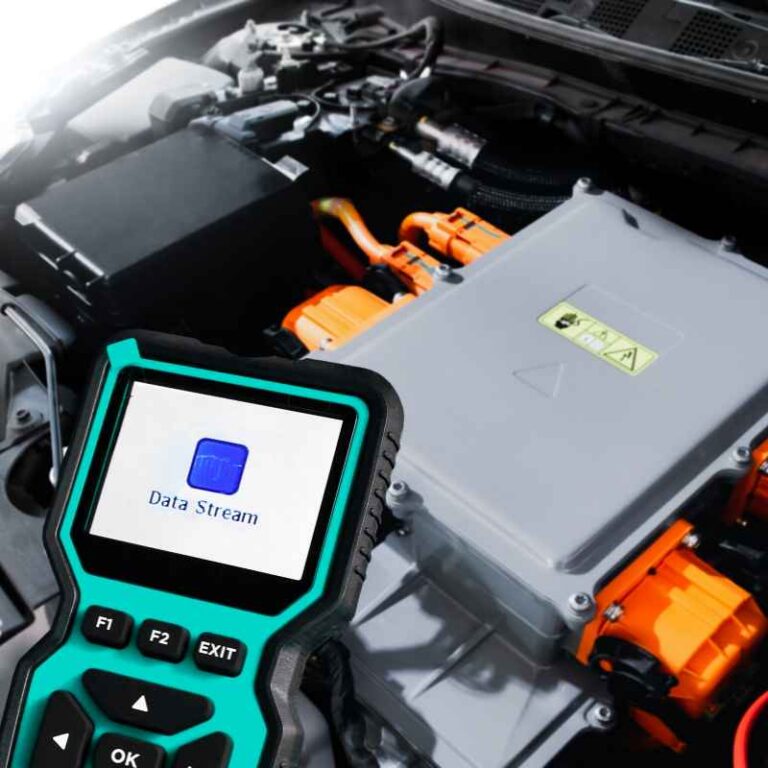
For a deeper check, look for stored codes, compare live wheel speed data, and watch for one sensor dropping out at low speed. Do not jumper connectors or disconnect sensors at random; that can create false faults and hide the real problem.
What does an abs control module do?
The module watches for a wheel that is slowing too quickly compared with the others. When that happens, it tells the hydraulic control unit to release or reapply pressure so the wheel keeps turning and steering control stays available.
In an integrated system, the same module may also share data with ESC logic. That is why a control-module fault can look like a brake problem, a stability problem, or both.
How to disable abs system
Do not disable ABS for road use. On a public road, ABS and ESC are safety systems, and turning them off removes anti-lock braking or skid correction when you may need them most.
If you need the system off for diagnosis, use the manufacturer’s service procedure or a scan tool when available. Temporary fuse removal is not a repair and can disable more than one system on integrated brake modules.
How accurate is the abs system
ABS is only as accurate as its inputs. Wheel speed sensors, wiring, tone rings, the hydraulic control unit, and the control module all have to agree before the system can modulate brake pressure correctly.
When those inputs are clean, ABS is very good at preventing lock-up during hard braking. It is less useful on loose gravel or deep snow where stopping distance can increase even while steering control improves.
Frequently asked questions
What is the electronic stability control?
Electronic Stability Control is the system that watches whether the vehicle is following the path you asked for with the steering wheel. It uses steering angle, yaw rate, and lateral acceleration inputs, then brakes individual wheels and may reduce engine torque to correct a slide or skid.
How does electronic stability control work?
ESC compares intended path with actual path. If the car is understeering or oversteering, the system brakes a specific wheel and may cut engine power to bring the vehicle back in line during cornering, evasive maneuvers, or a sudden lane change.
What does an abs control module do: the ABS control module reads?
The ABS control module reads wheel speed sensor data and commands pressure changes through the hydraulic system. It decides when a wheel is about to lock, then tells the modulator to release and reapply pressure so steering control stays available during hard braking.
What does abs prevent?
ABS prevents wheel lock-up during braking. That matters because a locked wheel loses much of its steering ability, while a rolling wheel can still help the driver steer around a hazard or hold a straight line on slippery pavement.
Abs vs cbs braking system
ABS is an anti-lock system for road vehicles; CBS usually means Combined Braking System on motorcycles. CBS links front and rear brake application, while ABS manages wheel slip during hard braking. They solve different problems and are not direct substitutes.
Cbs vs abs which is better
Neither is “better” in every case because they are built for different jobs. ABS is the right comparison point for wheel lock-up control, while CBS is about brake distribution on motorcycles. For cars and trucks, ABS and ESC are the relevant safety systems.
Products related to this article
Sponsored / affiliate links. As an Amazon Associate I earn from qualifying purchases. I may earn additional commission from eligible campaigns.