Best Dressing Sprays for Car Interiors (2026): We Compared
The best interior dressing sprays use low-residue formulas with controlled satin-to-matte finishes; for touchscreens, soft-touch plastics, vinyl, and rubber, pick solvent-free products built for cabin use. Choose the wrong dressing and you can leave greasy glare, dust cling, or hazing on trim and screens. This guide ranks top options by finish control, residue risk, and safe use on common interior surfaces.
Quick comparison
| Product | Badge | Best for | Price | ||
|---|---|---|---|---|---|
 |
Meguiar’s Natural Shine Protectant, 16 Oz | PlasticMeguiar’s | Our pick | 16 Oz · Meguiar’s · Plastic Restorer | $9.99
Price as of 21 Oct 2026
|
View |
 |
Legendary Gloss Dressing Spray 64oz (Half Gal) – Tire, TrimLegendary Car Care | Also great | 64 Oz · Legendary Car Care · Dressing Spray | $39.99
Price as of 21 Oct 2026
|
View |
 |
P&S Professional Detail Products Shine All PerformanceP & S PROFESSIONAL DETAIL PRODUCTS | Upgrade pick | 1 Gallon · P&S Professional Detail Products · Performance Dressing | $49.99
Price as of 21 Oct 2026
|
View |
 |
B’laster Plastic Restorer for Cars – Power Factory ShineBlaster | Pair with it | 11 Oz · Blaster · Plastic Restorer | $18.57
Price as of 21 Oct 2026
|
View |
 |
Adam’s Polishes Leather & Interior Matte Finish Dressing –Adam’s Polishes | Budget pick | 11 Oz · Adam’s Polishes · Matte Finish Dressing | $14.44
Price as of 21 Oct 2026
|
View |
The main trade-off is finish control versus residue risk. Glossier formulas can refresh tired trim quickly, but they are more likely to look slick on touchpoints, while satin and semi-matt products usually give you better cabin control and less glare.
Use the table below to sort by surface, not by marketing language. A product that looks right on textured dash plastic may be the wrong call on a steering wheel spoke, a piano-black bezel, or a screen surround.
How we chose
We compared finish control, residue and dust risk, surface compatibility, and how clearly each product fits interior use versus broader trim work. UV claims matter here, but only as part of the decision, not as a promise of permanent fade prevention.
We also separated true protectant dressings from quick detailer-style clean-and-shine products. That difference changes how much leveling you need, how likely streaks are, and whether the product fits a full cabin detail or a fast wipe-down.
Finish control
Matte, satin, semi-matt, and high-gloss are not the same cabin choice. Matte cuts reflection the most, satin leaves a mild sheen, semi-matt sits between the two, and high-gloss is best reserved for exterior trim or specific show-style looks, never touchpoints that need grip.
Residue and dust risk
Dry-to-touch behavior matters because sticky residue pulls dust and can leave a smeared look on textured plastic. Low-residue, water-based, and silicone-free formulas usually give better control on dashboards and door trim, especially when the goal is a clean, natural finish.
Surface safety and UV claims
These products are best treated as protectants for plastic, vinyl, and rubber surfaces, not as a fix for screens, pedals, or steering wheels where slickness matters. UV claims help most on dashboards, upper trim, and door tops that sit in direct sun.
Application ease
Spray-and-wipe products are fastest, but they can leave high spots if you overapply. Better technique is a light spray, an even wipe, then a second dry towel to level the finish. Cool surfaces matter because heat speeds evaporation and can lock in streaks.
Meguiar’s Natural Shine Protectant: best for budget satin care
Meguiar’s Natural Shine Protectant fits buyers who want a familiar, easy spray for plastic, vinyl, and rubber without chasing a wet look. Based on the listed product details, it is a practical pick for light trim refresh work and everyday dashboard care.
Its strength is simple use and a gentle visual reset. The drawback is that it is still a protectant-style spray, so it is not the right answer for glossy touchpoints or any area where you need a completely dry, friction-friendly surface.
For a daily driver, this is the kind of product that makes sense on lower dash trim, door panels, and console plastics when the goal is a modest restore rather than a dramatic shine change.
Legendary Gloss Dressing Spray: best for high-gloss trim
Legendary Gloss Dressing Spray is aimed at buyers who want a strong visual pop on tires, trim, vinyl, and dashboards. The listed details call out a high-gloss finish, non-greasy dry touch, and water-based formula, which makes it the most style-forward option in this group.
Its advantage is clear: it delivers a wet-looking finish without the old-school oily feel that many gloss dressings leave behind. The drawback is equally clear: high gloss is the least forgiving choice inside a cabin, so it is a poor fit for steering wheels, pedals, and any surface where grip matters.
Use it where you want bold contrast on textured plastics or exterior trim, and keep it away from LCD surrounds and other touchpoints that should stay low-slip.
P&S Professional Shine All Performance Dressing: best for glossy all-in-one use
P&S Shine All is the clear choice for someone who wants one product to handle rubber, vinyl, and leather with a glossy finish. The published details make it a straightforward all-in-one dressing for interior and exterior work, with fast-drying behavior aimed at reducing sling and streaking.
That flexibility is the selling point. The drawback is that a rich gloss is not the best interior default, especially if you care about the least amount of glare on a dashboard or if you are trying to keep touch surfaces as dry as possible.
It makes the most sense for dress-up work on trim, rubber mats that do not need extra grip, and exterior rubber or vinyl parts where a gloss finish is acceptable.
Blaster Plastic Restorer: best for satin plastic refresh
Blaster Plastic Restorer suits buyers who want a softer satin look on interior plastic and vinyl. The listed finish is satin, which places it in the safer middle ground for cabin work where you want renewed color without a reflective sheen.
Its main advantage is visual control. Satin usually reads cleaner than gloss and looks more natural on dashboards and door trim. The drawback is that satin products still need careful wiping, because any overapplication can leave uneven patches on textured plastic.
This is a sensible pick for faded panels that need a clean reset, especially when you want to avoid the brighter look of a gloss dressing.
Adam’s Polishes Leather & Interior Matte Finish Dressing: best for low-glare interiors
Adam’s Polishes Matte Finish Dressing is aimed at buyers who want the least reflective cabin look of the five. The listed finish is matte, and that makes it the best fit for soft-touch interiors, dash tops, and trim where glare control matters more than visible shine.
Its advantage is restraint. A matte dressing can preserve the factory look better than a glossier product, and it is easier to keep from looking greasy. The drawback is that matte finishes can appear too flat for owners who want a little visual warmth or a fresher-than-factory sheen.
Use it when the goal is clean, subdued, and easy on the eyes. It is not the right product for a glossy show-cabin finish.
Interior dressing decision matrix
This matrix separates finish, residue risk, and surface safety so you can choose by use case instead of by a slogan. It also shows where the product should stay off the car.
| Product | Finish | Residue risk | Dust attraction | UV claim | Surface compatibility | Best-use scenario | Avoid on |
|---|---|---|---|---|---|---|---|
| Shine Supply Clean ‘N Shine | Non-greasy satin | Low | Low to moderate | Yes, UV blockers | Plastic, vinyl, rubber | Fast cabin wipe-down with cleaning and conditioning in one step | LCD screens, pedals, steering wheels |
| Koch Chemie Top Star | Semi-matt | Low | Low | Not stated here | Interior plastic | Factory-look dash and trim control | LCD screens, pedals, steering wheels |
| Koch Chemie Gummifix | Natural low-sheen | Very low | Low | Not stated here | Rubber, plastic | Rubber care where slickness must stay down | LCD screens, pedals, steering wheels |
| CarPro PERL | Adjustable from low-sheen to glossy | Low to moderate | Moderate | Not stated here | Trim, tyres, interior and exterior plastic | Multi-use detailing when one bottle needs to cover more than the cabin | LCD screens, pedals, steering wheels |
| P&S Natural Finish Dressing | Natural finish | Low | Low | Yes, UV sunscreen | Vinyl, rubber | Protection for vinyl and rubber with a soft final look | LCD screens, pedals, steering wheels |
| P&S Swift Clean & Shine | Satin to light sheen | Moderate | Moderate | Not stated here | Interior surfaces | Quick clean-and-shine pass between deeper details | LCD screens, pedals, steering wheels |
| Generic silicone-free matte dressing | Matte | Very low | Low | Varies by formula | Plastic, vinyl, rubber | Touch-heavy cabins where glare must stay down | LCD screens, pedals, steering wheels |
| Generic high-gloss dressing | High-gloss | High | Moderate to high | Varies by formula | Plastic, vinyl, rubber | Exterior trim or show-style accents | LCD screens, pedals, steering wheels, slick floor mats |
Finish control matters more than shine claims
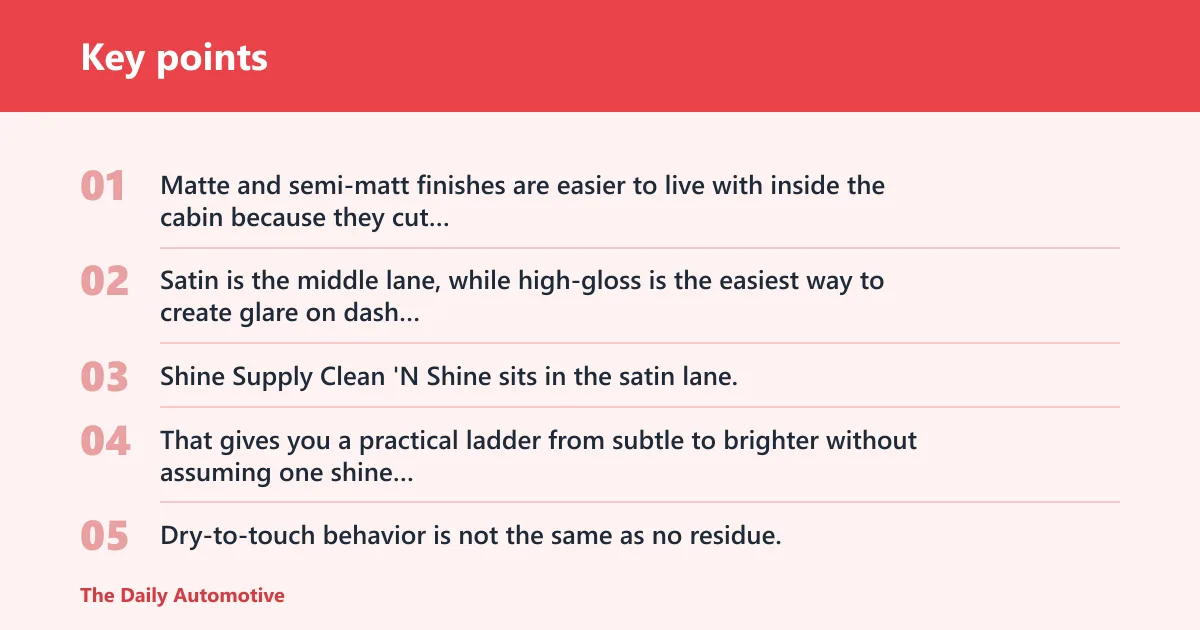
Matte and semi-matt finishes are easier to live with inside the cabin because they cut reflection without making the trim look dull. Satin is the middle lane, while high-gloss is the easiest way to create glare on dash tops and around screens.
Shine Supply Clean ‘N Shine sits in the satin lane, Koch Chemie Top Star sits in semi-matt, and Adam’s leans matte. That gives you a practical ladder from subtle to brighter without assuming one shine level fits every surface.
Residue and dust risk need separate judgment
Dry-to-touch behavior is not the same as no residue. A formula can feel dry and still leave enough film to catch dust on textured plastic. Silicone-free products and low-sheen formulas usually score better when the goal is a cleaner look between wash days.
Koch Chemie Gummifix is the clearest low-residue choice in the group because it is silicone-oil-free and positioned as non-greasy care. P&S Swift Clean & Shine, by contrast, is more about speed than the cleanest long-term finish.
UV claims matter most on sun-facing trim
UV protection is most useful on upper dashboards, A-pillars, and top door panels that sit in direct sunlight. It is less important on hidden lower plastics, but it still matters if the material is exposed for long stretches in hot weather.
Shine Supply Clean ‘N Shine includes UV blockers, and P&S Natural Finish Dressing includes UV sunscreen. Those claims help in the right spots, but they do not make a glossy dressing safe for every interior surface.
Choose application based on the finish you want
A lighter spray and a second dry towel reduce streaks, especially on textured trim. For a matte or semi-matt finish, level the product quickly and stop early. For satin, leave a slightly fuller wipe, then inspect from an angle before adding more.
Say your dashboard is warm after a drive and you spray too much product. The solvent flashes unevenly, and the panel ends up with shiny patches. The fix is simple: let the surface cool, apply less, and level with a dry microfiber before the finish sets.
Shine Supply Clean ‘N Shine: best for satin all-in-one care
Shine Supply Clean ‘N Shine is the best fit if you want one product to clean and condition in a single step while landing on a non-greasy satin finish. The listed 1 gallon size also makes sense for frequent interior work or larger detailing volumes.
What stands out is the combination of UV blockers, anti-static properties, and a satin result that is easier to manage than a gloss dressing. That makes it especially useful on dash plastics and trim where you want a controlled finish rather than a shine surge.
The drawback is simple: satin is not zero-sheen, so buyers who want a dead-flat matte look may find it a little brighter than they want. It is also not a substitute for careful wipe-down technique on screens or other slick-sensitive areas.
Koch Chemie pair: best for finish control
Koch Chemie’s interior pair is the strongest option here if finish control matters more than one-step convenience. Top Star is the better choice for plastic, while Gummifix is the cleaner fit for rubber and low-sheen trim care.
Top Star’s semi-matt result is useful when you want the cabin to look refreshed without a glossy film. Gummifix is the safer side of the pair for rubber because it is silicone-oil-free and positioned as non-greasy care.
The drawback is that these are more specialized than an all-in-one quick detailer. You get better control, but you also have to choose the right one for the right surface instead of reaching for a single bottle every time.
Koch Chemie Top Star: best for interior plastic
Top Star fits dashboards, hard trim, and interior plastic where a semi-matt finish looks closest to factory. Its strength is not dramatic shine; it is restraint and finish consistency on plastic parts that can look patchy with heavier dressings.
The honest downside is that it is less flexible than a general-purpose dressing spray. If you want one product to do plastic, vinyl, rubber, and exterior trim, this is not the broadest answer.
Koch Chemie Gummifix: best for rubber care
Gummifix is the best call when rubber needs care without slickness. The silicone-oil-free formula is the key difference, because it helps keep the finish non-greasy on parts where grip and cleanliness matter more than visible sheen.
The drawback is that it is more targeted. It is a smart rubber-and-plastic product, but it is not the broadest “everything in the cabin” spray, so you may still need a separate plastic or quick-detail product.
CarPro PERL and P&S options: best for multi-use value
CarPro PERL is the best multi-use choice when you want one dressing that can move between trim, tyres, interior plastic, and exterior plastic. Its water-based, silicon-oxide formula makes it the most flexible of the group for mixed-detail jobs.
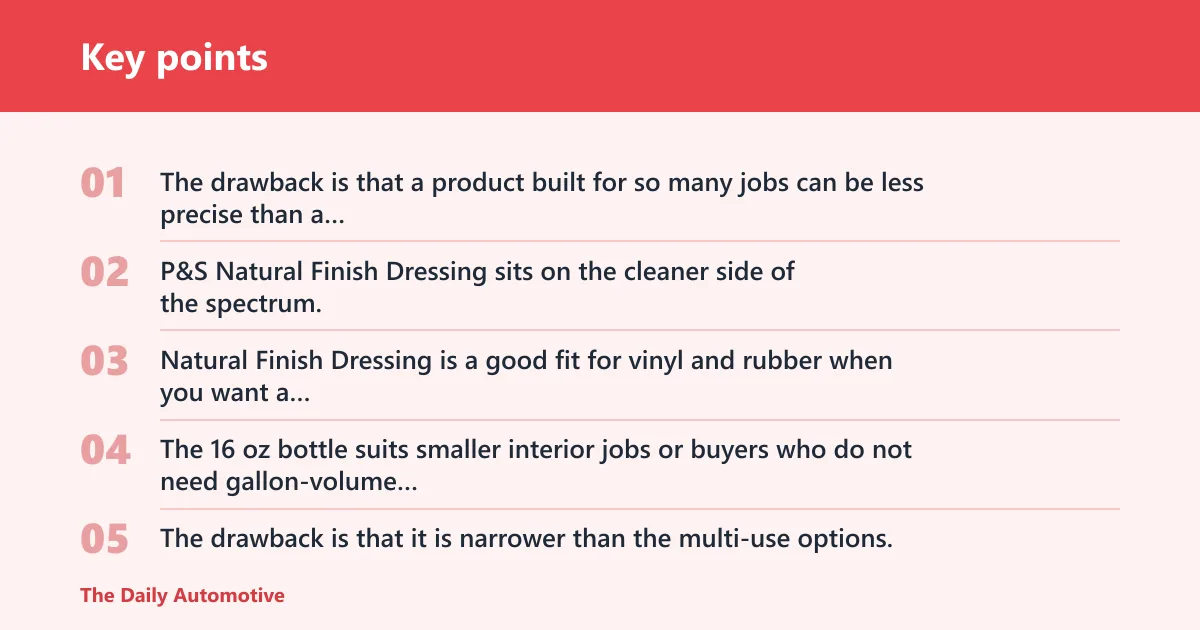
That flexibility is the appeal. The drawback is that a product built for so many jobs can be less precise than a dedicated interior-only semi-matt dressing, especially if you are trying to hold a very specific cabin finish.
P&S Natural Finish Dressing sits on the cleaner side of the spectrum, with vinyl and rubber conditioning plus UV sunscreen, while P&S Swift Clean & Shine is the faster cleanup choice when speed matters more than finish tuning.
P&S Natural Finish Dressing: best for soft protection
Natural Finish Dressing is a good fit for vinyl and rubber when you want a softer-looking result with UV sunscreen in the formula. The 16 oz bottle suits smaller interior jobs or buyers who do not need gallon-volume product.
The drawback is that it is narrower than the multi-use options. It is labeled as an interior spray dressing, so it is more of a targeted protectant than a one-bottle solution for trim, tyres, and exterior plastic.
P&S Swift Clean & Shine: best for fast clean-and-shine work
Swift Clean & Shine is for quick interior refreshes when you want a clean and shine product rather than a dedicated protectant. The advantage is speed: one bottle handles light cleaning and dressing in the same pass.
The downside is that quick detailer-style dressings usually give up some finish control. If you need the least residue and the most predictable matte result, a true protectant dressing is the safer choice.
Which one should you buy?
Pick by finish first. If you want matte, Adam’s Polishes Leather & Interior Matte Finish Dressing is the cleanest visual choice. If you want satin, Shine Supply Clean ‘N Shine is the best balanced answer. If you want semi-matt, Koch Chemie Top Star is the strongest fit. If you want high-gloss, Legendary Gloss Dressing Spray or P&S Shine All makes the most sense, but only for surfaces where shine is acceptable.
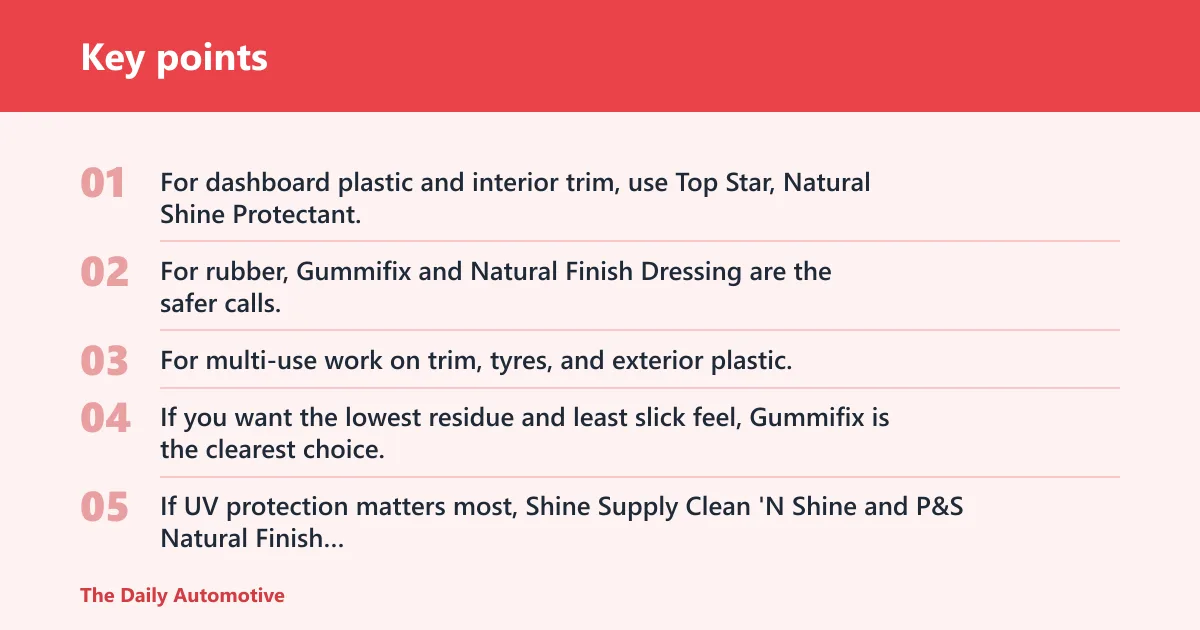
Pick by surface second. For dashboard plastic and interior trim, use Top Star, Natural Shine Protectant, or Clean ‘N Shine. For rubber, Gummifix and Natural Finish Dressing are the safer calls. For multi-use work on trim, tyres, and exterior plastic, CarPro PERL is the most flexible of the group.
Pick by need last. If you want the lowest residue and least slick feel, Gummifix is the clearest choice. If UV protection matters most, Shine Supply Clean ‘N Shine and P&S Natural Finish Dressing deserve first look. If you want the fastest clean-and-shine workflow, P&S Swift Clean & Shine is the convenience pick.
Choose Shine Supply Clean ‘N Shine if you want one bottle for cleaning and conditioning with a satin look. Choose Koch Chemie Top Star if you care more about finish control on plastic than broad versatility. Choose CarPro PERL if you want one dressing that can move between interior and exterior trim without switching products.
A common first-timer mistake is dressing every surface the same way. Picture a cabin with a glossy dashboard, a satin door panel, and a slick steering wheel spoke. That mix usually means too much product on the wrong parts. Keep glossy formulas off touchpoints, and use the least reflective finish that still meets the goal.
Frequently asked questions
What is the best interior dressing spray for a non-greasy finish?
Shine Supply Clean ‘N Shine is the best fit if you want a satin finish that stays away from the greasy look many dressings leave behind. Koch Chemie Gummifix is even more restrained on rubber because it is silicone-oil-free and positioned as non-greasy care.
Can I use interior dressing spray on plastic, vinyl, and rubber surfaces?
Yes, many interior dressing sprays are built for plastic, vinyl, and rubber, but the finish still matters. Use satin, matte, or semi-matt formulas on dash and trim surfaces, and be more selective on rubber parts that need grip rather than shine.
Which interior dressing dries to the touch and doesn’t leave a slick feel?
Koch Chemie Gummifix is the clearest match here because it is silicone-oil-free and marketed as non-greasy. Adam’s Polishes Matte Finish Dressing is also a strong option when you want the least reflective look with a dry-feeling finish on interior plastic and vinyl.
What is the difference between matte, satin, and high-gloss interior dressings?
Matte gives the least reflection and the most factory-like look. Satin adds a mild sheen without turning the cabin shiny. High-gloss creates the strongest visual pop, but it is the riskiest choice for touchpoints, since it can look slick and draw attention to streaks.
Are silicone-free interior dressings better for dashboards and trims?
Often, yes, if you want lower slickness and less residue risk. Silicone-free formulas are easier to trust on textured dashboards and trim where you want a cleaner finish. They do not automatically beat every other formula, but they usually make finish control simpler.
Can an interior dressing also work on tires or engine bay plastics?
Some can, but only if the label supports that use. CarPro PERL is the strongest example here because it is marketed for trim, tyres, interior, and exterior plastic. Most interior-only dressings should stay on cabin surfaces and not be assumed safe for every exterior job.
How do I apply interior dressing without making surfaces greasy or streaky?
Work on a cool surface, spray lightly, and wipe immediately with a clean microfiber. Then use a second dry towel to level the finish. If the panel still looks shiny in patches, you applied too much. Reduce the amount before adding another layer.
Products related to this article
Sponsored / affiliate links. As an Amazon Associate I earn from qualifying purchases. I may earn additional commission from eligible campaigns.