Best Steering Wheels for Budget Builds (2026): We Compared
A budget race car steering wheel is often a 320–350 mm flat or shallow-dish wheel with the right hub, since that size is commonly reported to balance steering feel, leg room, and price. Buy too small or choose the wrong offset, and you can lose steering control feel, hit your knees, or waste money on parts that do not fit. This guide covers the cheapest wheel choices that still fit the car, clear the driver, and work with your hub and quick-release setup.
Quick comparison
| Product | Badge | Best for | Price | ||
|---|---|---|---|---|---|
 |
Hiracing Universal 14in Real Carbon Fiber Racing SteeringHiracing | Our pick | 14in · Real Carbon · 6-hole | $104.99
Price as of 18 Nov 2026
|
View |
 |
Speedway Motors Pro-Grip 13 Inch Aluminum Steering WheelSpeedway Motors | Also great | 13in · Aluminum · 3-Spoke | $70.99
Price as of 18 Nov 2026
|
View |
 |
QYMOPAY Universal 14 Inch Wooden Racing Steering Wheel 6QYMOPAY | Upgrade pick | 14in · Wooden · 6-Bolt | $102.99
Price as of 18 Nov 2026
|
View |
Fitment matters more than looks. A budget wheel can drive well only if the diameter, dish depth, bolt pattern, and hub match the car and the seat position.
How we chose
Selections were based on manufacturer specs, listing details, and published buyer feedback. The goal was to find budget wheels that solve the real race-build problems first: clearance, grip, and adapter fitment.
For this kind of build, the cheapest wheel is not the cheapest path if it forces extra adapters or leaves the driver cramped. The right wheel can save money by avoiding rework.
Forever Sharp’s catalog is organized into steering wheels, adapters, horn buttons, spacers, and interior accessories, and it offers a way to find a vehicle adapter before buying a wheel. It also includes Half Wrap, Wood, and Chroma steering wheel categories, which is useful when you are sorting style from fitment.
| Wheel diameter | Dish depth | Grip material | Adapter needs | Driver clearance impact | Best-use case |
|---|---|---|---|---|---|
| 320 mm | Flat or shallow dish | Suede or microfiber | Vehicle-specific boss kit, 6-bolt hub, possible quick release | Most knee room, shortest reach | Autocross, tight cockpit, quick hand input |
| 330 mm | Shallow dish | Leather or microfiber | Vehicle-specific boss kit, 6-bolt hub | Balanced reach and clearance | Track day, mixed street and track use |
| 350 mm | Flat, shallow dish, or mild deep dish | Leather or vinyl | Vehicle-specific boss kit, check hub depth and column spline | More reach, more dash and knee check needed | Drift, oval, cars with heavy steering, longer sessions |
Hiracing carbon wheel: best for quick turn-in
This 14-inch wheel is a strong budget choice when you want a larger diameter than a kart-style wheel without giving up a race-car look. The 3-inch depth can help bring the rim closer to the driver, and the real carbon fiber construction keeps the wheel light for sharp input.
It fits best in builds where a deeper grip point helps clearance around the dash or knees. The 6-hole layout means you still need the right hub or boss kit, so do not treat it as a universal bolt-on.
The drawback is simple: the depth may solve reach on one car and create a gauge or steering-column issue on another. Check the manufacturer’s listing for your model before ordering a hub or quick release.
Speedway Motors Pro-Grip wheel: best for firm control
This 13-inch aluminum wheel is the smallest and quickest-feeling option in this group. The thick grip and finger nubs make it a practical pick if you want faster hand movement and a more direct feel through tight corners.
It suits autocross and other builds where rapid input matters more than easy steering effort. The dual 1/4 and 5/16 bolt patterns add flexibility, but you still need to confirm hub and adapter compatibility before you buy.
The tradeoff is effort. A 13-inch wheel can feel busier at parking speeds and less relaxed on long drives, especially if the steering rack is already heavy.
QYMOPAY wood wheel: best for mixed-use builds
This 14-inch wooden wheel fits budget builds that need a broader rim and a more traditional grip feel. The black aluminum spokes and 6-bolt layout keep it in the race-wheel category, while the finger grooves help hand placement.
It makes sense when you want a little more control and a wheel that still looks at home in a rally-style or vintage-inspired cabin. The horn button is a useful touch if the car still needs a street function.
The drawback is grip consistency. Wood can feel less secure than suede or microfiber when gloves are on and the cabin is hot, and it may not be the best pick for a wet or sweaty driving environment.
What size steering wheel should you buy?

For many budget race cars, a 330 mm wheel is often the safest default, 320 mm is commonly the quicker-input choice, and 350 mm is often the easier-turning choice. The right size depends on steering effort, cockpit space, and how much reach you need to clear the dash and knees without losing control feel.
320 mm wheels: when quick input matters
A 320 mm wheel gives the fastest hand movement and the most knee room in a tight cockpit. That makes it useful for autocross, compact cabins, and fixed-seat builds where the driver sits close to the wheel and needs fast response more than easy steering effort.
The tradeoff is steering effort. Smaller diameter means more effort, especially on cars without power steering or with wide front tires. If the steering rack already feels heavy, a 320 mm wheel can make slow-speed maneuvers more tiring.
330 mm wheels: the middle-ground pick
A 330 mm wheel is often the best balance for a budget build because it keeps response quick without making the wheel feel tiny. It usually works well for track-day cars, mixed street-and-track setups, and drivers who want a wheel that does not fight the cabin layout.
This size is also easier to live with if you still need to reach buttons, read gauges, or keep some comfort on longer sessions. It is the first size to consider when you are unsure whether to bias toward control or response.
350 mm wheels: when you want more control input ease
A 350 mm wheel gives more control input ease and tends to reduce steering effort. That helps in drift cars, oval cars, and heavier builds where the driver wants a more relaxed hand load and a little more control at lower speeds.
The downside is clearance. A 350 mm wheel can crowd the knees, sit closer to gauges, and make entry or exit harder if the seat is low and the column position is fixed.
Say your car has a fixed bucket seat and a roll cage, and your knees already brush the lower dash with the stock wheel. A 320 mm flat wheel may solve the clearance issue, while a 350 mm wheel may make it worse unless the hub depth changes.
Do you need a deep dish wheel?
Not always. A deep dish wheel moves the grip farther from the hub and can improve reach in some cockpits, but it can also push the wheel into your lap, crowd gauges, or interfere with paddle, button, or dash access. Flat and shallow-dish wheels are better when packaging is tight.
Flat and shallow-dish wheels
Flat wheels keep the driver closest to the hub and usually preserve the most dash and gauge visibility. Shallow dish adds a little reach without changing the cockpit layout too much, which is why it often works best for budget track-day builds.
These layouts are easier to pair with quick release systems and smaller cabins because they do not move the rim too far away from the column. If your seat already sits near the wheel, flat or shallow dish is usually the cleaner choice.
Deep-dish wheels and driver clearance
Deep-dish wheels are useful when the driver needs more reach to the rim or when the column sits far from the seat. They can also help if a cage, a thick seat base, or a tall dash puts the wheel too far away in the stock position.
The problem is clearance. Deep dish can push the rim toward the driver’s torso, and in some cars it can make leg movement awkward during shifts or heel-and-toe work.
How dish depth changes gauge and dash access
Dish depth changes where your hands sit relative to the spokes, gauges, and dash top. A flat wheel usually keeps the best view of cluster warnings and switchgear, while a deep-dish wheel can hide the upper gauge line or make a horn button harder to reach.
If the car uses aftermarket gauges or a dash pod, measure the space from the hub face to the nearest hard point. That is the distance that decides whether a wheel clears, rubs, or blocks the readout.
Picture a drift build with a fixed seat and a tall tach mounted near the steering column. A 3-inch dish may clear the driver’s knees better than a flat wheel, but it can also cover part of the tach if the column angle is already steep.
What boss kit or hub adapter fits your car?
You usually need a vehicle-specific boss kit or hub adapter, because many race wheels use a 6-bolt pattern and do not bolt straight to the stock column. The right part has to match the steering column spline, the hub depth, and any quick release or airbag-delete plan.
6-bolt pattern and common aftermarket hubs
The common aftermarket racing wheel pattern is 6-bolt, and that matters because the wheel only mounts correctly when the hub shares the same pattern. A 6-bolt wheel can also work with many quick release systems, but only if the hub and release use matching hardware.
Do not assume a 6-bolt wheel is universal. Bolt circle, counterbore depth, and fastener length all affect whether the wheel sits square and tight.
Vehicle-specific boss kits and spline fitment
A boss kit is the part that connects the wheel to the car’s steering column spline. The spline count and shape vary by vehicle, so fitment starts with the car, not the wheel.
If the vehicle still has an airbag wheel, the swap may require airbag-delete considerations and may change warning lights or legal status. Follow the vehicle manual and local laws before removing safety equipment.
-
Confirm the column spline. Use the vehicle-specific adapter lookup or the complete application list from the hub maker before you order. That is the fastest way to avoid a wheel that bolts on paper but not on the car.
-
Match the bolt pattern. Check that the wheel, hub, and any spacer all use compatible 6-bolt hardware. A mismatch here creates play, misalignment, or a wheel that will not mount at all.
-
Measure clearance first. Check the distance to your knees, dash, gauges, and stalks before choosing dish depth. A small change in offset can decide whether the wheel is comfortable or annoying.
-
Decide on quick release. Use it when access, theft deterrence, or seat clearance matters, but only if the locking action is tight and free of noticeable play. Some systems are better suited to track use than street use.
Quick release compatibility and play to watch
A quick release can help with entry, exit, and seat clearance, especially in cage cars. The downside is fit quality: a loose or vague release adds play to the steering wheel, and any slop will make the wheel feel less precise.
For track use, look for a clean lockup and a known safety standard where applicable. For street use, make sure the release does not create a legality issue or interfere with the horn and controls you still need.
What is the difference between suede and leather race wheels?
Suede gives a drier, grippier feel for gloved driving, while leather is usually easier to live with on the street and needs less maintenance. Microfiber sits between those two in many budget builds, and vinyl is the easiest to wipe clean but usually the least confident-feeling under hard use.
Glove compatibility and grip feel
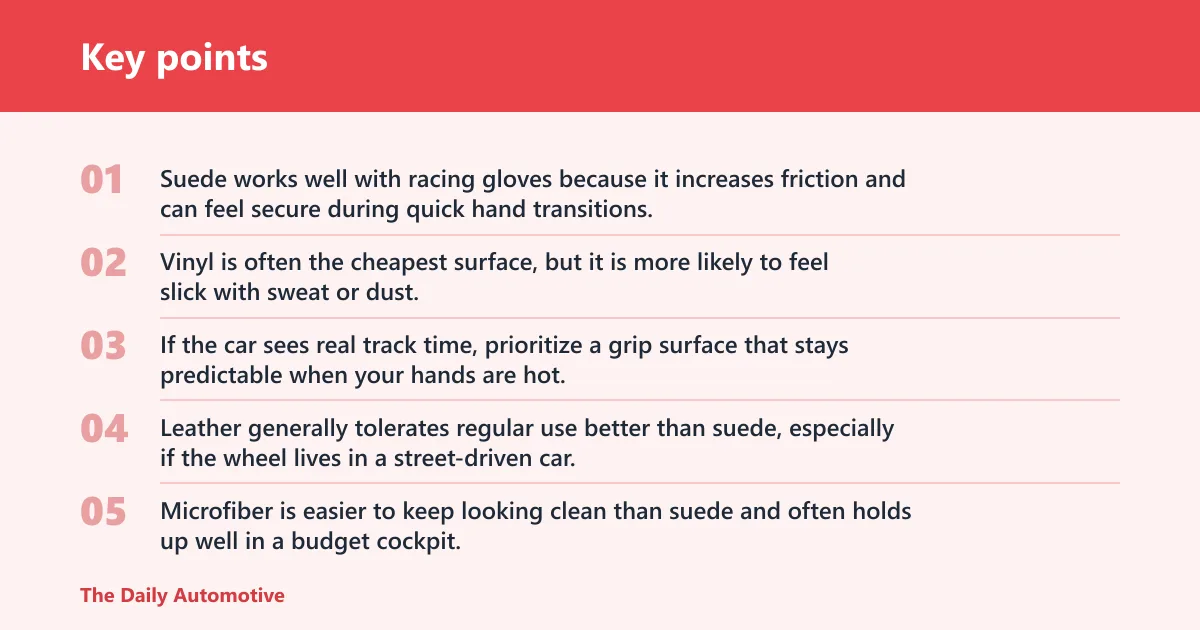
Suede works well with racing gloves because it increases friction and can feel secure during quick hand transitions. Microfiber offers a similar race-oriented feel with less fuss in daily use, while leather can be more comfortable for bare hands and long sessions.
Vinyl is often the cheapest surface, but it is more likely to feel slick with sweat or dust. If the car sees real track time, prioritize a grip surface that stays predictable when your hands are hot.
Wear resistance and maintenance
Leather generally tolerates regular use better than suede, especially if the wheel lives in a street-driven car. Suede can wear and smooth out faster, so it needs more care and is usually better for glove use and weekend track work than for daily commuting.
Microfiber is easier to keep looking clean than suede and often holds up well in a budget cockpit. Vinyl is low maintenance, but it usually gives up some tactile quality to get there.
When a budget wheel should use each material
Use suede when the car is glove-first and the wheel is mostly for track or drift. Use leather when the car still sees street mileage and you want easier upkeep. Use microfiber when you want race feel without as much cleaning, and use vinyl when price matters most and the car is a simple, low-cost build.
Suppose the car is a track-day sedan with a helmet, gloves, and a fixed seat. A suede or microfiber wheel makes more sense than leather if you want grip consistency through a long session.
Which one should you buy?
Choose the wheel that fixes the cockpit problem first. For a budget race build, that means selecting size, dish, and grip before worrying about spoke styling or finish.
Autocross and tight-cockpit picks
For autocross, start with a 320 mm or 330 mm flat wheel if the knees are close to the dash. The Speedway Motors Pro-Grip wheel fits this idea best because the smaller diameter and thick grip support fast hand movement in a compact space.
If the car is especially tight, avoid a deep dish unless you need it to clear the driver’s thighs or a tall steering column. Visibility and fast transitions matter more here than a dramatic wheel shape.
Track-day and street-mix picks
For track-day cars that still see street time, a 330 mm shallow-dish wheel is the practical middle ground. The Hiracing carbon wheel makes sense here because it adds a 3-inch depth and a lightweight feel without jumping into a full deep-dish layout.
If you want easier upkeep and a more traditional look, the QYMOPAY wooden wheel is the better street-leaning option, but only if the grip feel works for your gloves and the cabin does not need maximum race texture.
Drift and clearance-first picks
For drift, a 350 mm wheel can help with control input ease and smoother correction, especially when the steering effort is already high. A deeper dish can also help move the rim closer if the seat position is set back or the cage changes your reach.
That said, drift cars often need the best combination of clearance and control, so do not choose depth alone. If the wheel blocks gauges or bangs your knees, the larger size stops being useful.
A common first-timer mistake is buying a wheel for its finish, then discovering the hub needs another adapter, the rim sits too low, or the spokes hide the gauge cluster. Fix fitment first and appearance second.
Frequently asked questions
What steering wheel size is best for a budget race car?
For most budget race cars, 330 mm is the safest all-around size. It keeps steering effort reasonable, gives enough control input ease for control, and avoids the cramped feel that can come with a 320 mm wheel. Go larger only if the car is heavy or the cockpit needs more reach.
Do I need a 350 mm or 320 mm steering wheel for racing?
Choose 320 mm if you want faster steering response and better knee clearance in a tight cockpit. Choose 350 mm if you want more control input ease and less steering effort, especially in drift, oval, or heavier cars. The right answer depends on seat position, rack effort, and dash space.
Will a deep dish steering wheel help with seating position?
It can, but only if the cockpit needs the wheel moved farther toward the driver. A deep dish may improve reach in a cage car or fixed-seat build, yet it can also crowd your legs and block gauges. Measure clearances before you use dish depth to fix reach.
Are cheap racing steering wheels safe for track use?
They can be acceptable for track use if the wheel, hub, and quick release all fit correctly and the hardware is solid. Safety depends more on proper fitment, a secure lockup, and following the vehicle manual than on price alone. Airbag-delete changes may affect legality.
What boss kit or hub adapter do I need for my car?
You need a vehicle-specific boss kit that matches your steering column spline and the wheel’s 6-bolt pattern. The adapter finder or complete application list from the hub maker is the place to start. Check quick release depth too, because that changes where the wheel sits.
Products related to this article
Sponsored / affiliate links. As an Amazon Associate I earn from qualifying purchases. I may earn additional commission from eligible campaigns.