BBS Racing Wheels Review: Worth It for Track Cars Now?
BBS Racing Wheels are worth it if repeatable fitment, low unsprung weight, and real track support matter more than badge appeal; if the goal is the cheapest strong wheel, they usually are not. The math works only when the wheel choice matches the car, the brake package, and how the car gets used. That is where BBS earns its keep.
This guide is part of our Race car types and specs series.
BBS Racing Wheels review: are they worth it?
BBS is a strong buy for track-day drivers who want good fitment, careful engineering, and a dealer network that can help with selection. It is a weaker buy for shoppers chasing the lowest price per wheel or those who are likely to bend, curb, or replace wheels often.
BBS has operated since 1970, and the brand says motorsport has driven its technology for over 50 years. I care about that only when it shows up in parts that fit, balance, and hold up under hard use better than a generic wheel at the same price.
Bottom-line verdict for track-day buyers
For autocross, time attack, and serious street/track builds, BBS makes sense when the wheel program matches the use case. The higher price is easier to defend on a light forged wheel or a well-chosen motorsport fitment than on a heavy street package with oversized tires.
How to read this review before you spend
Judge the wheel on total ownership cost, not just purchase price. The real bill includes mounting, balancing, valve stems, hub-centric parts, adapters if needed, and the cost of a replacement if one wheel gets bent or damaged.
According to BBS USA – Technology Through Motorsports – Braselton, GA — BBS has operated since 1970.
Pros and cons
Pros for track and motorsport use
- Motorsport focus backed by long use in competition.
- Forging, flow-forming, and casting options for different budgets and goals.
- Vehicle-first fitment tools with bolt pattern and hub bore fields.
- Dealer search support for buyers who want help with selection.
- BBS Unlimited adds unusual fitment flexibility across many 5-stud applications.
Cons, hidden costs, and setup risk
- Premium pricing can outgrow the real lap-time gain.
- Wrong offset, hub bore, or brake clearance can turn a good wheel into a headache.
- BBS Unlimited adds hardware and setup complexity.
- Adapters, rings, stems, mounting, and balancing raise the real bill.
- Repair or replacement can hurt more than with cheaper wheels.
Which BBS wheel type is best for racing?
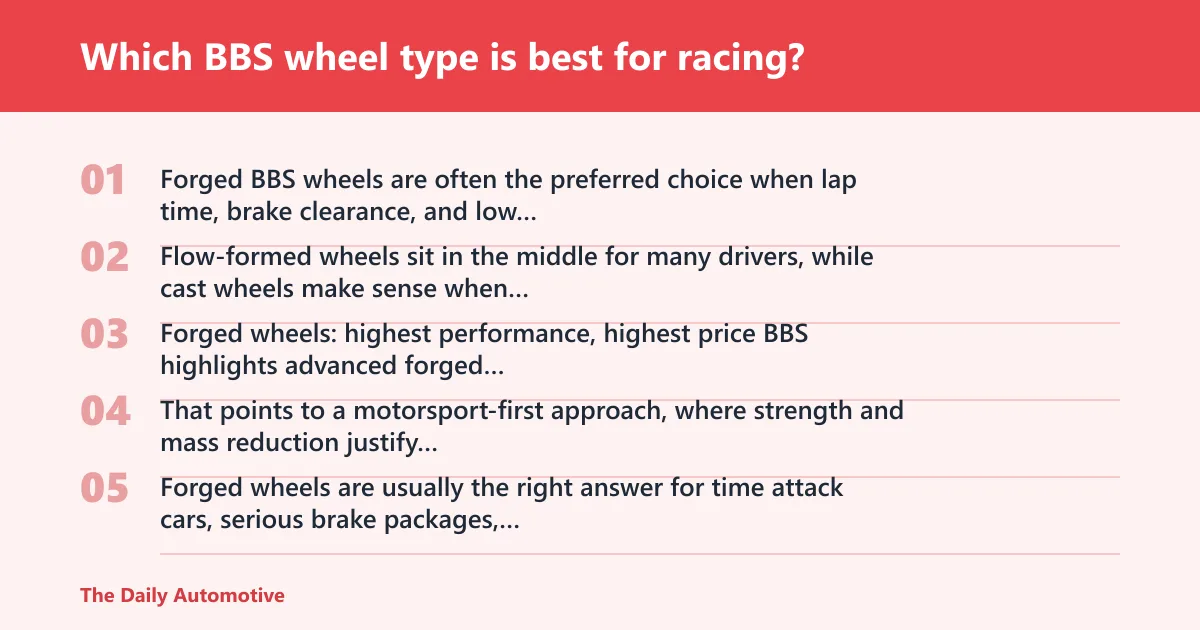
Forged BBS wheels are often the preferred choice when lap time, brake clearance, and low mass matter most, though they are typically the most expensive option. Flow-formed wheels sit in the middle for many drivers, while cast wheels make sense when the budget matters more than shaving the last bit of weight.
Forged wheels: highest performance, highest price
BBS highlights advanced forged technology as a key offering, and its two-piece forged technology dates to 1997. That points to a motorsport-first approach, where strength and mass reduction justify the cost on cars that see real track loads.
Forged wheels are usually the right answer for time attack cars, serious brake packages, and drivers who want the lowest weight they can buy without moving into full race-only parts.
Flow-formed wheels: the middle ground for many drivers
BBS lists flow-forming as one of its wheel technologies. For a dual-duty car, this is often the sweet spot, lighter and stronger than a basic cast wheel, but less costly than forged hardware.
Flow-formed wheels are often the sensible pick for track-day users who need better performance than cast gives, yet do not need the last ounce of weight savings.
Cast wheels: when lower cost matters more than peak performance
BBS also lists casting as a wheel technology. Cast wheels remain the budget-friendly option, and they are usually heavier than forged alternatives. That extra mass matters at the hub and can dull the feel of a car that already works hard on track.
They still have a place. If a car sees only light use, or the driver expects frequent wear and replacement, a lower-cost cast wheel can make more financial sense than paying for premium construction.
What makes BBS different from cheaper aftermarket wheels?
BBS is different mainly in how it approaches motorsport fitment, support, and product breadth. A cheaper wheel can look right on paper and still arrive with poor balance, weak finish consistency, or limited help when fitment goes sideways.
Motorsport pedigree versus real lap-time value
BBS describes its parts as race-proven technology and says it is proud of motorsport achievements that test its designs to the limit. That matters, but history alone does not cut lap times. The gain comes when the wheel is lighter, fits correctly, and clears the brakes without spacer tricks.
Fitment quality, runout, and balancing expectations
In practice, track buyers care about how a wheel centers, balances, and survives repeated tire changes. A wheel that needs fewer compromises is worth more than one that merely has a famous badge.
Support, dealer search, and replacement logistics
BBS offers a dealer search for buyers, which matters when exact fitment questions need a real answer. That support can save time on offsets, hub bore choices, and hardware selection, especially for cars with uncommon brake or hub setups.
Decision matrix: BBS vs forged, flow-formed, and cast wheels
This matrix scores wheel types for track use, not for styling. The numbers are a practical buying guide, not a lab result. Higher is better for weight, strength, fitment flexibility, repair risk, and cost per use.
| Wheel type | Weight | Strength | Fitment flexibility | Repair risk | Cost per use |
|---|---|---|---|---|---|
| BBS forged | 5 | 5 | 4 | 4 | 3 |
| BBS flow-formed | 4 | 4 | 4 | 3 | 4 |
| BBS cast | 2 | 3 | 3 | 2 | 5 |
| Generic forged aftermarket | 5 | 4 | 3 | 3 | 3 |
| Generic flow-formed aftermarket | 4 | 3 | 3 | 3 | 4 |
How to read the matrix
BBS forged earns the best blend of weight and strength, but not the best cost per use. BBS flow-formed is often the smarter value for cars that see both road miles and track days. Cast wins on cost, which is why it still belongs in the discussion for lower-risk use.
Will BBS fit your car without headaches?
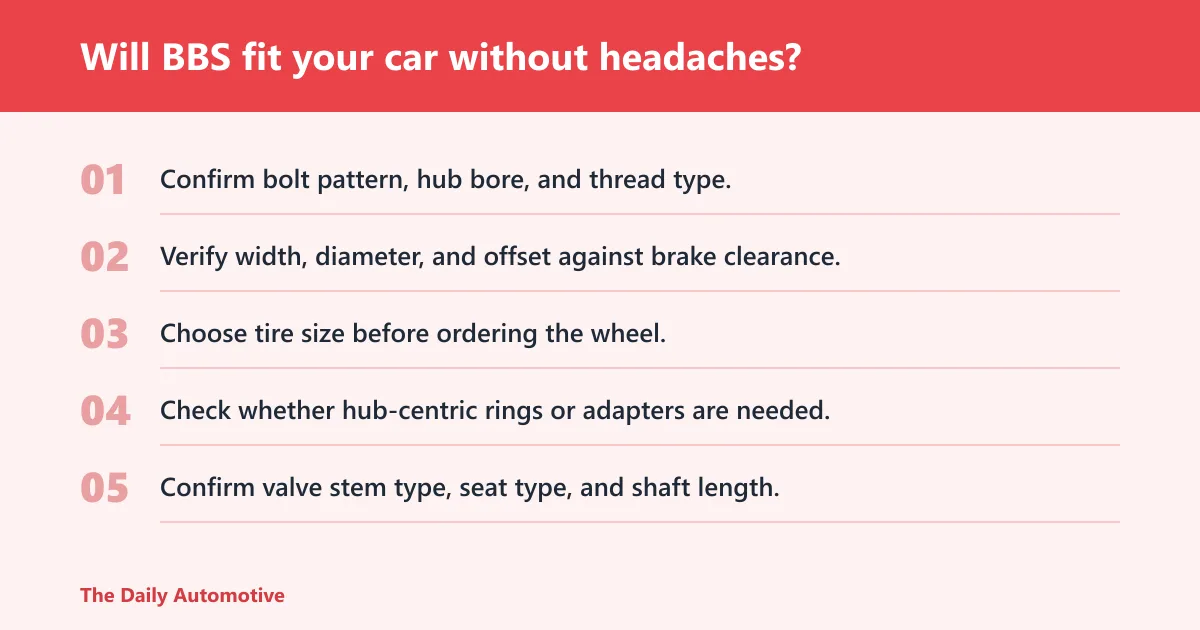
BBS can fit very well, but only when the bolt pattern, hub bore, offset, width, and brake clearance are correct. BBS product pages require choosing a vehicle first, and that is the right way to shop a wheel that will live under track loads.
Bolt pattern and hub bore
Fitment starts with the bolt pattern, because it is vehicle-specific and non-negotiable. Hub bore is just as important, because the wheel must center correctly on the hub rather than hang on the studs or bolts alone.
BBS vehicle fitment fields include bolt pattern and hub bore, which is exactly what buyers should confirm before ordering.
Offset, width, and brake clearance
Offset and width decide where the tire sits, how the steering feels, and whether the wheel clears calipers and suspension parts. For track cars, brake clearance deserves more attention than style. A wheel that misses the caliper by a few millimeters can become a bad purchase fast.
Valve stems, hub-centric rings, and adapters
BBS also shows thread, seat, and shaft length for mounting. Those details matter when hardware is not matched to the wheel. Add hub-centric rings when needed, and budget for valve stems, mounting, balancing, and any required adapters.
- Confirm bolt pattern, hub bore, and thread type.
- Verify width, diameter, and offset against brake clearance.
- Choose tire size before ordering the wheel.
- Check whether hub-centric rings or adapters are needed.
- Confirm valve stem type, seat type, and shaft length.
- Plan for mounting, balancing, and a spare or repair path.
What is BBS Unlimited and is it worth the extra complexity?
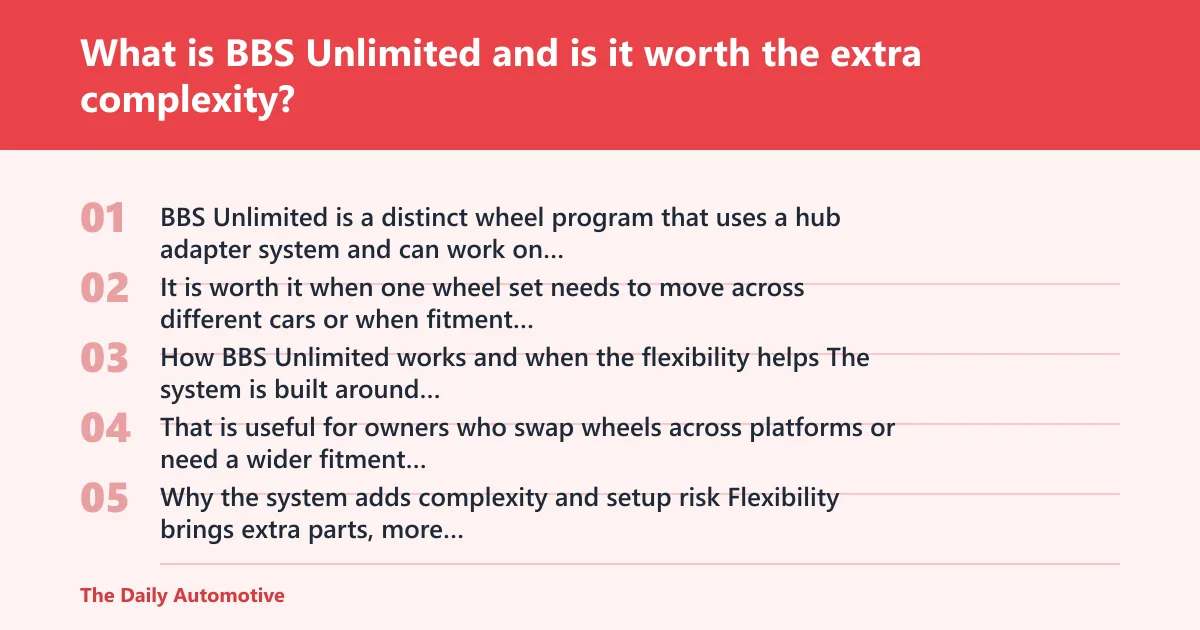
BBS Unlimited is a distinct wheel program that uses a hub adapter system and can work on nearly all 5-stud bolt patterns. It is worth it when one wheel set needs to move across different cars or when fitment flexibility matters more than simple installation.
How BBS Unlimited works and when the flexibility helps
The system is built around fitment flexibility rather than one fixed mounting pattern. That is useful for owners who swap wheels across platforms or need a wider fitment window than a standard wheel usually allows.
Why the system adds complexity and setup risk
Flexibility brings extra parts, more decisions, and more chances to get something wrong. A hub adapter system means more setup steps, more parts to inspect, and more responsibility to verify torque, clearances, and compatibility before the first session.
BBS XR as a motorsport-focused example
BBS XR is presented as an example of the brand’s motorsport-inspired design direction. It is the kind of model buyers should look at when the goal is track use first, with fitment and brake clearance sorted before style.
Who should buy BBS wheels?
BBS wheels suit drivers who want track-ready fitment, good support, and a wheel program that covers forged, flow-formed, and cast options. They are less attractive to buyers who need the lowest upfront price or expect frequent wheel damage from rough roads and tight paddock use.
Best for autocross, time attack, and dual-duty builds
Autocross drivers benefit from light wheels and consistent fitment. Time attack and serious track-day cars benefit even more, especially when brake clearance and wheel stiffness matter. Dual-duty street/track builds often land on flow-formed or forged BBS wheels because the compromise is easier to live with.
When to skip BBS and buy something simpler
Skip BBS when the car will live on rough roads, the budget is tight, or the wheel is likely to be damaged often. In those cases, a cheaper forged, flow-formed, or even cast wheel can offer better value if replacement cost and repair risk are the real concern.
Final buyer checklist before ordering
Before placing an order, confirm the exact car, brake package, tire size, bolt pattern, hub bore, offset, mounting hardware, and whether the wheel needs a hub adapter or ring. That checklist prevents most of the expensive mistakes.
How much do BBS racing wheels typically cost?
BBS racing wheels usually sit at the premium end of the market, with forged models at the top and cast models at the lower end of the BBS range. The real cost is higher than the sticker if the package needs adapters, rings, stems, or specialty mounting work.
For track use, cost per use matters more than the purchase figure alone. A more expensive wheel that lasts through more sessions, fits cleanly, and avoids repeated replacement can be the cheaper option over time.
Are BBS wheels strong enough for daily driving and track abuse?
Yes, when the wheel construction and fitment are matched to the car and tire. Forged and flow-formed BBS wheels are the safer choices for hard use, while cast wheels are better reserved for lighter-duty duty cycles or tighter budgets.
The bigger threat is often not the brand. It is abuse from curb hits, potholes, oversized tire setups, or incorrect offsets that push the wheel into contact with suspension or brake parts.
Frequently asked questions
Are BBS racing wheels worth it for track use?
Yes, when the buyer values fitment confidence, lower unsprung weight, and real support more than the cheapest possible wheel. They are less compelling if the goal is only to get a strong wheel at the lowest price. The value is in the whole package, not the badge.
What makes BBS wheels better than cheaper aftermarket wheels?
BBS tends to stand out in fitment tools, motorsport-oriented construction choices, and buyer support. Cheaper wheels can still work well, but they often ask the buyer to do more homework and accept more uncertainty on finish, balancing, and replacement logistics.
Which BBS wheel construction is best for racing: forged, flow-formed, or cast?
Forged is the top pick for pure performance, flow-formed is often the best value for mixed street and track use, and cast is the budget choice. The right answer depends on how hard the car is driven and how often the wheels are likely to be replaced.
Are BBS wheels good for autocross and time attack?
Yes. Autocross rewards light wheels and responsive fitment, while time attack rewards those same traits plus brake clearance and consistency under repeated heat cycles. BBS forged and selected flow-formed models are the strongest fits for those jobs.
What is BBS Unlimited and is it worth the extra complexity?
BBS Unlimited is a fitment-flexibility system that uses a hub adapter layout and can work on nearly all 5-stud bolt patterns. It is worth it when the same wheel must cover multiple applications, but the added parts and setup steps make it less attractive for simple installs.
Which BBS models are best for motorsport use?
BBS XR is a good motorsport-oriented example, especially for buyers who want the brand’s track focus in a modern package. More broadly, the best model is the one that matches the car’s bolt pattern, hub bore, brake package, and intended tire size without spacer guesswork.
Products related to this article
Sponsored / affiliate links. As an Amazon Associate I earn from qualifying purchases. I may earn additional commission from eligible campaigns.