Spec Miata vs Honda Civic Race Car
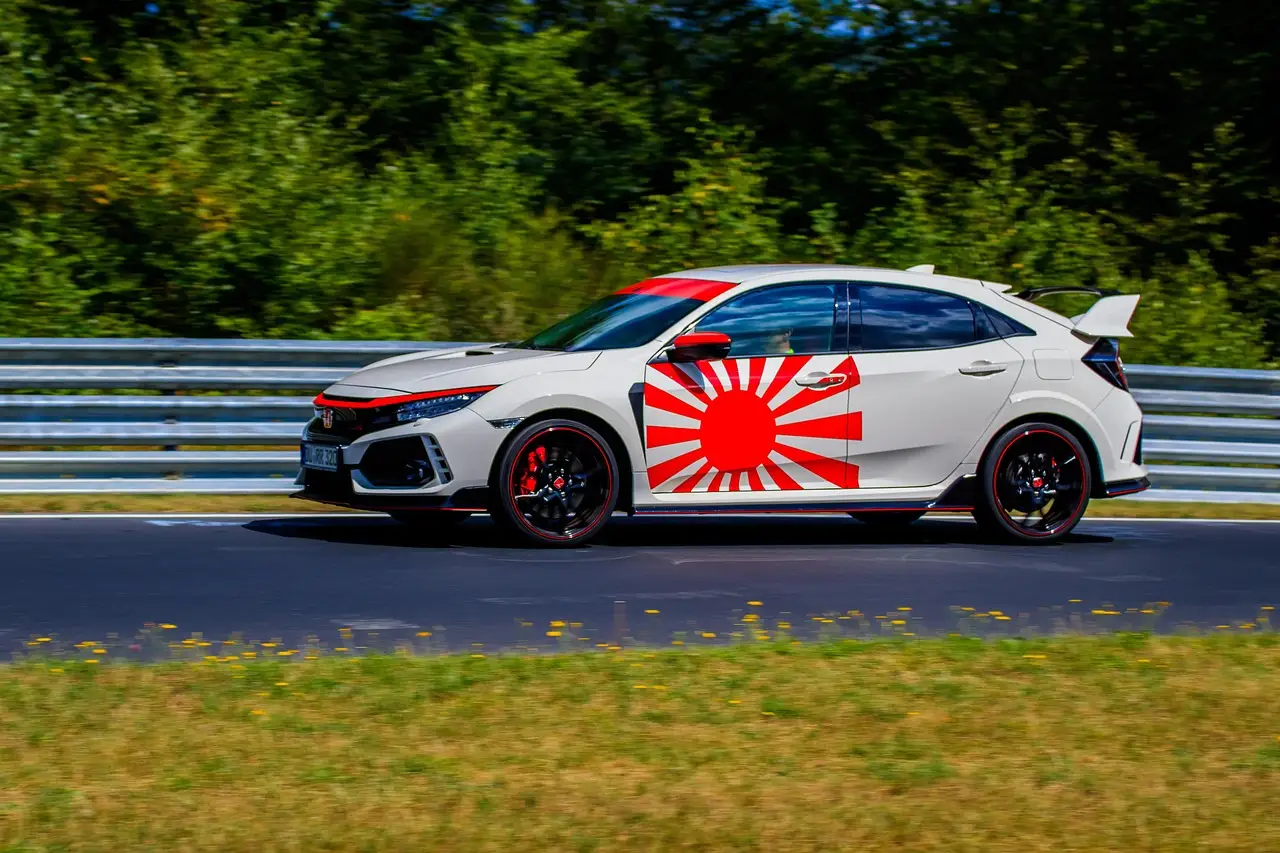
Spec Miata is the lower-variance, rule-bound choice. A Honda Civic Race Car gives you more parts freedom and a higher power ceiling. Pick Miata for class certainty, Civic for broader build options. Choose wrong, and you can spend more chasing pace, parts, and setup than the car is worth. This guide compares rules, cost, reliability, and lap-time ceiling so you can choose the platform that fits your budget and goals.
| Factor | Spec Miata | Honda Civic Race Car | Winner |
|---|---|---|---|
| Budget | Usually higher upfront if you buy a ready-to-race car, because legality and prep matter as much as the chassis. | Can start cheaper as a donor-based build, but costs rise fast once you add cage work, seat, belts, and swap parts. | Tie |
| Rules flexibility | Strict class limits keep the car in a known rule box. | Much broader freedom, unless you are building to a specific Civic class. | Honda Civic Race Car |
| Fabrication complexity | Lower if the car already fits the class and has the cage, seat, and suspension work sorted. | Higher if you are swapping engines, wiring, cooling, or driveline parts. | Spec Miata |
| Reliability | Strong when the car stays inside class limits and is maintained to spec. | Depends heavily on how complex the build is and how much custom work it uses. | Spec Miata |
| Parts availability | Excellent for a broad Miata ecosystem. | Excellent for Civic parts, especially if you stay close to factory hardware. | Tie |
| Safety spend | Usually focused on a cage, seat, and harness package that must fit class and safety rules. | Similar safety spend, but a swap-heavy build can also need more fabrication and validation. | Spec Miata |
| Upgrade ceiling | Limited by class rules, by design. | Higher if you are willing to leave spec-style limits behind. | Honda Civic Race Car |
The core difference between racing paths
The split is rule certainty versus build freedom. Spec Miata is a class, so the car has to stay inside a narrow legal box; a Honda Civic Race Car can mean anything from a light track build to a more open race shell with a swap, which changes the cost, pace, and parts story. (Wikipedia)
That matters because legality is part of performance. A car that is fast on paper but not class-legal can be expensive to certify, hard to resell inside a class, and awkward to keep consistent across seasons.
How the two paths differ
Miata buyers usually start from a Mazda MX-5 Miata, the two-seat convertible sports car launched in 1989 and known for compact dimensions and low weight. Civic buyers may start with a factory Civic shell and build toward a local time attack, open track, or a named race class. (Wikipedia)
Spec Miata rewards staying inside a ruleset. Civic builds reward choosing where to spend money: power, tire, suspension, cooling, or weight reduction.
Quick comparison matrix
If you want the short version: Spec Miata is the safer choice for sanctioned spec racing, while Honda Civic Race Car is the broader platform for custom goals. The better pick depends on whether you need a rule box or more open choices.
| Decision factor | Spec Miata | Honda Civic Race Car | Best fit |
|---|---|---|---|
| Budget | Costs stay controlled when the car already fits the class. | Can be cheaper to start, then climb fast with custom work. | Spec Miata for known costs; Honda Civic Race Car for a low-entry donor build |
| Rules flexibility | Low flexibility, high clarity. | High flexibility, but more decisions. | Honda Civic Race Car |
| Fabrication complexity | Lower if the chassis already has the required safety work. | Higher if the build needs a swap or custom fabrication. | Spec Miata |
| Reliability | Usually easier to keep consistent because the parts list stays tight. | Can be excellent, but custom combinations add failure points. | Spec Miata |
| Parts availability | Strong aftermarket support. | Strong aftermarket support. | Tie |
| Safety spend | Cage, seat, belts, and padding still cost real money. | Same basic spend, plus possible extra fabrication checks. | Spec Miata |
| Upgrade ceiling | Class limits cap the ceiling. | Higher ceiling if you leave spec rules behind. | Honda Civic Race Car |
Budget
Budget is not only the donor car. A competitive build usually spends first on safety, then on suspension, then on tires and maintenance, and only then on power if the rules allow it.
Rules flexibility
Spec Miata wins if you care about legality and parity. A spec class keeps competition driver-focused, which is the point of the rule set.
A Civic build wins if you want to choose the rulebook, or write most of it yourself in an open class. That freedom is useful, but it makes every other decision less predictable.
Fabrication complexity
The more custom the Civic build, the more likely it is to need welding, wiring changes, cooling upgrades, exhaust work, and time spent sorting fitment. Spec Miata is simpler when the car already has the correct cage and legal suspension parts.
Reliability
The simpler platform usually gets the nod here. A car with fewer custom parts tends to have fewer weak links, fewer odd fasteners, and fewer one-off fixes between events.
Suppose a Civic build needs an engine swap, custom mounts, and a revised cooling setup. That car may make good power, but the first failures are often in the swapped systems, not in the shell itself.
Parts availability
Both platforms have deep parts support. The difference is that Miata parts often arrive in class-friendly combinations, while Civic parts can range from factory-replacement pieces to highly specialized race hardware.
Safety spend
A roll cage is commonly required for serious track use. It adds weight, improves stiffness, and usually means interior removal that changes both comfort and resale.
Follow the vehicle and product manual, never work under a vehicle held only by a jack, never exceed the vehicle’s rated roof, hitch, or tow limit, keep items out of airbag zones and the driver’s view, and check local laws. The cage also has to fit the class rules and the safety rules for the series you want to run.
What Spec Miata rules change
Spec Miata rules matter because they limit what you can change and keep the car legal for the class. That usually protects resale inside the class and keeps lap times closer together, so driver skill matters more than a parts catalog.
Rules also tend to keep the build direction narrow. On a legal Spec Miata, a common example of permitted changes is limited upgrades such as tires and brakes, while major power or geometry changes are not the point of the class.
Where suspension upgrades fit
Suspension upgrades are one of the main handling changes on both platforms. Springs and shocks change damping, ride control, and how much grip the car can carry through transitions, which is why alignment and setup matter so much.
That project used a fully-functional roll cage, a performance clutch, subframe reinforcements, Toyo Proxes RR Tires, Bilstein Shocks & Struts, Eibach Springs, Eibach Anti-Roll Sway Bars, Kirkey Racing Seats, and Konig Rewind Graphite Wheels at NCM Motorsports Park.
Can a Honda Civic be built to spec rules?
Yes, but only if you mean a Civic built to a specific rulebook, not a generic Civic with track parts. A class-legal Civic can absolutely be built for spec racing, but it needs the same discipline that Spec Miata does: the right cage, the right allowed parts, and no drift into unsupported modifications.
The bigger the gap between your Civic and the class rules, the more money it takes to certify and the harder it becomes to stay legal. That is why an open-build Civic makes sense when you want freedom, while a spec-built Civic makes sense when the rulebook is already decided.
When the Civic is the better choice
Choose the Civic path if you want more room for power, more room for fabrication, or a chassis that fits your local racing series better than Miata does. It also makes sense if you already own a Civic donor and want to build around that shell instead of buying into a spec class.
Which platform is cheaper to build?
Neither platform is always cheaper. A bare Civic donor can be cheaper to buy, but a legal, sorted Spec Miata can cost less to finish if it already has the cage, seat, suspension, and class-correct parts in place.
The money split usually lands in the same places on both cars: safety first, then tires, then brakes and suspension, then maintenance. The difference is that a Civic build can spend more on fabrication and powertrain parts, while Spec Miata spends more on staying legal and consistent.
Where the money goes first
On a race build, the first big-ticket items are often the cage and seat, because they are tied to safety and legality. After that, suspension and alignment matter more than horsepower for most budget drivers.
A common first-timer mistake is to chase engine upgrades before deciding whether the Spec Miata or Honda Civic race car platform suits the driver’s budget and handling goals. Say your Civic has a fresh intake and tune but no proper seat mount or cage. The car may feel faster in a straight line, yet it is still not the right order of priorities for real track use.
Which is faster on track, a Spec Miata or a honda Civic race car?
The faster car depends on which Civic you mean. A class-correct Spec Miata usually has a higher certainty of being quick within its rules, while a heavily built Civic can have a higher ceiling if the chassis, tires, and powertrain are all sorted.
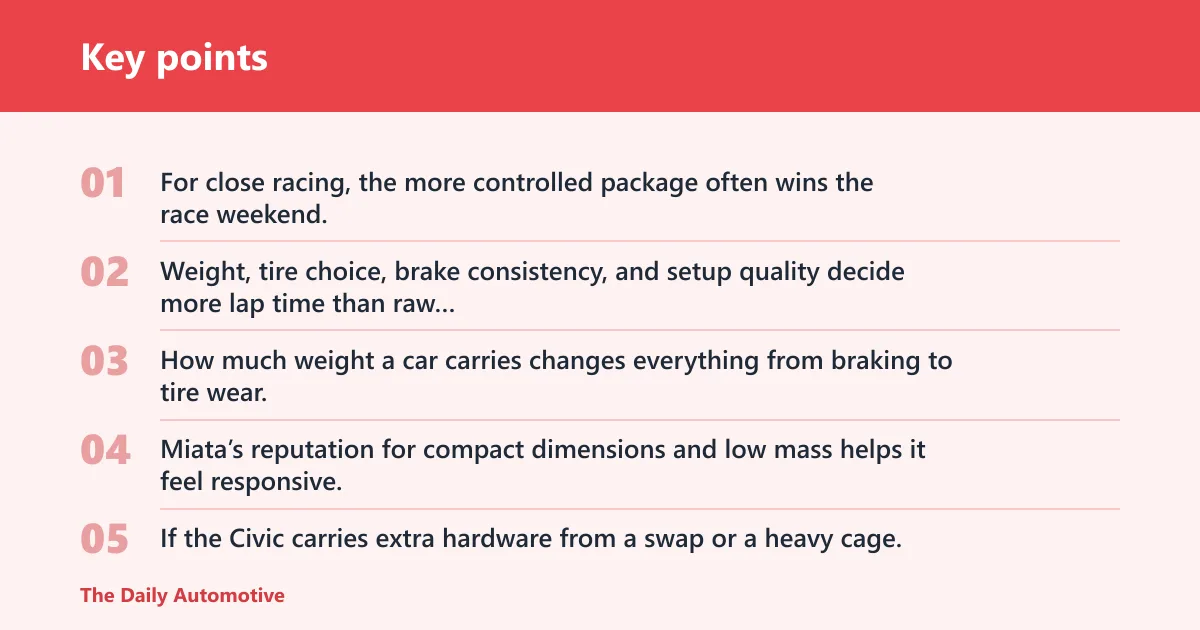
For close racing, the more controlled package often wins the race weekend, not the dyno sheet. Weight, tire choice, brake consistency, and setup quality decide more lap time than raw horsepower when the field is tight.
Weight and grip balance
How much weight a car carries changes everything from braking to tire wear. Miata’s reputation for compact dimensions and low mass helps it feel responsive, while a Civic race build can get very quick if weight is controlled and the chassis is balanced.
If the Civic carries extra hardware from a swap or a heavy cage, it can lose the advantage that the power adders were supposed to create. That is why a well-sorted Spec Miata often feels quicker than a more powerful but less refined Civic on a technical course.
Driver skill versus horsepower
In spec-style racing, the ceiling is set by the rules and by the driver. Extra horsepower matters less than staying within the grip window, braking later without cooking the tires, and carrying speed through corners.
Choose Spec Miata if… / Choose Honda Civic Race Car if…
Choose Spec Miata if you want a class-defined build, lower fabrication complexity, and a clearer path to legal competition. Choose Honda Civic Race Car if you want more build freedom, a higher power ceiling, or a platform that can be shaped around your local series and budget.
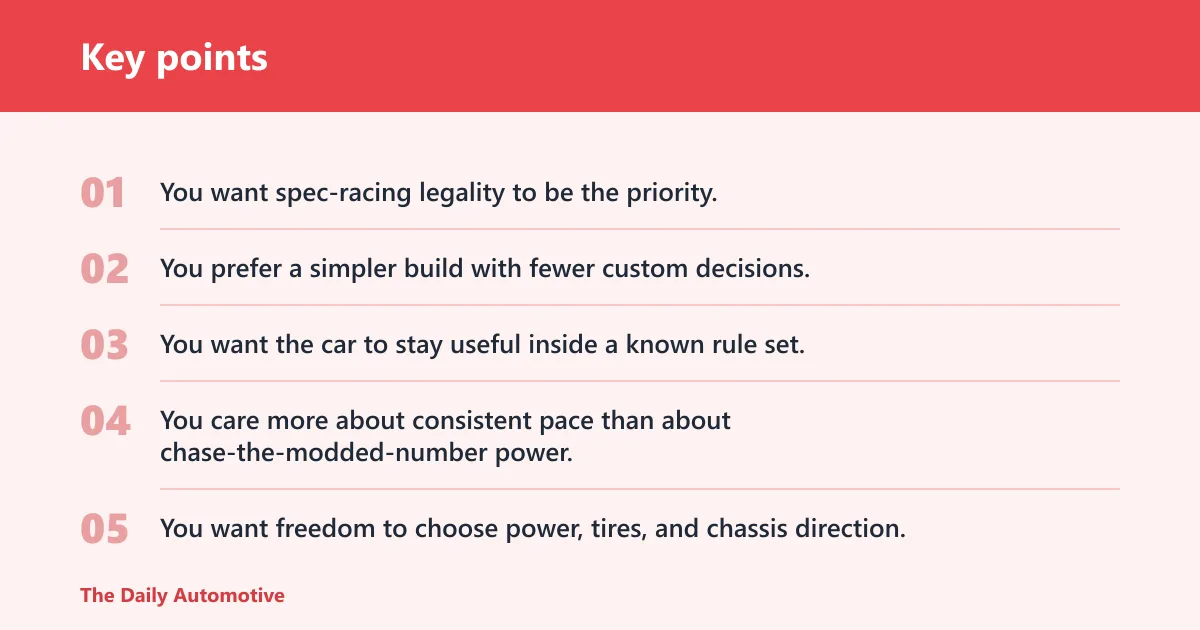
Choose spec miata if…
- You want spec-racing legality to be the priority.
- You prefer a simpler build with fewer custom decisions.
- You want the car to stay useful inside a known rule set.
- You care more about consistent pace than about chase-the-modded-number power.
Choose honda civic race car if…
- You want freedom to choose power, tires, and chassis direction.
- You are comfortable with fabrication or swap work.
- You are building for open track days, time attack, or a local class with looser rules.
- You want the option to push beyond spec-style limits later.
Best Miata for racing: NA, NB, or NC?
For racing, the best Miata depends on class rules and parts availability, not just model year. The NA is the classic starting point, the NB often offers a strong balance of cost and support, and the NC can make sense when the rulebook or class structure favors it.
If you are targeting Spec Miata, start with the generation your series allows and buy the cleanest legal example you can find. If you are building outside that class, choose the chassis that gives you the least fabrication for the most seat time.
Civic Si or Miata for racing?
Civic Si or Miata comes down to goals. The Civic Si can be a good choice if you want a modern front-drive chassis with broader street-to-track flexibility, while a Miata is often the cleaner answer for a lightweight rear-drive race build and sharper handling feel.
Miata Club vs Sport and mazda Miata Club vs Sport
Miata Club vs Sport is usually a trim question, not a racing strategy. For track use, the better starting point is the car with the equipment you need or the one that avoids expensive duplicate parts you will replace anyway.
Mazda Miata Club vs Sport matters less than the car’s condition, title status, and rule-legal setup. If you are turning the car into a race build, buy the cleaner shell and spend the difference on the cage, seat, suspension, and maintenance.
Honda Beat vs Miata
Honda Beat vs Miata is not a direct race-build comparison. The Beat is a much smaller kei car, while the Miata is a more established platform for sanctioned amateur racing, parts access, and class structure.
Frequently asked questions
Spec Miata vs Honda Civic race car: which is cheaper to build?
It depends on whether the Civic is an open build or a class-legal build. A donor Civic can be cheaper up front, but custom fabrication and swap work can erase that edge quickly. Spec Miata can cost more to buy ready-to-race, yet it may cost less to finish correctly.
Is a Spec Miata better than a Civic for beginner racing?
Usually yes, if the beginner wants spec-racing structure and a known rule set. The Miata is easier to evaluate for legality and tends to demand fewer custom decisions. A Civic can still be a good beginner car if the goal is open track days rather than strict class racing.
How much does a Miata weigh compared with a Civic race car?
The Miata has a compact, low-weight reputation, which is part of why it is so popular in racing. A Civic race car can be light too, but the final weight depends heavily on the body style, cage, and swap parts. The safer answer is to compare your exact build sheet, not the badge.
What mods are allowed in Spec Miata?
Spec rules usually keep modifications narrow so the racing stays driver-focused. The key point is legality: only the allowed items may change, and the car has to stay inside the class rules. That is why you should verify your series before buying tires, brakes, or suspension parts.
Can a Honda Civic be built to spec race rules?
Yes, if you build it to a specific Civic class and stay inside that rulebook. It cannot be treated like a generic Civic track car. The cage, seat, suspension, and any engine or tire changes must match the class requirements you plan to run.
Products related to this article
Sponsored / affiliate links. As an Amazon Associate I earn from qualifying purchases. I may earn additional commission from eligible campaigns.