Best Tire Inflators for Everyday Drivers (2026): We Compared
The best tire inflators for everyday drivers are compact 12V plug-in units or cordless models with automatic shutoff, a clear gauge, and enough speed to add 5 to 10 psi during monthly top-offs. Choose poorly, and you waste time, risk running tires underinflated, and may still be stuck with a flat in the driveway. This guide ranks portable inflators by storage, power source, ease of use, and trunk-friendly convenience.
Quick comparison
| Product | Badge | Best for | Price | ||
|---|---|---|---|---|---|
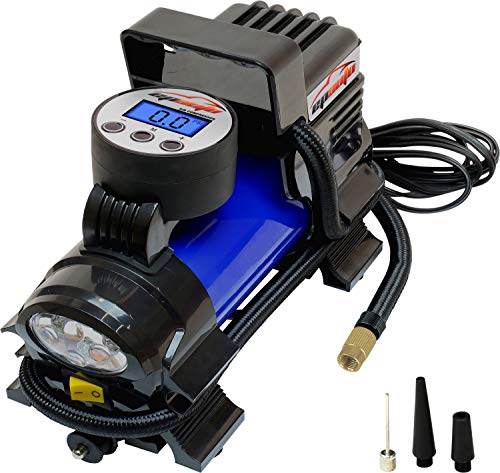 |
EPAuto 12V DC Portable Air Compressor PumpEPAuto | Our pick | 12V DC · Digital · Portable | $35.97
Price as of 13 Nov 2026
|
View |
 |
DEWALT 20V MAX Air InflatorDEWALT | Upgrade pick | 20V MAX · Tool Only · Auto Shut-Off | $127.89
Price as of 13 Nov 2026
|
View |
 |
SmittyBilt PORTABLE DUAL HEAD COMPRESSOR WITH BAG – SB2782Smittybilt | Also great | Dual Head · Portable · With Bag | $239.97
Price as of 13 Nov 2026
|
View |
For routine use, the right inflator is the one you can grab fast, power without fuss, and put back without rearranging the trunk. Faster models matter most when you have large tires or low pressure, while a simple plug-in unit can be enough for monthly checks.
📊 Car and Driver reports the Slime Cordless Pro Power has a ’15-foot, flexible hose’. Source: Best Portable Tire Inflators of 2026, Tested.
How we chose
We compared manufacturer specs, listing details, and published buyer feedback for storage, power setup, hose reach, gauge controls, and everyday convenience. The focus stayed on monthly top-offs, not emergency roadside recovery.
EPAuto 12V DC Portable Air Compressor Pump: best for simple plug-in use
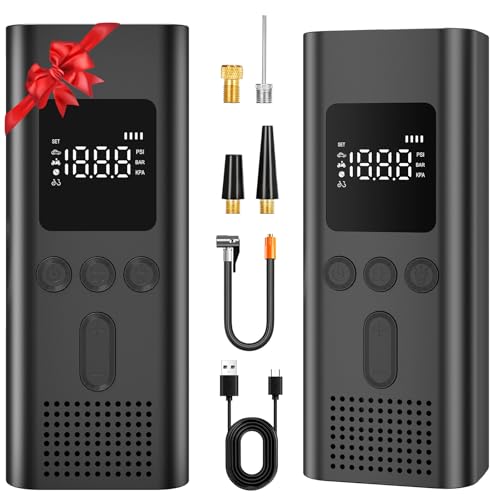
The EPAuto 12V DC Portable Air Compressor Pump fits drivers who want a low-fuss plug-in inflator for routine tire checks. Its standouts are vehicle power, auto shutoff, and a digital display that shows pressure in four units, which helps if you switch between PSI, BAR, or kPa.
The main drawback is the same one shared by many 12-volt inflators: your reach depends on cord length and vehicle layout. If you need to reach all four tires from one socket, check the listing and your car’s outlet locations before you buy.
Pros:
- Plugs into your vehicle’s 12V outlet
- Auto shutoff helps prevent overinflation
- Shows pressure in four display units
Cons:
- Needs vehicle power, so it is tied to cord reach
- Not the cleanest choice if you want an untethered trunk tool
DEWALT 20V MAX Air Inflator: best for mixed power options
The DEWALT 20V MAX Air Inflator suits drivers who want flexibility. Based on the product details, it can run on a 20V MAX battery, 12V DC, or 110V AC, so it works in a driveway, garage, or vehicle without forcing one power setup.
The tradeoff is cost and complexity. It is a tool-first inflator, so the battery platform matters, and the battery is not part of the tool-only listing. If you already own compatible batteries, that helps; if not, check the total ownership cost before choosing it.
Pros:
- Works with 20V MAX battery, 12V DC, or 110V AC
- Onboard accessory storage keeps attachments handy
- High-pressure mode with automatic shutoff
Cons:
- Tool only, so battery ownership adds cost if you are starting from zero
- Bulkier than a basic glove-box style inflator
SmittyBilt portable dual head compressor: best for larger tires
The SmittyBilt portable dual head compressor is the pick for drivers with larger vehicles who care more about reach and output than compact storage. The quick-release 26-foot hose is the headline detail here, and the carry bag helps contain the extra size when it is stowed.
The drawback is plain: this is more compressor than a casual commuter may need. It is priced and built like a more serious setup, so daily top-offs on a small sedan may not justify the space or cost unless you regularly deal with bigger tires.
Pros:
- Dual-head motor for higher air output
- Quick-release 26-foot hose adds reach
- Comes with a carry bag for storage
Cons:
- More expensive than basic everyday inflators
- Overkill if you only need occasional sedan top-offs
Which one should you buy?
If you want the simplest everyday answer, start with the EPAuto if your car already gives you easy access to a 12V outlet and the tires are close enough for the cord to reach. If you want one inflator that can move between vehicle power, garage power, and battery use, the DEWALT is the more flexible choice. If reach and airflow matter more because you drive a larger vehicle, the SmittyBilt is the better fit.
A common mistake is choosing a bulky inflator meant for roadside emergencies instead of a compact model you can use for topping off tires at home. Say your compact sedan loses 4 psi in a month and you park in a garage: a smaller plug-in inflator is usually enough, because you only need a short session and easy storage. Suppose you park outside in an apartment lot and cannot rely on an outlet nearby: a cordless or dual-power model usually makes more sense.
Which inflator fits your daily driving?
The right choice depends on where the car sits, how easy power access is, and whether you only need small top-offs or more regular tire service. For everyday drivers, slower inflation can still be fine if the inflator is easy to grab, simple to read, and reliable enough to add a few psi without a long setup.
| Vehicle type | Parking access | Preferred power source | Minimum useful specs | Red flags |
|---|---|---|---|---|
| Apartment parking | Street or shared lot | Cordless battery or dual power | Auto shutoff, clear PSI readout, enough runtime for a 5 to 10 psi top-off | Battery sold separately with no charger plan, short hose, confusing storage |
| Suburban garage | Easy access to home power | 12-volt outlet or dual power | Long enough cord or hose to reach all four tires, readable gauge, preset PSI control | Outlets that only work in one position, cord that cannot reach the rear tires |
| Compact car | Any normal parking spot | 12-volt outlet | Light weight, compact storage, Schrader valve chuck that fits standard car tires | Oversized compressor that crowds the trunk |
| SUV | Driveway or larger parking space | Dual power or stronger 12-volt unit | Long hose, higher maximum PSI than a basic mini inflator, stable body for repeated use | Short hose that makes rear tires awkward, slow inflation on a larger tire |
| No spare tire | Needs dependable trunk storage | Cordless battery or dual power | Fast enough for emergency top-offs, LED flashlight, battery status that is easy to read | Dead battery after storage, no light, no clear way to check pressure |
For apartment parking, the real issue is convenience, not maximum speed. A cordless inflator avoids hunting for a power source, but the battery needs to be charged often enough to stay useful. If the battery is sold separately, factor in the charger and platform cost before you buy.
For suburban garages, a 12-volt outlet model often makes sense because you can keep it in the vehicle and plug it in when needed. The weak point is reach. A cord that cannot comfortably work at the rear tires turns a simple top-off into a small hassle.
Compact-car owners can usually prioritize size and storage. If the inflator fits neatly in the trunk and uses a Schrader valve chuck that matches standard car tires, that matters more than a giant air output number you may never need.
Should I buy a cordless or 12-volt tire inflator?
Buy cordless if you value grab-and-go convenience, park far from outlets, or want a tool that lives in the trunk without relying on the car to power it. Buy 12-volt if you want predictable power, lower ownership cost, and don’t mind a cord. Dual-power models solve the gap between those two use cases.
When a battery pack is the easier choice
Cordless inflators are easier when you top off tires in places where power is inconvenient. They are also useful if you want the inflator ready before you start the car. The main downside is runtime: battery capacity matters, and a tool with a sold-separately battery creates extra cost and another thing to keep charged.
When a plug-in cord is the safer bet
A 12-volt outlet inflator is usually the safer budget pick for predictable home use because you do not have to manage battery health between uses. It is often the better choice if you only inflate tires once a month and want a device that is always ready as long as the vehicle has power.
What dual-power models solve
Dual-power inflators reduce the risk of having the wrong setup. A model that can use a battery, a 12-volt outlet, or house power gives you more ways to recover from a flat tire or a low battery pack. That flexibility can justify a higher price if you want one inflator for multiple locations.
Portable tire inflator checklist
Use this checklist to decide whether a model fits your vehicle and parking situation. A good everyday inflator should be easy to store, easy to power, and simple enough that you can bring it out for a quick pressure check without digging through your trunk for adapters.
| Checklist item | What to look for | Why it matters |
|---|---|---|
| Vehicle type | Compact car, SUV, or other regular passenger vehicle with standard tires | Reveals whether you need more hose reach or a stronger compressor |
| Parking setup | Apartment lot, driveway, garage, or street parking | Determines whether cordless convenience matters more than corded power |
| Preferred power source | 12-volt outlet, rechargeable battery pack, or dual power | Affects setup time and how often the inflator is ready to use |
| Minimum useful specs | Auto shutoff, clear PSI readout, hose long enough to reach the valve without strain | Reduces mistakes and makes routine top-offs faster |
| Valve connection | Schrader valve chuck that fits standard car tires, with screw-on or clamp-on style you can operate easily | A poor connector wastes time and leaks air during setup |
| Display and controls | Digital pressure gauge with preset control and PSI, BAR, and kPa modes | Makes it easier to match the vehicle placard without guessing |
| Storage | Compact body, carry bag, or onboard accessory storage | Improves trunk fit and reduces loose parts |
| Lighting | LED flashlight for dark parking areas | Helps with night use and emergency visibility |
Red flags that signal extra hassle: no clear PSI display, a hose that is too short for rear tires, a battery platform you do not already own, or a bulky body that will not sit neatly in the trunk.
How do you use a tire inflator safely?
Use the inflator only as directed by the vehicle and product manuals. Set the target PSI first, confirm the valve connection, and make sure the hose, cord, and battery or outlet setup are in good condition before you start. Never rely on a jack alone if the job requires lifting, and use jack stands on level ground if the manual calls for vehicle support.
Set the target PSI before you start
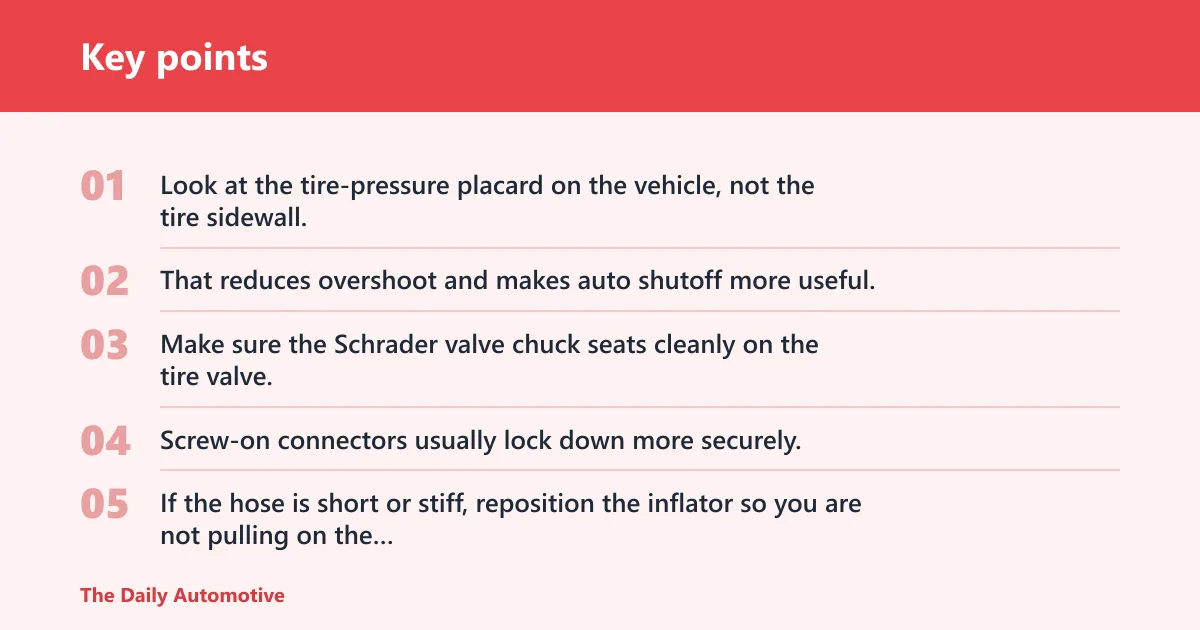
Look at the tire-pressure placard on the vehicle, not the tire sidewall, and set the inflator’s preset if it has one. That reduces overshoot and makes auto shutoff more useful, especially for everyday top-offs where you may only need a few psi.
Check the valve, hose, and cord before inflating
Make sure the Schrader valve chuck seats cleanly on the tire valve. Screw-on connectors usually lock down more securely, while clamp-on styles can be faster to remove. If the hose is short or stiff, reposition the inflator so you are not pulling on the valve stem during use.
Follow the vehicle manual for tire pressure
Check the recommended pressure when the tires are cold unless your vehicle manual says otherwise. Hot days can make pressure readings and fill behavior less predictable, so a tire that seems fine after a drive may not reflect the pressure you want for daily use.
Suppose a driver tops off a rear tire after a hot afternoon commute and the gauge seems to climb slowly. That does not mean the inflator is failing. Tire temperature can change the reading, and a hose or chuck that heats up during repeated use can also make a session feel slower than the specs suggest.
What features matter most for daily drivers?
Auto shutoff, a readable gauge, and enough hose or cord length matter more for daily driving than chasing the highest max PSI number. A good everyday inflator should feel simple enough for monthly use, not like a tool you need to relearn every time the tires drop a little.
Auto shutoff and preset PSI
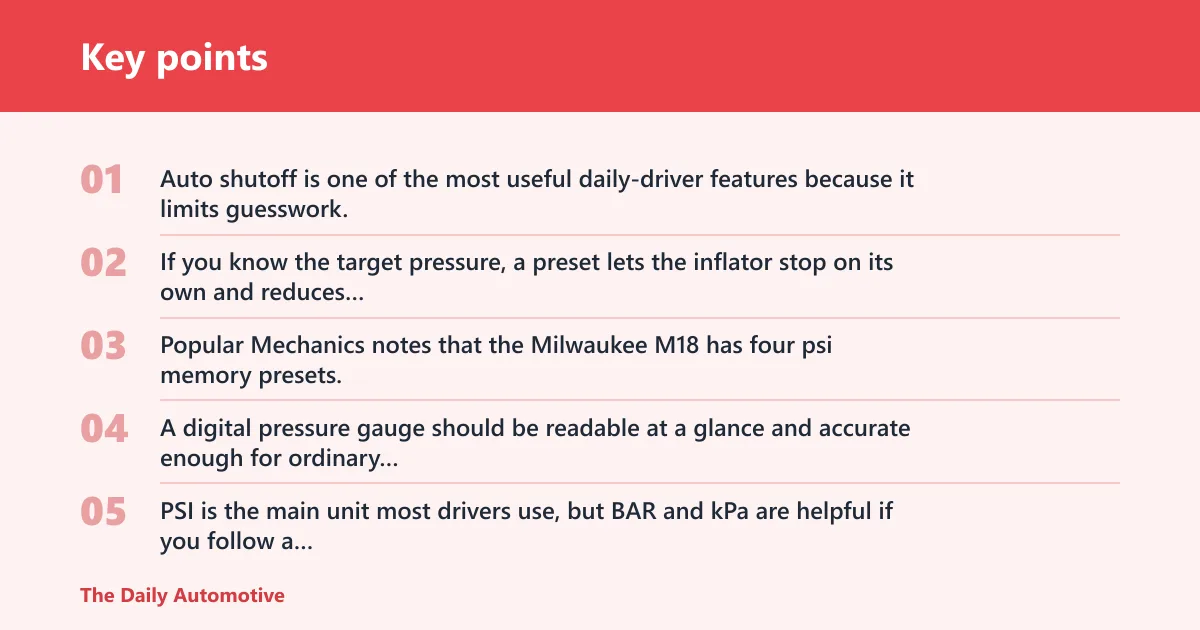
Auto shutoff is one of the most useful daily-driver features because it limits guesswork. If you know the target pressure, a preset lets the inflator stop on its own and reduces the chance of overinflation. Popular Mechanics notes that the Milwaukee M18 has four psi memory presets, which is the kind of convenience feature that saves time when you use the same pressures often.
Gauge readability and unit modes
A digital pressure gauge should be readable at a glance and accurate enough for ordinary tire top-offs. PSI is the main unit most drivers use, but BAR and kPa are helpful if you follow a placard or manual that lists multiple units. If the display is hard to read in daylight, the convenience advantage disappears fast.
Flashlight, hose reach, and storage size
An LED flashlight matters more than people expect when you are dealing with a low tire after dark or in a dim garage. Hose reach matters too. Car and Driver reports a 15-foot, flexible hose on the Slime Cordless Pro Power, while the Avid ACAP008 has a 9.8-foot power cord. Those details are the difference between easy access and awkward repositioning.
Another common first-timer mistake is assuming every inflator’s reach is the same. A short cord can be fine on one car and annoying on another, especially if the outlet is in the front cabin and the rear tires are far away. Check the layout before you buy, not after the first flat warning light.
What PSI and airflow should you look for? For daily drivers, the better question is whether the inflator can add 5 to 10 psi without a long delay. Higher airflow matters more as tire size grows. Car and Driver measured the Slime Cordless Pro Power at 2:18 min to 30 psi, while Car and Driver reports the Milwaukee M18 at under three minutes to 45 psi and describes it as the fastest to inflate a tire in testing. The same source says the Avid ACAP008 took several minutes on larger tires, which is still acceptable for occasional top-offs if you are not in a hurry.
How long does it take to inflate a car tire? It depends on the starting pressure, target PSI, tire size, and power source. For routine top-offs, a few minutes is often acceptable. If you need to inflate multiple low tires or larger SUV tires, slower models become more annoying, especially if the hose or cord setup forces you to move the unit around.
Frequently asked questions
What is a good tire inflator for everyday use?
A good everyday tire inflator is compact, easy to power, and simple to read. Look for auto shutoff, a clear pressure display, and enough reach to work without awkward repositioning. For most drivers, a 12-volt or cordless model makes more sense than a large shop-style compressor.
What is the best tire inflator for my car?
The best inflator for your car depends on where you park and how often you check pressure. If you have easy outlet access, a 12-volt model is practical. If you park away from power or want less cord hassle, a cordless or dual-power inflator is the better fit.
Which tire inflator is easiest to keep in the trunk?
The easiest trunk choice is usually the smallest unit that still has a clear gauge and enough reach for your car. Compact 12-volt inflators are often simpler to store than larger dual-head compressors. If the tool also includes accessory storage or a carry bag, that helps keep loose parts together.
Products related to this article
Sponsored / affiliate links. As an Amazon Associate I earn from qualifying purchases. I may earn additional commission from eligible campaigns.