Best Tire Inflators for Small Cars (2024): We Compared
The best tire inflators for small cars are compact 12-volt or USB-C units that fit in a door pocket or cargo cubby and can add 5 to 10 psi without straining the battery. Pick the wrong one and you end up with a bulky tool that is hard to store, slow for routine top-offs, or too weak for a flat. This guide compares size, airflow, power source, hose length, and pressure accuracy so you can pick one that fits your car.
Quick comparison
| Product | Badge | Best for | Price | ||
|---|---|---|---|---|---|
 |
AstroAI AIRUN H Tire Inflator Portable Air Compressor, 12VAstroAI | Our pick | Portable · 12V DC · Digital | $30.39
Price as of 24 Oct 2026
|
View |
 |
VIAIR 85P/00085 Portable Tire Inflator, 12V Air CompressorVIAIR | Also great | Portable · 12V · Compact | $69.69
Price as of 24 Oct 2026
|
View |
 |
160PSI Tire Inflator Cordless for Dewalt 20V Max Battery,RAYLEEY | Pair with it | Cordless · 160PSI · Tool only | $39.99
Price as of 24 Oct 2026
|
View |
For small cars, storage comes first. Then power source. Then how quickly the unit can add air to a passenger tire. A model that is easy to reach and easy to read is more useful than one that looks powerful on paper.
How we chose
These picks are built around the things small-car owners notice first: footprint, cord or hose reach, pressure control, and whether the unit can live in the cabin instead of taking over the trunk. We also weighed auto shutoff, digital readability, and whether the inflator is realistic for a glove box, door pocket, or under-seat cubby.
Speed matters, but only after fit. A compact car does not need the largest compressor; it needs one that stores close at hand and still reaches a valve stem without awkward stretching around a tight wheel well.
We also separated emergency use from routine use. A roadside tool can be larger if it lives in the cargo area, while a daily top-off tool should be small enough to keep in the cabin and simple enough to use in low light.
Small-car inflator comparison table
| Model | Footprint | Storage location | Power source | Hose length | Estimated top-off time | Realistic for compact cars? |
|---|---|---|---|---|---|---|
| AstroAI AIRUN H | Compact handheld | Door pocket or under seat | 12V DC | 9.8 ft cord | About 3-5 minutes for a 5 psi top-off | Yes |
| VIAIR 85P | Compact, slightly bulkier than glove-box class | Under seat or cargo bin | 12V cigarette-lighter outlet | Not stated in supplied specs | About 4-6 minutes for a 5 psi top-off | Yes |
| RAYLEEY cordless inflator | Tool-body only, battery pack adds bulk | Under seat or cargo bin | DeWalt 20V MAX battery | Short integrated hose style | About 3-5 minutes for a 5 psi top-off | Maybe, if you already carry DeWalt batteries |
This table is aimed at small cars, not crossovers. A compact hatchback or sedan usually has less spare room for accessories, so even a small footprint matters if you want the inflator to stay inside the cabin instead of becoming cargo clutter.
AstroAI AIRUN H: best for glove-box storage
The AstroAI AIRUN H is the cleanest fit for a small-car owner who wants a simple 12V inflator with auto shutoff, a digital pressure gauge, and an LED light. The 9.8-foot cord gives you enough reach for most passenger tires, and the added accessories make it useful for bikes and balls without turning into a large kit.
Its main advantage is that it stays practical without feeling overbuilt. For a car with limited cabin storage, that matters more than headline airflow. Road & Track notes that inflators are useful in a trunk, garage, or road trip kit, but a small-car owner often wants the tool closer than that.
The drawback is that this is still a plug-in unit. You need the car’s accessory power, so it depends on the vehicle battery and the reach of the cord. If you want something that lives in a glove box and gets used for routine top-offs, though, that tradeoff is reasonable.
VIAIR 85P: best for roadside use
The VIAIR 85P is the better pick if you want a compact 12V compressor with a more serious roadside feel. It plugs directly into a 12V cigarette-lighter outlet, includes a built-in pressure gauge, and adds a work light for dim parking lots or shoulder stops.
Based on the published details and buyer feedback, this is the one to consider when you want a sturdier emergency tool rather than the smallest possible cabin stowage. It is still compact, but it makes more sense under a seat or in a cargo bin than in a crowded glove box.
The drawback is storage efficiency. Compared with the lightest glove-box options, it asks for a little more room. If your small car has almost no spare space and you mainly need quick top-offs, the extra size may be more than you want to carry every day.
RAYLEEY cordless inflator: best for battery flexibility
The RAYLEEY cordless inflator is the best fit if you already own DeWalt 20V MAX batteries and want a no-cord option. That makes it useful when you do not want to route a cable around the car, and the built-in gauge plus auto shutoff make it easy to set a target PSI and walk away.
This style is appealing for small cars because it removes the cord from the storage problem. You still need to keep the tool body and battery somewhere, but the setup is easier to move between cars and easier to use in awkward parking spaces.
The drawback is obvious: it is tool-only, so the battery is part of the purchase decision. If you do not already have compatible DeWalt packs, the value case weakens. It is also a less tidy fit for the smallest storage spaces because the battery adds bulk.
Battery or 12V inflator: which is better?
For most small-car owners, 12V is the safer default because it is always ready when the car is running and does not require battery charging ahead of time. Battery-powered inflators are better when you value cord-free use, own compatible batteries already, or do not want to depend on a 12V outlet in an older or very small cabin.
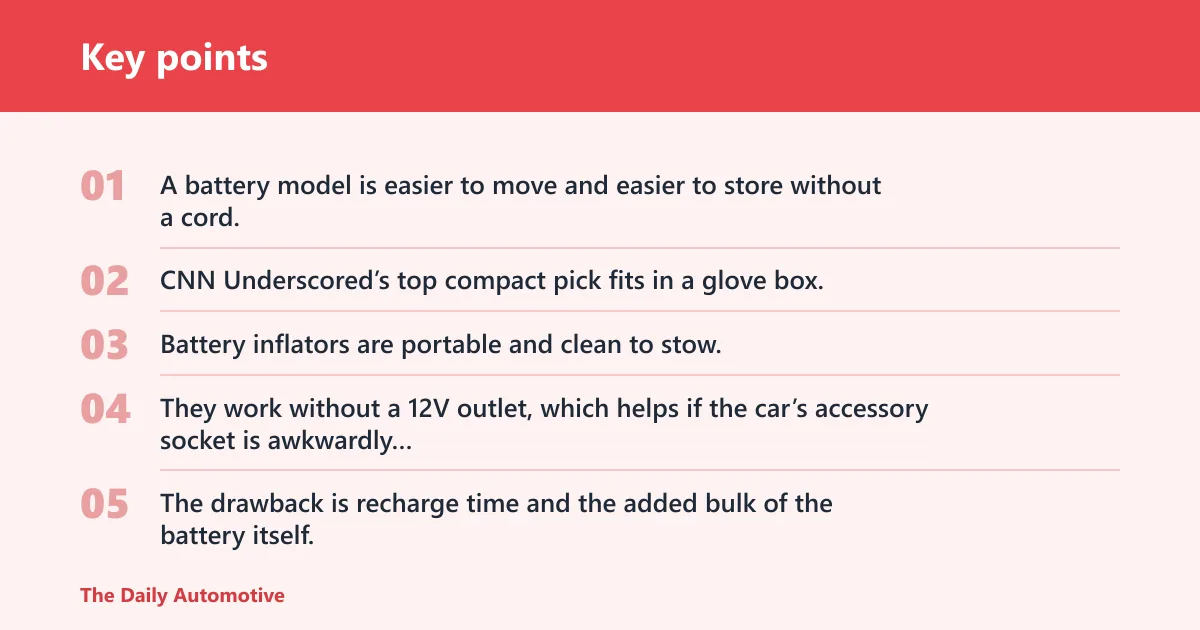
The tradeoff is simple. A battery model is easier to move and easier to store without a cord, but a plug-in unit avoids recharge planning. CNN Underscored’s top compact pick fits in a glove box, which shows how small a useful 12V inflator can be when the design is tuned for compact storage.
Battery-powered pros and trade-offs
Battery inflators are portable and clean to stow. They work without a 12V outlet, which helps if the car’s accessory socket is awkwardly placed or already used for another device. The drawback is recharge time and the added bulk of the battery itself.
For a small car, battery life matters most when the inflator is expected to sit untouched for long stretches. If the charge is low when you need it, the portability advantage disappears quickly.
12-volt pros and trade-offs
12-volt inflators are the easier match for occasional top-offs and roadside use. They are usually cheaper, simpler, and better suited to compact-cabin storage because there is no separate battery to keep charged. The downside is dependence on the vehicle battery and cord length.
That last point matters around compact wheels. A short cord can turn a simple valve check into a frustrating reach, especially on cars with tight wheel wells or awkward valve placement.
High-airflow inflator: best for faster top-offs
If speed matters, look at airflow as the rough indicator, then translate it into a real job: adding a few psi to a passenger tire. Road & Track reports a passenger tire hit 38 psi in under three minutes, and CNN Underscored says the Gooloo GT160 Dual averaged 37 seconds for top-offs, which is the kind of pace that makes routine checks feel practical.
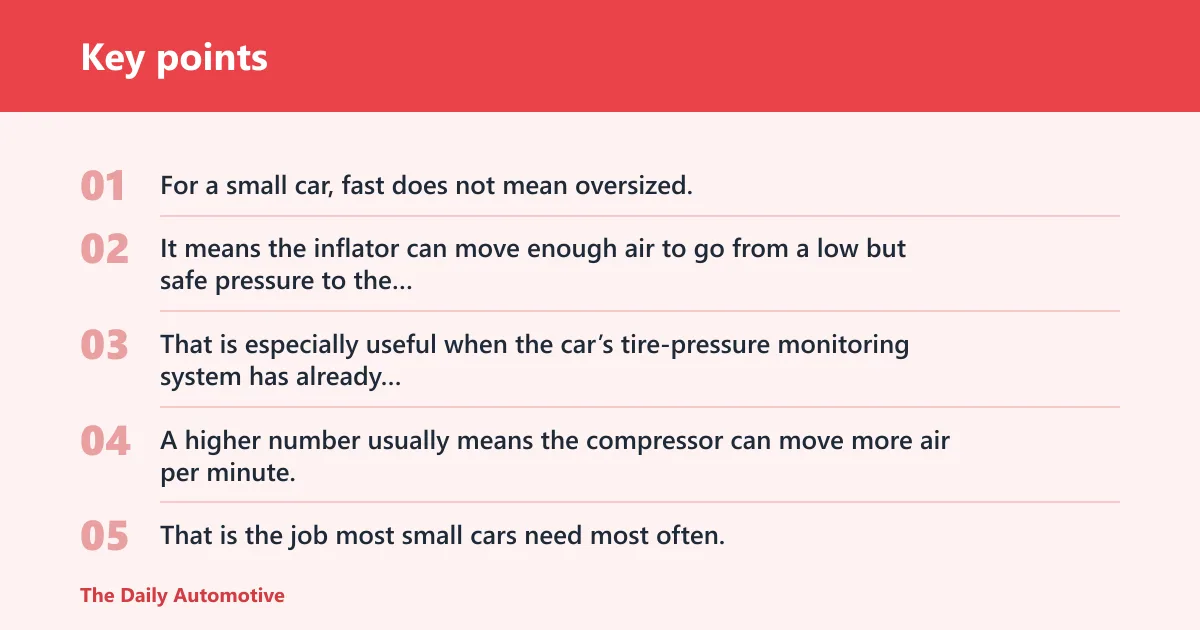
For a small car, fast does not mean oversized. It means the inflator can move enough air to go from a low but safe pressure to the target setting without making the owner wait around in a parking lot. That is especially useful when the car’s tire-pressure monitoring system has already warned you that one tire is drifting low.
What CFM tells you
CFM is a speed signal, not the whole story. A higher number usually means the compressor can move more air per minute, which helps with fill rate, but the real test is still how long it takes to add 5 to 10 psi to a passenger tire. That is the job most small cars need most often.
Do not chase the highest number alone. A compact inflator with good pressure control and a clear display can be more useful than a larger unit that is awkward to store.
When speed matters most
Speed matters when the tire is low enough that you need a quick correction before commuting. It also matters in cold weather, when a tire can read lower than expected and you want to bring it back to the door-jamb target pressure without waiting.
Suppose your hatchback is down 6 psi in one tire and you are parked in a narrow apartment garage. A fast inflator cuts the time spent blocking space, and a clear shutoff point keeps you from overshooting while you are watching traffic and the pressure display at the same time.
What matters in a small-car inflator?
The main questions are not glamorous ones. You need the right PSI setting, a readable display, enough hose or cord reach, and a body small enough to store where you will actually keep it. Those details decide whether the inflator gets used often or stays buried in the cargo area.
Rolling Stone recommends a digital LED screen for easier use, and that is especially relevant in a small car where the tool may be used outside at night, in a dim garage, or on the side of the road.
PSI settings and cold-tire checks
PSI is the tire pressure reading you set against the vehicle maker’s cold-tire specification. That target is usually on the driver-door placard or in the owner’s manual. Use the cold reading, not a tire that has just been driven on, because heat changes the number.
The car’s tire-pressure monitoring system helps by warning you that pressure is drifting, but it does not replace the target setting. Set the inflator to the correct PSI and let auto shutoff stop the fill at the preset point.
Auto shutoff and display readability
Auto shutoff prevents overinflation by stopping at the pressure you set. That matters more than it sounds, because a small car often has less room to kneel, watch the gauge, and babysit the fill. A digital LED display is easier to read at night and easier to trust than a tiny analog gauge in poor light.
A common first-timer mistake is aiming for “close enough” instead of the placard number. That can leave a tire underfilled in winter or overfilled after a warm garage stop, and the difference shows up as handling, wear, and TPMS alerts.
Hose length, adapters, and storage
Hose and cord length matter because compact wheels can hide the valve stem behind spokes or near the brake hardware. If the inflator cannot reach cleanly, the owner ends up twisting the hose at an awkward angle or moving the car just to get a better approach.
Adapters are useful, but only if they do not create clutter. A small-car inflator should keep its extras organized so the nozzle, ball needle, and bike adapter do not become loose parts rolling around the cabin.
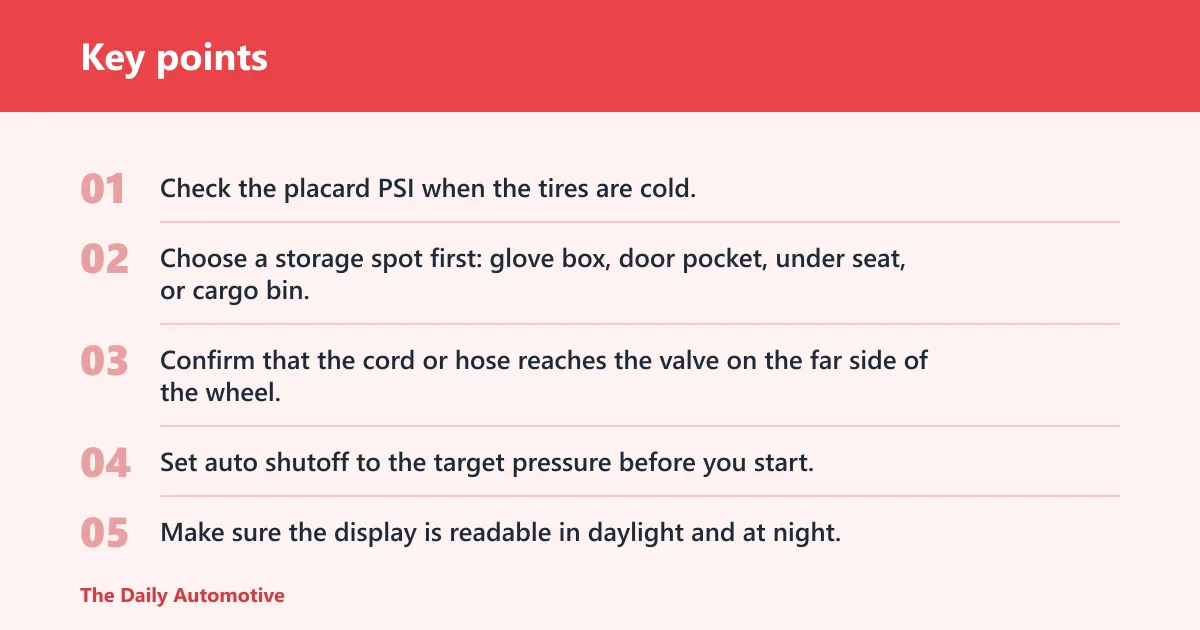
- Check the placard PSI when the tires are cold.
- Choose a storage spot first: glove box, door pocket, under seat, or cargo bin.
- Confirm that the cord or hose reaches the valve on the far side of the wheel.
- Set auto shutoff to the target pressure before you start.
- Make sure the display is readable in daylight and at night.
Which one should you buy?
If the goal is the tightest storage fit, start with the AstroAI AIRUN H. It is the easiest of the three to justify for a glove box or door pocket, and it gives you the basic features that matter most: 12V power, digital pressure readout, auto shutoff, and enough cord reach for routine top-offs.
If you want the most roadside-friendly choice, the VIAIR 85P is the stronger emergency pick. It is still compact, but its setup feels more suited to a trunk or under-seat location than to the smallest cabin storage spaces.
If you already own DeWalt batteries and want cord-free flexibility, the RAYLEEY cordless inflator makes sense. It is the least tidy option for a tiny car if you are starting from scratch, but it is the most convenient if the battery system is already part of your toolkit.
Road & Track’s top pick includes a jump starter, and that kind of all-in-one setup is useful if you want a roadside kit in one package. For most small cars, though, separate compact tools are often easier to store and easier to keep organized.
Frequently asked questions
What is the best tire inflator to buy?
The best tire inflator to buy for a small car is the one that fits your storage space first and still has auto shutoff, a readable display, and enough hose reach for the far wheel. For most compact cars, a small 12V model is the most practical starting point because it balances size and usefulness.
What is the best portable air compressor for car tires?
The best portable air compressor for car tires depends on how you store it and how often you use it. For small cars, compact 12V units are usually the best match. If you need cord-free use and already own a compatible battery system, a cordless model becomes more attractive.
Which is the best tyre inflator for car?
The best tyre inflator for a car is the one that matches the car’s use pattern. For a small car, that usually means a compact unit with a digital PSI display, auto shutoff, and enough reach to avoid awkward valve access. Speed is useful, but storage fit matters just as much.
What features matter most in a tire inflator for a small car
The biggest features are compact storage size, hose or cord reach, clear PSI control, and auto shutoff. A digital LED display helps in low light, and a built-in gauge makes it easier to set the correct cold-tire pressure without guessing. Those basics matter more than extra attachments.
Will a compact tire inflator fit in a glove box or under a seat?
Some will, some will not. CNN Underscored’s best compact pick fits in a glove box, which shows that truly small units can live in the cabin. Under-seat storage is easier to achieve, but you should still check the footprint and cord storage before buying.
How fast should a portable tire inflator fill a passenger tire
For a passenger tire, a good compact inflator should make a small top-off useful in minutes, not in a long wait. Road & Track reports a passenger tire hit 38 psi in under three minutes, and CNN Underscored says one compact unit averaged 37 seconds for top-offs, which is a strong speed reference point.
Should I choose a battery-powered or 12V tire inflator?
Choose battery-powered if you want cordless convenience and already own compatible batteries. Choose 12V if you want the simpler, smaller, and usually cheaper option for routine top-offs. For many small cars, 12V is the better default because it avoids charging another battery and usually stores more neatly.
What PSI and airflow are enough for a small car tire inflator
Enough PSI means the inflator can reach your car’s cold-tire target, which is usually printed on the door placard. Enough airflow means it can add 5 to 10 psi quickly enough to be useful for routine checks. Higher CFM usually means faster fills, but the real test is whether the inflator handles a passenger tire without wasting time.
Products related to this article
Sponsored / affiliate links. As an Amazon Associate I earn from qualifying purchases. I may earn additional commission from eligible campaigns.