Can Felons Rent Cars? Essential Guide to Approval Rules
Yes, many people with felony records can rent cars, because most agencies screen for age, license status, payment method, and driving record rather than a felony alone. A bad counter check can mean a denied pickup, lost time, and a nonrefundable reservation fee. This guide explains what rental companies verify and how to judge your approval risk before you arrive.
Can felons rent cars?

Often, yes. A felony record by itself is usually not the main rental gate; the bigger questions are whether your license is valid, your payment method clears, and you meet the company’s age rules. Final approval still happens at pickup, and location-level policy can change the result.
Why policy variation matters by company and location
Rules can differ by brand, airport, and neighborhood branch. One desk may take a debit card with a larger deposit, while another may insist on a credit card hold. The same reservation can be accepted online and refused at the counter if staff cannot verify your documents or payment method.
Reservation approval is different from pickup approval
An online reservation is usually only a hold on inventory, not a promise of rental approval. The counter agent can still reject the rental if the name on the card does not match the license, the license is expired, or the renter does not meet the age threshold for that vehicle class.
What rental companies actually check
Most agencies care about practical screening points. In many cases, a valid driver’s license, a matching identity document, an acceptable card or deposit, and the renter’s age matter more than the felony record alone. The felony record can still matter if it appears alongside supervision status or travel restrictions.
- Driver’s license status: expired, suspended, revoked, or mismatched names are common denial triggers.
- Age: younger drivers may face higher fees or tighter vehicle limits.
- Payment: card type, deposit, and hold amount can decide approval.
- Identity: counter staff may ask for a second ID if anything is unclear.
Do rental companies run background checks?
Usually not as a standard, universal step. Many companies rely on license verification, payment screening, and identity checks instead of a formal criminal background check. Extra review can happen when documents do not match, payment is unusual, or the rental request raises travel or age concerns.
When a standard screening is more likely than a criminal check
A routine rental file is typically about driving eligibility, not criminal history. Staff usually confirm the name on the card and license, inspect the license for validity, and check whether the renter qualifies for the booked vehicle. That means many felony-related issues never surface unless another problem triggers review.
What can trigger extra review at pickup
Extra scrutiny can come from a debit card deposit, a one-way request, a luxury or van booking, or a mismatch between the reservation and the documents presented. A rental desk may also slow down if the license address, age, or name format looks different from the booking file.
Why company policy is the deciding factor
There is no single industry rule that says every company must treat a felony record the same way. Some locations may never ask about criminal history. Others may have internal risk filters or local policies that are not visible during online booking. The branch policy controls the final answer.

Will a felony stop me from renting a car?
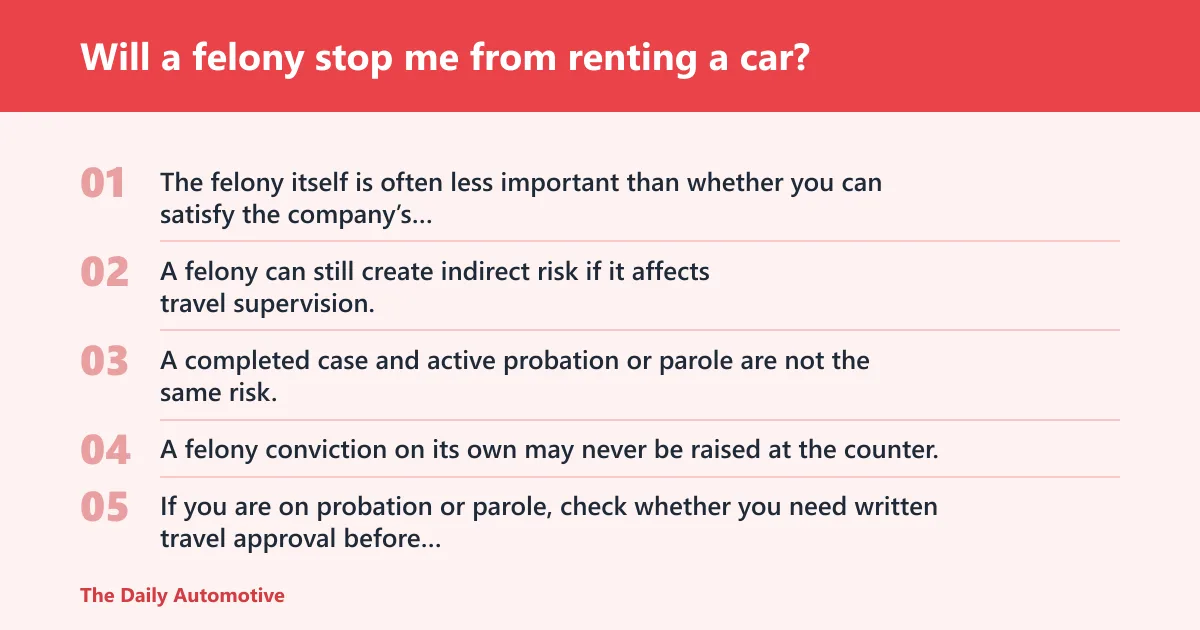
Not necessarily. The felony itself is often less important than whether you can satisfy the company’s licensing, age, and payment rules. A felony can still create indirect risk if it affects travel supervision, identity screening, or your ability to provide the documents and payment the desk requires.
Felony record versus active supervision
A completed case and active probation or parole are not the same risk. A felony conviction on its own may never be raised at the counter, but active supervision can limit travel, require permission to leave a state, or create documentation issues if you must prove you are allowed to travel.
Travel limits and documents that may matter
If you are on probation or parole, check whether you need written travel approval before crossing state lines or leaving a local jurisdiction. Some officers or courts require reporting details, destination, or rental dates. A rental agent may never ask, but a violation can still create a legal problem after pickup.
State-specific restrictions and local policy differences
Some states, counties, or agencies may have rules that affect how people on supervision travel. Rental desks do not apply criminal law the same way courts do, but local policy can still matter if the company asks for a second ID, a home address, or proof that the reservation matches your license.
Picture a driver with a valid license, a debit card, and a compact-car booking. If the counter requires a credit card hold and the card name does not match the license, the rental can fail even if the felony record never comes up. That is why approval risk is broader than criminal history.
Can you rent a car with a criminal record?
Often yes, if the record is not paired with a licensing, age, or payment problem. The criminal record itself is usually not the only approval gate. Still, active supervision, identity mismatches, and branch-level screening can turn a routine pickup into a denial if the desk cannot complete verification.
How to separate record risk from rental risk
Ask three questions: is your license valid, can your payment method satisfy the hold or deposit, and do you meet the vehicle’s age rule? If the answer is yes to all three, the criminal record may not matter at all. If any answer is no, the chance of denial rises.
What documents do I need to rent a car?
At minimum, you need a valid driver’s license in your name. Many locations also ask for a second ID and a payment card that matches the reservation name. If you are on probation or parole, bring any travel paperwork that may be required by your supervision officer or court.
Identity checks at the counter
Counter staff may compare the reservation name, driver’s license, and payment card. If any detail does not match, they may ask for a passport, state ID, or another form of identification. The point is to confirm that the renter is the same person who booked the car and who will drive it.
Name match and license status
The name on the booking should match the license closely. Nicknames, missing middle names, or recent name changes can create a delay. An expired, suspended, or revoked license is a bigger issue. In practice, license status is one of the fastest ways to lose approval at the counter.
Do rental companies require a credit card or debit card?
Many companies prefer a credit card because it makes the security hold easier, but some branches accept debit cards with extra checks, a larger deposit, or stricter rules. Payment method can matter as much as age or license status, especially for renters with limited banking access.
Credit card hold, debit card acceptance, and security deposits
A credit card often allows a pre-authorization hold. Debit card acceptance may be possible, but the branch can require proof of return travel, a bigger deposit, or additional ID. If funds are tight, the hold amount matters because it can reduce your available balance during the rental period.
Prepayment and cash-like payment limits
Prepayment can lock in the reservation, but it does not guarantee counter approval. Some companies still need a qualifying card at pickup even if the booking was paid in advance. If you have limited banking access, review deposit and hold rules before booking instead of assuming cash-like payment will work.
What age do you have to be to rent a car?
Minimum age rules vary by company and vehicle class, but younger drivers often face extra fees and more restrictions. Some search tools expose a driver age filter ranging from 25 to 65, which reflects how important age is in eligibility. Underage or young-driver bookings are a common denial point.
Young-driver surcharges and vehicle-class exceptions
Drivers below the standard age threshold may be allowed to rent only certain vehicle types, and they often pay a young-driver surcharge. Luxury cars, vans, and larger SUVs can have stricter age rules. A booking that looks available online may still fail at the counter if the branch applies a class-specific age cap.
Can I rent a car one way?
Yes, one-way rentals are often available, but they can be limited by location, vehicle type, and branch policy. One-way trips may cost more and can add counter review, especially if the renter is young, using a debit card, or booking from a location with tighter inventory rules.
Booking filters that affect one-way approval
Search tools often let you filter for one-way trips, same drop-off, car type, and cancellation policy. HotelsCombined says it searches hundreds of travel sites at once, scans hundreds of travel sites in seconds, includes same drop-off as a search option, and lets users apply filters such as price, hire agency, car hire type, and cancellation policies. It also says you can set price alerts.
How one-way trips can change your risk
One-way rentals can draw stricter checks because the car returns to a different location. If your payment method is borderline or your age is near the cutoff, a one-way request can raise the odds of denial. Always compare the final terms before you reserve, not after.
Are there different rules for luxury or van rentals?
Luxury cars and vans often have tighter age rules, higher deposits, and stricter card requirements than standard economy cars. Even if you qualify for a compact car, you may not qualify for a larger passenger van or premium model because the class can have its own approval limits.
Vehicle class can change the approval outcome
Vehicle type is a real filter, not a cosmetic choice. A driver who qualifies for a standard sedan may be rejected for a van, premium SUV, or luxury model. That is why booking filters matter: they should match your age, payment method, and risk tolerance before you arrive at the desk.
Use this approval checklist before you book
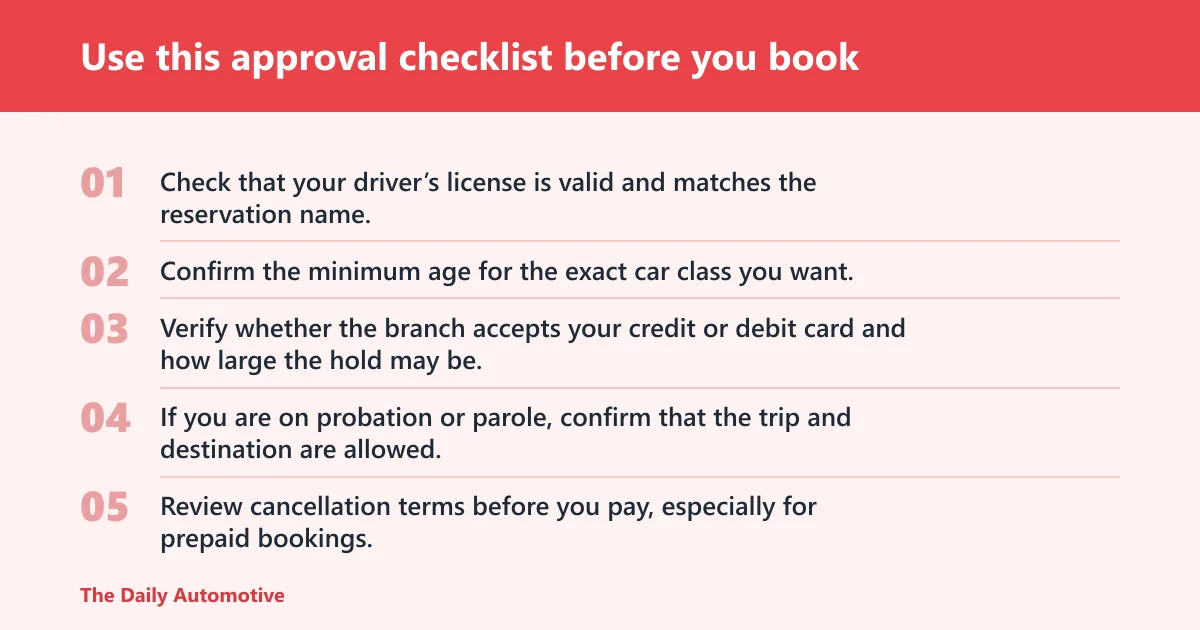
Use a quick self-screen before you reserve. The goal is not to predict every branch rule, but to catch the common denial points early. If you fail one of the core checks, choose a different car class, payment method, or provider before you pay a fee.
| License status | Age | Payment method | Probation or parole status | Counter-risk level |
|---|---|---|---|---|
| Valid, unexpired, name matches booking | Meets posted minimum for chosen car class | Credit card available for hold | No active supervision or travel limit | Low |
| Valid license, minor name formatting mismatch | Meets base age but may face surcharge | Debit card accepted by branch, deposit possible | Supervision present, but travel permission verified | Medium |
| Expired, suspended, revoked, or state ID only | Below threshold for selected class | No qualifying card or deposit funds | Active travel restriction or unclear permission | High |
Step-by-step pre-booking self-screen
- Check that your driver’s license is valid and matches the reservation name.
- Confirm the minimum age for the exact car class you want.
- Verify whether the branch accepts your credit or debit card and how large the hold may be.
- If you are on probation or parole, confirm that the trip and destination are allowed.
- Review cancellation terms before you pay, especially for prepaid bookings.
- Choose a vehicle class that fits your documents, budget, and approval risk.
Counter-risk level guide
Low risk: valid license, correct name, meeting age rule, and a qualifying credit card. Medium risk: debit card use, young-driver surcharge, or a one-way request. High risk: license problems, active travel restrictions, or a mismatch between the booking and your documents.
For example, a 24-year-old renter with a valid license may want a van for a family trip and plan to use a debit card. That booking can fail even before any criminal history matters, because age, vehicle class, and payment rules line up against approval. Booking a standard car may reduce risk.
Can I lower the chance of denial at pickup?
Yes. The best way to lower denial risk is to match the booking to your documents, age, and payment method. Choose a vehicle class you clearly qualify for, read the cancellation terms before prepaying, and review the branch rules before you commit money or travel time.
Choose a vehicle class that matches your age and payment method
If you are near the company’s age minimum, avoid premium, luxury, and larger van categories unless the rules clearly allow them. Standard economy or compact cars usually carry fewer approval barriers. Matching the class to your payment method also helps, because some cards and deposits are accepted only for lower-risk rentals.
Call the location or review terms before reserving
Branch policy can differ from what the general website suggests. Review the posted age, card, and ID rules for the exact pickup location if they are available. If the booking site offers filters for cancellation policy, same drop-off, or vehicle type, use them before paying.
Basic booking flow to follow
Start with destination, dates, pickup, and drop-off details. Then apply filters for car type, cancellation policy, and one-way trips if needed. HotelsCombined lists major providers such as Enterprise, Europcar, Hertz, Budget, and Alamo, and says it can help you explore different locations within a destination region.
What happens if I get denied at the counter?
If you are denied at pickup, the reservation may be useless unless the company allows a change or refund. The fastest response is to stay calm, ask for the exact reason, and check whether a different card, document, or vehicle class would satisfy the branch. Time matters here.
How to avoid losing time and prepaid money
Before you leave for the counter, bring the license, secondary ID, and payment card you plan to use. If the reservation is prepaid, read the cancellation rules carefully because some fares are harder to recover after denial. A prepaid booking is not the same as guaranteed rental approval.
What documents to have ready
Have a valid driver’s license, a second ID if available, and any supervision or travel approval paperwork if your probation or parole requires it. Keep your card and booking confirmation accessible. Small document mismatches are a common cause of delays that can become a denial.
How to switch providers fast if allowed
If the branch denies the rental and time remains, compare other providers at the airport or nearby location. Search filters for price, agency, vehicle type, and cancellation rules can help you move quickly. Some sites also support price alerts for later bookings, which can help if you need to rebook after a refusal.
Frequently asked questions
Can felons rent cars?
Often yes, because most rental counters focus on license status, age, and payment method rather than a felony alone. A felony can still matter if it connects to active probation or parole, identity problems, or travel restrictions. Final approval always depends on the company and location.
Do car rental companies run background checks?
Usually not as a standard step. Many companies use license and payment screening instead of a formal criminal check. Extra review can happen when documents do not match, the payment method is unusual, or the booking involves a one-way trip, a luxury car, or a van.
What documents do I need to rent a car?
You generally need a valid driver’s license in your name and a payment card accepted by the branch. A secondary ID may help if the desk wants extra verification. If you are on probation or parole, bring any travel approval paperwork that could be relevant.
Do rental companies require a credit card or debit card?
Many prefer a credit card because the hold is simpler, but some branches accept debit cards with stricter rules. Expect possible deposits, extra ID, or proof of return travel. Always confirm the branch’s policy before booking if your banking access is limited.
What age do you have to be to rent a car?
The minimum age depends on the company, the location, and the vehicle class. Young drivers may face surcharges and tighter vehicle limits, especially for vans and premium models. A search filter showing ages from 25 to 65 reflects how much age can affect eligibility.
Can Definition & Meaning | YourDictionary — Can definition: Used to request or grant permission.
In rental terms, “can” means permission is possible, not guaranteed. A company can allow a rental only if its policy, your license, your age, and your payment method all line up. That is why online availability should never be treated as final approval at pickup.
Products related to this article
Sponsored / affiliate links. As an Amazon Associate I earn from qualifying purchases. I may earn additional commission from eligible campaigns.