Speaker for Car: Enhance Your Ride with Premium Sound Solutions
Choose a car speaker by matching size, impedance, and power to your head unit: 4-ohm coaxials fit most factory systems, while 2-ohm or component speakers make more sense with an amplifier. Pick wrong, and you can waste money on poor fit, weak volume, or damaged gear. This guide compares speaker types, impedance, amplifier need, and fit so you can buy the right upgrade for your sound goals.
What should you match first?
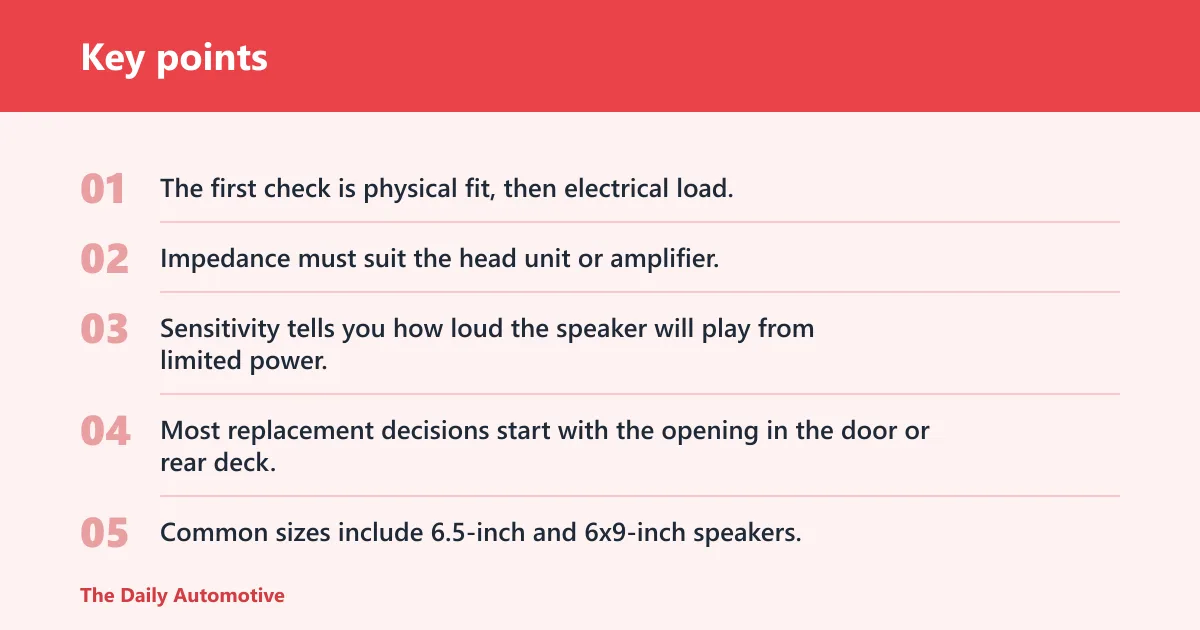


The first check is physical fit, then electrical load, then how much power the system can deliver. Speaker size must match the factory opening. Impedance must suit the head unit or amplifier. Sensitivity tells you how loud the speaker will play from limited power.
Speaker size and factory opening
Most replacement decisions start with the opening in the door or rear deck. Common sizes include 6.5-inch and 6×9-inch speakers, but the correct choice depends on the vehicle rather than the label on the box. Straight.com notes that speaker size and shape determine fit in the car.
Do not assume a 6.5-inch speaker will drop in cleanly just because the diameter matches. Depth, mounting tabs, grille clearance, and window track space can all matter. A 6×9-inch opening may also accept smaller speakers with an adapter, but that usually adds extra parts and labor.
Impedance and head-unit compatibility
Impedance affects how hard the speaker is on the radio. Most factory head units are generally happiest with 4-ohm speakers, while 3-ohm or 2-ohm speakers can draw more current and may play louder if the stereo is built for them. Straight.com lists the JBL GTO609C with 3-ohm speakers, which is useful only when the rest of the system can support that load.
Mismatch creates two common problems. If impedance is too low for the head unit, the stereo may run hot, shut down, or distort at higher volume. If impedance is too high for the amplifier, output drops and the system can sound flat.
Sensitivity versus power demand
Sensitivity matters most when the car still uses a factory radio or another low-power source. Straight.com says sensitivity tells how much sound speakers can produce with a given power. High-sensitivity speakers reach useful volume sooner, which helps when the stereo does not make much power.
That does not make sensitivity a cure-all. It only means the speaker wastes less of the limited power it gets. A low-sensitivity model can still sound good, but it usually asks for more amplifier power to reach the same listening level.
Are coaxial or component car speakers better?
Neither type is always better. Coaxial car speakers are easier to install and suit simple factory-replacement jobs, while component car speakers usually give better staging and clarity because the tweeter and woofer are separate. The right choice depends on your sound goal, install tolerance, and whether an amplifier is part of the plan.
When coaxial speakers make sense
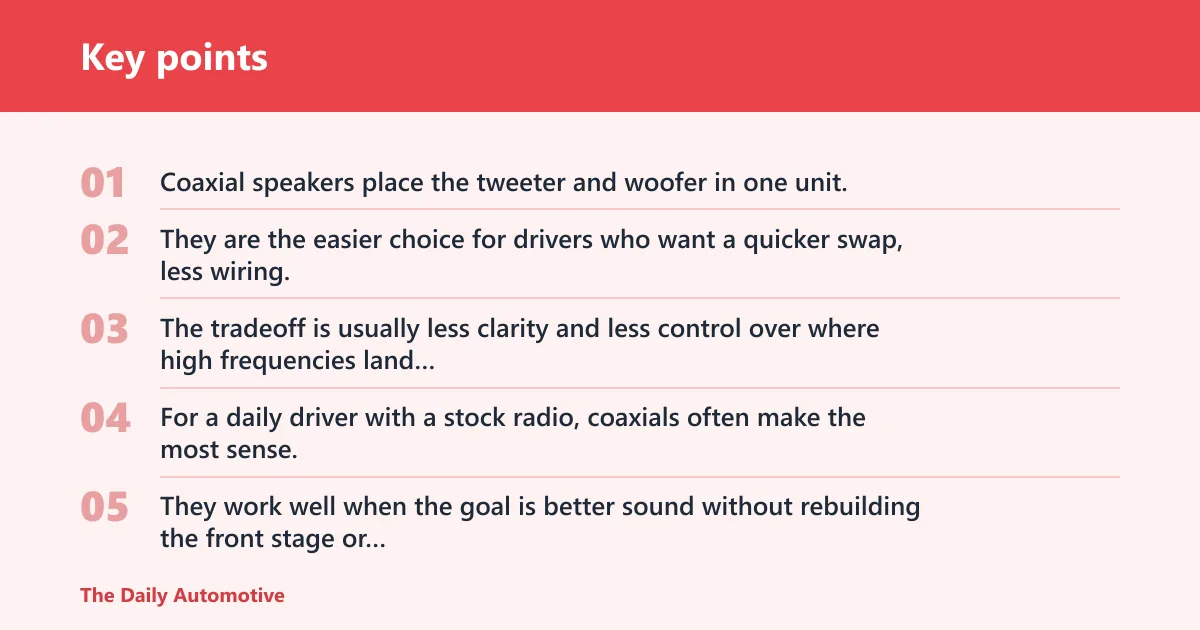
Coaxial speakers place the tweeter and woofer in one unit, so they are common factory-replacement formats. They are the easier choice for drivers who want a quicker swap, less wiring, and fewer fitment surprises. The tradeoff is usually less clarity and less control over where high frequencies land in the cabin.
For a daily driver with a stock radio, coaxials often make the most sense. They work well when the goal is better sound without rebuilding the front stage or adding amplifier channels.
When component speakers are worth the extra work
Component car speakers separate the tweeter from the woofer. That arrangement often gives better staging, more precise vocals, and cleaner detail across the front seats. The cost is more installation work, since you must place the tweeter, route wiring, and sometimes add crossovers.
If a system already has an amplifier, component speakers usually deserve a closer look. They are a strong match for drivers who care more about vocal clarity and front-seat imaging than about the simplest install.
Clarity, staging, and install complexity
Tweeters matter here. Soft-dome tweeters usually aim for smoother high frequencies, while super tweeter variants can push more top-end energy. That top end affects how crisp cymbals, speech, and string sounds feel, but placement matters just as much as the part itself.
Picture a sedan with 6.5-inch factory door openings and a basic head unit. A coaxial swap can improve the sound quickly. Now suppose the owner wants the singer to sound centered on the dash and not buried in the door. That is where component speakers start to make more sense.
How do watts and sensitivity matter?
Watts matter, but they matter in the right way. RMS wattage is the number to use for system matching because it reflects sustained power. Peak wattage is the short burst figure and tells you far less about everyday use. Sensitivity then determines how much output you get from that power.
RMS wattage versus peak wattage
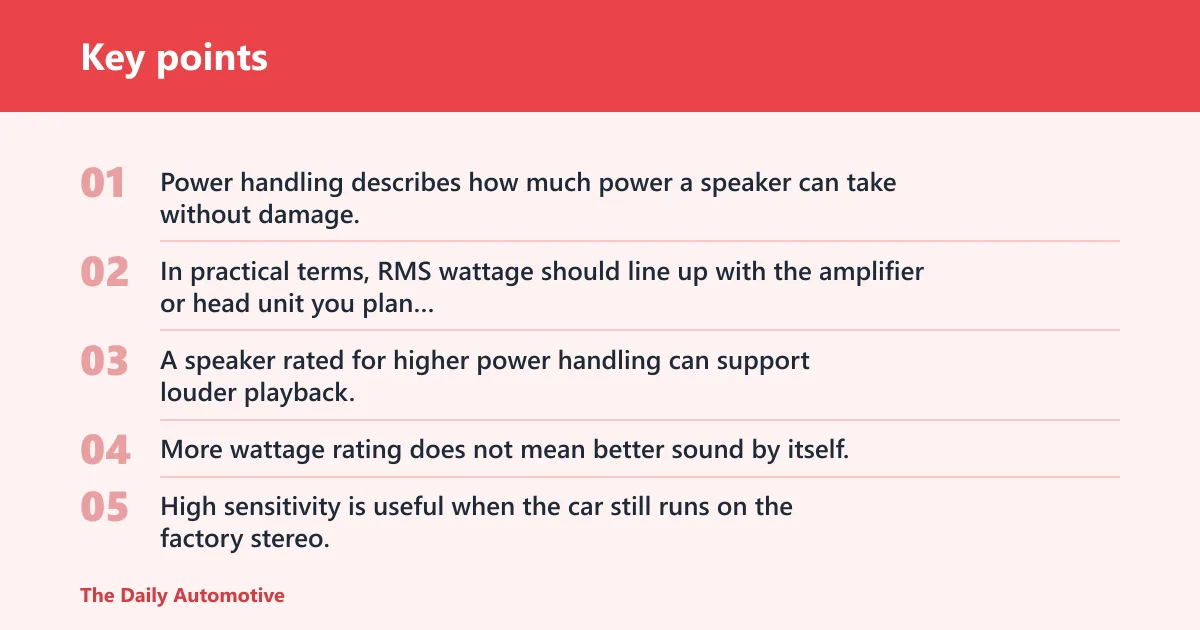
Power handling describes how much power a speaker can take without damage. In practical terms, RMS wattage should line up with the amplifier or head unit you plan to use, while peak wattage is a momentary ceiling that should not drive the buying decision.
A speaker rated for higher power handling can support louder playback, but only if the rest of the chain can feed it clean power. More wattage rating does not mean better sound by itself.
Why sensitivity helps factory systems
High sensitivity is useful when the car still runs on the factory stereo. A speaker that turns limited power into more sound can fill the cabin with less strain on the head unit. That is one reason sensitivity gets more important on low-power systems than on amplified ones.
For a commuter who wants clearer voices and a modest jump in volume, sensitivity can matter more than chasing a big power number on the box. It helps the system sound alive before an amplifier enters the picture.
What happens when power and speaker ratings do not align
Underpowering a speaker does not usually harm the speaker by itself, but it can contribute to clipping when the volume is turned up too far. Clipping often sounds harsh and can overheat tweeters. Overpowering a speaker can also damage it if the amp sends more clean power than the speaker can handle.
A common first-timer mistake is buying a large-power speaker for a weak radio, then turning the volume up to compensate. The result is often distortion, not better sound.
Speaker decision matrix
Use this matrix to tie your listening goal to the right speaker type, source unit, and install risk. It is a practical shortcut for factory head units, amplified systems, and mixed goals like bass feel or vocal clarity.
| Listener goal | Source | Recommended speaker type | Expected tradeoffs | Common install risks |
|---|---|---|---|---|
| Clearer vocals on a factory head unit | Factory head unit | High-sensitivity coaxial, usually 4-ohm | Easy fit, better day-to-day volume, less imaging precision than components | Door depth limits, adapter rings, grille clearance |
| Louder daily-driver sound with an amplifier | Amplified system | Component speakers with matching tweeters | Better staging and detail, more wiring and tuning work | Crossover placement, tweeter mounting, wiring mistakes |
| Better bass feel without adding a subwoofer | Factory head unit or amp | 6×9-inch coaxial or component set with good midbass output | More punch in the upper bass, no deep sub-bass | Rear-deck fitment, vibration, weak door sealing |
| Full upgrade with speakers and amp | Amplified system | Component front stage plus coaxial rear fill or rear deletes | Highest clarity potential, highest cost and install complexity | Impedance mismatch, amp gain errors, extra labor |
Do you need an amplifier?
You do not always need an amplifier, but many higher-performance speakers sound better with one. A head unit can be enough for efficient coaxials and moderate listening levels. An amp becomes more useful as soon as you want cleaner volume, better control, or component speakers that expect real power.
Signs a head unit is enough
If your goal is clearer sound at normal volume, a factory radio may be enough. That is especially true with high-sensitivity coaxials and 4-ohm impedance. This path keeps installation simpler and avoids extra wiring, power runs, and tuning.
It also fits drivers who want convenience more than a full audio project. If the stock system already plays loudly enough and the issue is mostly muddied sound, a speaker swap alone can be the right first step.
Signs an amp will improve results
An amplifier helps when the speakers sound strained at higher volume, the bass thins out, or the vocals blur once the volume rises. It is also useful when the speaker choice leans toward components, lower-impedance models, or higher power handling that the radio cannot support on its own.
Buyers who want deeper control over gain and crossover points usually end up in amplifier territory. That is where sound quality changes more than just volume.
When amplifier matching becomes non-negotiable
Some combinations need an amp to work as intended. A lower-impedance speaker, such as a 3-ohm design, can stress a weak head unit if the radio was not built for that load. Higher-end component sets can also sound underfed and flat without proper power.
Joe’s Stereo says its speaker installation services replace weak factory audio, and it emphasizes vehicle-specific installation for upgrades. That kind of fit-first approach matters when an amp, crossovers, and speaker mounting all need to work together.
What costs come with installation?
Installation cost depends on speaker type, vehicle layout, and whether the job needs adapters, wiring, or sound treatment. Basic coaxial replacement is usually cheaper than a component install with tweeter mounting and amplifier wiring. Hidden parts can move the total more than the speaker price itself.
Labor for basic versus component installs
A simple coaxial swap often costs less because the work is mostly removal and replacement. Component installs take more labor because of separate tweeter placement, crossover wiring, and more careful routing. If the installer must remove door panels, the price rises with the vehicle’s complexity.
Adapters, brackets, and wiring accessories
Many upgrades need adapter rings, brackets, or harness adapters to preserve factory plugs. Those parts are easy to miss when budgeting. If the vehicle uses a nonstandard opening, the small parts list can grow quickly.
Amplified systems may also need new speaker wire, power wire, fuse holders, and signal adapters. Those items do not change the headline product, but they change the final bill.
Sound-deadening and other hidden costs
Sound-deadening material can help reduce door resonance and improve midbass response, especially with larger door speakers. It is not mandatory, but it is a common add-on when a buyer wants cleaner sound rather than just louder sound. Labor for that work adds up.
BPS Audio positions its products around deep bass and crystal-clear highs, and it explicitly sells car speakers, amplifiers, and subwoofers. That mix reflects how audio upgrades often stack: speakers first, then amplification, then low-frequency support if the budget allows.
Can upgraded speakers improve bass?
Upgraded speakers can improve bass perception, especially midbass and kick-drum punch, but they will not replace a subwoofer for deep low end. Fit, door seal, and speaker size matter here. A good 6×9-inch setup can sound fuller than a small factory speaker, but it still has limits.
What speakers can do for midbass and punch
Better speakers can make bass lines easier to hear and drums feel tighter. A properly fitted 6.5-inch or 6×9-inch speaker can strengthen the upper bass range and reduce the hollow sound that comes from weak factory paper cones. Amplifier power helps here, but only when the system is matched well.
What they cannot do without a subwoofer
Speakers alone cannot move enough air for deep sub-bass. If you want the low notes you feel more than hear, you still need a subwoofer. Door speakers can give more body, but they cannot replace a dedicated low-frequency system.
How enclosure fit and door treatment affect low end
Door mounting acts like a crude enclosure, so sealing gaps matters. Loose panels, poor gaskets, and rattles steal low-frequency output. A better speaker in a leaky door can still sound thin.
Suppose a hatchback owner installs 6.5-inch coaxials and keeps the factory door trim loose. The bass may seem weaker than expected, even though the new speakers are technically better. Tightening the mount and treating the door can change that more than a bigger box claim on the package.
Frequently asked questions
What size car speakers fit my vehicle?
The correct size depends on the factory opening, mounting depth, and grille clearance. Common sizes include 6.5-inch and 6×9-inch speakers, but the vehicle decides the fit, not the badge on the box. Check the opening before you buy, especially if the car has unusual brackets or shallow door space.
How many watts should car speakers have?
Match RMS wattage to the power your system can actually deliver. Peak wattage matters far less for real-world use. A speaker with high power handling is useful only if the amplifier or head unit can feed it clean power without clipping or overload.
Do I need an amplifier for new car speakers?
Not always. High-sensitivity coaxials can work well on a factory head unit, especially if you only want clearer sound and modest volume gains. An amplifier becomes more helpful for lower-sensitivity speakers, component systems, or any setup that needs cleaner output at higher volume.
How much does car speaker installation cost?
Cost depends on speaker type, vehicle fit, labor time, and extras such as adapters, brackets, wiring, or sound-deadening material. Basic coaxial swaps are usually cheaper than component installs. Amplified systems cost more because they add power wiring, tuning, and more time on the vehicle.
Will upgraded speakers improve bass without a subwoofer?
They can improve bass feel, especially midbass and punch, but they will not replace a subwoofer for deep low end. Good fitment, a solid door seal, and proper power help more than many buyers expect. If deep bass is the goal, speakers alone will not get you there.
Products related to this article
Sponsored / affiliate links. As an Amazon Associate I earn from qualifying purchases. I may earn additional commission from eligible campaigns.