Can You Custom Order A Leased Car: Genius Guide
Yes, you can absolutely custom order a leased car! While it might sound complicated, it’s a straightforward process that allows you to get the exact car you want, complete with your chosen features and options, all under a lease agreement. This guide will walk you through everything you need to know to make your dream car a reality.
So, you’re looking to lease a new car, and you’ve got some specific ideas about what you want. Maybe it’s a certain color, a premium sound system, or a particular trim level. The big question on your mind is likely: “Can I custom order a leased car?” The good news is, you definitely can! It might feel a bit daunting to think about speccing out a car you don’t plan to own outright, but it’s a perfectly normal and often beneficial way to lease. This guide is here to break down the process for you, step-by-step, so you can drive away in a car that’s exactly to your liking, without any confusion. Let’s get started on making that perfect lease happen!
Understanding the Basics: Customizing vs. Choosing from Inventory
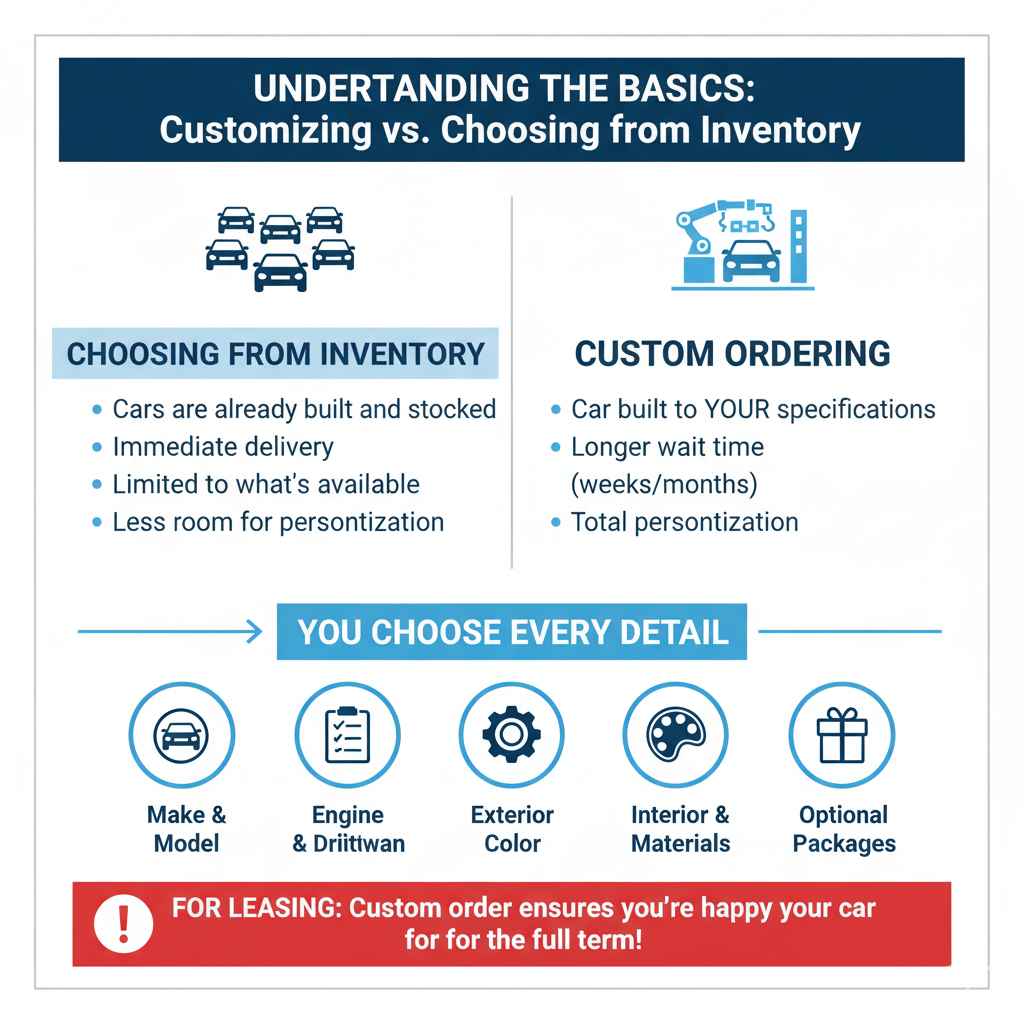
When you walk into a dealership, you’ll often see a lot full of cars ready to go. These are cars the dealership has ordered and stocked. They’re great if you need a car right now and one of them fits your needs. But what if you have a very specific vision? That’s where custom ordering comes in.
Custom ordering a car means you’re essentially telling the manufacturer exactly what specifications you want. This includes:
- Make and Model: The specific car brand and model you desire.
- Trim Level: The package of features (e.g., LX, EX-L, Sport, Platinum).
- Engine and Drivetrain: Whether you want a specific engine, all-wheel drive (AWD), front-wheel drive (FWD), etc.
- Exterior Color: The exact paint color.
- Interior Color and Materials: The shade of the interior and whether you prefer cloth, leather, or a synthetic option.
- Optional Packages: Things like technology packages, safety feature upgrades, towing packages, or sunroofs.
- Individual Options: Specific add-ons like upgraded wheels, premium audio systems, or floor mats.
When you custom order, the factory builds your car to your exact specifications. This is different from choosing a car already on the lot, which is already built with a pre-determined set of features. For leasing, custom ordering can be a fantastic way to ensure you’re happy with every aspect of the vehicle you’ll be driving for the next few years.
Why Custom Order a Leased Car? The Advantages
Leasing is all about paying for the depreciation of a car over a set period. When you custom order, you’re choosing exactly what you want to “depreciate,” which can lead to several benefits:
- Get Exactly What You Want: This is the biggest perk. No compromises on color, features, or options. You’re not settling for what the dealer has; you’re getting precisely the car you desire.
- Potentially Better Lease Deals: Sometimes, ordering a car with a specific, in-demand feature package can make it more attractive for leasing. Conversely, if you avoid features you don’t need, you can lower the car’s MSRP, which can directly reduce your monthly payment.
- Newest Technology and Safety Features: By ordering, you guarantee you’re getting the latest model year with the most up-to-date infotainment, driver-assistance systems, and safety technologies.
- Higher Resale Value (if you decide to buy): If you fall in love with your car and consider buying it out at the end of the lease, a custom-ordered vehicle with desirable options can hold its value better than a base model.
- Unique Factory Options: Some desirable options or special editions might not be regularly stocked by dealerships and can only be obtained through a factory order.
The Process: Step-by-Step to Your Custom Leased Car
Ordering a custom car, whether for purchase or lease, follows a similar path. The key difference will be in the financing and contract stage.
Step 1: Research and Decide on Your Vehicle
This is the fun part! Figure out what car, make, and model best suits your needs and budget. Consider factors like:
- Your needs: How many passengers do you typically carry? What’s your daily commute like? Do you need AWD?
- Fuel efficiency: Important for mitigating running costs.
- Reliability ratings: Check resources like Consumer Reports for unbiased owner feedback and predicted reliability.
- Lease-friendliness: Some cars hold their value better (have higher residual values), which can lead to lower monthly payments on leases.
Step 2: Configure Your Dream Car Online
Most manufacturers have excellent online configurators on their websites. Use these tools to:
- Select your desired model.
- Choose your trim level.
- Pick your exterior and interior colors.
- Add all the optional packages and individual features you want.
- Save your configuration. You can often get a PDF or a unique code for your build.
Pay close attention to the MSRP (Manufacturer’s Suggested Retail Price) that the configurator provides. This will be a key number for negotiating your lease.
Step 3: Find a Dealership and Discuss Your Custom Order
Not all dealerships are equally equipped to handle custom orders, but most can facilitate them. Here’s how to approach it:
- Contact the Sales Department: Call ahead or visit the dealership and speak with a sales manager or a salesperson experienced with factory orders.
- Provide Your Configuration: Share the details or the saved configuration code from your online research.
-
Discuss Lease Terms: This is where it becomes specific to leasing. You’ll need to talk about:
- MSRP: The full sticker price of your custom-configured vehicle.
- Negotiated Price (Cap Cost): While you’re ordering, there’s still room for negotiation on the capitalized cost, especially on well-priced models or during manufacturer incentives. You want to reduce this as much as possible.
- Residual Value: This is the estimated value of the car at the end of the lease term, set by the leasing company. Higher residuals mean lower payments.
- Money Factor: This is like the interest rate for your lease. A lower money factor means lower payments.
- Lease Term: How many months you want the lease to last (e.g., 24, 36, 48 months).
- Mileage Allowance: How many miles you expect to drive per year (e.g., 10,000, 12,000, 15,000).
- Get a Quote: Ask for a detailed lease quote showing all these figures for your ordered vehicle.
Step 4: Place the Order and Make a Deposit
Once you’ve agreed on the terms and the dealership confirms they can place the order for your specific configuration, you’ll typically need to:
- Place a Deposit: Most dealerships require a deposit to place a factory order. This is usually a few hundred to a couple of thousand dollars, depending on the vehicle and dealership policy. This deposit usually goes towards your down payment or the purchase of the car.
- Sign Order Agreement: You’ll sign an agreement detailing the exact specifications of the car you’ve ordered. Ensure this is accurate before signing!
Step 5: Wait for Production and Delivery
This is the hardest part – the waiting! Production and delivery times vary significantly based on the manufacturer, the model, and current supply chain conditions.
- Check Order Status: Some manufacturers allow you to track your order online, or your dealership might provide updates.
- Be Patient: It can take anywhere from a few weeks to several months.
Step 6: Finalize the Lease and Take Delivery
When your car arrives at the dealership:
- Inspect the Vehicle: Thoroughly check if it matches your order specs and if there are any damages from transit.
- Review the Paperwork: Carefully go over the final lease agreement. All the numbers should match what you discussed and were quoted. Ensure the MSRP, negotiated price, residual value, money factor, and terms are correct.
- Sign the Lease: Once you’re satisfied, you’ll sign the lease contract and any other required documents.
- Drive Home! Congratulations, your custom-ordered leased car is ready!
When Custom Ordering Might Not Be Ideal for Leasing
While custom ordering is often a great option, there are a few scenarios where it might not be the best path for a lease:
- You Need a Car Immediately: If you need transportation within days, you’ll have to choose from the dealership’s inventory.
- Limited Manufacturer Incentives on Orders: Sometimes, amazing lease deals (like steep discounts or very low money factors) are only available on specific, in-stock models that the manufacturer wants to move. Custom orders might not qualify for these aggressive incentives. Always ask about available incentives.
- You’re Unsure of Your Preferences: If you’re not entirely sold on specific features or colors, picking from inventory allows you to see and touch the car first.
- Extended Wait Times Are Unacceptable: Delays can happen. If waiting is not an option, inventory vehicles are the way to go.
Key Lease Terms Explained for Custom Orders
When you’re custom ordering, understanding these lease terms is crucial for getting the best deal. Think of these as the building blocks of your lease payment.
Here’s a quick breakdown:
| Lease Term | What It Means | How It Affects Your Custom Order |
|---|---|---|
| MSRP (Manufacturer’s Suggested Retail Price) | The sticker price of your precisely configured vehicle. | This is the starting point. A higher MSRP means a higher potential lease payment. |
| Capitalized Cost (Cap Cost) | The agreed-upon price of the car for the lease. It’s the MSRP minus any discounts, rebates, and negotiation. | Crucial for custom orders! Negotiate this down as much as possible. A lower cap cost directly lowers your monthly payment. |
| Cap Cost Reduction: | Any down payment, trade-in value, or rebates applied directly to the cap cost. | Reduces the amount you’re financing over the lease term. |
| Residual Value: | The estimated value of the car at the end of the lease, set by the leasing company (e.g., 55% of MSRP). | Your monthly payment is partly based on the depreciation from MSRP to residual value. Higher residuals often mean lower payments. |
| Money Factor: | The interest rate expressed as a small decimal (e.g., .00125). Multiply by 2400 to get an approximate APR (e.g., .00125 2400 = 3% APR). | A lower money factor means lower monthly payments. Negotiate this if possible. |
| Lease Term: | The duration of the lease agreement (e.g., 24, 36, 48 months). | Shorter terms usually have higher monthly payments but lower total cost. Longer terms have lower monthly payments but you pay more interest and the car is older. |
| Mileage Allowance: | The maximum number of miles you can drive annually without incurring overage charges. | Ensure your estimated mileage for the car you’re ordering makes sense for the allowance to avoid costly fees at lease end. |
| Acquisition Fee: | A fee charged by the leasing company to set up the lease. Sometimes negotiable or waived. | Often baked into the cap cost or paid upfront. |
| Disposition Fee: | A fee charged by the leasing company at the end of the lease to process the return of the vehicle. | Usually paid at lease end, unless you purchase the vehicle. |
To get a rough idea of your monthly payment, you can use a formula: (Cap Cost - Residual Value) / Lease Term (in months) + (Cap Cost + Residual Value) Money Factor. Remember, this is a simplification and doesn’t include taxes or other fees.
Negotiating Your Custom Lease Deal
Negotiation can feel intimidating, especially when you add custom ordering into the mix. However, your negotiation power lies in a few key areas:
- Negotiate the Capitalized Cost (Cap Cost): This is the most important number to negotiate when custom ordering. Since the MSRP is fixed by the manufacturer for your specific build, the dealership’s profit margin and any available incentives are where you can find savings. Work to get the dealer to reduce the cap cost as close to MSRP as possible, or even below if manufacturer incentives allow significant discounts.
- Understand Manufacturer Incentives: Ask your dealer about any current manufacturer rebates or special lease programs that might apply to your ordered vehicle. These can significantly reduce your cap cost.
- Shop Around: Get quotes from multiple dealerships for the same custom order. Even though the car is the same, different dealers might have different incentives or be willing to negotiate the cap cost more aggressively.
- Be Aware of Fees: Keep an eye on acquisition fees, documentation fees, and other dealer add-ons. While some are standard, others might be inflated.
- Consider Your Trade-In Separately: If you have a trade-in, negotiate its value AFTER you’ve agreed on the lease terms for your new car.
A helpful resource for understanding lease negotiations and finding fair market values is Edmunds, which provides leasing guides and tools.
The Role of Dealerships in Custom Orders
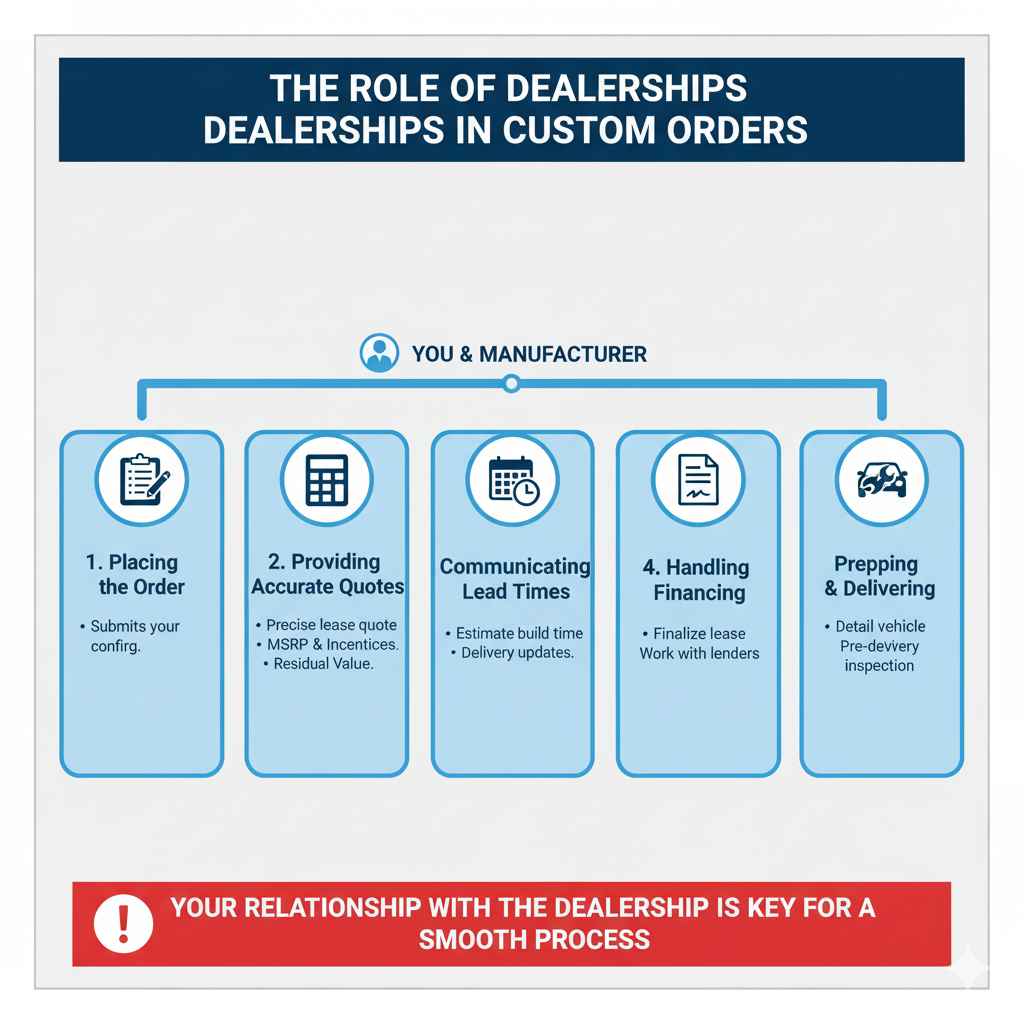
Dealerships act as the intermediary between you and the manufacturer. When you custom order, their role includes:
- Placing the Order: They submit your specific configuration to the manufacturer’s order system.
- Providing Accurate Quotes: They should be able to generate a precise lease quote for your configured vehicle, factoring in its specific MSRP, any applicable incentives, and residual values.
- Communicating Lead Times: They are responsible for giving you the best available estimate for when your car will be built and delivered.
- Handling Financing: They finalize the lease contract with the lending institution (which could be the manufacturer’s captive finance arm like Ford Credit or Chase, or another lender).
- Prepping and Delivering the Vehicle: Before you take delivery, they’ll detail the car and perform any necessary pre-delivery inspections.
Your relationship with your salesperson and the dealership’s management is key here. A good dealership will be transparent and helpful throughout the custom order process.
Can You Custom Order From Any Manufacturer?
Generally, yes. Most major automotive manufacturers allow customers to place factory orders for custom-configured vehicles. However, the specifics of the process, the available options, and the wait times can differ significantly.
Manufacturer Specifics to Consider:
- Luxury Brands: Brands like BMW, Mercedes-Benz, Audi, and Lexus often have extensive customization options and a well-established custom order process. They may even offer exclusive customization services (e.g., BMW Individual).
- Mainstream Brands: Manufacturers like Toyota, Honda, Ford, and Chevrolet also offer custom ordering, though the depth of customization might be slightly less extensive than luxury brands. They focus more on trim levels and option packages.
- High-Demand Vehicles: For extremely popular models, particularly those with long waiting lists (like certain EVs or performance cars), custom orders might be allocated based on demand, and wait times can be very long.
- Production Capacity: Sometimes, due to production limitations or supply chain issues, certain options or entire models might temporarily be unavailable for custom order.
It’s always best to check the specific manufacturer’s website or speak directly with a dealership representative for the most current information on their custom order procedures and policies.
FAQs About Custom Ordering Leased Cars
Q1: How long does it usually take to get a custom-ordered leased car?
A1: Wait times vary widely. It can range from 4-8 weeks for some common models to 3-6 months or even longer for high-demand vehicles or those with extensive customization. Production schedules, global supply chains, and port delays can all impact delivery times.