Can You Drive an American Car in Europe? 6-Month Rule Explained
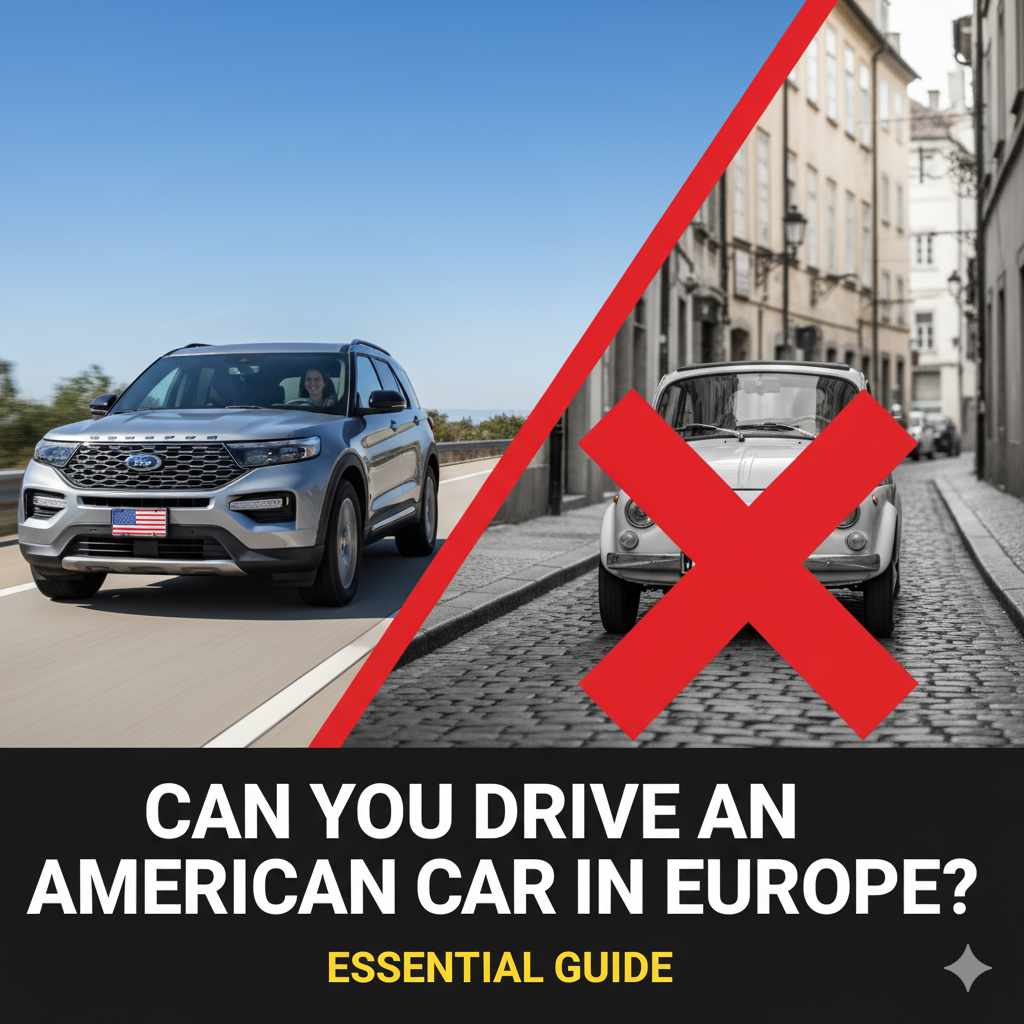
Yes, but the answer depends on how long you plan to stay. A US-registered car can be driven in the EU for up to 6 months under its temporary admission rules, with no import duty owed. Permanently importing it is a different story: most American cars were never built to EU type-approval, so registering one long-term often means modifications, an individual inspection, or in some cases isn’t possible at all. This guide covers both scenarios plus what to carry instead.
Quick Answer
For a short trip, drive your US car as-is with your original title, registration, and either your US license plus an International Driving Permit or your license alone (rules vary by country). You do not need a “Green Card” in the EU/EEA anymore — that requirement ended in 2021 — but you do need valid liability insurance and, in many countries, a warning triangle and reflective vest in the car.
Can You Drive An American Car In Europe? The Short Answer & What to Know
Can you drive an American car in Europe? The straightforward answer is yes for a limited period, but it isn’t as simple as shipping the car over and driving off. Vehicle size, headlight aim, required safety gear, insurance, and — above all — how long you intend to stay all affect what’s legal.
Temporary Tourist Driving vs. Permanent Import: Two Very Different Answers
Most confusion around this topic comes from treating “driving my car in Europe” as one question when it’s really two, with two very different answers. A short visit and a permanent move are governed by completely different rules.
Driving in Europe as a Short-Term Visitor (Up to 6 Months)
If you’re visiting rather than relocating, the EU’s temporary admission rules let you use a non-EU-registered vehicle for up to 6 continuous months in any 12-month period without paying import duty, VAT, or registering it locally. Your car keeps its US plates and registration the entire time — you’re not importing it, just visiting with it. The vehicle must stay under your name and can’t be lent to EU residents (close family is usually an exception).
Switzerland, which isn’t in the EU customs union, runs its own version of this rule through its federal customs office (BAZG): a foreign car can stay up to 6 months for personal use, extendable to 12 months if you’re there for study or work, using a temporary customs certificate (Form 15.25/TVI). Rules like this are set at the national level, so always confirm the current policy for each specific country on your route before you cross the border.
The Green Card myth: A lot of driving-abroad advice — including older versions of this guide — still tells travelers they need a “Green Card” (an international insurance certificate) to drive in Europe. That requirement was dropped for the EU and EEA on 2 August 2021; UK and other insurers no longer need to issue one for trips to EU/EEA countries, Andorra, Bosnia and Herzegovina, Switzerland, or a handful of others. A Green Card is still required in a short list of non-EU countries, including Turkey, Belarus, and Azerbaijan. What you do still need everywhere is valid liability insurance that actually extends to the countries you’re driving in — check this with your insurer before you leave, since many standard US policies stop at the US border entirely.
Bringing Your Car to Europe Permanently (Import & Registration)
Permanent import is a different problem entirely, and it’s the one most guides gloss over. To be registered long-term, a car generally needs EU type-approval — a certification that the exact model met EU safety, emissions, and lighting standards during production and comes with a matching certificate of conformity. American market cars are built and tested to US federal standards instead, which overlap with EU rules in places but diverge in others (headlight beam pattern, bumper height, some emissions test cycles). Since most US-spec cars were never put through EU type-approval, they don’t have that certificate.
The usual path around this is an individual vehicle approval — a national-level inspection and paperwork process the EU’s own Your Europe citizen portal confirms exists specifically for vehicles without an EU certificate of conformity. It can involve emissions retesting, headlight or bumper modifications, and a technical inspection, and the cost, paperwork, and even whether it’s possible at all varies significantly by which EU country you’re registering in. Some countries process individual approvals routinely; others make it slow, expensive, or effectively impractical for an older or heavily modified US car. Check with the destination country’s national transport authority before assuming your car qualifies.
| Factor | Temporary Visit (≤ 6 Months) | Permanent Import |
|---|---|---|
| Registration | Keeps US plates and title | Needs a new EU/local registration |
| Duties/VAT | None, under temporary admission | Import duty and VAT typically apply |
| Type-approval | Not required | Required, or individual vehicle approval |
| Insurance | Valid liability cover for the trip | Standard local EU motor insurance |
| Typical cost | Insurance + travel costs only | Duties, testing, and modifications, often $1,000s |
| Realistic for most US cars? | Yes, with preparation | Often difficult or not possible without work |
📊 A foreign-registered vehicle can stay in an EU member state for up to 6 continuous months in any 12-month period without import duty, VAT, or local registration — after that, it becomes liable for full registration tax. — Source: EUR-Lex, EU tax-free allowances for motor vehicles (Directive 83/182/EEC)
“You do not need to carry a green card when you drive in the EU (including Ireland), Andorra, Bosnia and Herzegovina, Iceland, Liechtenstein, Montenegro, Norway, Serbia, and Switzerland.”
Key Considerations for Driving Your American Car in Europe
Whether you’re visiting for a few weeks or seriously considering a permanent move, these are the checkpoints that matter once you’ve settled the temporary-vs-permanent question above.
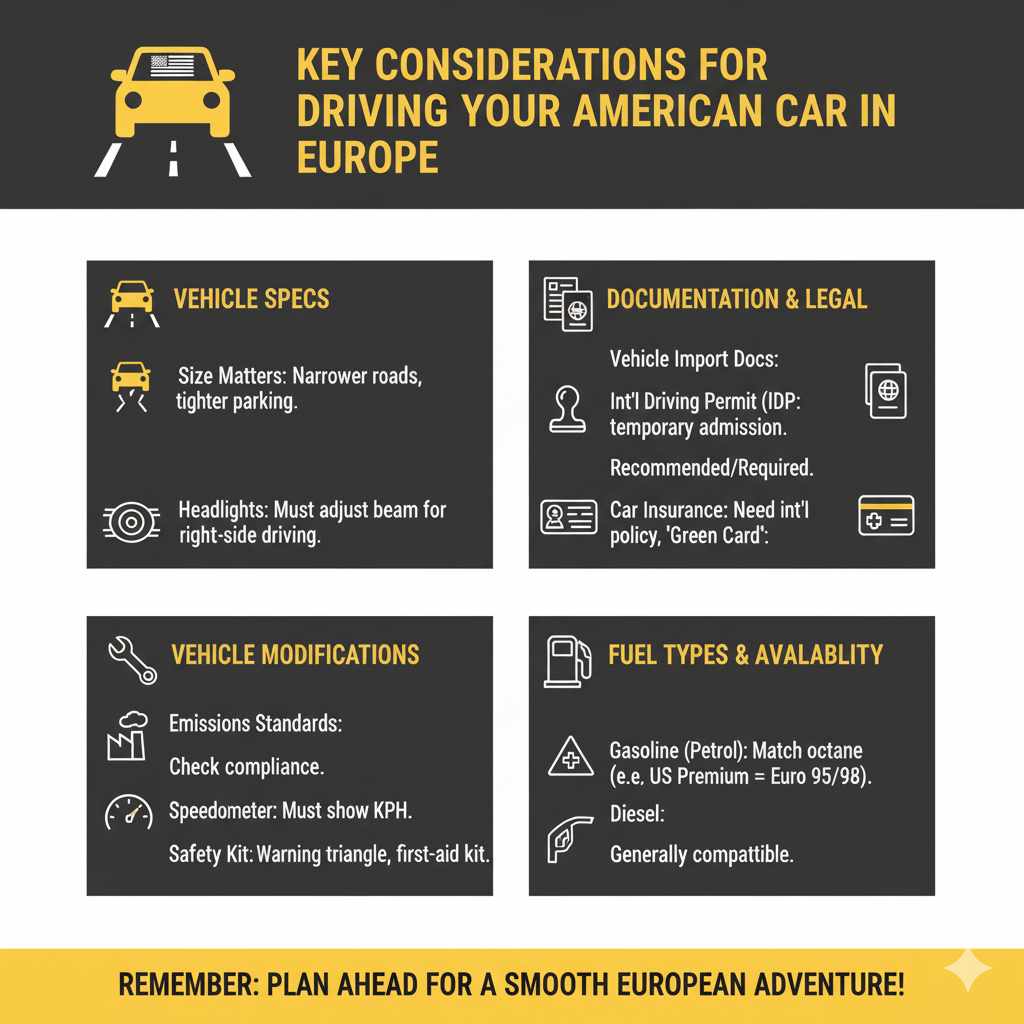
1. Vehicle Specifications and Road Compatibility
American cars are often designed with American roads and regulations in mind. Europe’s roads can be narrower, and parking spaces can be tighter. This is especially true in older European cities.
- Size Matters: Many American vehicles, particularly SUVs and trucks, are larger than the average European car. This can make navigating narrow city streets, winding country lanes, and especially parking quite challenging. You might find yourself spending extra time searching for suitable parking spots or needing to be extra cautious when maneuvering.
- Headlights: Continental Europe drives on the right, same as the US, but headlight beam patterns are still cut differently to match local road markings and won’t always aim correctly out of the box. If you’re driving to the UK or Ireland (left-hand traffic), a US car’s headlights will need a proper conversion or approved beam-deflector stickers, not just an adjustment. A quick check with your car’s manufacturer or a specialized auto shop can tell you if your car has this feature.
- Tires: Ensure your tires are in good condition and appropriate for the potential weather conditions you might encounter. Many European countries enforce a legal minimum tread depth (commonly 1.6mm across the tire’s central grooves), and some require winter tires or chains seasonally in mountain regions. Always double-check the specific rule for each country you’ll be driving through.
2. Documentation and Legal Requirements
This is a critical area. Without the correct paperwork, you won’t be able to legally drive your American car in Europe.
- Vehicle Importation Documents: For a short visit, you generally don’t need import paperwork at all — you’re using the temporary admission allowance covered above. If you’re staying long enough to need permanent registration, see the import and type-approval section further up this page.
- Proof of Ownership: You’ll need to have your car’s title and registration documents with you. Ensure these are up-to-date and clearly show you are the legal owner.
- International Driving Permit (IDP): Your US driver’s license is recognized for short tourist stays in many European countries, but an International Driving Permit (IDP) is required or strongly recommended in several — including Austria, Italy, Spain, Greece, and Poland. It’s a certified translation of your license issued under the 1949 Geneva or 1968 Vienna Convention on Road Traffic, and it’s what a roadside officer who doesn’t read English will actually check. You can get one from AAA before you leave the US.
- Car Insurance: Your standard US car insurance policy will almost certainly NOT cover you in Europe. You will need to secure additional international auto insurance. Often, shipping companies can help arrange this, or you can research policies specifically designed for expatriates or long-term travelers. You’ll need to ensure your policy meets the minimum liability requirements for the countries you plan to visit.
- Insurance Proof at the Border: Older advice says to carry a “Green Card” everywhere in Europe — that’s outdated for EU/EEA travel since 2021 (see the correction above), though it’s still worth asking your insurer for one if you’re heading to Turkey, Belarus, Azerbaijan, or Moldova, where it’s still required.
3. Vehicle Modifications for European Standards
Beyond headlights, there might be other subtle modifications or checks needed.
- Emissions Standards: Some countries have strict emissions regulations. Modern American cars generally meet these, but older vehicles might face scrutiny. It’s wise to have documentation showing your car’s emissions compliance.
- Speedometer: While most modern cars display speed in both miles per hour (MPH) and kilometers per hour (KPH), ensure yours clearly shows KPH, as this is the standard unit of speed in Europe.
- Warning Triangle and First-Aid Kit: Many European countries legally require vehicles to carry a warning triangle and a first-aid kit. These are relatively inexpensive to purchase and can often be bought at an auto parts store before you leave or upon arrival. It’s also common to see a high-visibility vest (reflective vest) required for each occupant.
Best EU Safety Kit Pick

FLKQC 2-Pack Warning Triangle & Reflective Vest Safety Kit
Covers the two items police checks ask for most often in France, Germany, Spain, and most EU countries.
- Best for: meeting the warning-triangle-and-hi-vis-vest law in most EU countries
- Why we picked it: covers the two most commonly mandatory items in one glovebox-sized kit
- Main drawback: doesn’t include a first-aid kit, which several countries also require
Compare more Europe road-trip essentials
 Option 1 General Medi 127-Piece Roadside Emergency Kit
|
 Option 2 EVERLIT 250-Piece Survival First Aid Kit
|
 Option 3 Valardoh Car Registration & Insurance Document Holder
|
As an Amazon Associate we earn from qualifying purchases.
4. Fuel Types and Availability
The type of fuel your car uses is a significant factor.
- Gasoline (Petrol): Most American gasoline cars will run fine on European gasoline. However, octane ratings differ. American Premium is roughly equivalent to European Super Unleaded (95 or 98 octane). You’ll need to know your car’s required octane rating and find the corresponding fuel at European stations.
- Diesel: If your American car is diesel, it will likely run on European diesel without issues. However, be aware that diesel prices can fluctuate and sometimes be higher than gasoline in Europe.
- Availability: While major cities and highways have abundant gas stations, rural areas might have fewer. It’s always a good idea to keep your tank reasonably full, especially when venturing off the beaten path.
The Process of Driving Your American Car in Europe
Bringing your car over involves a few steps beyond just deciding you want to. Here’s a general overview, but remember, specific details will vary by country.
Step-by-Step Guide
- Research Your Destination Countries: Identify the specific countries you plan to drive in. Each country has its own rules regarding vehicle import, registration, and local driving laws. Websites of national transportation ministries or official tourism sites are good places to start.
- Assess Vehicle Suitability: Consider the size and handling of your car for European roads. Research potential modifications needed for headlights and any other safety equipment required (like the warning triangle and vest).
- Gather Essential Documentation: Collect your vehicle title, registration, driver’s license, and obtain an International Driving Permit (IDP).
- Secure International Insurance: This is non-negotiable. Contact your insurance provider or specialized international insurers to obtain coverage valid in Europe.
- Arrange Shipping or Driving Over: If you’re shipping your car, research reputable international auto transport companies (see our guide on how cars are shipped). Consider the costs, timeframes, and insurance coverage for the shipment. If driving over, you’ll need to plan your ferry or Eurotunnel crossing and have all documents ready for border checks.
- Understand Local Driving Laws: Familiarize yourself with speed limits, toll road systems (many European countries have toll roads), parking regulations, and any specific rules (e.g., laws about using mobile phones while driving, requirements for child seats). Individual country tourism and transport ministry sites will detail traffic laws.
- Prepare Your Vehicle: Make any necessary modifications (e.g., headlight adjustments). Ensure you have the required safety equipment (warning triangle, first-aid kit, hi-vis vest).
- Upon Arrival: Present all your documentation at customs and border control. Be prepared to explain your vehicle’s purpose and duration of stay.
Alternatives to Driving Your American Car
While driving your own car offers familiarity, exploring options can sometimes be more practical or cost-effective, especially given the permanent-import hurdles above. Here are some alternatives:
- Rent a Car in Europe: This is often the simplest solution for tourists. Rental companies have a wide variety of vehicles suitable for European roads, and you won’t have to worry about import duties, shipping, or insurance technicalities. See our guides on renting in Santorini and renting in Scotland for destination-specific costs.
- Purchase a Used Car in Europe: If you’re planning a very long stay or moving to Europe, buying a used car locally can be a more economical choice than importing. However, this involves understanding European used car markets and registration processes.
- Leasing a Car: Programs exist where you can lease a car specifically for use in Europe, often with unlimited mileage and full insurance included. These are popular with expats and long-term visitors.
- Use Public Transportation: Europe boasts an excellent and extensive public transportation network, including high-speed trains, buses, and local transit systems. For many travelers, especially those sticking to major cities, this is the most convenient and cost-effective way to get around.
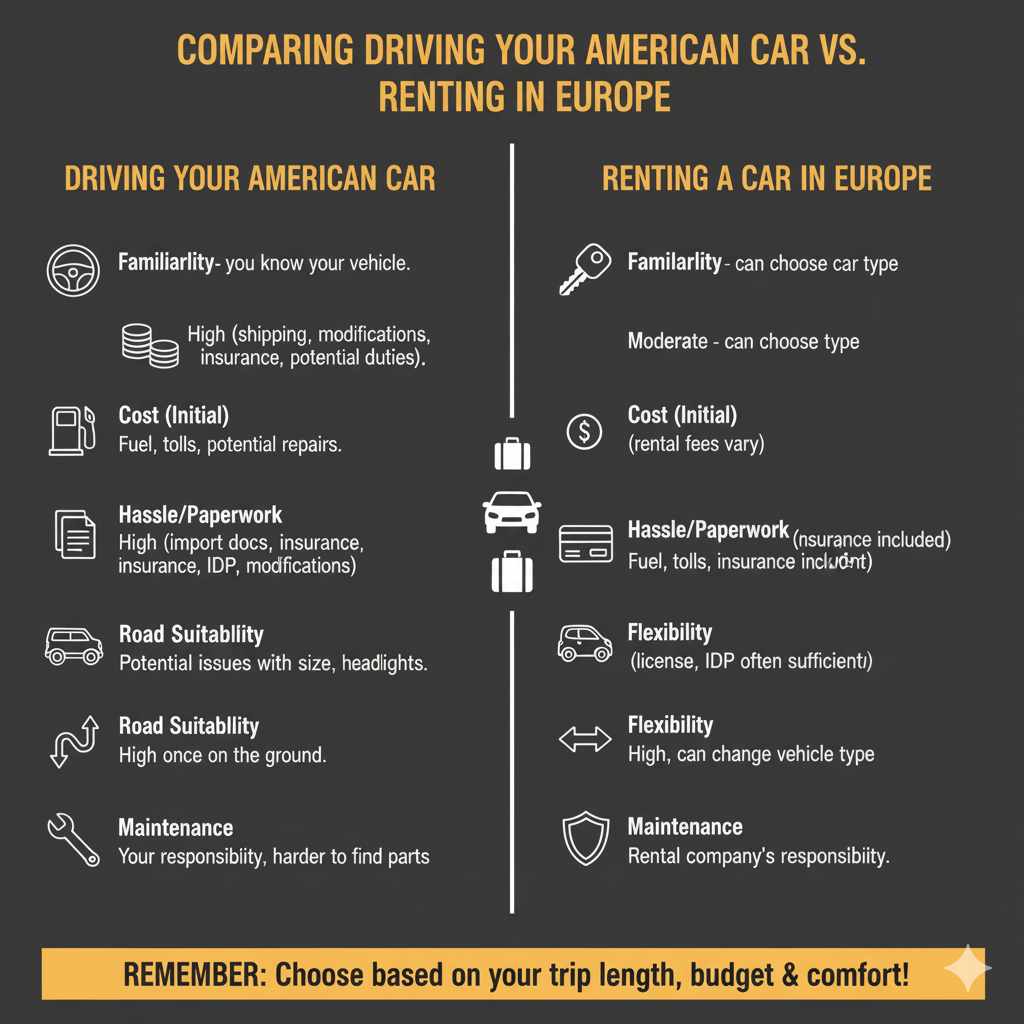
Table: Comparing Driving Your Car vs. Renting in Europe
To help you weigh your options, here’s a quick comparison:
| Feature | Driving Your American Car | Renting a Car in Europe |
|---|---|---|
| Familiarity | High – you know your vehicle. | Moderate – you can choose your preferred type. |
| Cost (Initial) | High (shipping, modifications, insurance, potential duties). | Moderate (rental fees vary by car type and duration). |
| Cost (Ongoing) | Fuel, tolls, potential repairs. | Fuel, tolls, insurance included in rental fee (usually). |
| Hassle/Paperwork | High (import docs, insurance, IDP, modifications). | Low (driver’s license, IDP often sufficient for rental). |
| Road Suitability | Potential issues with size, headlights. | Vehicles sized appropriately for European roads available. |
| Flexibility | High once on the ground. | High, can change vehicle type if needed. |
| Maintenance | Your responsibility, potentially harder to find parts. | Rental company’s responsibility. |
Frequently Asked Questions (FAQ)
Do I need an International Driving Permit (IDP) to drive my American car in Europe?
Some countries allow you to drive with just your US driver’s license for short tourist stays, but an IDP is required or strongly recommended in several EU countries, including Austria, Italy, and Spain. It’s an official translation of your license issued under an international road-traffic convention, and it can prevent fines or having your car impounded. You can get one from AAA in the US before you leave.
Will my U.S. car insurance cover me in Europe?
No, your standard US car insurance policy will not provide coverage in Europe. You must secure separate international auto insurance that is valid in the countries you plan to drive in. You do not need a “Green Card” for this in the EU/EEA anymore (that ended in 2021), but you still need proof your policy actually extends abroad.
Are American cars too big for European roads?
Some American cars, especially larger SUVs and pickup trucks, can be significantly wider and longer than typical European vehicles. This can make navigating narrow city streets, rural lanes, and parking in tight spots challenging. It’s wise to compare your car’s dimensions against common European car sizes before you go.
What modifications does my American car need for driving in Europe?
The most common modification is adjusting your headlights, especially if you’re crossing into a left-hand-traffic country like the UK or Ireland. You’ll also likely need to carry a warning triangle, a first-aid kit, and a high-visibility vest for each occupant, which are mandatory in many European countries.
How do I handle fuel for my American car in Europe?
Most gasoline (petrol) cars will run on European gasoline, but be mindful of octane ratings. American premium gasoline typically corresponds to European Super Unleaded (95 or 98 octane). Diesel cars will usually run fine on European diesel. Check your car’s manual for the correct fuel type and octane rating.
How long can I drive my US-registered car in Europe before I have to register it?
In the EU, the standard limit is 6 continuous months in any 12-month period under the temporary admission rules, after which the car becomes liable for local registration and tax. Switzerland allows up to 6 months as well, extendable to 12 months if you’re there for work or study. Always confirm the current rule for each specific country you’ll be driving through.
Can I permanently register my American car in Europe?
Sometimes, but it’s often the hardest part of the whole process. Since most US-spec cars were never given EU type-approval, permanent registration usually requires an individual vehicle approval — a national inspection and paperwork process that can involve emissions retesting and modifications. Cost, timeline, and whether it’s practical at all vary significantly by country, so check with the destination country’s transport authority before committing to shipping the car over for good.
Conclusion
So, can you drive an American car in Europe? For a visit of up to 6 months, yes, with the right insurance, an IDP if your destination requires one, and the required safety kit in the trunk. For a permanent move, it’s a much harder yes, gated by EU type-approval and individual vehicle inspections that not every US car will pass.
Research the specific requirements of every country you intend to visit or import into, since the rules genuinely differ country by country. If the paperwork or cost for bringing your own car starts to outweigh the benefit, renting, leasing, or buying locally are all solid alternatives covered above.
Products related to this article
Sponsored / affiliate links. As an Amazon Associate I earn from qualifying purchases. I may earn additional commission from eligible campaigns.