Cancer Decals for Cars: What Each Ribbon Color Means
A cancer ribbon car decal means one specific cancer only when the color has a clear label. Otherwise, one ribbon color can stand for several cancers, so the decal or nearby text should spell out the cause. A mislabeled ribbon can confuse supporters, misstate the cause, and make a tribute look careless. This guide lists the main ribbon colors, shows where meanings overlap, and gives practical ways to label and display a car decal without ambiguity.
What cancer ribbons mean on cars


On a vehicle, a cancer ribbon usually signals awareness, support, remembrance, or advocacy. The decal may honor a survivor, remember someone lost, or back a cause tied to screening, treatment, or research. Because cars move through public space, the message needs to be readable and specific.
That specificity matters more when a color has more than one meaning. A pink ribbon is widely understood, but purple, orange, and lavender can point to more than one cause. If the exact meaning matters, the decal should carry text or another cue.
Ribbon colors and cancer meanings
Pink ribbons are commonly used to represent breast cancer awareness, and pink is a commonly recognized cancer ribbon color. October is Breast Cancer Awareness Month, so pink decals are often used for that timing, too. Blue ribbons symbolize colon cancer awareness, with March tied to Colon Cancer Awareness Month.
Orange ribbons are associated with leukemia and kidney cancer. Purple can represent pancreatic cancer, testicular cancer, thyroid cancer, and cancer survivors. Lavender is used for general cancer awareness and is often treated as a universal symbol of solidarity.
White or pearl ribbons represent lung cancer, including mortality awareness, and November is Lung Cancer Awareness Month. Light blue ribbons represent prostate cancer, with September tied to Prostate Cancer Awareness Month. Gold ribbons stand for childhood cancer and the preciousness of children.
Which ribbon color means what?
The short answer is that some colors point cleanly to one cancer, while others do not. Pink, blue, white or pearl, and light blue are easier to read at a glance. Purple, orange, and lavender need more care because their meanings overlap or broaden beyond one diagnosis.
Breast, colon, lung, and prostate cancer
Pink means breast cancer. Blue means colon cancer. White or pearl means lung cancer. Light blue means prostate cancer. If you want the decal to read clearly from a passing car or parking lot, these are among the simplest colors to use because each has a common, specific association.
Pancreatic, testicular, thyroid, and childhood cancer
Purple can mean pancreatic cancer, testicular cancer, thyroid cancer, or cancer survivorship. Gold is the color for childhood cancer. Orange can mean leukemia or kidney cancer. Lavender points to general cancer awareness rather than one single diagnosis.
Suppose you buy a purple ribbon decal for a hatchback and plan to honor a thyroid cancer survivor. Without text, someone else may read it as pancreatic cancer support or survivorship generally. Adding a short label next to the ribbon removes that guesswork.
Cancer ribbon decal matrix
This table turns ribbon meanings into buying guidance. Use it before you place an order, especially if the same color can point to several cancers. The safest choice is the one that can be understood without explanation from a few feet away.
| Ribbon color | Cancer meanings | Best use case | Ambiguity note |
|---|---|---|---|
| Pink | Breast cancer | A clear breast cancer tribute or awareness decal | Widely recognized; usually the least confusing |
| Blue | Colon cancer | Support for colon cancer awareness or remembrance | Specific meaning is generally clear |
| Orange | Leukemia; kidney cancer | Only if the intended cause is labeled | Multiple meanings; add text to avoid mix-ups |
| Purple | Pancreatic cancer; testicular cancer; thyroid cancer; cancer survivors | Broad survivorship or a labeled diagnosis-specific decal | High overlap; text is strongly recommended |
| Lavender | General cancer awareness | Solidarity with many cancer causes | Not tied to one cancer type |
| White or pearl | Lung cancer | Lung cancer awareness, remembrance, or advocacy | Usually specific, but the finish should stay visible |
| Light blue | Prostate cancer | Prostate cancer awareness and support | Specific meaning is generally clear |
| Gold | Childhood cancer | Support for children and families affected by cancer | Specific cause, but often paired with wording for clarity |
How to choose the right decal
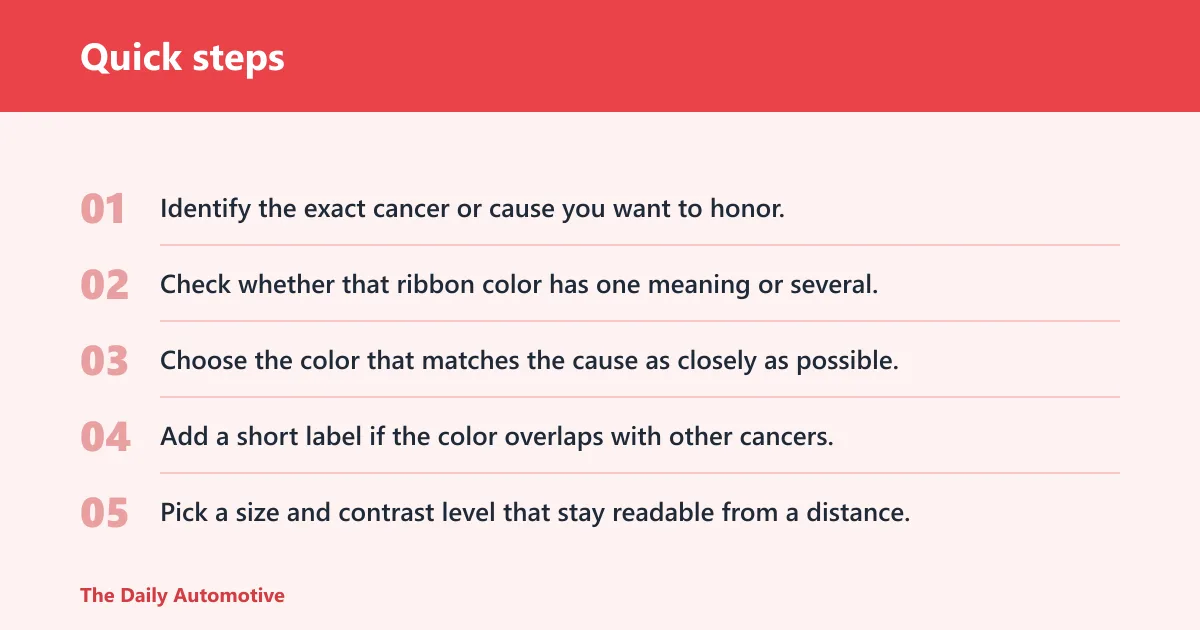
Start with the exact cause you mean to honor, then choose the color that matches that cause. If the ribbon color has more than one meaning, add short text such as the cancer type, “survivor,” or “awareness.” The goal is readable identification, not decoration alone.
Pick the exact color for the intended cause
If your message is breast cancer awareness, pink is the direct choice. If it is colon cancer, choose blue. For lung cancer, white or pearl is the clearest pick. For prostate cancer, use light blue. These colors reduce confusion because they are the most closely associated with one cause in common use.
Add text when a color has more than one meaning
Orange should usually be labeled if the decal is meant to honor leukemia or kidney cancer. Purple should also be labeled unless the message is broad survivorship. Lavender is a better fit when the point is general cancer awareness or solidarity across diagnoses, not one named cancer.
A common first-timer mistake is ordering a purple ribbon with no text for a rear window, then assuming the meaning will be obvious. On a moving vehicle, the viewer has only a second or two. A label like “Thyroid Cancer” or “Survivor” keeps the message intact.
Match size and contrast to vehicle visibility
Use a size that can be read at normal following distance, not one that disappears into the glass or paint. High contrast matters more than a fancy finish. A light ribbon on a dark window works better than a low-contrast decal that blends into the body color.
Keep the design simple. Thin script, tiny border text, or crowded artwork can make the ribbon hard to read. If the decal sits on tinted glass, test whether the ribbon and any label still stand out in daylight and shade.
- Identify the exact cancer or cause you want to honor.
- Check whether that ribbon color has one meaning or several.
- Choose the color that matches the cause as closely as possible.
- Add a short label if the color overlaps with other cancers.
- Pick a size and contrast level that stay readable from a distance.
- Place the decal where it will not be blocked by trim, wipers, or cargo.
How should you display it?
Place the decal where other drivers can see it without straining. Rear glass is common because it faces traffic behind you, but side windows can work if they remain clear. The best spot is one with flat surface, good contrast, and no obstruction from tint, defroster lines, or interior clutter.
Placement, visibility, and readability from a distance
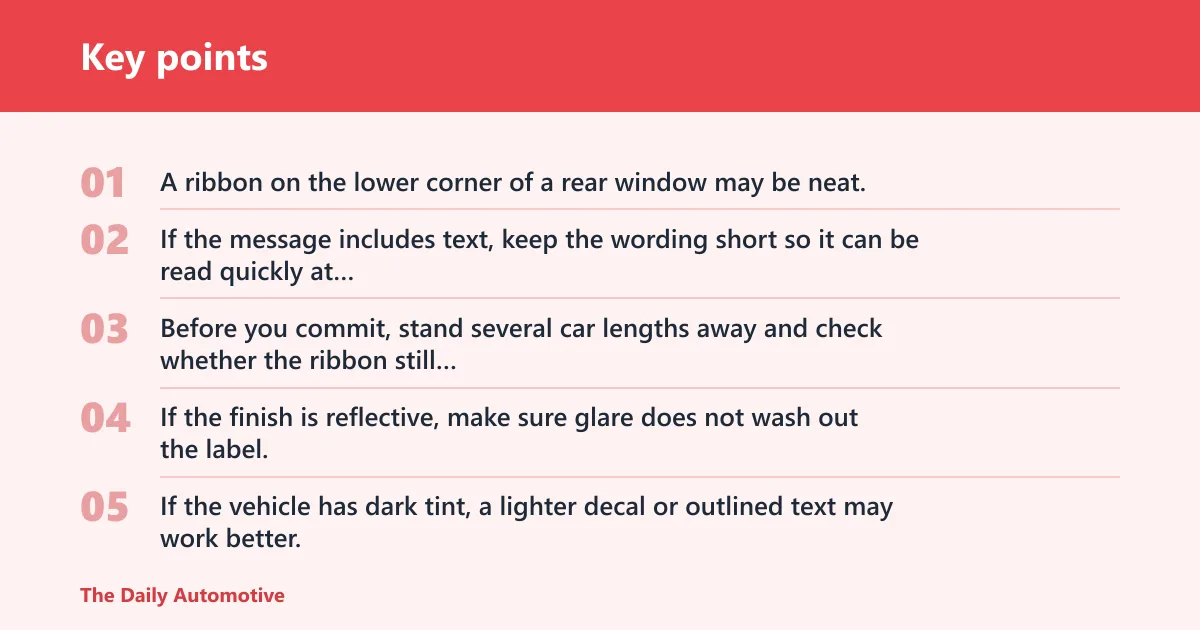
Readability matters more than decoration. A ribbon on the lower corner of a rear window may be neat, but it can be too small or partially hidden. If the message includes text, keep the wording short so it can be read quickly at stoplights or in parking lots.
Before you commit, stand several car lengths away and check whether the ribbon still looks clear. If the finish is reflective, make sure glare does not wash out the label. If the vehicle has dark tint, a lighter decal or outlined text may work better.
Avoiding confusion with overlapping ribbon meanings
When a color has several meanings, the safest display is one that names the exact cause. That is especially true for purple and orange. A ribbon alone may be sincere, but it can still be interpreted in more than one way.
Display etiquette is simple: do not let a tribute look like a different cause by accident. If the color is broad, the wording should be specific. If the wording is not possible, choose a more distinctive color or a design that includes the full cause name.
Frequently asked questions
What does each cancer ribbon color mean?
Pink means breast cancer. Blue means colon cancer. Orange is linked with leukemia and kidney cancer. Purple can mean pancreatic cancer, testicular cancer, thyroid cancer, or cancer survivorship. Lavender means general cancer awareness. White or pearl means lung cancer, light blue means prostate cancer, and gold means childhood cancer.
Which ribbon color is for breast cancer?
Pink is the ribbon color for breast cancer awareness. It is also the most widely recognized cancer ribbon color, which makes it a clear choice for decals. Breast Cancer Awareness Month is in October, so pink decals often appear then as well.
What color ribbon is for colon cancer?
Blue is the ribbon color for colon cancer awareness. It is tied to Colon Cancer Awareness Month in March. For a car decal, blue is a straightforward pick because the meaning is specific and usually understood without extra explanation.
What does a purple cancer ribbon stand for?
Purple can stand for pancreatic cancer, testicular cancer, thyroid cancer, and cancer survivors. Because it has several meanings, a purple car decal should usually include text if you want the viewer to understand the exact cause. Without wording, the message can be read more than one way.
What do orange cancer ribbons mean?
Orange ribbons are associated with leukemia and kidney cancer. That overlap makes orange a color that benefits from labeling on a car decal. If you want the message to be specific, add the cancer type beside the ribbon so the meaning is not left to guesswork.
What ribbon color is used for lung cancer?
White or pearl ribbons are used for lung cancer. The color also connects to lung cancer mortality awareness, and November is Lung Cancer Awareness Month. For vehicle use, a white or pearl ribbon should stay high-contrast enough to remain visible on the window or body panel you choose.
Products related to this article
Sponsored / affiliate links. As an Amazon Associate I earn from qualifying purchases. I may earn additional commission from eligible campaigns.
 Touch Up Paint for Cars, 3-Pack - White Car Scratch Repair Pen, Color Accurate Automotive Touch Up Paint, Long-Lasting Scratch Resistance, Fast-Drying & User-Friendly, Safe & Water-Resistant for Automotive & Household Touch-Ups
 VulgrCo Windshield Custom Vinyl Decals for Cars - Personalized Car Stickers