Do You Need Fuel Stabilizer for Winter Storage?
Use fuel stabilizer for winter storage if gasoline will sit more than 30 days, especially with E10 fuel, humid storage, or carbureted engines. Without it, fuel can oxidize, absorb water, form varnish, and make spring starting costly or impossible. This guide explains when stabilizer is worth it, when it is optional, and how storage time, fuel blend, climate, and engine type change the answer.
Fuel storage decision matrix

This is the quickest way to decide. The right answer depends on how long the fuel will sit, whether it is E10 or ethanol-free, and whether the engine is carbureted or fuel-injected. Long storage pushes the answer toward stabilizer. Short storage often does not.
| Storage duration | Fuel type | Engine type | Recommended action |
|---|---|---|---|
| Under 30 days | E10 or ethanol-free | Fuel-injected | Usually no stabilizer needed. Keep the tank reasonably full and follow the manual. |
| Under 30 days | E10 | Carbureted | Stabilizer is optional, but it helps if the fuel is already close to 30 days old or the storage area is humid. |
| 30-90 days | E10 | Fuel-injected | Use stabilizer before storage. Run the engine afterward so treated fuel reaches the lines and injectors. |
| 30-90 days | E10 | Carbureted | Use stabilizer or drain the system if the manual allows it. Carburetors are less tolerant of sitting fuel. |
| 30-90 days | Ethanol-free | Fuel-injected | Stabilizer is often wise, especially if storage is warm or humid, but it is less urgent than with E10. |
| Over 90 days | E10 or ethanol-free | Carbureted | Use stabilizer or drain the fuel system as allowed by the manual. Long storage without either is a bad bet. |
| Over 90 days | E10 | Fuel-injected | Treat the fuel before storage. In humid storage, premium stabilizers with corrosion inhibitors deserve a close look. |
Do you need fuel stabilizer for winter storage?
For most drivers, yes if the fuel will sit longer than about a month, especially if the layup stretches into winter. Short storage can be fine without it. Long storage, humid air, E10 fuel, and carbureted systems all push the decision toward stabilizer.
When short storage does not need it
If a car will sit for only a few weeks, fresh fuel often handles the job on its own. Fuel-injected vehicles are more tolerant because the fuel system is sealed and pressurized. If the tank is recent and the storage period is short, stabilizer is usually optional rather than mandatory.
When winter storage does need it
Once the fuel will sit beyond 30 days, stabilizer starts to make sense. The benefit rises further at 60 or 90 days, and more so when the fuel is E10 or the storage space stays damp. In those cases, stabilizer is a cheap hedge against a bad spring restart.
When draining the tank is the better route
Draining can be the better route for some carbureted engines, some small engines, and some equipment that will sit a long time. But the vehicle or engine manual comes first. Do not drain simply because it sounds cleaner; some systems are built to sit with treated fuel, not empty lines.
That tradeoff matters. A bottle of stabilizer costs little compared with the labor of clearing varnish from a carburetor or replacing fuel-system parts. Draining may be practical on a leaf blower or generator. On a modern car, it is often unnecessary work unless the manual calls for it.
Why gasoline goes bad
Gasoline degrades mainly through oxidation. As it sits, it turns stale, then forms gum and varnish that can cling to jets, injectors, and tank surfaces. Water exposure makes the problem worse, and that is where storage time and humidity become the real decision drivers.
Oxidation, gum, and varnish
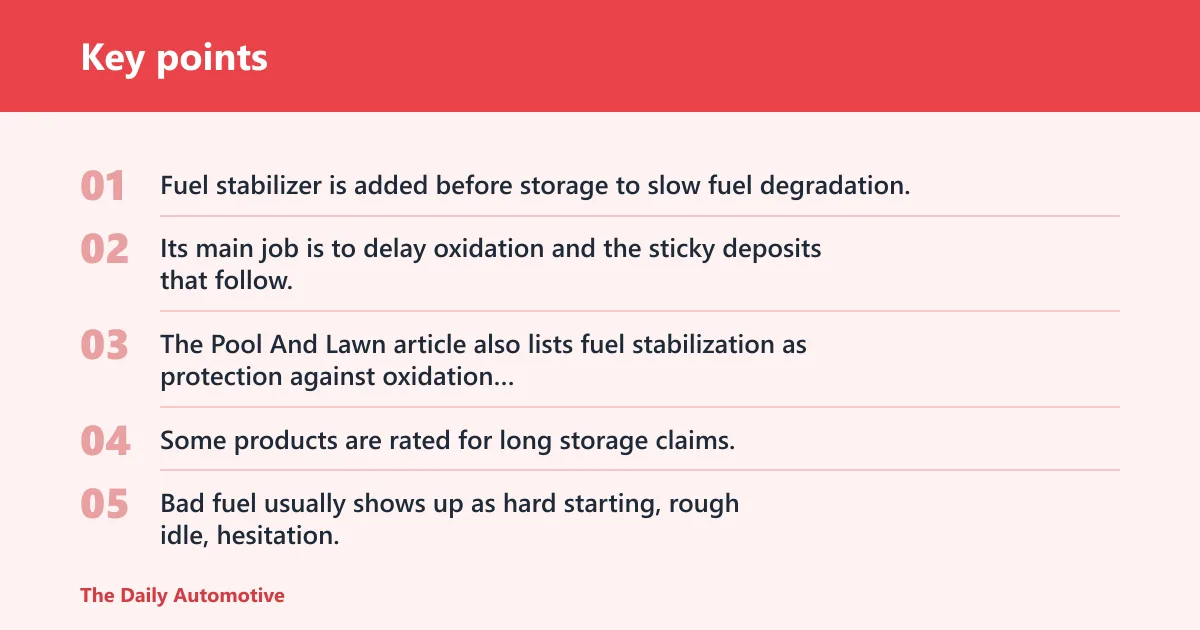
Fuel stabilizer is added before storage to slow fuel degradation. Its main job is to delay oxidation and the sticky deposits that follow. The Pool And Lawn article also lists fuel stabilization as protection against oxidation and moisture, which matches the basic storage problem.
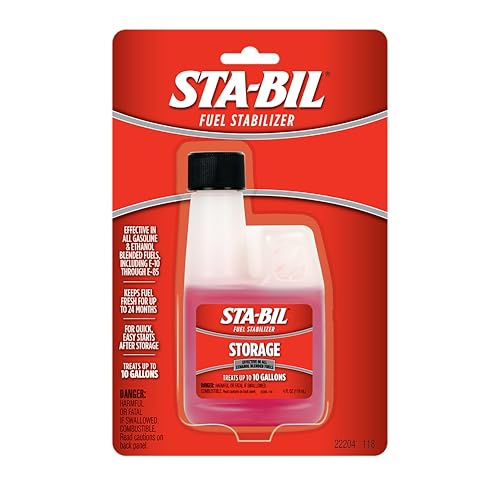
Stabilizer does not make fuel immortal. Some products are rated for long storage claims, including up to 24 months for STA-BIL Storage, but those claims assume the fuel is fresh when treated. A fresh tank plus stabilizer is the point. Old fuel plus stabilizer is a weaker plan.
How stale fuel affects starting and drivability
Bad fuel usually shows up as hard starting, rough idle, hesitation, and a crank-no-start condition. In carbureted engines, the float bowl can dry out and leave residue behind. In fuel-injected systems, stale fuel can still foul injectors and make cold starts sluggish.
Say your mower is filled in October, then left in a damp shed until March. If the fuel was E10 and untreated, the first symptom may be long cranking and a sputtering idle. The issue is not mystery wear. It is fuel that changed while sitting still.
Why storage time matters more than the calendar
The calendar matters because time gives oxidation and moisture more room to act. But storage conditions matter just as much. A cool, dry garage slows the problem. A humid unheated shed speeds it up. That is why the same fuel can survive one layup and fail another.
Does E10 need stabilizer more often?
Yes, E10 usually deserves more attention than ethanol-free fuel because it contains 10% ethanol and is more moisture-prone. In humid storage, the risk of water absorption and phase separation rises. That makes stabilizer more valuable, especially for longer layups and older fuel systems.
Why ethanol-blended fuel absorbs moisture
E10 gasoline is the standard U.S. pump fuel in many areas. Ethanol attracts water more readily than straight gasoline, so the fuel can pick up moisture from air in the tank and storage space. That extra water load is what raises storage risk.
How humidity raises phase-separation risk
Phase separation happens when water and ethanol collect into a layer at the bottom of the tank. That layer can create starting problems, poor drivability, and fuel-system corrosion. The risk rises with humidity and time, which is why a damp shed is a worse storage place than a dry garage.
Corrosion inhibitors matter here. Many premium stabilizers include them, and they are especially useful when the fuel system will sit in humid conditions. They do not remove water already separated out, but they help protect metal parts from the moisture that comes with storage.
When ethanol-free fuel changes the answer
Ethanol-free fuel is less moisture-prone, so the storage decision is a little easier. That does not make stabilizer pointless. It just means short storage is less risky, and the need becomes more tied to duration than to ethanol exposure. Long storage still favors treatment.
Carbureted vs fuel-injected engines
Carbureted engines face more storage risk than fuel-injected engines. Fuel injection is sealed and pressurized, so it handles short storage better. Carburetors leave more fuel exposed to air and evaporation, which makes stale fuel and varnish more likely.
Why carbureted engines face more storage risk
Carburetors often have a float bowl that can dry out during storage. As fuel evaporates, residue can remain in the passages and jets. That is why carbureted engines often need stabilization or draining for long storage, especially when the fuel is E10.
Picture a classic car that sits for four months with a half tank of E10 in a damp garage. Even if it cranks, the first issue may be a sticky carburetor and rough idle. The vulnerable part is small, but the repair bill is not.
Why fuel-injected engines tolerate short storage better
Fuel-injected engines are not immune to stale fuel, but they are less sensitive to brief layups. The system is more sealed, and the fuel lines are less exposed. For a short winter pause, many fuel-injected vehicles can sit on fresh fuel without trouble.
That tolerance drops as storage time grows. Once the fuel will sit for months, treated fuel is the safer choice. Stabilizer also helps keep the fuel that remains in the tank, rails, and lines in better shape.
What changes for small engines and power equipment
Small engines often have carburetors, small tanks, and more exposed fuel passages. That combination makes them higher risk than a modern car. Snow blowers, generators, trimmers, and pumps often benefit from stabilizer more strongly than passenger cars do.
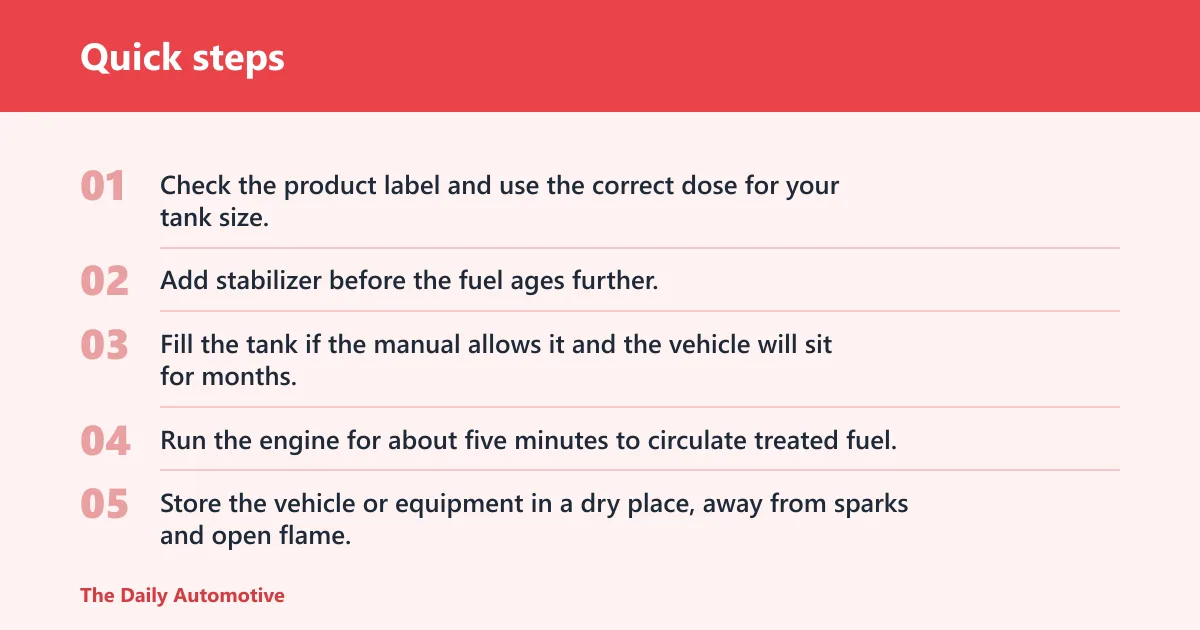
Add stabilizer before storage, not after fuel turns stale. The product works best with fresh fuel because it slows degradation instead of reversing it. After dosing, run the engine for about five minutes so treated fuel reaches the lines and carburetor.
Add it before storage, not after fuel turns stale
If the gas is already old, stabilizer is not a rescue tool. It can slow more decay, but it will not restore fuel that has already gone stale. If fuel smells sour, starts to darken, or has been sitting far too long, draining or service may be the better move.
Why fresh fuel matters
Fresh fuel gives the additive a clean starting point. That matters because stabilizer is meant to slow oxidation and gum formation before they get ahead of you. It works best when mixed into fuel that has not already been compromised.
Run the engine for about five minutes after dosing
This step is easy to miss. The point is to move treated fuel through the pump, lines, and carburetor so the whole system gets protection. The recommended step after dosing is to run the engine for about five minutes.
How to handle full tanks and half tanks
A fuller tank leaves less air space above the fuel, which can help limit moisture exchange. If the manual allows it, topping off before storage is sensible. A half tank can still be stabilized, but it leaves more room for humid air to work on the fuel.
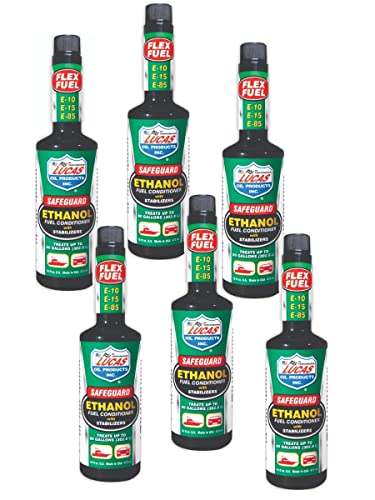
Keep the dose tied to the product label. Dosing ratios vary by brand, and the label is the correct source. For example, STA-BIL Storage is rated to keep gasoline fresh for up to 24 months, and STA-BIL Storage dosing is 1 ounce per 2.5 gallons of gas. Star Tron Stabilizer+ treats 40 gallons of gas in an 8 oz bottle. STA-BIL 360 Marine treats up to 80 gallons.
- Check the product label and use the correct dose for your tank size.
- Add stabilizer before the fuel ages further.
- Fill the tank if the manual allows it and the vehicle will sit for months.
- Run the engine for about five minutes to circulate treated fuel.
- Store the vehicle or equipment in a dry place, away from sparks and open flame.
Fuel storage checklist
This is the practical do-this-now list. It keeps the process simple and avoids the most common mistake, which is adding stabilizer and then forgetting to circulate it. That leaves the treated fuel sitting in the tank instead of reaching the parts that need it.
- Add the correct amount from the product label.
- Use stabilizer before storage, not after the fuel has turned stale.
- Top off the tank if the vehicle or equipment manual allows it.
- Run the engine for about five minutes after dosing.
- Store the machine in a dry place when possible.
- For carbureted equipment, consider whether draining is allowed by the manual.
Fuel, coolant, and electrical work need ventilation, no sparks, and the battery disconnected. Follow the vehicle and product manual. Never work under a vehicle supported only by a jack; use jack stands on level ground.
Frequently asked questions
Is fuel stabilizer necessary if my car sits only a month or two?
For a month, often no. For two months, it becomes more situational. If the fuel is E10, the storage area is humid, or the car has a carbureted system, stabilizer is a smart move. Fuel-injected cars handle short storage better, but they still benefit from treated fuel for longer layups.
Do I need to add fuel stabilizer to E10 gas before storage?
Yes, E10 gas deserves more attention because ethanol absorbs moisture more easily than ethanol-free fuel. That raises the chance of phase separation and starting trouble during storage. If the fuel will sit through winter, treat it before storage and run the engine afterward so the treated fuel reaches the system.
How long can gasoline sit before it goes bad?
There is no single exact date, but risk rises after about 30 days and becomes more serious by 60 to 90 days, especially in E10 fuel and humid storage. Fresh fuel lasts longer than old fuel, and stabilized fuel lasts longer than untreated fuel. Time, air, and moisture all work against it.
Should I use fuel stabilizer in a fuel-injected car?
Yes if the storage period is long enough. Fuel-injected cars tolerate short storage better than carbureted engines, but they still benefit from treated fuel when the layup goes beyond a month or two. The fuel system may be sealed and pressurized, yet stale fuel can still cause hard starting and drivability problems.
Can I just drain the tank instead of using stabilizer?
Sometimes, but only if the manual allows it and the engine type makes it sensible. Draining can be a good route for some carbureted small engines and long storage, but it is not automatically better for every vehicle. On many modern cars, treated fuel is simpler and safer than an empty fuel system.
Will fuel stabilizer fix old gas that has already gone stale?
No. Stabilizer slows further degradation, but it does not restore fuel that has already turned stale or separated. If the fuel smells off, has been sitting too long, or the engine now runs poorly on it, draining, refilling with fresh fuel, or service may be needed instead.
When should I add fuel stabilizer before storing my car?
Add it before the car sits, while the fuel is still fresh. That gives the additive time to mix into the tank and protect the fuel before oxidation and varnish set in. After dosing, run the engine for about five minutes so the treated fuel reaches the lines and injectors.
Products related to this article
Sponsored / affiliate links. As an Amazon Associate I earn from qualifying purchases. I may earn additional commission from eligible campaigns.