How Much Does a Lithium Car Battery Cost?
Most lithium car batteries cost about $300 to $1,500, with premium 12-volt or performance batteries reaching $2,000 or more. The right choice depends on fitment and electrical demand. Buy the wrong type, and you can spend more on replacements, charging fixes, or fitment issues than the battery saved you upfront. This guide breaks down typical prices, when lithium makes sense, and how to check compatibility before you buy.
Installed cost by battery type and use
Lithium usually costs more than lead-acid or AGM upfront. The better question is total installed cost and how much life you get each year. For many 12-volt replacement jobs, labor can add to the bill, and compatibility checks can matter as much as the battery itself.
Battery-only price versus installed replacement cost
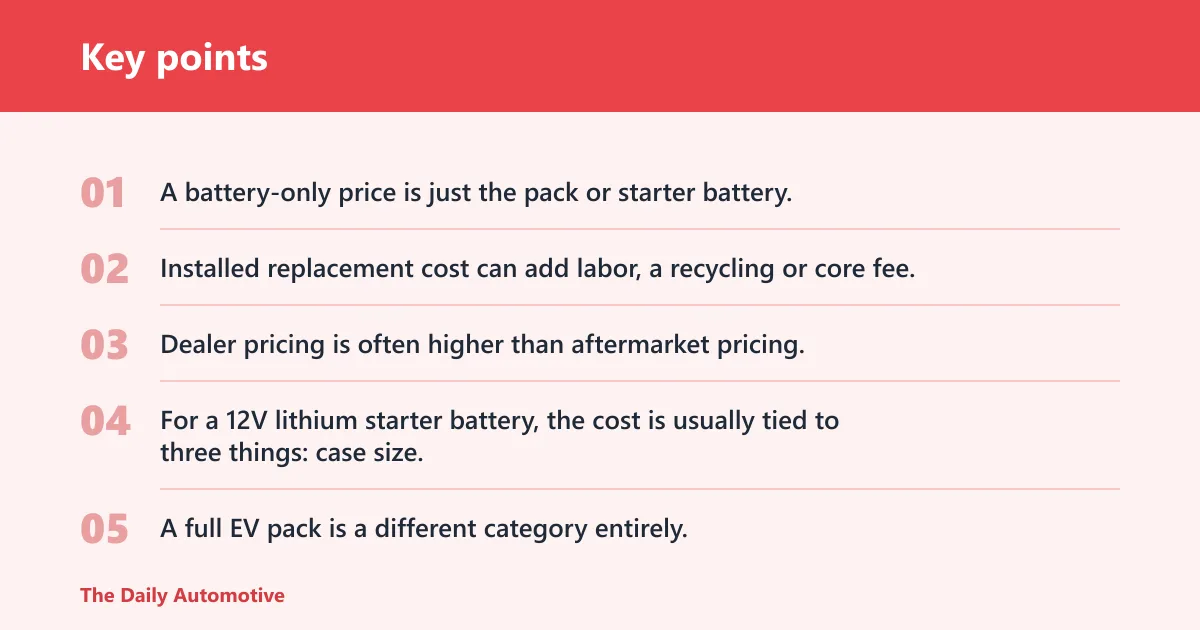
A battery-only price is just the pack or starter battery. Installed replacement cost can add labor, a recycling or core fee, and sometimes a charging-system check. Dealer pricing is often higher than aftermarket pricing, and the gap can widen when a vehicle needs a lithium-specific fitment or charging change.
For a 12V lithium starter battery, the cost is usually tied to three things: case size, terminal layout, and electrical performance such as reserve capacity and cranking performance. A full EV pack is a different category entirely, with a different price scale and service process.
Daily commuter, stop-start vehicle, and audio build comparison
| Use case | Battery-only price | Install and checks | Expected lifespan cost per year | Why lithium may fit |
|---|---|---|---|---|
| Daily commuter | $300 to $700 | $75 to $150 | About $75 to $170 per year if a $375 to $850 installed battery lasts 5 years | Lighter weight, fewer deep-cycle losses, and cleaner replacement when the vehicle supports lithium charging |
| Stop-start vehicle | $400 to $900 | $100 to $200 | About $80 to $220 per year if a $500 to $1,100 installed battery lasts 5 years | Better cycle life can help when the car shuts down and restarts often |
| Audio or high-load build | $600 to $1,500+ | $100 to $250 | About $117 to $350+ per year if a $700 to $1,750 installed battery lasts 6 years | Higher current demand and deeper cycling can make lithium worthwhile if the charging system is compatible |
These are framework examples, not a universal quote. The point is simple: a higher sticker price can still produce a lower cost per year if the battery lasts longer and fits the vehicle’s electrical demands better.
When a higher upfront price can make sense
Say your car sits in stop-and-go traffic, uses start-stop operation, and has a battery tucked in a tight trunk location. A lithium replacement can cost more on day one, but the weight savings and cycle-life benefits may matter if the vehicle is set up for that chemistry.
A common first-timer mistake is treating every battery with the same case size as interchangeable. It is not. Physical size, terminal layout, reserve capacity, and starting performance all have to line up with the vehicle and the charging system.
What are you actually buying?
For automotive use, the phrase “lithium car battery” can mean two very different products. A 12V lithium starter battery replaces a conventional starter battery. A high-voltage EV battery pack powers an electric vehicle and sits in a different cost and service class.
12V starter battery versus high-voltage EV pack
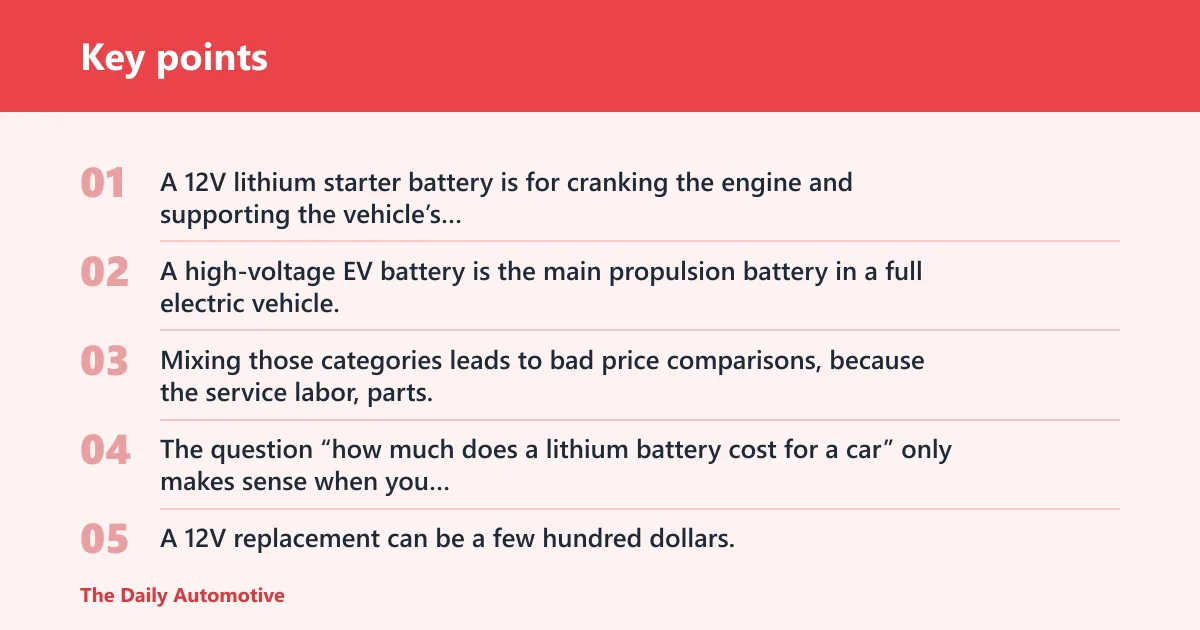
A 12V lithium starter battery is for cranking the engine and supporting the vehicle’s accessories and electronics. A high-voltage EV battery is the main propulsion battery in a full electric vehicle. Mixing those categories leads to bad price comparisons, because the service labor, parts, and risk profile are not the same.
The question “how much does a lithium battery cost for a car” only makes sense when you define the vehicle. A 12V replacement can be a few hundred dollars. A traction pack is a much larger and more expensive system.
Capacity, reserve capacity, and starting performance
For starter batteries, capacity is often expressed in amp-hours, while EV packs use kilowatt-hours. In a 12V replacement, reserve capacity and cold-cranking performance matter because the battery has to support starting and short electrical loads. If the battery listing does not match the vehicle’s requirements, check the manufacturer’s listing for your model.
Some lithium starter batteries use a BMS low-voltage cutoff, which protects the cells by disconnecting them before damage occurs. That protection is useful, but it also means a weak charging system or parasitic draw can strand the vehicle if the battery is not the right match.
Physical size and terminal layout fitment
Fitment is not optional. You need the correct group size or equivalent physical dimensions, the right terminal layout, and enough hold-down compatibility for the battery tray. If the terminals sit in the wrong place, the battery may fit poorly or require cable changes that add cost.
Check the manufacturer’s listing for your model, and confirm the exact fitment in the owner’s manual when the vehicle is sensitive to battery type or charging strategy.
Lithium chemistry and BMS basics
LiFePO4 is commonly used as an aftermarket automotive lithium chemistry, but not every lithium chemistry is a good automotive swap. LiFePO4, or lithium iron phosphate, is the common aftermarket automotive chemistry because it is generally safer and more stable than many other lithium types, and it usually offers strong cycle life and weight savings.
LiFePO4 versus other lithium chemistries
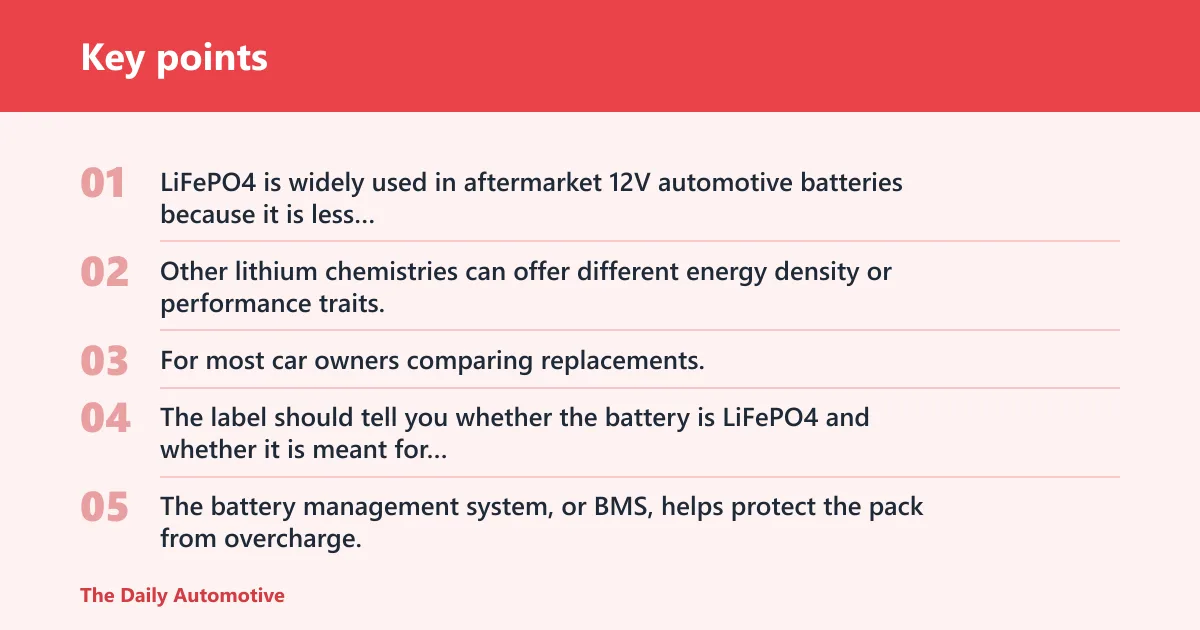
LiFePO4 is widely used in aftermarket 12V automotive batteries because it is less volatile than many other lithium chemistries and works well in deep-cycle and starter roles when the vehicle supports it. Other lithium chemistries can offer different energy density or performance traits, but they are not automatically better for cars.
For most car owners comparing replacements, chemistry matters more than marketing language. The label should tell you whether the battery is LiFePO4 and whether it is meant for starter use, auxiliary use, or another application.
What the BMS protects against
The battery management system, or BMS, helps protect the pack from overcharge, over-discharge, and cell imbalance. Many designs also include low-temperature charging protection, which matters in winter because lithium cells can be damaged if charged below their safe limit.
That protection is valuable, but it is not a free pass to ignore the vehicle. If the charging voltage is wrong, or the alternator behavior does not suit lithium, the BMS cannot fix the entire system by itself.
Cold-temperature charging limits
Cold weather is a real issue for 12V lithium starter batteries. Starting performance can drop in low temperatures, and charging may be restricted until the battery warms enough for safe acceptance. That is why some owners see a battery that looks fine in mild weather act weak on cold mornings.
Suppose your car is parked outside overnight in a freezing climate. The battery may still crank the engine, but a lithium pack with low-temperature charging protection may refuse charge until conditions improve. That is a feature, not a defect, but it must fit the climate.
Will your charging system work?
Maybe. That is the honest answer until you check the charging profile. A lithium replacement can work well in the right vehicle, but alternator voltage setpoint, smart alternator behavior, and the car’s stated lithium support all matter before you buy.
Alternator voltage setpoint and smart alternator behavior
Some vehicles use a conventional charging profile. Others use a smart alternator that changes output based on load, temperature, and fuel-saving logic. Lithium batteries are more sensitive to the charging profile than many lead-acid batteries, so a system that looks “close enough” on paper can still be a poor match.
If the vehicle does not support lithium charging, do not assume a drop-in replacement will behave correctly. Check the owner’s manual or the battery manufacturer’s vehicle fitment guide before purchase.
Low-voltage cutoff and charge profile requirements
The BMS low-voltage cutoff protects the battery, but it also means the battery can shut down earlier than a lead-acid battery would. That makes proper charge profile matching important. The charging system should maintain the voltage range the battery expects, without overcharging or hunting up and down in a way the BMS dislikes.
Battery work and jump-starting should follow the vehicle manual’s connection order. Fuel, coolant, and electrical work need ventilation, no sparks, and the battery disconnected where the manual requires it.
When to confirm lithium support in the owner’s manual
Confirm support before buying if the car uses start-stop technology, a battery monitor, or a smart charging system. Also confirm it if you are moving from AGM to lithium. Not every AGM battery can be replaced with lithium without changes.
Follow the vehicle and product manual. Never work under a vehicle supported only by a jack; use jack stands on level ground. Keep dashboard and windshield items out of airbag zones and the driver’s view, and check local laws.
Lithium car battery cost framework
This framework separates battery-only price from installed cost and then spreads that cost across expected life. That gives a better answer than sticker price alone. The exact numbers vary by brand, region, and vehicle, but the method stays the same.
Battery-only price
Typical 12V lithium starter batteries can land in the mid-hundreds for mainstream fitments, with higher prices for premium performance, unusual case sizes, or specialty vehicle applications. If the vehicle needs a specific terminal layout or cold-weather features, expect the price to move upward.
Installation labor and recycling fees
Labor can add a meaningful amount to the replacement bill. A shop may also charge a recycling or core fee, and dealer pricing is often higher than aftermarket pricing. If the vehicle needs battery coding, registration, or a system reset, confirm the fee with the shop before authorizing the job.
Expected lifespan cost per year
Here is the simple method: add battery price, labor, and any recycling fee, then divide by expected service life. An installed lithium starter battery costing about $600 and lasting around 5 years works out to roughly $120 per year. An installed battery costing about $1,050 and lasting around 7 years works out to roughly $150 per year. The longer life can offset the higher entry price.
- Identify the battery type your vehicle actually accepts.
- Check physical size, terminal layout, and hold-down fitment.
- Confirm reserve capacity, starting performance, and BMS behavior.
- Check the charging system, including smart alternator behavior.
- Add battery price, labor, and recycling fees.
- Compare total installed cost against expected life per year.
A battery that looks expensive can still be rational if the car keeps it charged correctly and the pack lasts longer than the cheaper option. The reverse is also true. A cheap battery that needs early replacement is not a bargain.
Is lithium worth it for you?
For the right car, yes. For the wrong car, no. Lithium is worth the extra cost when the vehicle supports it, the climate suits it, and the owner values lighter weight, cycle life, or higher electrical demand handling more than a lower sticker price.
Daily driver value case
For a normal commuter, lithium can make sense if the replacement interval is long enough and the charging system is compatible. The value case gets better when you want a lighter battery and predictable service life, and worse when the vehicle simply needs a basic replacement battery with no special demands.
Stop-start and high-load use case
Stop-start vehicles cycle batteries repeatedly, so chemistry and BMS behavior matter more. High-load builds, such as audio-heavy setups, can also benefit if the battery and charging system are designed for the demand. In both cases, fitment and charging support decide whether lithium is an upgrade or a waste.
Picture a truck with a large audio setup that idles often at shows. If the battery is undersized or the charging profile is wrong, the owner may pay more twice, once for the battery and again to fix the system around it.
When AGM is the better buy
AGM is often the better choice when the vehicle is not lithium-ready, the climate is very cold, or the owner wants the least complicated replacement path. It can also be the smarter buy when the car is old enough that a premium lithium battery would exceed the value of the improvement.
Check warranty length and return policy before purchase. If the listing does not clearly state fitment, charging requirements, and warranty terms, keep shopping.
Frequently asked questions
How much does a lithium ion battery cost?
For a car, a 12V lithium ion battery usually costs a few hundred dollars and can move higher for premium, performance, or specialty fitments. The total replacement bill can rise after labor, recycling fees, or charging-system checks. High-voltage EV packs sit in a completely different price category.
How much does it cost to replace a lithium car battery?
Replacement cost depends on battery-only price, installation labor, any recycling fee, and whether the vehicle needs charging-system work. For a 12V lithium starter battery, the installed total can be much higher than the battery price alone. Dealer pricing is often higher than aftermarket pricing.
How much do lithium car batteries cost?
Most lithium car batteries land above comparable lead-acid or AGM batteries, with price varying by size, brand, and capacity. A 12V starter battery, an auxiliary battery, and a full EV pack are not comparable products, so the correct range depends on the exact use case.
How long do lithium car batteries last?
Life depends on chemistry, climate, charging profile, and how the vehicle uses the battery. LiFePO4 often has a cycle-life advantage over many other lithium chemistries, but poor charging or cold-temperature use can shorten service life. The best comparison is cost per year, not sticker price alone.
What makes lithium car batteries more expensive than lead acid?
Lithium batteries usually cost more because of chemistry, BMS electronics, and tighter fitment or charging requirements. They can also offer lighter weight and longer cycle life, which is why some buyers accept the higher upfront cost. The value only appears when the vehicle can use the battery correctly.
Can you replace an AGM battery with lithium?
Sometimes, but not automatically. You need the correct physical size, terminal layout, starting performance, and charging profile, and the vehicle must support lithium charging or be compatible with the battery manufacturer’s requirements. If the owner’s manual does not support it, treat the swap as unsafe until verified.
Products related to this article
Sponsored / affiliate links. As an Amazon Associate I earn from qualifying purchases. I may earn additional commission from eligible campaigns.