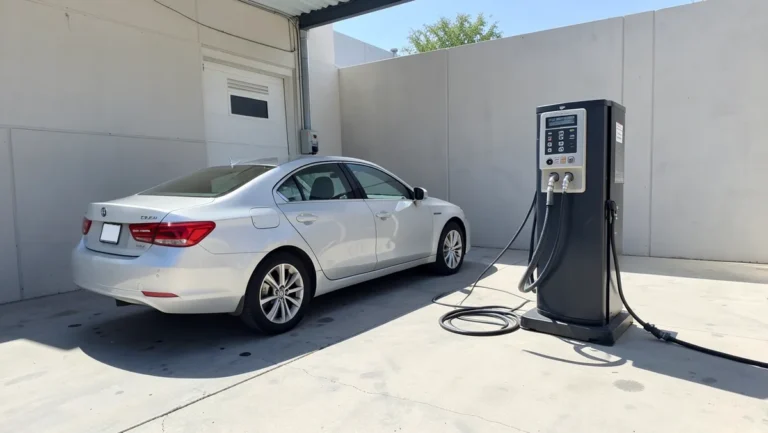
How Much Does It Cost to Test a Car Battery?
A car battery test is often free at parts stores, and many repair shops charge about $10 to $30; a paid load test can be worth it when the battery’s health is unclear. Skipping diagnosis can lead to an unnecessary battery replacement or a dead car at the worst time. This guide explains when testing costs nothing, when a small fee is normal, and when paying for a proper load test makes sense.
Battery test cost table


| Test path | Typical cost | What it reveals | When it is worth it |
|---|---|---|---|
| Free store test | $0 | Basic battery state and often starting/charging system health | First step for most drivers, especially if the battery is older than 3 years |
| DIY multimeter check | About $20 to $50 for a home-use tool if you do not already own one | Resting voltage and charging voltage | Good for quick screening before a shop visit |
| Paid load test | About $10 to $30 at many repair shops | How the battery performs under load | Best when the battery looks okay at rest but symptoms keep returning |
How much does it cost to test a car battery?
For most drivers, the answer is either free or a small fee. Major auto parts stores such as AutoZone, O’Reilly, and Advance Auto Parts test batteries for free, while many repair shops charge about $10 to $30 for a battery check or more for a full diagnostic. A paid test makes sense when you need more than a simple voltage reading.
When a shop fee makes sense
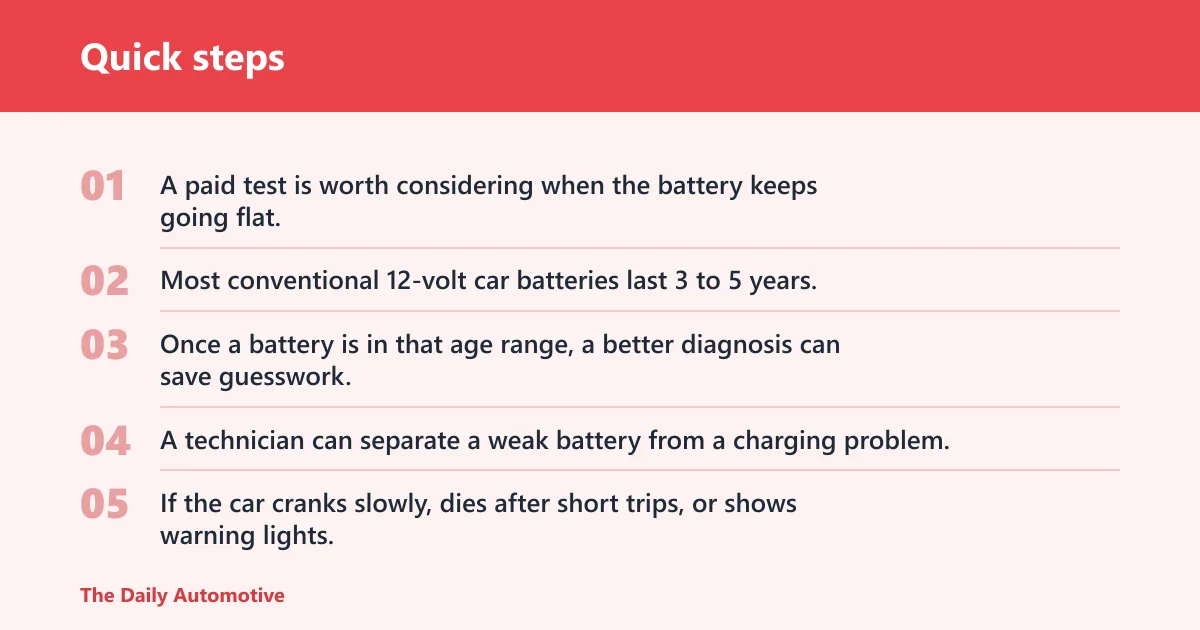
A paid test is worth considering when the battery keeps going flat, the car is hard to start in cold weather, or the battery is nearing the end of its normal life. Most conventional 12-volt car batteries last 3 to 5 years, and premium AGM batteries typically last 4 to 7 years. Once a battery is in that age range, a better diagnosis can save guesswork.
That fee also buys convenience. A technician can separate a weak battery from a charging problem, which matters because the battery may be fine and the alternator may be the real issue. If the car cranks slowly, dies after short trips, or shows warning lights, the diagnosis is often worth more than the test fee itself.
What you pay for convenience
A shop test can be the right choice if you need an answer fast and do not want to buy a tool you may rarely use. In many cases, the real value is not the printout. It is avoiding a wrong replacement, since a battery that seems weak may actually be undercharged or supported by a failing alternator.
Where can you get a free battery test?
You can get a free battery test at AutoZone, O’Reilly, and Advance Auto Parts. These stores commonly check battery condition at no charge, and the test is often the simplest place to start before paying a repair shop. If the result is unclear, you can then decide whether a more detailed load test is worth paying for.
Auto parts stores
Free store testing is useful because it gives you a quick read without opening your wallet. It is also a practical first step before winter or before a long trip, when a weak battery is more likely to fail at an inconvenient time. If the battery passes but the complaint remains, that is a sign to look beyond the battery alone.
Say your sedan is 4 years old and starts fine on a mild day, but it struggles after a cold night. A free store test can point you toward the battery, the alternator, or both, and it costs nothing to start that process.
What does a multimeter tell you?
A multimeter gives you a basic voltage check, which is useful for a home screen but does not settle the full question. With the engine off, a healthy, fully charged battery reads about 12.6 volts. Around 12.4 volts or lower means the battery needs attention, and readings near or below 12 volts usually mean the battery is failing.
Resting voltage with the engine off
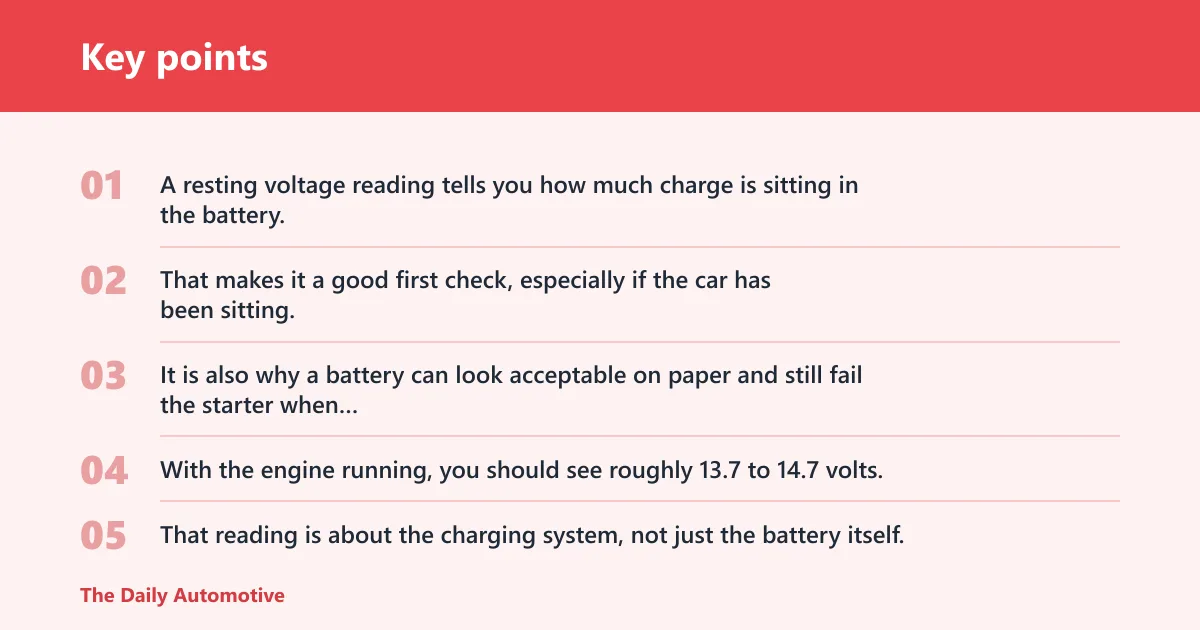
A resting voltage reading tells you how much charge is sitting in the battery, not how well it can perform under load. That makes it a good first check, especially if the car has been sitting. It is also why a battery can look acceptable on paper and still fail the starter when demand rises.
Charging voltage with the engine running
With the engine running, you should see roughly 13.7 to 14.7 volts. That reading is about the charging system, not just the battery itself. If the running voltage is outside that range, the alternator or charging circuit may need attention even if the battery test looks okay at rest.
A common first-timer mistake is to rely only on a quick voltage check and skip the battery-load test when estimating the cost to test a car battery. Suppose a compact SUV shows about 12.6 volts after sitting overnight, then drops when headlights and the blower are on. The resting number may look healthy, but the real question is whether the battery can hold up when demand rises or whether the charging system is struggling.
When the reading points to the alternator
If the battery voltage is low with the engine running, the alternator may not be charging correctly. That is separate from battery condition. A new battery will not fix a weak alternator, and a bad battery can still leave the charging system looking suspicious if the state of charge is already low.
What is the difference between a multimeter test and a load test?
A multimeter test checks voltage. A load test checks performance under demand. That difference matters because a battery can show a decent resting number and still fail when asked to deliver starting power. For battery health, a load test is the more reliable answer.
Why a load test is more reliable
A load test is especially useful when the complaint is intermittent. The battery may start the car on a warm afternoon, then stumble on a cold morning. Load testing is the better way to catch that weak spot because it measures how the battery behaves while doing real work, not just while sitting still.
When a battery passes at rest but still fails
Some batteries look fine with a multimeter and still fail in the car. Cold weather can expose that weakness first, because battery output drops as demand rises and temperatures fall. If the car has recurring no-starts, a load test is the better next step than another quick voltage check.
When is a load test worth paying for?
Pay for a load test when the battery’s condition is unclear, the car keeps showing symptoms, or the free check does not settle the question. It is the best option when you need to know whether the battery can actually do the job, not just whether it holds a surface charge. That is especially important on older batteries and in cold weather.
Older batteries and recurring no-starts
Once a battery is past 3 years old, a free test once or twice a year is recommended. If the vehicle has slow cranking, repeated jump-starts, or warning signs that come and go, the battery may need a load test even if a resting voltage number looks acceptable. That is where paying for a better diagnosis earns its keep.
A load test is also worth paying for before winter or a road trip. The battery may survive everyday driving, then fail when a cold morning or a long stop exposes its weakness. That is far cheaper to learn in a parking lot than on the shoulder of a highway.
Does the battery need a full charge first?
Not always. A battery does not have to be fully charged to be tested, but state of charge affects the result. A low battery can make a simple voltage check look worse than the battery truly is, while a full charge gives a clearer picture of its resting voltage and reserve.
State of charge and test accuracy
If the battery was recently jump-started, left with the lights on, or sat unused for a long time, charge can be part of the problem. In that case, a tester may first recommend charging it and then retesting. That helps separate a low charge from a weak battery cell.
Why a low battery can mislead a voltage check
A low resting voltage does not always mean the battery is damaged. It may simply be discharged. That is why a single number is only part of the story. If the battery stays weak after charging and retesting, then the diagnosis shifts from state of charge to battery health.
When should you test an older battery?
Once your battery passes 3 years old, test it once or twice a year. That timing is practical because aging batteries are more likely to show weakness in cold weather, after short trips, or during long parking periods. Testing before winter or before a long trip is a smart habit.
Three-year threshold
The 3-year mark is a useful line because many conventional batteries are moving into the risk zone by then. Most conventional 12-volt car batteries last 3 to 5 years, while premium AGM batteries typically last 4 to 7 years. Age alone does not prove failure, but it does justify closer checks.
Before winter or long trips
Cold weather reduces battery output and makes weak batteries easier to spot. Long trips matter too, because a failing battery or charging system can turn a routine drive into a roadside problem. A free battery test before either one is cheap insurance.
Picture a pickup that is 4 years old and sits outside in freezing weather. A battery that still starts the truck on a mild day may fail when temperatures drop. Testing before the first cold snap is a better plan than waiting for a no-start call.
Battery replacement cost compared with testing
Battery testing is far cheaper than replacement, which is why diagnosis should come first. Battery only replacement costs roughly $100 to $160 for a standard flooded battery, and premium AGM battery replacement costs about $200 to $325. Most drivers pay somewhere in the $120–$320 range for replacement once installation labor is included.
Independent shops typically charge around $30 to $100 in labor. That makes a paid test or diagnostic step a sensible filter before buying parts. If the problem is the alternator, parasitic drain, or a loose connection, replacing the battery alone does not solve it.
| Item | Typical price |
|---|---|
| Free battery test at a parts store | $0 |
| Paid shop battery check or load test | $10 to $30 |
| Independent shop labor | $30 to $100 |
| Standard flooded battery only | $100 to $160 |
| Premium AGM battery only | $200 to $325 |
| Most replacement jobs all in | $120–$320 |
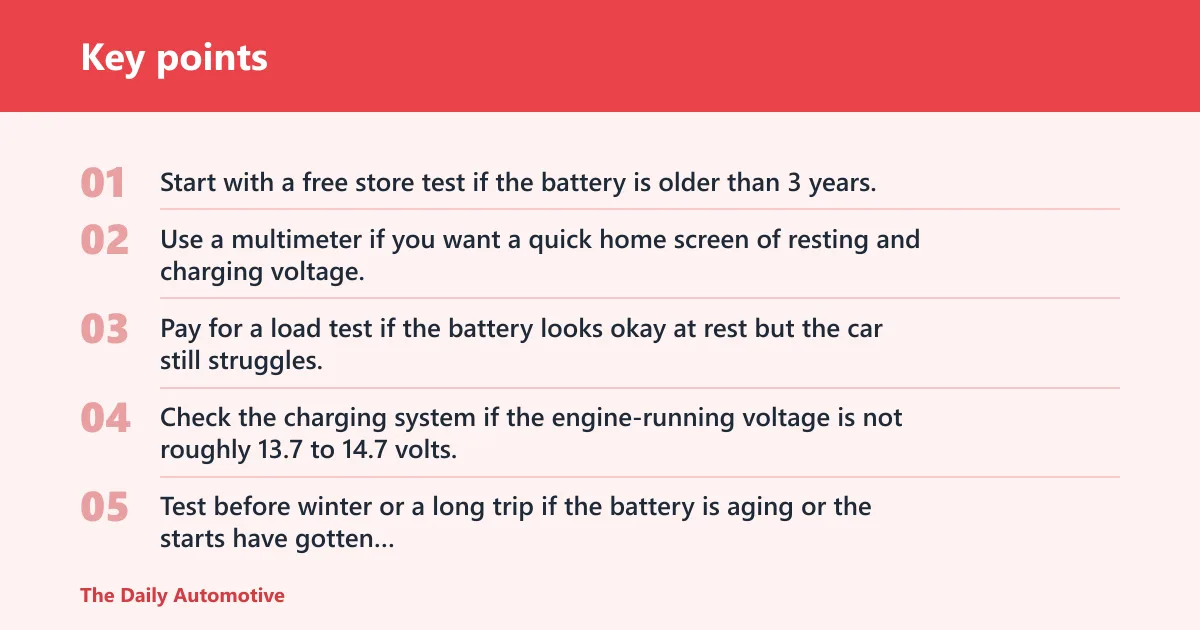
- Start with a free store test if the battery is older than 3 years.
- Use a multimeter if you want a quick home screen of resting and charging voltage.
- Pay for a load test if the battery looks okay at rest but the car still struggles.
- Check the charging system if the engine-running voltage is not roughly 13.7 to 14.7 volts.
- Test before winter or a long trip if the battery is aging or the starts have gotten slower.
Frequently asked questions
How much does it cost to check a car battery?
It is often free at major auto parts stores, including AutoZone, O’Reilly, and Advance Auto Parts. Many repair shops charge about $10 to $30 for a battery check or load test. If the battery is older or symptoms are unclear, paying a small fee can be cheaper than buying the wrong part.
How much to test a car battery?
For most drivers, the cost is either $0 for a store check or about $10 to $30 for a paid shop test. A DIY multimeter check only costs anything if you need to buy the tool. The right choice depends on whether you want a quick screen or a fuller diagnosis.
How much does it cost to get a car battery tested?
A free battery test is available at AutoZone, O’Reilly, and Advance Auto Parts. A paid test at a repair shop usually runs about $10 to $30, especially if it includes a load test. That small fee is often worth it when the battery has failed before or the symptoms keep returning.
Does a car battery have to be charged to test it?
It does not have to be fully charged, but state of charge affects the result. A low battery can make a voltage check look worse than the battery truly is. If the battery was recently run down, charge it and then retest so the result reflects battery health more accurately.
Does a car battery have to be fully charged to test it?
No, but a full charge gives the clearest resting-voltage reading. A healthy, fully charged battery reads about 12.6 volts. If the reading is around 12.4 volts or lower after charging, or near or below 12 volts, the battery needs attention or may be failing.
How often should an older car battery be tested?
Once your battery passes 3 years old, test it once or twice a year. That schedule is especially useful before winter or a long trip. It gives you a chance to catch a weak battery before it strands you, and it helps separate battery aging from charging-system problems.
Products related to this article
Sponsored / affiliate links. As an Amazon Associate I earn from qualifying purchases. I may earn additional commission from eligible campaigns.