Best 4 Inch Car Speakers for Clearer Sound (2026): We Compared
The best 4-inch car speaker is the one that matches your factory depth, impedance, and mounting pattern first; for most upgrades, a coaxial 4-inch from JBL, Pioneer, or Infinity gives clean sound without cutting metal. Pick badly and you can lose bass, add rattles, or end up with a speaker that will not fit the dash or door opening. This guide ranks fit-first 4-inch replacements by sound quality, OEM compatibility, and the real pain points they solve.
Best 4 inch car speakers at a glance
If you need the shortest path to a good swap, start with the model that fits the opening and matches your power source. Sound quality matters, but a speaker that clashes with mounting depth or impedance creates more problems than it solves.
The top overall fit-first pick here is the Pioneer TS-F1035R. It is built for straightforward factory replacement, and its 86dB sensitivity gives it a better chance of sounding lively from a stock head unit than low-sensitivity options.
Quick comparison
| Product | Badge | Best for | Price | ||
|---|---|---|---|---|---|
 |
JBL Club 44F – 4" (100mm) Two-Way Car Speaker, 35W RMS,JBL | Our pick | 4" · 35W RMS · two-way car speaker | $99.95
Price as of 27 Oct 2026
|
View |
 |
Pioneer F-Series TS-F1035R 4" 2-Way Coaxial Car SpeakersPIONEER | Budget pick | 4" · 150W max · 2-way coaxial | $25.00
Price as of 27 Oct 2026
|
View |
 |
Rockford Fosgate Prime R14X2 4" 2-Way Full Range SpeakersRockford Fosgate | Upgrade pick | 4" · 30W RMS · full-range pair | $59.99
Price as of 27 Oct 2026
|
View |
 |
Infinity REF-4022cfx 105W 4" Reference Series Coaxial CarInfinity | Also great | 4" · 105W max · Reference coaxial | $69.99
Price as of 27 Oct 2026
|
View |
Use this table to sort the speakers by fit, driveability, and where they make the most sense in the cabin. The best choice is often the one that avoids adapters, depth conflicts, and weak output from an OEM radio.
How we chose
Fit came first. That means the speaker had to make sense as a factory replacement, not only on paper but in the places small speakers actually get installed: dash corners, door tops, and rear quarter panels.
Sound quality came second, but only after accounting for real-world use. For 4-inch speakers, that means vocal clarity, treble control, and how much midbass survives when the cabin gets noisy.
Install ease also mattered. A model that includes grilles or mounting hardware, or that is clearly aimed at OEM power, gets a stronger ranking than one that asks for extra parts and guesswork.
Spec literacy mattered too. RMS power handling is the number that matters for continuous use, while peak power is secondary. Sensitivity in dB tells you how easily a speaker plays from limited power, and 4-ohm impedance is the standard load for most factory systems.
Pioneer TS-F1035R: best for easy factory replacement
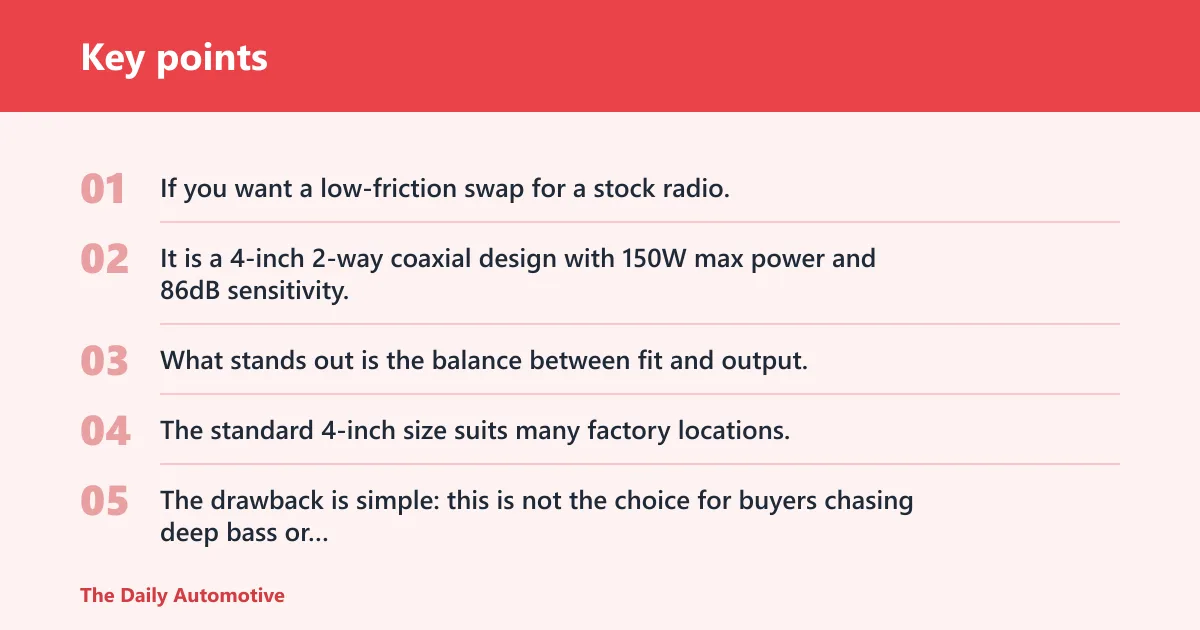
If you want a low-friction swap for a stock radio, the Pioneer TS-F1035R is the safest place to start. It is a 4-inch 2-way coaxial design with 150W max power and 86dB sensitivity, which makes it a sensible choice for OEM power and basic clarity without a lot of setup.
What stands out is the balance between fit and output. The standard 4-inch size suits many factory locations, and the 86dB sensitivity is high enough to be useful in a system that is not getting much amplifier power.
The drawback is simple: this is not the choice for buyers chasing deep bass or high-output sparkle. Like most 4-inch speakers, it will sharpen vocals more than low-end weight, and it is best treated as a replacement, not a bass solution.
Why it fits common OEM locations
This model is aimed at factory speaker replacement, so it makes the most sense where the original speaker opening is already 4 inches. That usually means dash mounts, small door locations, or compact rear quarter-panel positions in older or economy vehicles.
Because it is designed for OEM power, it is a good match when you do not want to add an amplifier right away. That matters in cars where the stereo, not the speaker, is the limiting factor.
Sound traits you should expect
Expect cleaner vocals and better separation than a tired factory cone, along with smoother treble than many basic paper-cone replacements. The payoff is clarity at normal listening levels, not room-filling low end.
If your current speakers sound dull or papery, this kind of 2-way coaxial upgrade usually fixes that faster than chasing a higher max-power number. Peak power is not what makes a daily driver sound cleaner.
When it is the wrong choice
Skip it if your factory opening is shallow enough to create clearance problems or if your goal is strong midbass from a small speaker alone. A 4-inch driver cannot replace a subwoofer, and it will not solve a system that already needs more low-frequency support.
Infinity REF-4022cfx: best for clear highs
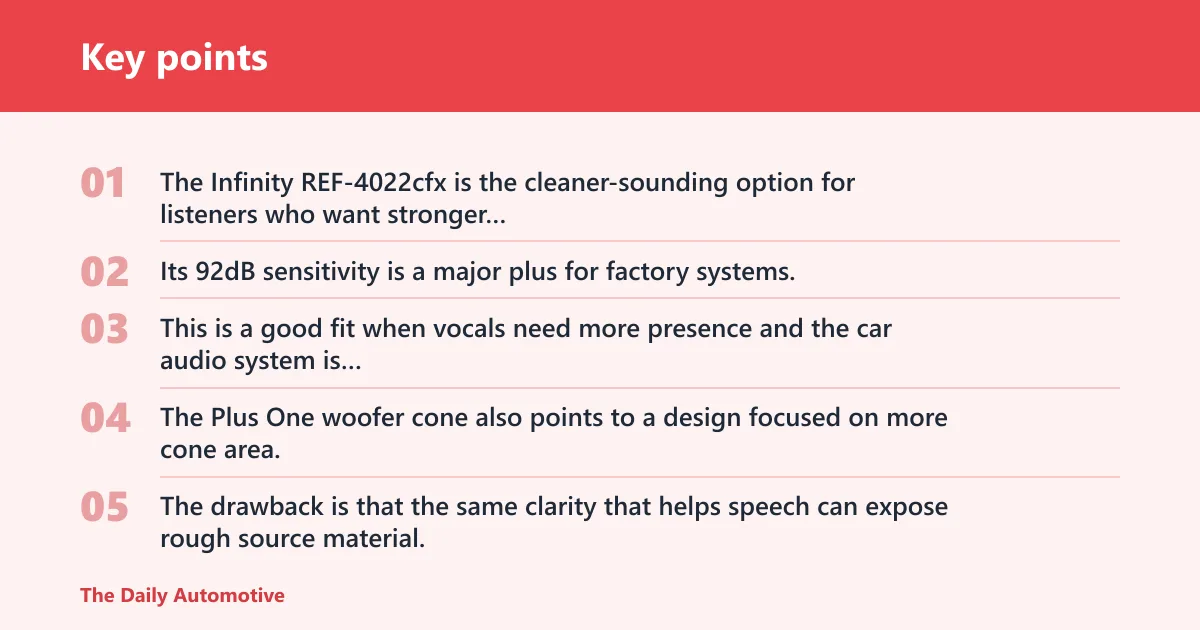
The Infinity REF-4022cfx is the cleaner-sounding option for listeners who want stronger high-frequency detail from a 4-inch format. Its 92dB sensitivity is a major plus for factory systems, and the edge-driven textile tweeters are meant to keep the top end clear rather than harsh.
This is a good fit when vocals need more presence and the car audio system is underpowered. The Plus One woofer cone also points to a design focused on more cone area, which can help a small speaker feel less thin.
The drawback is that the same clarity that helps speech can expose rough source material. On a bright head unit or an untreated door panel, the top end may feel more forward than some buyers expect.
Sensitivity and head unit pairing
At 92dB sensitivity, this speaker is easier to drive than many small coaxials. That matters when the factory radio is doing all the work, because higher sensitivity usually means more output for the same power.
If you are upgrading a weak OEM system and want immediate loudness without adding an amplifier, this is one of the stronger matches in the list.
Where it works best in the cabin
This model suits dash locations and other places where vocal clarity matters more than bass. It can also work in rear quarter panels when you want rear fill that does not draw attention away from the front stage.
It is less convincing if the goal is chesty midbass from a small opening. A 4-inch speaker can sharpen the image, but it cannot create the air movement of a larger driver.
Bass limits to expect
Do not buy this expecting a low-end fix. Like any 4-inch coaxial, its bass output will be limited by cone area and enclosure volume, not by the brand badge on the grille.
If the cabin already lacks low end, plan on a subwoofer or at least a stronger front-stage amplifier later.
Rockford Fosgate Prime R14X2: best for install convenience
The Rockford Fosgate Prime R14X2 is the easiest choice when you want a 4-inch 2-way full-range coaxial speaker pair with fewer install headaches. It carries 30 watts RMS and 60 watts max, and it includes grilles and mounting hardware, which helps when the original parts are worn or missing.
That included hardware is the key advantage. In factory replacement work, a speaker that arrives with the pieces you need can save time and reduce the odds of a loose fit or broken trim clip situation.
The drawback is output headroom. Thirty watts RMS is fine for modest systems, but it is not a high-power option for buyers planning a stronger amplifier later.
Why included hardware matters
Many replacement jobs fail on small parts, not on the speaker itself. Missing grilles, incorrect screws, or worn mounting points can make a simple job take much longer than expected.
With this pair, the included grilles and mounting hardware give it a real edge for factory-fit convenience.
When it makes the most sense
This is a smart choice for older vehicles, budget refreshes, and any installation where the original trim pieces are damaged. It also makes sense when the priority is restoring clean sound without building a more complex system.
Because it is a 2-way coaxial full-range pair, it stays in the common replacement category that works well in dash, small door, or rear quarter-panel locations.
What to watch
Its modest RMS rating means you should not overdrive it from an amplifier that is far stronger than the speaker is designed to handle. RMS is the continuous rating that matters for everyday listening, so match the speaker to the system rather than chasing peak watts.
JBL Club 44F: best for tighter premium fitment
The JBL Club 44F is the premium-leaning pick for buyers who want stronger speaker materials and more refined top-end behavior in a 4-inch package. It is a 4-inch two-way speaker rated at 35W RMS and 105W peak, with 90dB sensitivity and a nominal impedance of 3.0 ohms.
The Plus One cone, edge-driven silk dome tweeter, and UV-resistant polypropylene cone all point toward controlled sound and durability. That combination is attractive when you want clearer output than a plain factory replacement, but still need a compact speaker.
The drawback is compatibility caution. The 3.0-ohm nominal impedance is not the standard 4-ohm load most cars expect, so it deserves a closer check with your head unit or amp before you buy.
Who should consider it?
This is a good option for listeners who want clearer highs and a more polished factory upgrade, especially in a system that can tolerate a slightly lower impedance load. It is also a sensible fit where material quality matters as much as output.
If you are shopping for the cleanest sound in a compact opening and can confirm compatibility, this is one of the more compelling premium choices in the group.
Where its advantages show up
The silk dome tweeter helps vocal overtones and cymbals sound smoother, while the polypropylene cone helps resist resonance. That matters in a small door or dash cavity, where harshness often comes from the panel, not just the speaker.
It is better suited to clarity-focused front or rear fill than to low-end expectations.
When to skip it
Skip it if you need a textbook 4-ohm replacement or if you are unsure about amplifier compatibility. A mismatch here can create more trouble than the upgrade is worth.
Which one should you buy?
Start with fit, then move to output, then decide whether your system needs help from an amplifier. If you want the easiest factory replacement, the Pioneer TS-F1035R is the safest default. If clarity is the priority and your system is underpowered, the Infinity REF-4022cfx is the strongest sensitivity pick.
If your old trim pieces are missing or broken, the Rockford Fosgate Prime R14X2 is the most install-friendly choice because it includes grilles and mounting hardware. If you want a more premium sound profile and can verify impedance compatibility, the JBL Club 44F is the most refined option here.
Say your compact car has a cracked 4-inch dash speaker and a stock radio that still works fine. In that case, a high-sensitivity coaxial like the Pioneer or Infinity is the better move than a low-efficiency speaker that needs more power to wake up.
Suppose your classic car has a shallow rear-quarter opening and the old grille is missing. Then the Rockford Fosgate pair makes more sense, because included hardware reduces the odds of a messy installation.
Best for stock head units
Choose the Pioneer TS-F1035R or Infinity REF-4022cfx. Higher sensitivity helps make up for limited factory power, and both are easier to live with when the radio is doing the driving.
Best for tighter fitment
Choose the Pioneer first, then verify the JBL if you are comfortable checking impedance and depth carefully. In tight OEM openings, fit beats theoretical sound quality.
Best if you want the easiest install
Choose the Rockford Fosgate Prime R14X2. The included grilles and mounting hardware help remove common friction points during a replacement job.
Best if you plan to add an amplifier
Choose the JBL Club 44F if your amp and system layout can handle its 3.0-ohm load. If you want a simpler 4-ohm path, the Rockford or Pioneer is the safer starting point.
Fit and sound decision table
This table is the practical shortcut. It ties each speaker to fit, output behavior, and where it belongs in the cabin so you can avoid the most common replacement mistakes.
| Speaker | Mounting depth | Impedance | Sensitivity | Expected vocal clarity | Bass limitation | Ideal placement |
|---|---|---|---|---|---|---|
| Pioneer TS-F1035R | Verify vehicle-specific clearance before buying | Standard replacement expectation | 86dB | Good for stock-system clarity | Limited low end, as with most 4-inch drivers | Dash or rear quarter panel |
| Infinity REF-4022cfx | Verify vehicle-specific clearance before buying | Standard replacement expectation | 92dB | Very good vocal and treble detail | Needs subwoofer support for real bass | Dash, rear fill, small door openings |
| Rockford Fosgate Prime R14X2 | Verify vehicle-specific clearance before buying | Standard replacement expectation | Not listed in supplied specs | Clear, balanced factory-replacement sound | Modest midbass, best with modest volume | Rear quarter panel or factory dash spots |
| JBL Club 44F | Verify vehicle-specific clearance before buying | 3.0 ohms | 90dB | Strong, refined vocal detail | Still limited by 4-inch cone area | Front dash or clarity-focused OEM replacement |
How to choose
Check the opening first. Measure speaker diameter, mounting depth, and screw pattern before you buy, because a 4-inch speaker that is a few millimeters too deep can hit the window track, dash structure, or grille backing.
Match impedance to the radio or amplifier next. Four ohms is the common car-audio load, and it is usually the safest starting point for most factory systems. If you step away from that, confirm your head unit or amp can handle it.
Then look at sensitivity. An 85dB-plus speaker is a practical benchmark for easy driveability in a low-power system. Higher sensitivity often matters more than a big peak-power number when the radio is still stock.
RMS power handling should guide everyday use. It tells you what the speaker can handle continuously, which is far more useful than peak watts for normal listening. Peak power is secondary and should not steer the purchase by itself.
Finally, pay attention to materials and hardware. Polypropylene cones and rubber or treated cloth surrounds are useful signs of durability and distortion control, and included grilles or mounting hardware can save you time during installation.
What 2-way and 3-way really change
A 2-way coaxial speaker uses a woofer and tweeter in one unit, which keeps installation simple and makes it the common factory replacement choice. A 3-way adds another driver, but in a 4-inch size that extra complexity does not always translate into better in-car sound.
For most buyers, 2-way is the smarter path because it fits more factory locations and avoids overcomplicating a small opening.
When a small speaker needs help
A 4-inch speaker usually needs a subwoofer if you want real bass, and an amplifier helps when the stock radio cannot supply enough clean power. That does not mean every 4-inch upgrade needs an amp, only that some systems run out of headroom quickly.
When a door panel sounds thin or a dash speaker seems harsh at higher volume, the problem is often power or placement, not the lack of another tweeter.
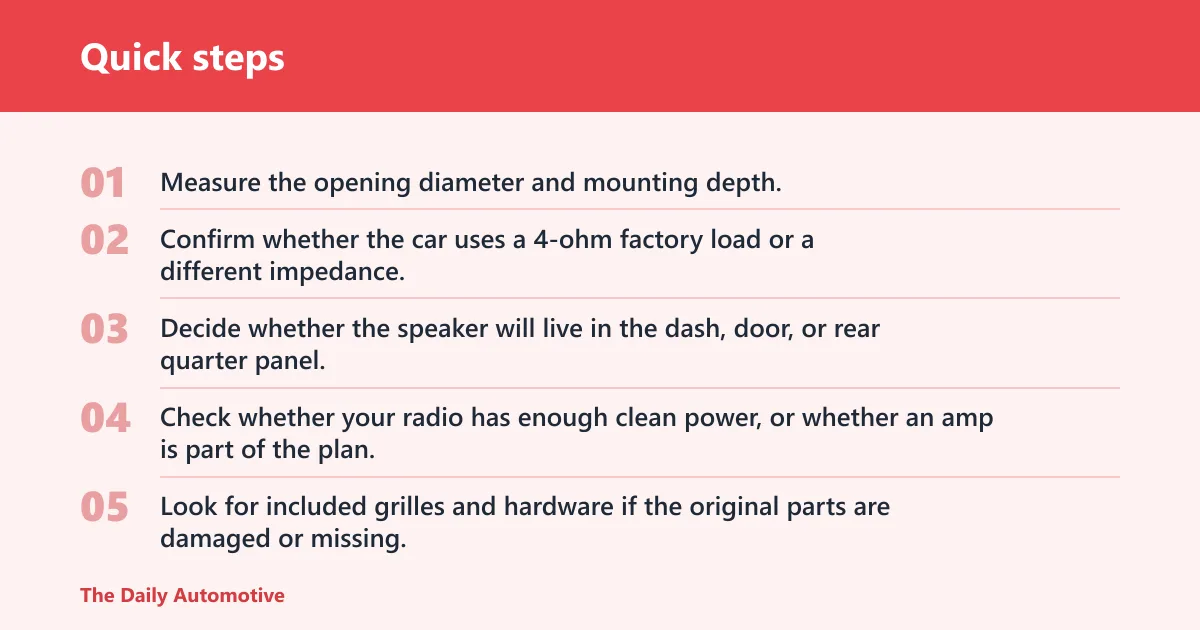
- Measure the opening diameter and mounting depth.
- Confirm whether the car uses a 4-ohm factory load or a different impedance.
- Decide whether the speaker will live in the dash, door, or rear quarter panel.
- Check whether your radio has enough clean power, or whether an amp is part of the plan.
- Look for included grilles and hardware if the original parts are damaged or missing.
Frequently asked questions
What is the best 4 inch car speaker for clear sound?
The Infinity REF-4022cfx is the clearest-sounding pick in this group for most factory systems because its 92dB sensitivity and edge-driven textile tweeters favor vocal detail. If you want a more premium fit and can confirm compatibility, the JBL Club 44F is also a strong clear-sound option.
Are 4 inch car speakers good for bass?
Not in the way most buyers mean it. A 4-inch speaker can tighten mids and improve punch, but it has limited cone area and limited air movement, so true bass usually needs a subwoofer. Treat bass from a 4-inch speaker as a bonus, not the main goal.
What 4 inch car speakers fit factory replacement slots?
They are all built around the common 4-inch coaxial format, which makes them suitable for many dash, rear quarter-panel, and small door openings.
What RMS rating should I look for in 4 inch car speakers?
Look for an RMS rating that matches your head unit or amplifier output, not a huge peak number. RMS is the continuous power figure that matters in daily use. If you are on a stock radio, a modest RMS rating paired with higher sensitivity is usually the smarter buy.
Which 4 inch car speakers are easiest to install?
The Rockford Fosgate Prime R14X2 is the easiest from an install-convenience standpoint because it includes grilles and mounting hardware. The Pioneer TS-F1035R is also straightforward if your factory opening already matches the standard 4-inch size and the depth clears cleanly.
Do 4 inch car speakers need an amplifier?
Not always. A sensitive 4-inch coaxial can sound good from a stock head unit, especially in a factory replacement slot. An amplifier becomes useful when the system sounds strained, when you want more clean volume, or when you plan to support the speakers with a subwoofer.
What is the difference between 2-way and 3-way 4 inch car speakers?
A 2-way speaker combines a woofer and tweeter, which is simpler and more common in factory replacement work. A 3-way adds another driver, but in a 4-inch size that does not guarantee better sound and can complicate fit without giving you more bass.
How do I measure if 4 inch speakers will fit my car?
Measure the opening diameter, screw-hole pattern, and mounting depth behind the factory speaker location. Then check for window track, dash brace, or grille clearance. If the speaker is close to the depth limit, an adapter or spacer may be needed to avoid rubbing or a poor seal.
Products related to this article
Sponsored / affiliate links. As an Amazon Associate I earn from qualifying purchases. I may earn additional commission from eligible campaigns.