Car Jack for Car: How to Choose the Right One
For most garage users, a low-profile 3-ton floor jack is the best first buy because it clears many modern cars, lifts quickly, and leaves room for jack stands. Match the jack’s minimum height to your vehicle’s lowest lift point, its maximum lift range to the wheel travel you need, and its rated capacity to the weight on that corner. Many passenger cars fit a 2-ton floor jack, while SUVs and trucks often need 3 tons or more. Pick poorly and the jack may not fit under the car, may run out of lift before the wheel clears, or may fail under load. This guide explains how to choose the right jack for garage or roadside use, with fit, capacity, lift points, and safety checks.
Best car jack for your vehicle



The best jack is the one that fits under your vehicle, reaches the correct lift point, and leaves enough height to work safely. For a sedan or compact crossover, that usually means a low-profile floor jack. For a truck or roadside kit, a bottle jack or scissor jack may make more sense because storage and vertical lifting matter more than speed.
If you only want one rule, start with clearance first and brand second. A jack with the wrong minimum height or the wrong lift range is a bad purchase even if its capacity looks impressive on paper.
Quick picks by need
- Best for garage work: low-profile floor jack with a fast lift and enough range for jack stands.
- Best for roadside emergencies: scissor jack or electric car jack, depending on whether you want manual simplicity or powered lifting.
- Best for lowered cars: low-profile floor jack with a very low starting height.
- Best for SUVs and trucks: higher-capacity floor jack or bottle jack with enough travel for taller suspension.
Say your sedan sits on a steep driveway apron and the pinch weld is only a few inches off the ground. A standard jack may never slide under the side skirt, even if its capacity is more than enough. In that case, the deciding factor is not tonnage; it is minimum height and approach angle.
📊 Vevor Pneumatic Jack has a stated weight rating of 6,000 lbs. Source: Caranddriver.
What type of car jack do you need?

Where you use the jack decides the type. Floor jacks suit garages because they lift quickly and roll into position. Bottle jacks suit compact storage and high force. Scissor jacks fit trunk kits. Electric car jacks are aimed at roadside use when you want powered lifting from a 12V source.
Floor jack for garage use and fast lifting
A floor jack is a hydraulic lift type with a low minimum height and a rolling chassis. It is the usual choice for garage maintenance because it lifts faster than a scissor jack and is easier to position under a control arm, frame point, or pinch weld adapter. Many common models are in the 2- to 3-ton range.
Competitor buying guides often stop at “buy a floor jack.” That leaves out the part that matters most: whether the jack starts low enough for your car. A low-profile floor jack is the version to look for if your car has low side skirts or a shorter front bumper lip.
Bottle jack for compact, high-force lifting
A bottle jack has a vertical compact design and a high lifting force for its size. It stores easily in a truck bed or garage corner and can be a strong choice when you need height more than speed. The trade-off is stability. It typically requires jack stands for anything beyond a quick tire change.
The Torin BIG RED Bottle Jack is rated at 6 tons, which shows why bottle jacks often appeal to truck owners. The shape is compact, but the footprint is small, so the ground underneath must be firm and level.
Scissor jack for trunk storage and emergencies
A scissor jack is a manual emergency lift tool. It is compact, slow to raise, and common in factory roadside kits. It makes sense when storage space is tight and you only need enough lift to change one flat tire. It is not the fastest choice, and it is not a substitute for stable support during under-car work.
Electric car jack for powered roadside use
An electric car jack uses 12V power and automated lifting, which can reduce effort during roadside tire changes. Many kits bundle an impact wrench or inflator, which is useful when you want a single trunk tool set. The downside is dependency on vehicle power and more parts to store and keep organized.
The E-HEELP Electric Car Jack Kit has a 5-ton capacity, while the ROGTZ Electric Scissor Jack is rated for 2 tons. That spread matters. Electric jacks are about convenience and emergency speed, not a free pass to skip support equipment.
How many tons should a car jack have?
Pick capacity from curb weight, not just vehicle class. A jack should comfortably handle the corner of the vehicle you are lifting, plus a safety margin. That is why a 2-ton jack can work for many passenger cars, while SUVs and half-ton trucks usually call for more reserve capacity.
Match capacity to curb weight, not just vehicle class
A car does not lift one full corner weight evenly. The load shifts as the suspension droops, the jack angle changes, and one side rises. For that reason, a jack with a rating close to the vehicle’s curb weight can still be the wrong choice. More margin is better, especially if you are lifting on uneven pavement or using an adapter.
Why SUVs and trucks need more margin
Higher vehicles usually have more ground clearance and more mass. They also often need a greater lift range before the wheel clears. A half-ton truck may look like a simple fit on paper, but the higher chassis and taller tires can push a small jack close to its maximum travel.
The Big Red AT84007R has an 8,000-pound capacity, which is the kind of rating that makes sense when the vehicle is heavier and the lift point sits higher off the ground. A stronger rating does not fix a jack that is too tall to fit under the frame, though.
Why a higher ton rating does not fix poor fit
Capacity and fit are different problems. A jack can be strong enough and still fail the job if its minimum pad height is too tall, its saddle cannot reach the lift point, or its maximum height is too short. Think of capacity as load reserve and fit as geometry. You need both.
Suppose you are choosing between a 2-ton and a 3-ton floor jack for a crossover. If both fit under the car, the 3-ton model may be the better long-term choice because it gives more margin for a heavier corner, a jack pad, and slightly uneven concrete. If the 3-ton model is too tall to slide under the pinch weld, it is the wrong tool.
Will it fit under your car?
Fit starts with minimum pad height and ends with lift-point access. Your jack must slide under the vehicle without forcing the body upward first, and it must reach the correct support point without crushing a side skirt or slipping off a pinch weld. Low-profile designs matter when the car sits close to the ground.
Minimum pad height and lowered side skirts
Measure the lowest front or side clearance you actually have where the jack enters. Lowered cars often need a jack with a very low starting height, not just a high max lift. A floor jack such as the Arcan Quick Rise Floor Jack, with a lift range from 3-1/4 inches to 18 inches, shows why minimum height matters as much as maximum height.
Pinch-weld access and lift-point clearance
Many vehicles use pinch welds or defined lift points near the rocker panels. If the saddle is too wide, too tall, or poorly shaped, the jack may contact bodywork before it reaches the lift point. A jack pad adapter can help, but it does not solve a bad fit between the jack and the car.
Why low-profile jacks matter for sports cars
Low-profile jacks start lower, so they can slide under sports cars and lowered sedans without scraping the front lip or side skirt. They are especially useful if the car has an aftermarket splitter or suspension that reduced the space under the chassis. That is a fit problem, not a brand problem.
Car jack fit table
This table turns vehicle type into a purchase decision. Use it before looking at brand names.
| Vehicle segment | Typical minimum height target | Recommended jack type | Minimum capacity | Jack stands mandatory? | Common failure mode |
|---|---|---|---|---|---|
| Sedan | About 3 to 4 inches | Low-profile floor jack | 2 tons | Yes for wheel removal and any under-car work | Jack body is too tall to slide under side skirts |
| Lowered car | About 2 to 3 inches | Low-profile floor jack | 2 to 3 tons | Yes | Front lip or side skirt blocks entry |
| Crossover | About 4 to 5 inches | Floor jack | 3 tons | Yes | Jack reaches the car but runs short on lift height |
| SUV | About 5 to 6 inches | Floor jack or bottle jack | 3 tons or more | Yes | Insufficient lift range for tall suspension |
| Half-ton truck | About 6 to 8 inches | Floor jack with tall lift or bottle jack | 3 tons or more | Yes | Lift point is too high for a short jack |
| Roadside emergency use | Varies by vehicle; low entry helps | Scissor jack or electric car jack | Match the vehicle, usually 2 tons or more for passenger cars | Recommended whenever a wheel leaves the ground for more than a quick swap | Soft shoulder, sloped curb, or loose gravel makes the setup unstable |
Floor jacks vs bottle jacks vs scissor jacks
These three tools solve different problems. The best one depends on how much space you have, how fast you need to lift, and whether you are working in a garage or on the shoulder of a road.
Floor jack: low minimum height and fast lift speed
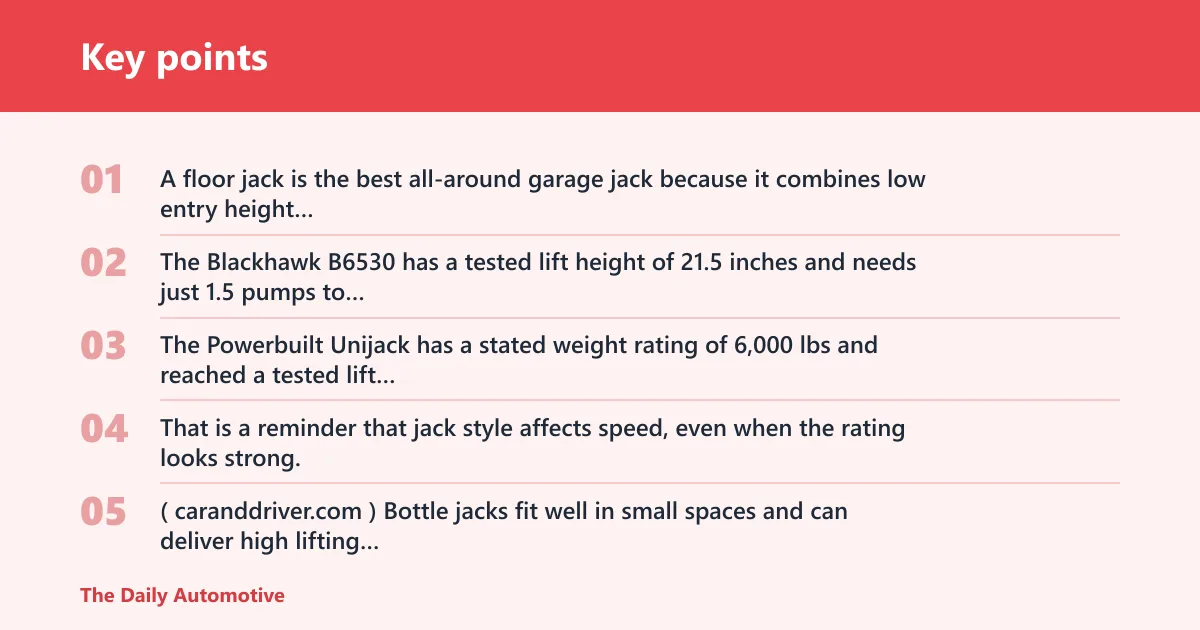
A floor jack is the best all-around garage jack because it combines low entry height with quick lifting. The Blackhawk B6530 has a tested lift height of 21.5 inches and needs just 1.5 pumps to reach full height under no load, which shows why many buyers prefer floor jacks for repeated tire rotations and brake work. The trade-off is storage space.
The Powerbuilt Unijack has a stated weight rating of 6,000 lbs and reached a tested lift height of 20.5 inches, but it took 46 pumps to reach maximum height. That is a reminder that jack style affects speed, even when the rating looks strong. (Caranddriver)
Bottle jack: compact storage and vertical force
Bottle jacks fit well in small spaces and can deliver high lifting force. They are a common choice for trucks, emergency kits, and situations where you need height more than speed. The Vevor Pneumatic Jack has a stated weight rating of 6,000 lbs and lifted to 15.8 inches in testing, which shows the type’s compact appeal, but also its shorter reach compared with larger floor jacks.
Scissor jack: small footprint and slow manual lifting
Scissor jacks are the simplest trunk tool. They store neatly and can be deployed at the roadside without much space. They are also slower and require more cranking effort. The Pro-Lift F-767 is listed as a 2-ton floor jack, which is a reminder that a true floor jack and a scissor jack are not substitutes for each other even when both are light enough to carry.
Electric car jack: 12V power and emergency convenience
Electric car jacks reduce manual pumping and can speed up a flat-tire change. That convenience matters at night or in bad weather. But the powered lift does not remove the need for firm ground, correct lift points, or support gear. If the shoulder is soft or the driveway is sloped, the power source does not solve the geometry problem.
Start with vehicle fit, then check support gear, then compare build quality. The safest home-use setup is usually the one that fits cleanly under the car, reaches the lift point without strain, and leaves enough room for jack stands and wheel chocks.
Lift range, stability, and ground conditions
Look at both ends of the lift range. Minimum pad height must clear the car before jacking starts, and maximum lift height must be enough for the wheel to leave the ground and the stand to fit underneath. Soft soil, sloped driveways, and uneven pavement can change a usable jack into a poor one very quickly.
Jack stands, wheel chocks, and pad accessories
Jack stands are secondary support after lifting. They are safety-critical for wheel removal, brake work, suspension work, and any task where part of your body could go under the vehicle. A jack alone should not be treated as sufficient support. Wheel chocks keep the opposite wheels from rolling, and lift pads help protect pinch welds and lift points.
Do you need jack stands with a bottle jack? Yes, for nearly any job beyond a brief wheel change. A bottle jack can raise the car, but it should not be the only thing holding the vehicle up while you work underneath it.
ASME PASE safety standards and build quality
ASME PASE safety standards can be a useful buying signal because they suggest the jack was built to a recognized safety benchmark. They do not replace fit checks. A jack can meet a safety standard and still be the wrong choice if its minimum height, saddle shape, or capacity does not suit your car.
Total ownership cost: jack, stands, chocks, pads, storage
Think beyond the sticker price. A proper home setup often includes the jack, a pair of jack stands, wheel chocks, and a pad or adapter. Storage matters too. A floor jack takes more space than a scissor jack, and a bottle jack needs a stable place where it will not tip or get buried under other tools.
A common first-timer mistake is buying a heavy-duty jack for an SUV, then discovering it is too tall to fit under the front crossmember. The second mistake is buying the jack and skipping stands. Both errors are preventable with a five-minute measurement and a short checklist.
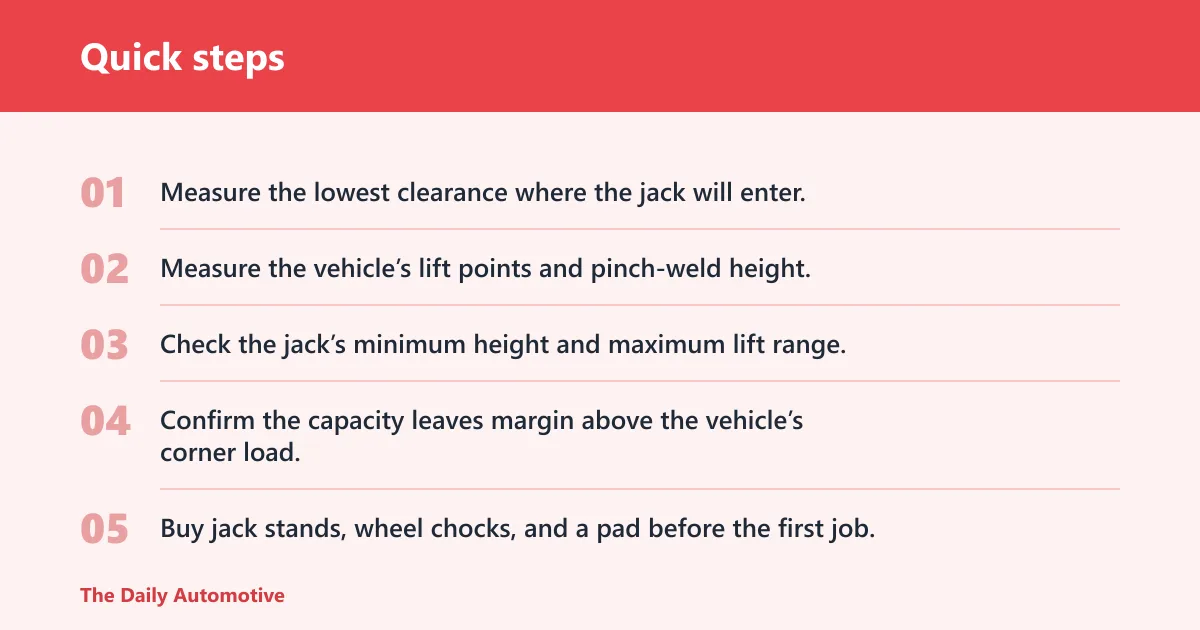
- Measure the lowest clearance where the jack will enter.
- Measure the vehicle’s lift points and pinch-weld height.
- Check the jack’s minimum height and maximum lift range.
- Confirm the capacity leaves margin above the vehicle’s corner load.
- Buy jack stands, wheel chocks, and a pad before the first job.
- Check whether your driveway or garage floor is level and firm.
Frequently asked questions
What type of car jack do I need for my car?
Choose the type that matches where you work and how much room you have. A floor jack fits garage use, a bottle jack suits compact storage and higher lift needs, a scissor jack works for emergencies, and an electric car jack is a convenience tool for roadside use. Clearance and support still decide the final choice.
How many tons should a car jack have for an SUV?
For most SUVs, a 3-ton jack is the safer starting point because it leaves room for weight, lift angle, and accessories. A 2-ton jack may work on some lighter crossovers, but it leaves less margin. Check the vehicle’s curb weight and choose enough reserve for the corner you are lifting.
Will a floor jack fit under my car?
Only if the jack’s minimum height is lower than your car’s lowest usable clearance at the entry point. Lowered cars and vehicles with side skirts often need a low-profile floor jack. Do not guess from the side of the vehicle. Measure the gap at the lift point and compare it to the jack’s starting height.
Are electric car jacks worth it?
They are worth it if you want powered lifting for roadside tire changes and prefer a kit that can include extra tools. They are less attractive if you want the lightest, simplest setup or if your storage space is limited. They do not remove the need for stable ground, correct lift points, or jack stands when needed.
Do I need jack stands with a bottle jack?
Yes for almost any maintenance task beyond a quick wheel swap. A bottle jack is good at lifting, but it is not meant to be the only support while you work under the car. Once the vehicle is up, place it on jack stands before removing wheels or reaching beneath the chassis.
What’s the difference between a scissor jack and a floor jack?
A scissor jack is compact, manual, and slow, so it works well as a trunk emergency tool. A floor jack is hydraulic, faster, and more stable on a garage floor. If you want speed and repeated use, the floor jack is better. If you want storage simplicity, the scissor jack wins.
Products related to this article
Sponsored / affiliate links. As an Amazon Associate I earn from qualifying purchases. I may earn additional commission from eligible campaigns.