Best Car Jacks for Lifting (2026): Based on Specs and Reviews
For many DIY owners, a good car jack is a low-profile floor jack rated at about 2 to 3 tons, with enough lift range for the vehicle’s pinch-weld or subframe clearance and room for jack stands. Pick the wrong jack, and you can run out of lift, crush trim, or leave the car unstable while you work. This guide compares jack types, capacity, lift height, clearance, and support gear so you can match the jack to your car and the job.
Quick comparison
| Product | Badge | Best for | Price | ||
|---|---|---|---|---|---|
 |
VEVOR Scissor Jack, 2.5 Ton/5512 lbs Scissor Car Jack withVEVOR | Our pick | 2.5 ton · 3.7"–17.1" range · w/ lug wrench kit | $33.90
Price as of 23 Oct 2026
|
View |
 |
Big RED 4 Ton (8,000 lb) Hydraulic Low Profile ServiceBIG RED | Also great | 4 ton · 3-7/8"–20" range · dual-piston hydraulic | $237.96
Price as of 23 Oct 2026
|
View |
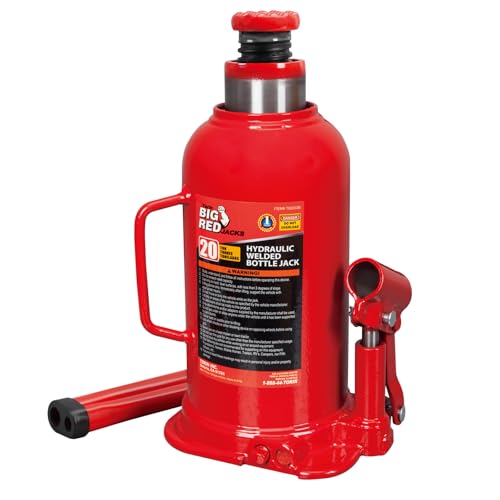 |
BIG RED 20 Ton (40,000 LBs) Torin Welded Hydraulic CarBIG RED | Upgrade pick | 20 ton · 9-7/16"–17-5/8" range · welded steel bottle jack | $59.99
Price as of 23 Oct 2026
|
View |
The right jack depends on where it has to fit, how far it must lift, and whether you need to work under the vehicle afterward. A jack that works on a sedan in a smooth garage can be a poor fit for an SUV on rough concrete or a lowered car with side skirts.
How we chose
This roundup focuses on fit, not marketing claims. The main filters were minimum height, lift range, capacity, support gear requirements, and whether the jack design makes sense for the vehicle geometry and the job.
We also weighed real garage constraints that many lists skip: handle swing, storage footprint, wheel-caster behavior on rough concrete, and whether a jack can reach a low pinch weld without scraping trim. Product claims below come from published specs and product details, not hands-on testing.
Capacity matters, but it is not the only answer. The right choice also depends on where the jack point sits, how much ground clearance you have, and whether you need a quick tire swap or a stable setup for brake work.
Floor jack: best for garage maintenance
A rolling trolley floor jack fits most home garages because it rolls under the vehicle, lands on a controlled jack point, and gives you a stable way to lift one corner or one axle at a time. It still needs jack stands before any work under the vehicle.
Look for a low minimum height if you have a sports sedan, coupe, or lowered car. Blackhawk’s service jack starts at about 5.5 inches and lifts to about 22 inches, while the Big RED low-profile floor jack starts at about 3-7/8 inches and reaches about 20 inches. That spread matters when your side skirt, splitter, or pinch weld sits close to the ground.
Dual-piston quick-lift systems help when you lift often. They cut pump count, which helps in a garage where you may be raising a car, setting stands, lowering, and then lifting again for another corner.
Common failure mode: the jack rolls awkwardly on rough concrete, the handle lacks enough swing near a bumper or splitter, or the owner works without stands. A floor jack is a lifting tool, not a support device.
Low-profile floor jack: best for lowered cars
A low-profile floor jack is the safer choice when the vehicle sits close to the ground. The key number is minimum height. Daytona’s low-profile jack starts at 2 ⅜ inches, which is the kind of entry height that can get under a lowered car without dragging the bodywork first.
Steel or aluminum-steel construction matters because lowered cars often need careful positioning and repeated use. The jack also needs enough saddle clearance to meet the pinch weld or subframe cleanly, especially when side skirts narrow the available entry angle.
Picture a coupe with side skirts and a stiff suspension. A standard floor jack may hit trim before the saddle reaches the jack point. A low-profile jack solves that by getting under the car sooner, which lowers the chance of scraping plastic or bending a pinch weld.
Common failure mode: the jack cannot slide under the car cleanly, so the operator starts from a tilted angle and damages trim. If the car sits extremely low, ramps plus a jack may be the better workflow than trying to force a tall jack under the nose.
Bottle jack: best for SUVs and trucks
A bottle jack lifts vertically, so it can be a better match for heavier vehicles, frame rails, and higher jack points. It stores compactly, which helps if you want a powerful jack in a small footprint rather than a wide rolling chassis.
That vertical shape comes with tradeoffs. It usually needs more ground clearance than a floor jack, and the footprint is smaller, so positioning matters more on uneven pavement or soft asphalt. For corner lifts on a truck, that can be fine. For low cars, it often is not.
The Big RED 20-ton bottle jack shows why this category exists. Its 9-7/16-inch starting height and 17-5/8-inch range suit heavier-duty lift points far better than a low-slung floor jack would. The Powerbuilt combo jack is rated at 3 tons, and the Powerbuilt unijack supports up to 6,000 pounds, showing how these hybrid designs try to bridge garage use and portability.
Common failure mode: not enough ground clearance to place the jack, or too little stable footprint for the surface. A bottle jack can be the right answer for a truck, but it is a poor match for a low splitter and a shallow driveway dip.
Scissor jack: best for roadside tire changes
A scissor jack is the compact emergency tool. It stores flat, weighs little, and works manually, which makes it practical for roadside tire changes where space is tight and the goal is to swap one wheel, not support the vehicle for maintenance.
The VEVOR scissor jack is commonly listed at 2.5 tons, with about a 3.7-inch to 17.1-inch lifting range, and it includes a ratchet wrench, lug wrench, and socket. That is useful in an emergency kit, especially when you want one package that covers the basic tire-change job.
Manual operation means slower lifts and more effort. The wider base helps, but scissor jacks still have limited stability and limited height compared with a floor jack. They are not a garage substitute.
Common failure mode: using it for more than a tire change. Do not go under a vehicle supported only by a scissor jack.
Do you need jack stands?
Yes. For any work under the vehicle, jack stands are mandatory. A jack lifts; stands hold. Use them in pairs, and make sure the pair is rated for the vehicle and the planned lift point.
Capacity on the stand should match the actual support task, not just the jack number on the box. A 2-ton jack does not mean every stand set is automatically acceptable, and a higher-rated jack does not make the stand optional.
Set the vehicle down onto stands before you remove wheels, work on brakes, or reach under the chassis. A jack can drift, settle, or roll. Stands reduce the risk of that movement becoming a collapse.
- Park on a level surface.
- Set the parking brake and chock the wheels that stay on the ground.
- Lift only at approved jack points.
- Place stands at approved support points.
- Lower the vehicle gently onto the stands.
- Shake the vehicle lightly to check stability before you work.
Jack decision table
This table matches the jack to the job, clearance, and support gear. Use it as a filter before you shop, not after.
| Vehicle type and clearance | Job type and lift range | Recommended jack category and capacity | Required support gear | Common failure mode to avoid |
|---|---|---|---|---|
| Low sedan or coupe with tight pinch-weld access | Oil changes, brake work, wheel swaps; enough lift for stands and wheel removal | Low-profile floor jack; 2-ton or 3-ton class | Jack stands in pairs; wheel chocks | Jack cannot slide under cleanly or scrapes trim |
| Lowered car with side skirts or very low front bumper | Tire rotation, brake service, seasonal wheel change; needs very low entry height | Low-profile floor jack with minimum height around 2 ⅜ inches to 3.35 inches | Jack stands in pairs; ramps may help the initial approach | Pinch-weld damage from poor saddle placement |
| SUV, pickup, or body-on-frame vehicle with higher jack points | Suspension, tire, and brake work; more lift height needed for axle or frame access | Bottle jack or high-lift floor jack; 3-ton to 5-ton class for heavy vehicles | Jack stands sized for the vehicle; chocks | Not enough ground clearance or too small a footprint on soft pavement |
| Roadside tire repair on a passenger vehicle | Wheel change only; short, temporary lift | Scissor jack; emergency use only | None for under-car work, because there should be none | Trying to work under the vehicle or overextending the jack |
| Heavy truck or large SUV with substantial mass | Corner lift or axle access; lift range must reach service height | Heavy-duty bottle jack; 5-ton class or higher where needed | Stands rated for the vehicle, plus stable ground surface | Using a narrow base on uneven asphalt or gravel |
Floor jack: best for garage maintenance
This Big RED floor jack fits garage owners who want a stable rolling jack for cars, SUVs, and utility vehicles. The dual-piston quick-lift pump matters if you lift often, and the 3-7/8-inch low profile helps with many lowered or stock-height cars.
The published 4-ton rating gives more headroom than a 2-ton unit, and the 20-inch range is useful for common garage jobs like wheel removal and brake work. The rubber saddle pad is a practical detail because it helps protect lift points during repeated use.
The drawback is size and cost. A 4-ton floor jack is heavier, less portable, and more expensive than simpler garage jacks. If your car sits low enough that 3-7/8 inches is still tight, you may need ramps first.
Low-profile floor jack: best for lowered cars
This VEVOR scissor jack is not the low-profile floor jack category, so the better low-profile pick from the available list is the Big RED floor jack above. For lowered cars, the clearest buying lesson here is that you need a jack with an entry height low enough to reach the pinch weld without scraping the front end.
For emergency tire changes, the VEVOR scissor jack starts at 3.7 inches and reaches 17.1 inches, but that still does not replace a true low-profile garage jack for service work. It is compact and includes the basic wrench kit, which makes it useful to keep in the trunk.
The drawback is the expected one for a scissor jack: slower manual operation and limited stability. It is a roadside tool, not a solution for regular under-car maintenance.
Bottle jack: best for SUVs and trucks
This BIG RED bottle jack is the strongest fit in the current list for heavy vehicles and higher jack points. The 20-ton rating is far beyond what most passenger cars need, and the 9-7/16-inch to 17-5/8-inch range is suited to truck and SUV service where the lift point sits higher.
The compact vertical shape is the point. It stores easily, positions directly under a frame rail or axle area, and uses the screw top extension for added setup flexibility.
The drawback is the same one that applies to most bottle jacks. It needs more clearance to fit in place, and the smaller footprint is less forgiving on uneven ground than a rolling floor jack. For low cars, this is usually the wrong tool.
Which one should you buy?
If you want one jack for most home-garage jobs, start with a low-profile floor jack in the 2-ton to 3-ton class, or a 4-ton unit if your vehicle is heavier and you want extra range. That is the best fit for tire changes, brake work, and routine maintenance on level concrete.
If your car is lowered or has aggressive side skirts, prioritize minimum height first. A jack that fits under the vehicle cleanly beats a higher-capacity jack that cannot enter without scraping trim. Ramps plus a jack can be the safer workflow for very low cars.
If you own an SUV or truck, a bottle jack can make more sense than a floor jack for certain lift points, especially when storage space is limited. For roadside-only use, a scissor jack is acceptable, but only for a tire change and only on stable ground.
Say your sedan sits on stock suspension, and you only need oil changes and brake pads in a garage. A low-profile floor jack plus stands is the practical answer. Suppose your pickup has higher frame rails and a spare tire service job. A bottle jack is the more natural fit, provided the ground is firm and level.
How much weight capacity do I need in a car jack?
Capacity should match the vehicle and the lift point, not just a simple “bigger is better” rule. A 1.5-ton or 2-ton jack can work for many sedans, while 3-ton and 3.5-ton models make more sense for heavier cars, crossovers, and some SUVs. Trucks may call for 5 tons or more.
The key is to make sure the jack can support the portion of the vehicle you are lifting with margin for the actual jack point and load distribution. That is why a 2-ton jack may be enough for a compact car, while a 3-ton jack is often the more practical home-garage choice.
Examples in this guide show the spread: Powerbuilt’s combo jack is rated at 3 tons, the Powerbuilt unijack supports up to 6,000 pounds, and the VEVOR electric car jack supports up to 5 tons. Those numbers show how capacity climbs with vehicle size and job type.
How much lift height do I need for oil changes and brake work?
For oil changes, you usually need enough lift to get under the drain plug and reach the filter without crawling against the floor. Brake work usually needs more height so the wheel comes off cleanly and the suspension can hang without fighting the control arms.
Most buyers should look for a jack with a max lift height that clears the service task, not just the tire. In the examples here, Blackhawk’s service jack reaches 22 inches, Road Dawg’s jack reaches just over 30 inches with its extension, and the VEVOR 5-ton air jack has an 18.5-inch lift.
If the goal is wheel removal and stand placement, the higher number matters. If the goal is simply to change a tire at the roadside, a shorter range may be enough.
Are electric car jacks worth it for roadside use?
For roadside emergencies, an electric jack can be convenient if you want less manual pumping and faster lift setup. The VEVOR electric car jack supports up to 5 tons and includes an electric impact wrench, which can save effort during a wheel change.
That said, electric convenience does not replace safe support gear for garage work. It is a roadside convenience tool, not a substitute for jack stands or a stable home-maintenance setup.
If your main use is home maintenance, a good floor jack still makes more sense. If your main concern is an occasional flat tire on the shoulder, electric assistance may be worth it for speed and ease of use.
Frequently asked questions
What is the best car jack for home garage maintenance?
A low-profile floor jack is the best all-around choice for home garage maintenance because it rolls, positions easily, and gives you enough lift for stands, wheel removal, and brake work. Look for a 2-ton to 3-ton class unless your vehicle is a heavier SUV or truck.
Should I buy a floor jack, bottle jack, or scissor jack?
Buy a floor jack for regular garage work, a bottle jack for heavier vehicles and compact storage, and a scissor jack for roadside tire changes only. The right choice depends on clearance, lift height, and whether you need to support the car or just swap a wheel.
What is the lowest profile car jack for lowered cars?
For lowered cars, the lowest entry height matters most. In the examples here, the Daytona low-profile jack starts at 2 ⅜ inches, which is the kind of minimum height that can fit under many lowered vehicles without forcing the body onto the jack first.
Are jack stands necessary with a floor jack?
Yes. A floor jack raises the vehicle, but jack stands hold it safely while you work. For any task that puts you under the car, stands are mandatory, and they should be used in pairs on the proper support points.
What jack is best for SUVs and trucks?
For SUVs and trucks, a bottle jack or a high-capacity floor jack is usually the better fit. The jack should match the vehicle’s height, jack-point location, and mass. Heavy-duty examples in this guide include 3-ton, 5-ton, and 20-ton class tools.
Products related to this article
Sponsored / affiliate links. As an Amazon Associate I earn from qualifying purchases. I may earn additional commission from eligible campaigns.