Car Vacuum for Detailing: 3 Cordless Handhelds Compared
For car detailing, pick the cordless handheld that pairs strong crevice tools with 15+ minutes of real runtime; that matters more than peak suction alone for seams, sand, and pet hair. Pick wrong, and you waste time chasing grit from stitching, leave hair in carpet, and run out of battery before the cabin is done. This guide compares three cordless handheld vacuums by suction, runtime, attachments, and how they handle tight seams, fine sand, and embedded pet hair.
Cordless car vacuums: the real trade-off
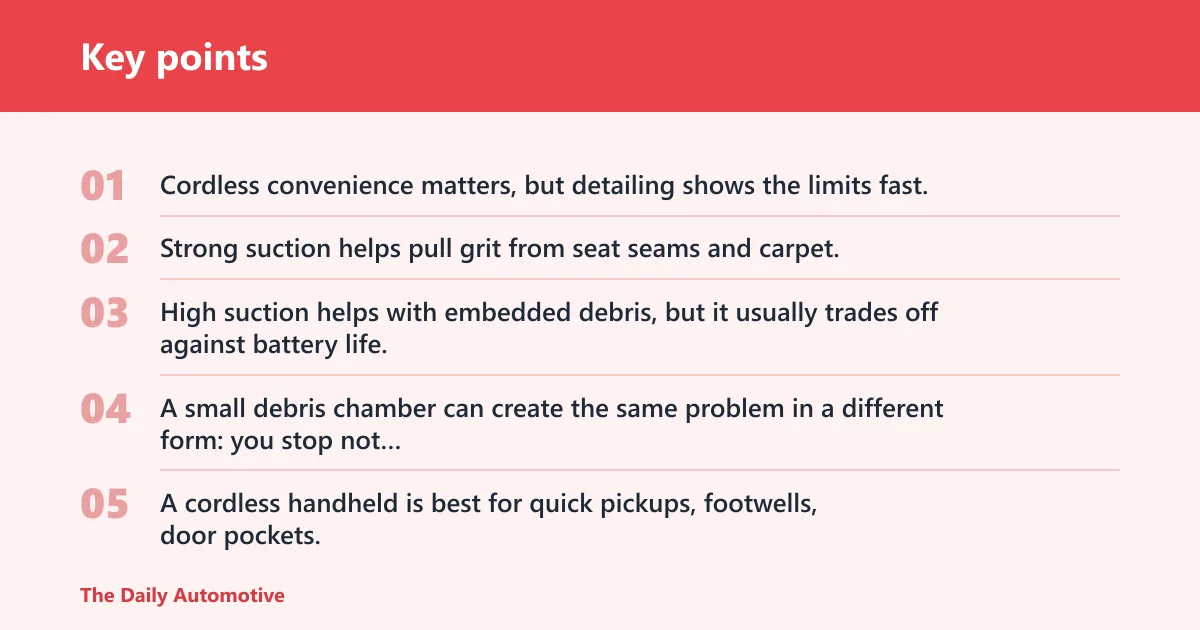


Cordless convenience matters, but detailing shows the limits fast. Strong suction helps pull grit from seat seams and carpet, while runtime and chamber size decide whether you finish a sedan in one pass or stop to empty and recharge.
High suction helps with embedded debris, but it usually trades off against battery life. A small debris chamber can create the same problem in a different form: you stop not because the battery is dead, but because the bin is packed with sand, crumbs, or pet hair.
Where cordless wins and where a shop vac still helps
A cordless handheld is best for quick pickups, footwells, door pockets, and routine interior care. It is easy to carry, quick to grab, and simpler to store than a corded unit or shop vac.
A shop vac or corded utility vacuum still makes more sense for full details with heavy sand, lots of dry leaves, or a very dirty SUV. It also helps when you want longer continuous cleaning without watching battery percentage or chamber fill level.
Three cordless handhelds, side by side
These three models differ most in suction, weight, and runtime. The right one depends on whether you clean a small cabin, a larger family vehicle, or a pet-heavy interior that needs stronger pickup on hair and seams.
| Model | Suction rating | Max runtime | Weight | Chamber size | Crevice-tool quality | Brush type | Filter type | Charging method | Best-use scenario |
|---|---|---|---|---|---|---|---|---|---|
| Fanttik Slim V10 Apex | 70 inches of water on high | 14 minutes, 26 seconds at max power | 1.16 pounds | Check the manufacturer’s listing for this model | Check the manufacturer’s listing for length and fit | Check the manufacturer’s listing for brush details | Check the manufacturer’s listing for filter type | Check the manufacturer’s listing for charging standard | Lightweight detailing in tight cabins, especially seat seams and quick touch-ups |
| Black+Decker Dustbuster | 16 inches of water | 14 minutes, 1 second at max power | 2.42 pounds | Check the manufacturer’s listing for this model | Check the manufacturer’s listing for length and fit | Check the manufacturer’s listing for brush details | Check the manufacturer’s listing for filter type | Check the manufacturer’s listing for charging standard | Basic cabin cleanup where low suction is acceptable and weight is less of a concern |
| Worx Cordless Cube | 50 inches of water on high | Just over 11 minutes on high-suction setting | 3.96 pounds with its battery | Check the manufacturer’s listing for this model | Check the manufacturer’s listing for length and fit | Check the manufacturer’s listing for brush details | Check the manufacturer’s listing for filter type | Check the manufacturer’s listing for charging standard | Mid-range suction for users who value pickup more than low carry weight |
What the table says in plain terms
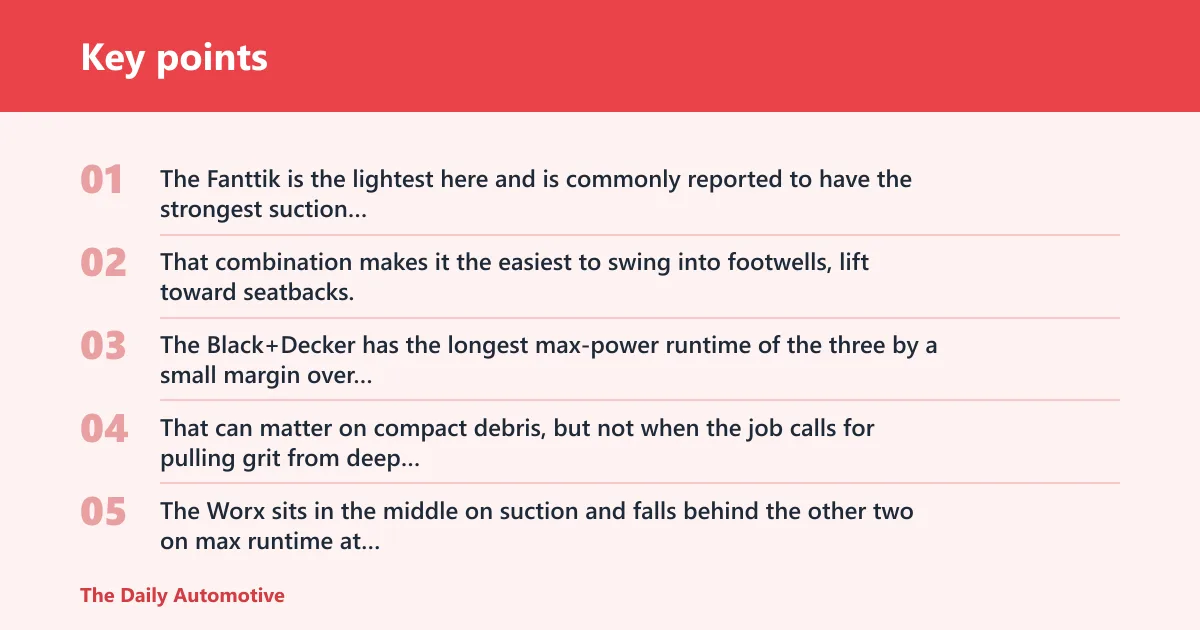
The Fanttik is the lightest here and is commonly reported to have the strongest suction of the three. That combination makes it the easiest to swing into footwells, lift toward seatbacks, and use for fast seam work.
The Black+Decker has the longest max-power runtime of the three by a small margin over the Fanttik, but its measured suction is far lower. That can matter on compact debris, but not when the job calls for pulling grit from deep carpet or packed seams.
The Worx sits in the middle on suction and falls behind the other two on max runtime at high suction. At 3.96 pounds with its battery, it is also the heaviest in this group, which can matter during overhead cleanup or long reaches into cargo corners.
Which vacuum handles seams and sand best?
Suction matters here, but the crevice tool matters almost as much. For seat seams, pedal wells, and the gap between seats and the center console, you need enough pickup to move grit and a narrow tool long enough to reach the debris without scraping trim.
Suction power in practical terms
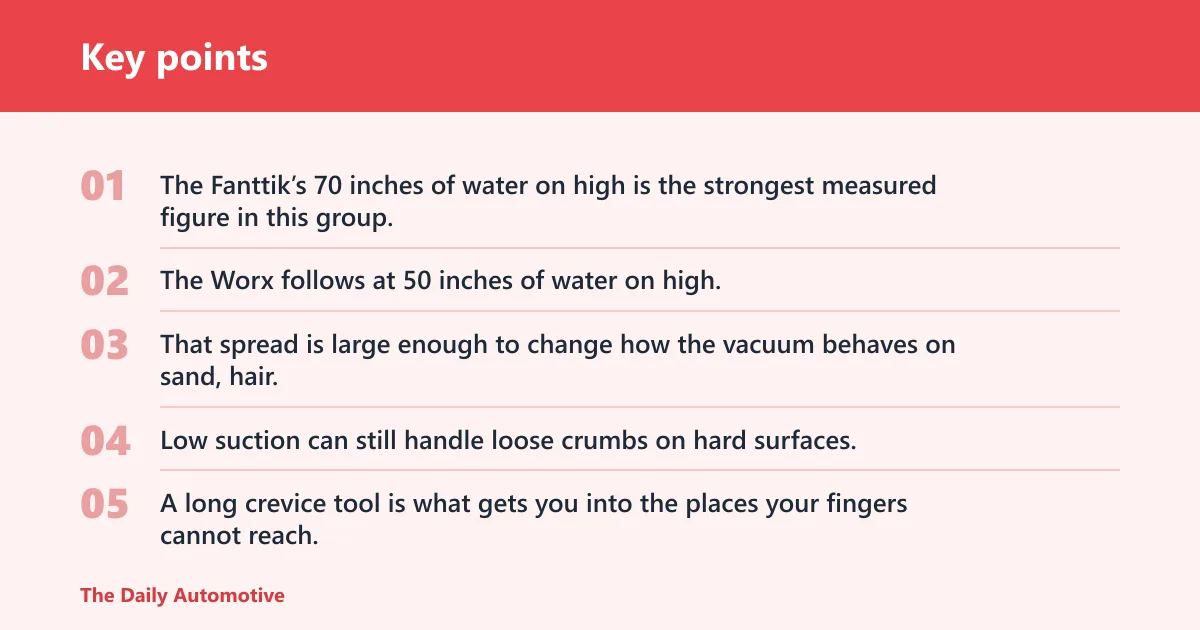
The Fanttik’s 70 inches of water on high is the strongest measured figure in this group. The Worx follows at 50 inches of water on high, while the Black+Decker sits at 16 inches of water. That spread is large enough to change how the vacuum behaves on sand, hair, and carpet fibers.
High suction helps with embedded grit. Low suction can still handle loose crumbs on hard surfaces, but it struggles sooner when debris is packed into seams or brushed into carpet pile.
Why a long crevice tool is non-negotiable
A long crevice tool is what gets you into the places your fingers cannot reach. It matters for seat seams, under pedals, between seats, and along console rails. If the tool is short, the vacuum may still be strong, but the debris stays put because you cannot place the nozzle where it needs to go.
Say your driver seat has a narrow stitched seam full of fine sand after a beach trip. A strong handheld with a short attachment may skim the top of the grit, while a longer crevice tool reaches deeper and lets the suction do the work.
Low and high power modes change pickup
Most cordless handhelds give you a trade-off between lower noise or longer runtime and stronger pickup on high. For detailing, low mode is fine for loose dust and crumbs. High mode is the one that matters for packed seams, carpet edges, and heavier debris that has settled into the fibers.
A common first-timer mistake is using low power on a mat that has already been agitated. The surface may look cleaner after one pass, but fine debris stays trapped until you switch up to stronger suction.
How do they handle pet hair and upholstery?
Pet hair is harder than crumbs because it clings to fabric and carpet. A motorized brush head helps more than a basic passive brush, especially on cloth seats and textured floor mats. If the brush has its own motor, it can agitate fibers instead of relying only on airflow.
Motorized brush head versus basic brush
A separate motor for the brush is the better setup for upholstery and pet hair. It gives the vacuum a second cleaning action that lifts hair loose before suction carries it into the chamber. A passive brush can still help, but it depends more on suction and user pressure.
That difference matters after a pet rides in the back seat. Hair can sit on top of the fabric, but it also threads into the weave, where airflow alone may miss enough of it to leave a visible layer behind.
Filter clogging and cleanup after fuzzy debris
Pet hair fills a chamber quickly and can load a filter with fine dust. If the filter clogs, suction drops even when the battery is still healthy. HEPA or washable filters help with dust recirculation and cleanup, but the filter still needs attention after a hairy job.
Check the manufacturer’s listing for the filter type and cleaning method. That matters more than many buyers expect, because a small filter can turn a strong vacuum into a weak one if it clogs too quickly.
Car vacuum comparison matrix
This matrix pulls together the details that actually affect detailing work: reach, cleanup frequency, battery trade-offs, and charging convenience. It also shows where the gaps are in the listing data, which is important when you are comparing cordless handhelds for a car rather than a kitchen drawer.
| Model | Attachment set | Battery runtime at max power | Charging standard | Travel convenience | Emptying frequency | Best for vents, gaps, and trunks |
|---|---|---|---|---|---|---|
| Fanttik Slim V10 Apex | Check the manufacturer’s listing for brush, hose, and extension details | 14 minutes, 26 seconds | Check the manufacturer’s listing | Best suited to carry-on style storage because of its 1.16-pound weight | Check the chamber size before larger jobs | Strong candidate for seams and quick cleanup in compact interiors |
| Black+Decker Dustbuster | Check the manufacturer’s listing for brush, hose, and extension details | 14 minutes, 1 second | Check the manufacturer’s listing | Heavier to move around than the Fanttik, but still cordless | Check the chamber size before larger jobs | Basic maintenance in smaller cabins and lighter debris pickup |
| Worx Cordless Cube | Check the manufacturer’s listing for brush, hose, and extension details | Just over 11 minutes | Check the manufacturer’s listing | Least nimble in this group at 3.96 pounds with its battery | Check the chamber size before larger jobs | Useful when you want moderate suction and can accept more carry weight |
Charging matters because travel use is not the same as garage use. A Type-C setup is often easier to live with in a car because it can share cables with other gear, while a proprietary charger may add another adapter to store. Check the manufacturer’s listing before you buy if charging convenience matters to you.
Attachment sets matter too. A brush helps on mats and upholstery. A hose or extension tube improves access to trunk corners, under seats, and between bucket seats. If the listing includes an inflator or blower function, treat that as a bonus, not a substitute for a proper crevice tool.
Choose Fanttik Slim V10 Apex if… / Choose Black+Decker Dustbuster if… / Choose Worx Cordless Cube if…
Choose the Fanttik Slim V10 Apex if you want the strongest measured suction in this group and the lightest body to move into tight spaces. It fits best when you clean a sedan, need fast seat-seam work, or want a handheld that is easier to lift into footwells and overhead areas.
Choose the Black+Decker Dustbuster if you care more about a simple cordless cleanup routine than strong pickup on embedded grit. It is the weakest suction choice here, so it makes more sense for light maintenance, quick crumbs, and low-stress touch-ups than for heavy sand or pet hair.
Choose the Worx Cordless Cube if you want a middle ground on suction and can accept the heaviest carry weight in the group. It is the better fit for an SUV than for a small coupe if you plan to clean more open cargo areas and do not mind shorter high-power runtime.
For a pet-heavy car, start with the Fanttik if seam pickup and lighter weight matter most. For a quick-maintenance car, the Black+Decker can be enough if the interior only needs light cleanup and you do not expect packed carpet grit. For an SUV with cargo debris, the Worx is the more practical middle choice if you can work within its shorter high-suction runtime.
Frequently asked questions
What is the best cordless car vacuum for detailing?
The best cordless car vacuum for detailing is the one that combines strong suction, a long crevice tool, and enough runtime to finish the cabin without constant recharging. In this comparison, the Fanttik Slim V10 Apex is the strongest overall fit for tight seams and quick interior work.
How much suction do I need for car detailing?
For detailing, enough suction means more than picking up loose crumbs. You want enough pull for seat seams, carpet edges, and sand in stitching. As a practical threshold, the higher measured suction models here handle those jobs better than the low-suction option, especially on carpet and packed debris.
How long should a cordless car vacuum battery last?
A cordless car vacuum should last long enough to clean one full cabin on a charge, ideally without having to stop halfway through. Around 14 minutes at max power is a workable rule of thumb for light to moderate interiors. Shorter max-power runtime is harder to live with on larger vehicles or pet hair jobs.
What attachments matter most for car vacuuming?
The most important attachment is a crevice tool, because seams and gaps are where grit hides. A brush head comes next for floor mats and upholstery. A hose or extension tube helps in trunks, under seats, and tight gaps. An inflator or blower function is secondary.
Is a cordless vacuum good enough for pet hair in a car?
Yes, if it has strong suction and a motorized brush head. Pet hair sticks to fabric and carpet, so a passive brush alone is often not enough. You also need a filter that does not clog quickly, because hair and dust together can cut pickup fast.
What is the difference between a car vacuum and a shop vac?
A car vacuum is compact, cordless, and easier to move around seats, pedals, and cargo corners. A shop vac or corded utility vacuum usually gives you more continuous cleaning time and better large-debris capacity. For big, dirty interiors, the shop vac still has the edge.
Products related to this article
Sponsored / affiliate links. As an Amazon Associate I earn from qualifying purchases. I may earn additional commission from eligible campaigns.