CB Radio for a Car: Tested & Reviewed 3 Picks
The best CB radio for a car is the one that fits your mounting space, antenna plan, and wiring tolerance; for most drivers, a compact 4-watt mobile CB with a vehicle-mounted antenna is the right default. Get that wrong, and you end up with weak range, cluttered wiring, or a radio that is too awkward to mount and use safely. This guide compares three CB radios for car use and shows which one fits small cabins, simple installs, and portable setups.
Quick picks


If you want the short version: choose the Cobra 75 All Road for flexible installs, the Uniden PRO520XL for a small, simple dash mount, and the Midland 75-822 for shared-car portability and weather reception.
| Pick | Best for | Key fit point | Notable feature |
|---|---|---|---|
| Cobra 75 All Road | Flexible car installs | Two-piece modular design | AM/FM, Bluetooth, IP66, all-in-handset layout |
| Uniden PRO520XL | Compact budget dash installs | Small conventional mobile radio | 40 channels, 4-watt transmit power, RF gain, squelch, automatic noise limiter |
| Midland 75-822 | Shared-car and removable use | Mobile and battery operation | 40 channels, NOAA weather reception, external antenna recommended for car use |
Best overall for flexible car use: Cobra 75 All Road
The Cobra 75 All Road is the best fit if you want a cleaner install than a traditional box radio and still want full vehicle use. Its two-piece modular design, all-in-handset layout, Bluetooth connectivity, and IP66 rating make it the most adaptable of the three for drivers who care about space and convenience.
Why the modular design helps
A conventional mobile CB needs a radio body, a mic, and a mounting spot. The Cobra 75 All Road splits the system so the controls live in the handset, which cuts dash clutter and helps in cars with crowded consoles or very little under-dash room.
That matters in vehicles where the center stack is already crowded. A modular handheld style CB can keep the transceiver hidden while the user handles the radio from the handset, which is the cleanest path for a space-saving installation.
Why AM/FM and Bluetooth matter here
AM/FM operation is useful if you want compatibility with radios that support both modes, but it is not a universal CB feature and it is not the main reason to buy this model. Bluetooth connectivity is the more distinctive extra here, especially if you want a tidier cabin and fewer loose cables.
Still, the vehicle antenna usually does most of the work. The Cobra 75 All Road requires a vehicle antenna, and that is a tradeoff worth accepting if your goal is better in-car performance than a handheld-only setup can deliver.
Who should choose it?
Choose this if you want a hidden or semi-hidden install, want a simpler handset-first layout, and are willing to mount and tune an external antenna. It is the strongest fit for drivers who want a modern, flexible CB without giving up vehicle-grade performance.
Best compact budget pick: Uniden PRO520XL
The Uniden PRO520XL is the best compact budget pick because it keeps the install simple. It is a compact conventional mobile radio with 40 channels and 4-watt transmit power, which is the legal CB output limit set by the FCC.
Why small size matters
In a daily driver, a small radio is easier to place low on the dash or under the dash without blocking controls or knee room. That matters more than most feature lists admit, because a radio you can mount cleanly is usually a radio you will actually keep installed.
The PRO520XL’s straightforward control layout also helps when you want a no-drama CB that does the basics well. It gives you RF gain, squelch, and an automatic noise limiter, which are the controls most drivers use to make a noisy channel more usable.
Where it fits best
This is the best match for a budget daily driver that needs a compact front end and a real external antenna. If you want a simple radio that stays out of the way, the PRO520XL makes more sense than a larger feature-heavy unit.
Suppose your sedan has a narrow center console and the only open spot is a small flat area below the climate controls. A compact radio avoids the common mistake of buying a larger unit first, then discovering there is nowhere safe to mount it without blocking the shifter or a cupholder.
Best removable CB radio for a car: Midland 75-822
The Midland 75-822 is the best removable option because it supports mobile and battery operation. That makes it the easiest of the three to move between vehicles or pull out when you do not want a permanent radio in the cabin. It also supports 40 CB channels and includes NOAA weather reception.
Why portability matters
For shared-car use, portability can matter more than extra features. If the same radio needs to move from one vehicle to another, a unit that can run on battery power and also work as a mobile radio is far more practical than a fixed dash mount.
The 75-822 is the clearest answer for drivers who want a removable setup without giving up the option of a proper antenna connection in the car. Midland recommends an external antenna for car use, and that is the right move if you care about usable range.
Weather reception is the extra advantage
NOAA weather reception is useful on road trips and during storm season because it gives you a quick way to track changing conditions. It does not replace local alerts from your phone, but it is a real advantage for drivers who spend time on rural roads or travel through fast-changing weather.
Picture a weekend trip where the radio stays in the glove box most of the week, then gets clipped into the car before a long drive. That is where a removable CB makes sense: minimal clutter on normal days, then quick deployment when you want CB traffic and weather updates.
Car CB setup decision table
This table maps the install choice to the real-world use case, because the best CB for a car is usually the one that fits the vehicle first and the feature list second.
| Scenario | Recommended radio format | Antenna type | Expected install complexity | Common failure points |
|---|---|---|---|---|
| Shared car | Removable handheld or modular handset radio | Magnet mount or temporary roof mount | Low to moderate | Poor coax routing, weak ground plane, skipped SWR tuning |
| Tight dash | Compact conventional mobile radio | Mirror, lip, or compact roof mount | Moderate | Blocked controls, bad mounting angle, noise from a poor ground |
| Hidden install | Modular handheld style CB | Permanent vehicle antenna | Moderate to high | Loose handset lead, hidden transceiver with poor ventilation, bad SWR |
| Budget daily driver | Small mobile radio with basic controls | Basic external antenna with proper mount | Low | Cheap mount, poor grounding, no meter check, noisy power lead |
Start with the antenna, not the radio. An external CB antenna is required for meaningful in-car performance, and its installation affects range more than minor feature differences between radios. The FCC caps CB output at 4 watts, so extra range comes mainly from antenna quality, mounting, and tuning.
What matters more for range
The radio sets the basic output limit, but the antenna system determines whether that power turns into usable signal. A good radio can still perform badly if the antenna is poorly mounted, poorly grounded, or matched with bad SWR.
SWR tuning is the matching step that helps the antenna and radio work together. You need an SWR meter for setup. Without it, you are guessing, and guessing can leave you with weak transmit performance or a stressed radio. (Wikipedia)
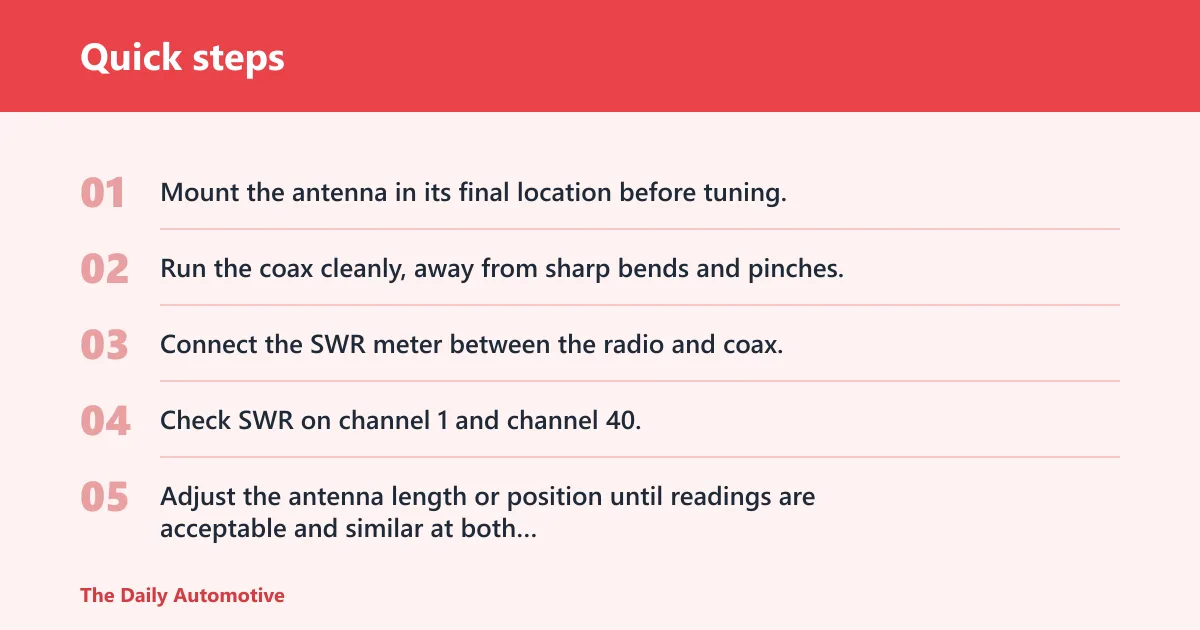
How to tune the antenna
- Mount the antenna in its final location before tuning.
- Run the coax cleanly, away from sharp bends and pinches.
- Connect the SWR meter between the radio and coax.
- Check SWR on channel 1 and channel 40.
- Adjust the antenna length or position until readings are acceptable and similar at both ends of the band.
- Recheck after any mount or coax change.
A common first-timer mistake is to buy the radio first and the antenna later, then assume the radio is weak when the real problem is a bad install. The opposite error is choosing a large, feature-heavy unit and mounting it to a weak antenna system that never gets tuned.
When AM/FM matters
AM/FM CB mode is useful on the models that support it, but it is not automatically better for every driver. If your priority is compatibility with radios using both modes, AM/FM is worth having. If your priority is simple daily use, it may not change much in practice.
For many car buyers, AM-only is still fine if the install is solid and the radio layout fits the cabin. The bigger mistake is treating AM/FM as a substitute for a proper antenna plan.
Typical total cost
A usable in-car setup usually includes the radio, an external antenna, coax, a mount, an SWR meter, and basic accessories such as a mic clip or power wiring. Budget for the whole system, not just the box on the product page.
Price varies by brand and mount style, so the practical way to shop is by cost buckets. A compact mobile radio plus antenna hardware often starts at a modest entry level, while a modular handset system with better mounting and cabling usually lands higher once you add the antenna and meter.
Do you need an external antenna for a car CB radio?
Yes. For meaningful in-car performance, you need an external antenna. Without one, a CB radio in a vehicle has limited range and far less useful transmit and receive performance than a properly mounted system with a tuned antenna.
Mounting choices that work
Magnet mounts are the easiest temporary choice for shared cars. Roof mounts often give better exposure and are a strong option when you can install them cleanly. Mirror and lip brackets are useful when roof mounting is not practical, especially on trucks and vehicles with limited roof access.
Whichever mount you choose, the antenna needs a good ground plane and a solid mechanical fit. Bad grounding is one of the fastest ways to end up with poor SWR and disappointing range.
Common failure cases
Poor grounding, crushed coax, loose connectors, and skipped tuning all create the same symptom: the radio seems underpowered even though it is working normally. That is why a “good” CB can still perform badly in a car.
If the antenna is not installed and tuned correctly, radio features will not rescue it. A compact radio with a proper antenna often outperforms a fancier unit that was installed badly.
Frequently asked questions
What is the best CB radio for a car?
The best CB radio for a car depends on how much space you have and whether you want a fixed or removable setup. For flexibility, the Cobra 75 All Road is the strongest fit. For a compact dash mount, the Uniden PRO520XL is the simple pick. For removable use, choose the Midland 75-822.
Which CB radio is easiest to install in a car?
The easiest to install is usually the one that best matches your cabin space and wiring tolerance. The Cobra 75 All Road simplifies the cabin with a two-piece modular design, while the Uniden PRO520XL keeps the radio body small. If you want the least permanent hardware, the Midland 75-822 is easier to move.
What is the best compact CB radio for a small car?
The Uniden PRO520XL is the best compact CB radio for a small car because it is a compact conventional mobile radio with 40 channels, 4-watt transmit power, RF gain, squelch, and an automatic noise limiter. It is the cleanest fit when dash space is tight and the install must stay simple.
Is AM/FM or AM-only better on a CB radio?
Neither is automatically better for every driver. AM/FM is useful on radios that support it, but it is not universal across CB radios and it does not replace a good antenna. If you want the simplest path to solid car use, AM-only is still fine when the install is done well.
Which CB radio has weather alerts?
The Midland 75-822 includes NOAA weather reception, which is useful for road trips and storm awareness. That makes it the strongest choice here for drivers who want a removable radio that can also keep an ear on changing weather while traveling.
How much does a good car CB radio cost?
The radio is only part of the bill. You also need an external antenna, coax, a mount, an SWR meter, and basic accessories. A compact budget setup costs less up front, while a modular or removable setup often costs more once you add the hardware needed to make it perform well.
What matters more for CB range, the radio or the antenna?
The antenna matters more. The FCC caps CB output at 4 watts, so the antenna system, mount, grounding, and SWR tuning do most of the work. A properly installed external antenna on a modest radio usually beats a better radio with a poor installation.
Products related to this article
Sponsored / affiliate links. As an Amazon Associate I earn from qualifying purchases. I may earn additional commission from eligible campaigns.