Best FM Transmitters for Cars (2026): We Compared
The best FM transmitter for most older cars is the Nulaxy 54W Bluetooth 5.3 Car Adapter; choose it for steadier day-to-day audio and simple controls, or move up only if faster USB-C charging matters most. Pick badly and you get hissy audio, slow charging, and more tapping at the wheel than driving. This guide compares three real transmitters by sound stability, charging speed, and distraction.
Quick comparison
| Product | Badge | Best for | Price | ||
|---|---|---|---|---|---|
 |
Nulaxy 54W Bluetooth 5.3 Car Adapter, FM Transmitter 4-PortNulaxy | Our pick | 54W · 4-Port · Bluetooth 5.3 · CVC Noise Cancellation | $13.98
Price as of 21 Oct 2026
|
View |
 |
Bluetooth Fm Transmitter for Car, Fast Charging, Blue ToothAILKIN | Budget pick | 54W · 4-Port · Bluetooth 5.4 · LED Display | $9.99
Price as of 21 Oct 2026
|
View |
 |
Syncwire Bluetooth 5.4 Car Adapter 48W FM Transmitter forSYNCWIRE | Upgrade pick | 48W · PD 36W+12W · Bluetooth 5.4 · HiFi Bass | $21.24
Price as of 21 Oct 2026
|
View |
The trade-off is straightforward: the Nulaxy leans toward stable, low-fuss use, the AILKIN leans toward maximum charging output at a low price, and the SYNCWIRE sits between them with a cleaner control layout. Sound quality still depends on three separate links: the phone’s Bluetooth connection, the transmitter’s FM broadcast, and the car radio’s tuning.
If you drive mostly in traffic and care more about quick setup than port count, start with the Nulaxy or SYNCWIRE. If you haul multiple phones or want the strongest charging spec on paper, the AILKIN deserves a look.
How we chose
These three were ranked by what drivers feel most on the road: sound stability first, charging speed second, and ease of use third. Only specs that affect commuting, road trips, and calls were kept in play.
That means Bluetooth version, charging output, FM tuning behavior, display readability, call hardware, and socket compatibility mattered. Cosmetic lighting and marketing phrases did not.
Only real listing details and manual-level specs were used. If a feature could not be checked on a product page or in the published details, it did not get a place in the ranking.
Nulaxy 54W Bluetooth 5.3 Car Adapter: best for stability
This is the best fit for drivers who want a dependable middle ground: enough charging for a phone and accessory, Bluetooth 5.3 for modern pairing behavior, and a four-port layout that works in a shared car. Based on the manufacturer’s specs, it also includes 54W charging with PD 36W plus QC18W and CVC noise cancellation for calls.
The strongest case for this model is everyday use. A car that sees short trips, stop-and-go traffic, and frequent reconnects needs predictable behavior more than a flashy screen, and the 54W layout gives you room for a cable and a passenger device.
The drawback is that 54W total output does not mean every port charges at full speed at once. Like most multi-port transmitters, the real charging split depends on how many devices are plugged in, so a single-phone buyer may be paying for capacity they rarely use.
AILKIN Bluetooth 5.4 car charger: best for charging
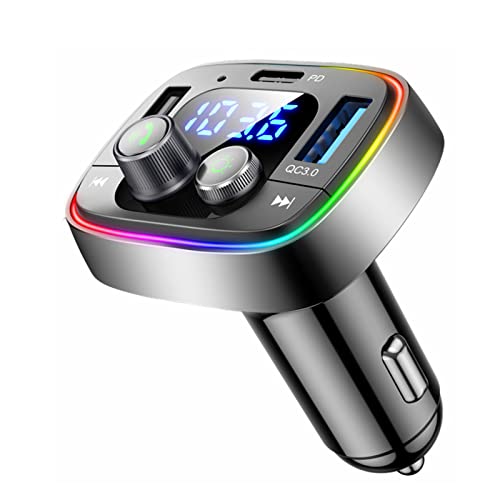
This is the pick for a family car, a work vehicle, or any shared cabin where charging is the main job. The listing calls out Bluetooth 5.4, 54W charging, an LED display, and a built-in mic with noise reduction, which makes it a practical match when more than one person needs power at once.
Its main advantage is the charging mix. Bluetooth 5.4 is helpful for pairing speed and reconnect behavior, but the real selling point is that it reaches the same 54W class as the Nulaxy while keeping the price low at $9.99.
The drawback is control confidence. Lower-cost transmitters often get the basics right, yet button feel, display legibility, and call clarity can be more uneven than on pricier models. If you care most about audio tuning and distraction reduction, this is the one to examine closely before buying.
SYNCWIRE Bluetooth 5.4 car adapter: best for simpler use
This is the easiest one to recommend if you want fewer accidental presses and a cleaner control routine. The listing’s physical light switch is a real road-use advantage, and the published spec set includes Bluetooth 5.4, 48W charging with PD 36W plus 12W, and support for hands-free calls and USB drive playback.
The display and switch layout matter here. A clear setup path can cut the time spent hunting for a station or checking whether the transmitter changed modes after a bump, which is useful in older cars with limited dash space.
The drawback is straightforward: 48W is less charging headroom than the two 54W models, and it is not the best choice for a vehicle that routinely needs to power several devices at once.
How sound, power, and tuning compare
FM transmitter sound quality has three separate failure points. Bluetooth can be fine while the FM channel is crowded, or the FM channel can be clear while the phone connection stutters, or both can be clean while the car radio itself is the weak link.
That is why empty-channel selection matters so much. In dense cities, adjacent-channel interference is common when a nearby station sits close to your chosen frequency. In rural areas, there are often more open gaps, so tuning can be easier and static may be less persistent.
| Model | Bluetooth version | Charging output | Display type | Call hardware | Price |
|---|---|---|---|---|---|
| Nulaxy 54W Bluetooth 5.3 Car Adapter | Bluetooth 5.3 | 54W total; PD 36W plus QC18W | Not listed in the provided data | CVC noise cancellation | $13.98 |
| AILKIN Bluetooth 5.4 car charger | Bluetooth 5.4 | 54W total | LED display | Built-in mic with noise reduction | $9.99 |
| SYNCWIRE Bluetooth 5.4 car adapter | Bluetooth 5.4 | 48W total; PD 36W plus 12W | Not listed in the provided data | Hands-free calls; support for noise suppression and echo cancellation | $21.24 |
Bluetooth version and reconnect behavior
Bluetooth 5.4 is the best of the three on paper for pairing speed and reconnect behavior, followed by 5.3. That does not automatically mean better sound over FM, but it can reduce the delay between turning the car on and getting music back.
Bluetooth 5.0 is still common in older transmitters, but it is not part of this comparison. If you see it in another listing, treat it as adequate rather than ideal unless the rest of the product is clearly stronger.
Charging output: 12W, 30W, 36W, 48W, 54W, and 60W
Think of charging output in two ways: single-port speed and total available power. A 12W port is fine for light top-ups or a low-demand accessory, while 30W and 36W are the range where many phones begin charging more usefully during a commute.
48W works better if one phone needs a stronger USB-C feed. 54W is the better family-car target because it leaves more overhead across multiple ports. 60W is the ceiling of the group and is the most attractive on a spec sheet, but only if your phone, cable, and port split can actually use it.
Multi-port transmitters make sense when two or more devices are plugged in at once. Single-port setups are easier to live with if the driver only wants one cable and less clutter around the shifter.
Display type and readability
A 1.8-inch color screen is useful when you need to read frequency, track info, or voltage at a glance. That is a real benefit in bright daylight, especially when you are trying to confirm a station without slowing down to stare at the dash.
A segment LCD is usually simpler and may be easier to read in some lighting conditions, but it shows less information. Extra brightness can help visibility, yet a bright screen can also pull attention away from the road if the controls are busy.
Hands-free calling hardware
Dual microphones and CVC noise reduction are the strongest call-focused hardware signals on this list. They matter because road noise and wind noise are what make FM-transmitter calls hard to hear, not just the microphone itself.
Noise reduction helps most at steady highway speed and in older cars with thin cabin insulation. It cannot erase all background noise, but it can make a caller sound less hollow and reduce the need to repeat yourself.
Vehicle power compatibility
All three plug into a 12V cigarette-lighter socket, which is still the basic requirement for this category. A 12V/24V compatible model is worth extra attention if the transmitter may move between cars, vans, or light commercial vehicles on road trips.
Weak sockets matter more than many shoppers expect. If the plug sits loose, charging can dip and reconnects can become inconsistent. That is one reason a lower-distraction transmitter with a simple control layout can be the safer choice in an older vehicle.
How to stop static on an FM transmitter in your car
Start with the channel, not the volume. Static usually comes from a crowded FM frequency, a poor empty-channel choice, or the car radio itself not locking cleanly onto the transmitter’s signal.
A practical checklist helps:
- Pick an empty frequency between 88.1 and 107.9 MHz.
- Move one step left and right to check adjacent-channel interference.
- Try a different station in the same area if the first one hisses.
- Re-seat the transmitter if the socket is weak or loose.
- Lower the phone volume if Bluetooth audio is overdriving the transmitter input.
Say your local area has two stations near your chosen channel, and the hiss rises only when you drive downtown. That is a tuning problem, not a phone problem. In that case, a different empty channel can help more than changing the transmitter.
FM transmitter scenario matrix
This matrix scores the three picks by what drivers feel in real use. Higher scores mean a better fit for that situation, not a universal ranking.
| Scenario | Nulaxy 54W | AILKIN 54W | SYNCWIRE 48W | Best choice |
|---|---|---|---|---|
| Noisy city commute | 4 | 3 | 4 | Nulaxy 54W |
| Long highway drive | 4 | 3 | 4 | SYNCWIRE 48W |
| Multi-device family charging | 4 | 5 | 3 | AILKIN 54W |
| Hands-free calls | 4 | 3 | 4 | Nulaxy 54W |
| Bright-sun visibility | 3 | 4 | 3 | AILKIN 54W |
| Bumpy-road stability | 4 | 3 | 5 | SYNCWIRE 48W |
| Weak-12V-socket tolerance | 4 | 3 | 4 | Nulaxy 54W |
Noisy city commute
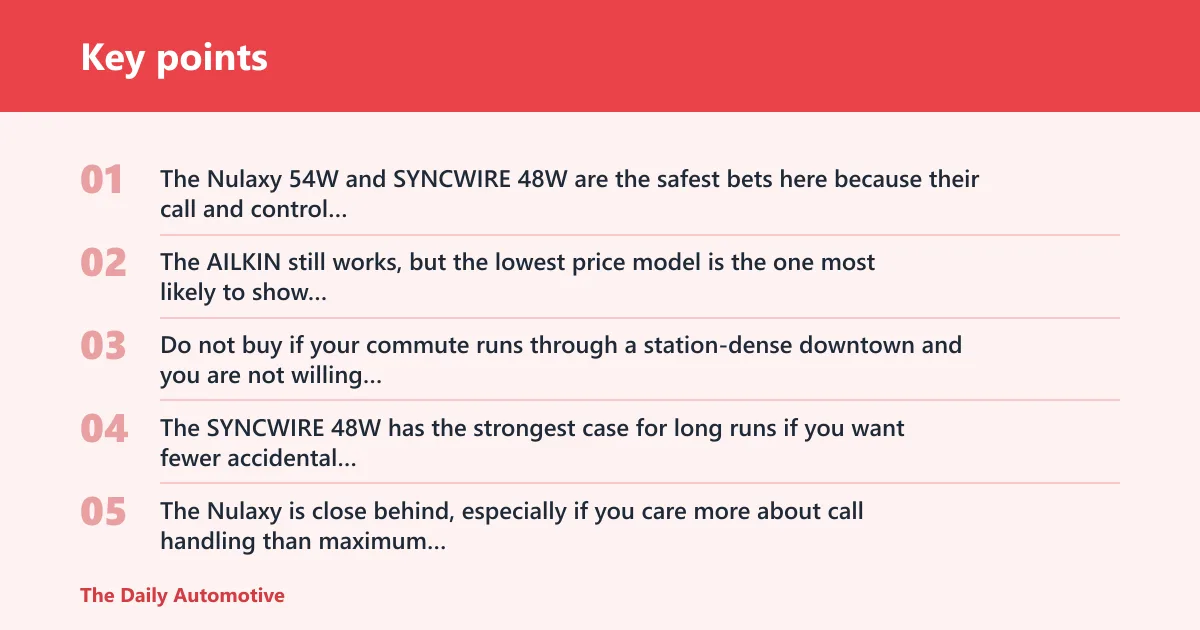
The Nulaxy 54W and SYNCWIRE 48W are the safest bets here because their call and control behavior are more suited to stop-and-go use. The AILKIN still works, but the lowest price model is the one most likely to show rougher control feel when the cabin is busy.
Do not buy if your commute runs through a station-dense downtown and you are not willing to retune when the signal changes block by block.
Long highway drive
The SYNCWIRE 48W has the strongest case for long runs if you want fewer accidental touches and a simpler control routine. The Nulaxy is close behind, especially if you care more about call handling than maximum power.
Do not buy if you want a bright screen and extra buttons more than you want a transmitter that disappears into the background.
Multi-device family charging
The AILKIN 54W is the best fit when the car has to charge more than one phone on a trip. The Nulaxy 54W is a close second because it also sits in the 54W class with stronger call hardware.
Do not buy if you only need one cable and you would rather not pay for a multi-port setup.
Hands-free calls
The Nulaxy 54W has the cleanest call-oriented spec set of the three because CVC noise cancellation is explicit in the listing. SYNCWIRE is also strong here thanks to its noise suppression and echo cancellation claims.
Do not buy if your car already has a better built-in microphone path and you are only buying for music playback.
Bright-sun visibility
The AILKIN’s LED display gives it the edge for quick glances in daylight. A readable screen matters when you need to check the channel without taking your eyes off traffic for long.
Do not buy if a bright screen tempts you to adjust settings too often while driving.
Bumpy-road stability
The SYNCWIRE 48W stands out because its physical light switch reduces accidental mode changes. On rough pavement, fewer touch-dependent controls usually mean fewer interruptions.
Do not buy if you need the highest total charging output in a vehicle that shakes enough to loosen accessories.
Weak-12V-socket tolerance
The Nulaxy 54W and SYNCWIRE 48W are better fits when the socket fit is not perfect, because simpler daily use matters when power delivery is unstable. A loose socket can turn a good transmitter into a frustrating one.
Do not buy if the plug already wiggles in the socket and you are expecting charging consistency from a high-draw setup.
What to check before you buy
Match Bluetooth 5.4, 5.3, or 5.0 to the kind of phone use you expect. Bluetooth 5.4 is the best bet for pairing speed and auto-reconnect behavior; 5.3 is still solid; 5.0 is acceptable if the price makes the trade-off worth it.
Choose USB-C PD if your phone supports it and you want faster charging from a single port. Choose QC3.0 if your device mix still leans toward older fast-charge hardware. If you travel with both, a dual-standard unit is the safer buy.
Check whether the model supports 12V only or 12V/24V if the transmitter may move between vehicles. Also look at display size and button placement, because a good spec sheet can still hide a frustrating control layout.
Picture a driver with a ten-year-old sedan, two phone cables, and a busy downtown route. A transmitter with a readable screen and one-touch channel switching usually beats a brighter, more crowded control panel that needs repeated taps.
Choose Nulaxy 54W if… / Choose AILKIN 54W if… / Choose SYNCWIRE 48W if…
Choose the Nulaxy 54W if you want the safest all-around pick for commuting, calls, and balanced charging. It is the best match when you want a little more confidence in sound stability without paying for the highest-output model.
Choose the AILKIN 54W if your top priority is charging output per dollar and your car carries more than one device at a time. It makes the most sense in family duty, rideshare use, or any shared car where the screen and ports matter more than button feel.
Choose the SYNCWIRE 48W if you want the least distracting control layout and are willing to give up some charging headroom. It is the one to buy when road stability, fast setup, and fewer accidental presses matter more than raw port count.
Frequently asked questions
What is the best FM transmitter for a car?
The best FM transmitter for most older cars is the Nulaxy 54W Bluetooth 5.3 Car Adapter. It is the strongest general pick here because it balances Bluetooth 5.3 stability, 54W charging, and call-focused hardware without asking the driver to manage a busy control layout.
Are FM transmitters legal and how strong is the signal?
FM transmitters are generally legal to use as low-power in-car accessories, but local rules can vary. Their signal is meant for the cabin and nearby reception, not long-range broadcasting, so the useful range is short and depends on channel choice, power, and interference.
Which FM transmitter has the clearest sound?
Clearest sound depends on the cleanest empty FM frequency, the phone connection, and the car radio. Among these three, the Nulaxy 54W and SYNCWIRE 48W are the better bets for clarity because they pair strong modern Bluetooth with more call-oriented hardware and simpler road use.
Which FM transmitter charges phones fastest?
The fastest charger in this group is the AILKIN 54W if you want the most charging headroom on paper, while the Nulaxy 54W is close behind with PD 36W plus QC18W. The SYNCWIRE 48W is still strong, but its total output is lower than the 54W models.
How do I stop static on an FM transmitter in my car?
Find a truly empty FM channel, then test nearby frequencies because adjacent-channel interference is common in cities. If static persists, reseat the plug, lower the phone volume, and check whether the car radio itself is struggling to lock onto the signal.
What Bluetooth version is best for an FM transmitter?
Bluetooth 5.4 is the best version in this comparison because it is the strongest choice for pairing speed and auto-reconnect behavior. Bluetooth 5.3 is still good, and the practical difference matters most on short trips where the car turns off and on often.
Should I choose an FM transmitter with USB-C PD or QC3.0?
Choose USB-C PD if your phone supports it and you want the best fit for modern USB-C charging. Choose QC3.0 if you still charge older fast-charge devices, or pick a dual-standard model if your household uses a mix of phones and cables.
Do FM transmitters work in older cars without aux or Bluetooth?
Yes. That is the whole point of this category: they plug into the 12V cigarette-lighter socket, pair to your phone over Bluetooth, and broadcast to an empty FM frequency. For older cars, they are a cheap way to add streaming and hands-free calling.
Products related to this article
Sponsored / affiliate links. As an Amazon Associate I earn from qualifying purchases. I may earn additional commission from eligible campaigns.