Best Car Radio Antenna Boosters for AM/FM (2026): We Compared
Use a booster only if the antenna and cable are intact. For weak AM/FM caused by signal loss, the two practical fixes are a mast-mounted in-line preamp or a powered antenna amp. If the radio is losing signal because of damage or electrical noise, a booster wastes money and can make interference louder. This guide compares both options, shows how to tell signal loss from antenna faults, and helps you avoid buying the wrong fix.
Quick comparison
The better choice for weak, clean FM reception is the in-line booster. The safer fix for factory amplified antennas and some aftermarket head units is a powered antenna adapter, because the problem there is often missing phantom power rather than weak signal at the antenna.
How we chose
Only real products with clear application notes made the cut. This comparison focuses on whether each option fits FM or AM use, whether it works with factory amplified antennas or aftermarket head units, and where it installs in the coaxial antenna cable path.
Noise floor matters too. If the vehicle already has heavy alternator whine, dense urban multipath, or a damaged coax run, a booster can raise the garbage along with the station signal.
We also weighed wiring needs, connector fitment, and the most common failure modes buyers run into after install.
Do car radio antenna boosters actually work?
Yes, but only in the right fault pattern. A car radio antenna booster is an in-line signal amplifier powered by the vehicle’s 12V electrical system, and it generally works best when the radio is already receiving a weak but usable antenna signal. It usually helps FM more than AM, and it cannot repair a broken mast, bad ground, or dead antenna power feed.
When an in-line booster helps
On FM band reception, 87.5–108 MHz, the signal may be weak because of distance, terrain, or multipath reflections. In that case, an amplifier placed in the coaxial antenna cable path can give the head unit a stronger signal to work with. (Wikipedia)
Placement matters. Put the booster near the antenna end if possible, because any coax loss before the amplifier still hurts the signal. Putting it only near the radio does not recover signal that was already lost in a long or damaged cable run.
When it only makes noise louder
If static is already present on most stations, the booster may simply raise the noise floor. That is common in high-interference vehicles, in dense urban areas, or when the antenna shield is compromised. AM band reception, 530–1710 kHz, is especially prone to electrical noise, so it often improves less than FM.
A common first-timer mistake is buying a booster for a loose mast or a corroded connector. The result is predictable: the same weak reception, only louder.
Bingfu Universal car Stereo FM radio antenna signal booster Amplifier Amp: best for weak FM reception

This Bingfu unit fits the classic inline-booster job. Based on the listed specs and buyer feedback, it is the stronger choice when the car has a working antenna, a Motorola-style automotive antenna connector path, and the issue is weak FM rather than a missing antenna power feed.
What stands out is the simple 12V power requirement and the stated anti-interference copper signal wire. That points to a use case where you want to strengthen a marginal FM signal without replacing the radio or antenna assembly.
The honest drawback is that it is a narrow tool. It is aimed at FM signal recovery, so it is less convincing for AM-heavy complaints, and it will not fix a damaged mast, broken coaxial antenna cable, or a bad ground.
Antenna booster decision table
| Symptom pattern | Likely cause | Booster likely? | Next test to run |
|---|---|---|---|
| Static on all stations | High noise floor, bad grounding, corroded connector, or damaged coax shielding | No | Inspect the mast base, antenna ground, and coax continuity before adding power |
| Weak only at highway speed | Marginal FM signal in a fringe area or at speed-related multipath changes | Yes, sometimes | Check whether the station holds better when parked in the same area |
| AM worse than FM | AM band’s higher sensitivity to electrical interference | Usually no | Turn off accessories one by one and see whether the noise changes |
| Reception improves when touching antenna | Bad antenna ground or missing body ground path | No | Test continuity from antenna base to chassis ground |
| Aftermarket head unit no-power issue | Head unit does not supply antenna power by default | No, use a powered antenna adapter | Check whether the radio has a blue or blue-white remote lead for phantom power |
| Factory amplified antenna mismatch | Built-in antenna amplifier needs phantom power or an adapter harness | No, use a powered antenna adapter | Confirm the vehicle uses a factory amplified antenna before changing the mast |
Will a booster work with factory and aftermarket car radios?
Sometimes, but the fitment problem is different for each system. Factory amplified antennas often need phantom power, and an aftermarket head unit may not supply that power unless you add the right adapter. A plain inline booster is not the same thing as a powered antenna adapter, even though both live in the antenna path.
Factory amplified antenna systems
Many factory amplified antennas use a built-in amplifier that depends on 12V feed from the radio side. If that feed is missing, reception can collapse even though the mast and cable are fine. In that case, the fix is usually a powered antenna adapter, not a signal booster placed anywhere along the coax.
Aftermarket head units with no antenna power output
An aftermarket head unit may need an antenna adapter wiring kit that supplies 12V remote or accessory power to the factory antenna amp. If the radio does not energize the antenna system, a booster will not solve the power problem. Check the connector type first, especially when the car uses a Motorola-style automotive antenna plug.
Picture a 2010 sedan with good FM reception in the stock stereo but weak reception after a replacement head unit goes in. The mast is fine, but the factory antenna amp is now unpowered. A powered antenna adapter is the correct fix, while a generic booster would be the wrong tool.
What is the best car radio antenna booster for FM and AM reception?
For FM, the best fit is usually an inline booster like the Bingfu unit when the signal is merely weak and the antenna path is intact. For AM, the better answer is often no booster at all, because AM reception is more likely to be limited by electrical interference, grounding, or shielding than by simple signal loss.
FM band first
FM is the most common booster use case because weak-station dropouts, fringe-area hiss, and multipath fades can sometimes be improved by a cleaner, stronger feed into the head unit. The gain only helps if the incoming signal is still cleaner than the noise floor.
AM band second
AM often responds less well, even with a good antenna amplifier. That band sits in a range where vehicle electronics, charging systems, and poor cable shielding can swamp the radio path. If AM is the main complaint, chase noise sources first.
Where do you install a car radio antenna booster?
Install an inline booster in the coaxial antenna cable path, ideally as close to the antenna as the wiring layout allows. That gives the amplifier the strongest possible raw signal before cable loss and connector loss eat into it. If the system uses a factory amplified antenna, the adapter belongs where the radio’s antenna feed can supply phantom power.
Practical installation order
- Unplug the antenna lead from the radio.
- Insert the booster or adapter in the coax run.
- Connect the 12V feed or remote lead if the unit requires it.
- Secure the wiring away from ignition coils, charging cables, and other noise sources.
- Test FM and AM separately before buttoning up trim panels.
Do not bury a booster in a bad system and hope for the best. If the mast is cracked, the coax shield is open, or the ground point is rusty, fix that first.
Which one should you buy?
Buy the inline booster if the antenna and cable are intact, FM is the main problem, and the reception is weak rather than noisy. A powered antenna adapter is commonly recommended if the car uses a factory amplified antenna or the replacement radio is not supplying antenna power. Skip both if the mast, cable, or ground is damaged.
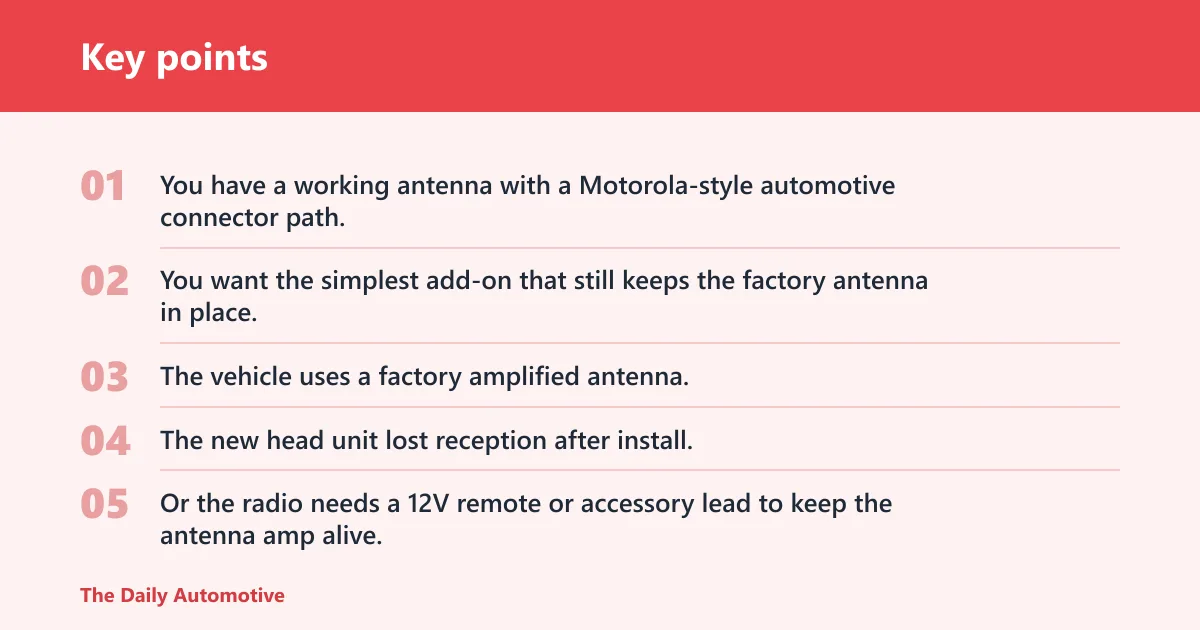
Choose the Bingfu inline booster if…
You want a budget fix for weak-but-clean FM. You have a working antenna with a Motorola-style automotive connector path, and the problem gets worse in fringe reception areas or at highway speed. You want the simplest add-on that still keeps the factory antenna in place.
Choose a powered antenna adapter if…
The vehicle uses a factory amplified antenna. The new head unit lost reception after install. Or the radio needs a 12V remote or accessory lead to keep the antenna amp alive. In those cases, the issue is compatibility and power, not signal strength.
Say your compact SUV gets decent FM around town but loses a local station once you leave the city. The mast is intact, the coax checks out, and AM is already noisy. That is the kind of pattern where an inline booster may help. Now change only one detail: the same SUV gets weak reception only after a new head unit goes in. That shifts the diagnosis toward a powered antenna adapter.
Can an antenna booster fix static and station dropouts?
It can help station dropouts when the root problem is marginal FM signal, but it is a poor cure for blanket static. Static on every station usually means the noise floor is too high, the antenna is damaged, or the shielding path is compromised. Dropouts that happen only at speed or near weak stations are a better fit for a booster.
If the radio hisses on every band and every channel, add diagnosis before parts. A booster cannot restore a torn coax shield or a rusted mounting point.
Will an antenna booster improve HD Radio reception?
Sometimes, but only if the receiver is right on the edge of usable signal and the antenna system is otherwise healthy. HD Radio is less forgiving than analog FM once the signal gets too weak, so a booster cannot create a clean digital signal where the received signal is already marginal. It may help a borderline station hold on; it will not rescue a broken antenna system.
How much does a good car radio antenna booster cost?
Most basic inline car radio antenna boosters sit in the low-cost range, and the Bingfu listing here is $10.99. A powered antenna adapter may cost a little more or a little less depending on connector type and whether it includes the phantom-power lead. If the antenna mast or coax is damaged, replacement parts usually make more sense than spending on a booster.
What are the signs an antenna booster will not help?
If every station is noisy, the antenna is visibly damaged, touching the antenna changes reception a lot, or the problem started right after a radio swap with a factory amplified antenna, a booster is probably the wrong fix. Those symptoms point to grounding, cabling, or power-feed issues, not simple weak signal.
Another warning sign is strong electrical noise that changes with engine speed, defroster use, or lights. That is usually a noise-floor problem, and amplification can make it more obvious.
Frequently asked questions
How do I know if my weak signal is caused by the antenna or the head unit?
Check whether reception changed after a stereo swap, whether the antenna base is grounded, and whether the head unit supplies antenna power. If a factory amplified antenna suddenly fails after an aftermarket install, the head unit or adapter is suspect. If touching the antenna changes the result, look at the antenna ground.
Products related to this article
Sponsored / affiliate links. As an Amazon Associate I earn from qualifying purchases. I may earn additional commission from eligible campaigns.