Bluetooth Adapter for Car Audio: 3 Top AUX Picks Compared
Pick the adapter that matches your input first: 3.5 mm AUX for the simplest install, RCA if your stereo lacks AUX but has red and white line-in, and a call-capable model only if you need hands-free calling. Pick the wrong type and you risk hiss, dead buttons, poor mic audio, or an adapter that will not connect to your head unit. This comparison covers three AUX-focused Bluetooth adapter types, plus install effort and failure risk.
Bluetooth adapter comparison matrix


The trade-off is connection fit against installation complexity. A 3.5 mm AUX dongle is often the quickest option for an older stereo with a true line-in, RCA modules suit head units built around cinch inputs, and a hybrid can offer the broadest compatibility when the stereo may be changed later.
| Adapter type | Install effort | Call support | Grounding needs | Best-fit stereo type | Likely failure point |
|---|---|---|---|---|---|
| 3.5 mm AUX dongle | Low; power plus one AUX lead | Usually music-only unless the listing adds a mic | Often needs a clean 12V ground to avoid hiss | Older car stereo with a 3.5 mm analog line-in | No sound if the stereo is set to the wrong input |
| RCA stereo module | Moderate; power plus red and white cinch leads | More likely to include a hands-free microphone lead | Needs a solid ground; weak grounding can add alternator whine | Aftermarket head unit with RCA line-level input | Wrong channel or poor contact in the RCA pair |
| AUX/RCA hybrid | Low to moderate; more flexible wiring | Depends on the exact listing | Needs the same clean ground as the other two | Car radio that may need either AUX or RCA over time | Misread wiring path or using the wrong adapter lead |
Which adapter type fits your car stereo?
If your stereo has a 3.5 mm AUX jack, start with a 3.5 mm Bluetooth dongle. If it only offers red and white RCA inputs, choose an RCA module instead. A hybrid makes sense when the radio or head unit may change later, or when the listing clearly includes both AUX and cinch outputs.
3.5 mm AUX dongle
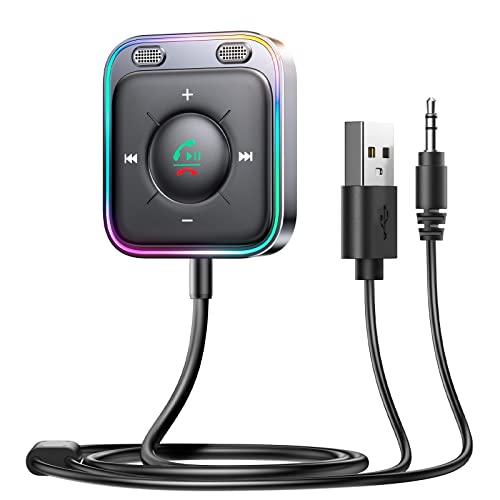
An AUX dongle is the cleanest option for older car stereos with a 3.5 mm analog line-in. It is a plug-and-play path when the unit only needs power and an audio connection, with no app required. That simple path also makes it the easiest one to miswire if the radio is not actually on AUX.
Say your hatchback has a factory radio with a front AUX jack and nothing else. A 3.5 mm adapter usually solves the job with the fewest parts, but the stereo must be switched to AUX or silent playback is the result.
RCA stereo module
An RCA module suits an aftermarket head unit that expects red and white line-level inputs. Standard RCA color coding assigns red to the right channel and white to the left channel. That matters because a swapped pair can make troubleshooting harder, even when the music still plays.
The Novexplus listing is a concrete example of this path: it is described as a Bluetooth adapter with AUX RCA connectors, it uses Bluetooth 5.0, and it connects to the radio using red and white cinch connectors. It is also marked in stock, priced at 299 Kč, and listed with an average rating of 4.5 out of 5 stars from 30 ratings.
AUX/RCA hybrid
A hybrid is the safer buy when you want one adapter that can work with either connection style. It is the right choice if you may move the unit to another car, or if you are unsure whether the radio’s input is a 3.5 mm line-in or a cinch pair. The price is usually that wiring becomes less obvious, so check the listing before you order.
How Bluetooth 5.0 affects pairing and range
Bluetooth 5.0 is a wireless standard, not a car-audio feature by itself. In adapter listings, the useful points are backward compatibility with older Bluetooth versions, steadier pairing behavior, and range claims that vary by model. A listing may mention a specific distance, but real-world stability still depends on the car interior and where the adapter sits.
Backward compatibility
Bluetooth 5.0 devices are commonly listed as supporting older versions too. That matters because the phone side may be newer or older than the adapter, and a mismatch can make pairing harder than it should be. The Novexplus description states Bluetooth 5.0 and support for older versions.
Pairing stability and remembered phones
For daily driving, the better question is whether the adapter remembers the last phone and reconnects cleanly on startup. A unit that drops the pairing list every time the ignition is cycled becomes annoying fast. That is a failure point worth checking in the product description before you buy.
Typical range claims
Keep range claims modest unless the listing gives a number. The Novexplus description gives an approximate range of 5 meters. That is enough for a dashboard-mounted adapter in a small cabin, but placement still matters if the stereo sits low or behind trim.
Which pick is best for calls and daily driving?
Choose a hands-free microphone model if you plan to take calls through the adapter. If you only want music or podcasts, a music-only unit is usually simpler and has fewer wiring points to get wrong. Android, iOS, and Windows support should be checked on the listing, not assumed from the Bluetooth logo alone.
When to choose a hands-free microphone
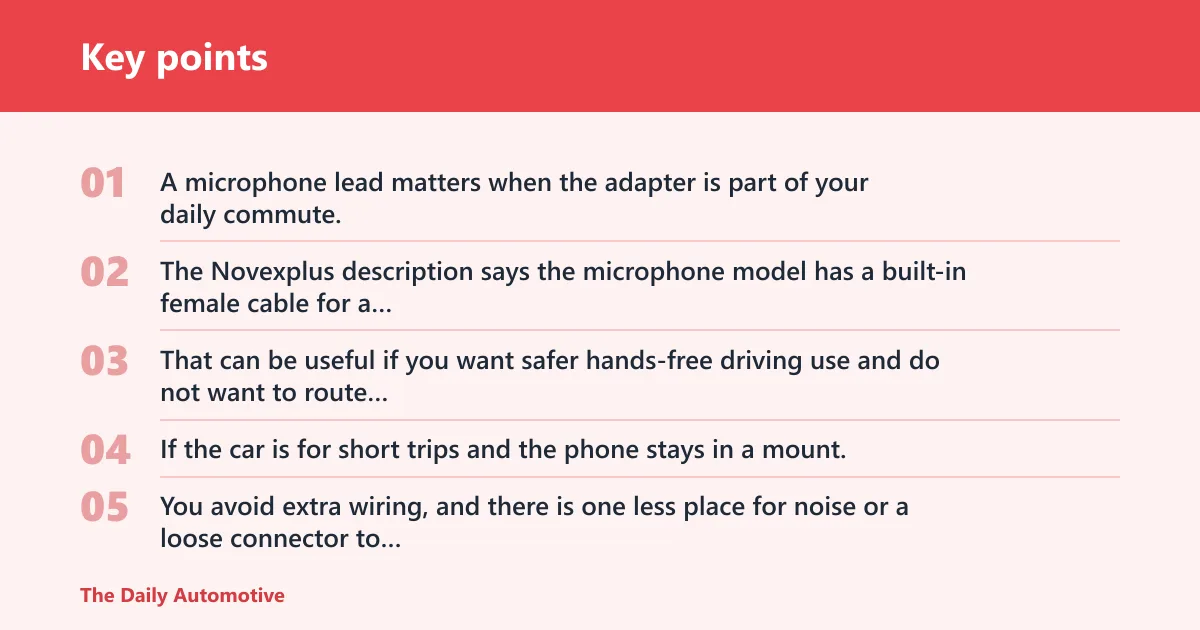
A microphone lead matters when the adapter is part of your daily commute. The Novexplus description says the microphone model has a built-in female cable for a hands-free kit, which means call support is a real feature, not an afterthought. That can be useful if you want safer hands-free driving use and do not want to route audio through a phone speaker.
When music-only is enough
If the car is for short trips and the phone stays in a mount, music-only is usually enough. You avoid extra wiring, and there is one less place for noise or a loose connector to appear. That choice suits drivers who only need streaming audio into an old stereo.
What to check for platform support
Do not assume cross-platform compatibility. The Novexplus description explicitly says it works with Android, Apple iOS, and Windows. That is a useful sign if you switch devices, but the same rule applies to other adapters: confirm the listing before ordering, especially if the phone is not your only source.
How to install and power it safely
Many car Bluetooth adapters need 12V power from the vehicle electrical system and a solid ground connection. The audio path then goes to AUX or RCA, depending on the unit. If the listing mentions an ISO loom takeoff, that is usually the cleanest way to pull power without improvising at the back of the radio.
- Confirm the stereo input first: 3.5 mm AUX, red and white RCA, or both.
- Find a switched 12V supply so the adapter powers on with the car.
- Attach ground to a clean metal point or the specified loom ground.
- Connect the audio lead to AUX or to the RCA pair, matching red to right and white to left.
- Pair the phone, then test for sound, hiss, and automatic reconnect after restart.
The Novexplus instructions mention power from an ISO connector block. That is the sort of detail that prevents guesswork at installation time, especially in older cars where the radio harness may have already been altered.
Suppose an aftermarket head unit only accepts RCA input, but the adapter you bought ends in a 3.5 mm plug. You need an RCA-to-3.5 mm adapter or the correct model from the start. Without that match, the stereo will never see a proper signal.
Bluetooth adapter troubleshooting checklist
Most post-install problems come from three places: the wrong input selected, weak grounding, or a pairing conflict with an old phone profile. Work through the checks in order. That usually finds the fault faster than swapping parts at random.
| Check | What to inspect | Likely fix |
|---|---|---|
| No sound | Correct input selected, audio cable fully seated, power light on | Switch the radio to AUX or the correct RCA source and reseat the plug |
| Hiss or alternator whine | Ground point, power source quality, cable routing near high-current wiring | Move the ground to clean metal and keep signal leads away from noisy power lines |
| Pairing problems | Old phone entries in the adapter memory, Bluetooth on the phone, nearby devices | Forget the adapter on the phone and clear the adapter memory if the manual allows it |
| Delay or weak sound | Input type, volume levels on phone and radio, low-quality connection path | Raise source volume, confirm the right input, and avoid unnecessary adapters |
| Does not remember the last phone | Startup behavior after ignition off, power loss to the adapter | Use a stable switched 12V feed and check whether the model supports memory retention |
Choose AUX if… / Choose RCA if…
Choose AUX if your radio already has a 3.5 mm line-in, you want the shortest install, and you do not need a microphone. Choose RCA if your head unit uses red and white line-level inputs, or if you are fitting an aftermarket stereo that expects cinch audio. Choose a hybrid if you may change stereos later and want one adapter to cover both paths.
Choose AUX if…
You have a factory or older radio with a visible 3.5 mm jack. You want quick setup with power plus audio only. You are not routing calls through the stereo.
Choose RCA if…
Your head unit exposes red and white inputs instead of a front AUX jack. You want a more integrated car-audio connection. You want a path that suits many aftermarket stereos.
Choose a hybrid if…
You are not sure which stereo will stay in the car. You want a backup path if the next radio changes from AUX to RCA. You prefer a broader compatibility margin over the most minimal wiring layout.
Frequently asked questions
Which Bluetooth adapter is best for car AUX input?
A 3.5 mm AUX dongle is usually the best fit when the stereo already has a true line-in jack. It keeps the install simple and avoids extra cabling. If you need hands-free calls, choose a version that explicitly includes microphone support rather than assuming it is built in.
Do Bluetooth AUX adapters work with my old car radio?
Yes, if the radio has an actual AUX input or a compatible line-level path. Older stereos often use the 3.5 mm jack, but some need RCA instead. If the radio has neither, the adapter alone will not solve the connection problem.
What is the difference between Bluetooth 5.0 and older versions in car adapters?
Bluetooth 5.0 is the wireless standard used by many current adapters, and many listings say it supports older Bluetooth versions too. In practice, the important points are pairing compatibility and stable reconnection after startup. Range claims still depend on the specific model and car layout.
Can I use a Bluetooth adapter for hands-free calls in the car?
Yes, but only if the adapter includes a microphone lead or a hands-free kit connection. Music-only adapters stream audio but do not handle call audio well. If calls matter, check the listing for mic support, not just Bluetooth support.
How do I connect a Bluetooth adapter to an AUX or RCA input?
Connect the adapter’s audio output to the stereo input, then supply 12V power and ground. A 3.5 mm plug goes to AUX, while an RCA adapter uses the red and white cinch pair. After that, switch the radio to the matching source and pair the phone.
How much do Bluetooth audio adapters cost in Czech shops?
Prices vary by connection type, call support, and whether the listing includes extra wiring. One concrete example is the Novexplus adapter at 299 Kč. For other models, check the current listing because pricing changes with stock and features.
Products related to this article
Sponsored / affiliate links. As an Amazon Associate I earn from qualifying purchases. I may earn additional commission from eligible campaigns.