Chevy Wiring Color Codes: What GM’s Own Manuals Show
Chevy wiring colors are not one universal chart: GM’s own documents use different colors, abbreviations and circuit names for the same function depending on model year and option package. This guide shows what two GM electrical manuals and two GM bulletins actually list, how GM writes base colors and stripes, and the checks to run before you cut or splice anything.
Why There Is No Single Chevy Wiring Color Chart
Most online charts promise one color per function across every Chevy. We could not support that from primary sources, so this page does not publish one. Every color below is tied to a named GM document and vehicle line, and anything we could not read in full is left out.
 |
Best Strip and Crimp Pick for Splices Klein Tools 80013 Wire Stripper and Ratcheting Crimper Kit (2-piece)
As an Amazon Associate we earn from qualifying purchases. Spec-based pick from the listing, not a hands-on test. |
The clearest proof is in GM’s own paperwork: one 7-way trailer connector part (15354653) appears in two GM electrical manuals, with the ground pin listed as black in one and white in the other. The circuit numbers match, the colors do not. So this guide leans on circuit numbers, connector pins and the wiring diagram for your exact truck.
How GM Writes Wire Colors: Base Color, Stripe and Abbreviations
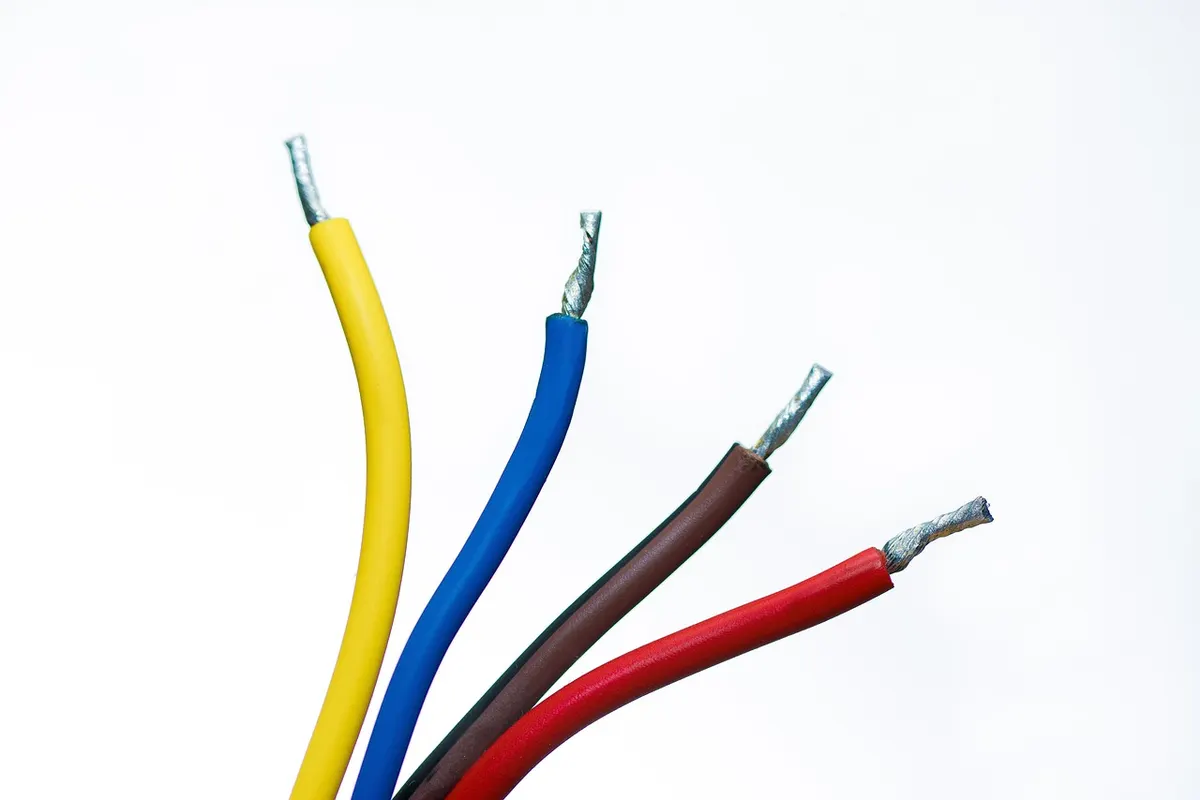
A GM upfitter electrical guide for gas models (revision 12/98, filed by GM under W-series medium duty) says all wires have color-coded insulation, wires in a system’s main harness carry a single color, and sub-circuit wires carry a colored stripe. Its example, 0.5 G / R, reads as wire size, then base color (green), then stripe color (red). So the base color comes first and the stripe second. A white wire with a blue stripe is not the same wire as a blue wire with a white stripe.
Abbreviations are where charts go wrong. L means blue in the W-series guide but light in the 2009 truck manual, where L-GN is circuit 1624, the same circuit the 2003 to 2006 manual lists as LT GRN.
| Document (vehicle line) | Abbreviations seen | What they show |
|---|---|---|
| GM W-series upfitter guide, rev. 12/98 | B, W, R, G, Y, L, O, BR, LG, GR, P, LB, V | L is blue, LB is light blue, LG is light green, BR is brown |
| GM 2003 and beyond light duty C/K manual, rev. 04/2006 | BLK, BRN, RED, YEL, PNK, ORN, LT GRN, DK GRN, DK BLU, YEL/BLK | Three-letter names, DK and LT prefixes, slash for a second color |
| GM 2009 light duty full size C/K manual | L-GN, D-GN, D-BU, BN, YE, WH, RD/BK | L means light, D means dark, BN is brown, YE is yellow |
GM service bulletins often skip abbreviations and describe wires in words. Bulletin 20-NA-188 on rear camera flicker (2019 Silverado 1500 and 2020 Silverado 2500/3500 HD) names the ground wire at the chassis-to-endgate harness, in its Silverado 1500 procedure, as black with a white stripe, the camera signal positive as gray with a yellow stripe, and the negative as white with a blue stripe.
Trailer Wiring Color Codes for Chevy Trucks
Trailer wiring is the one area where GM documents give a full, named list. The GM upfitter electrical manual for 2003 and beyond light duty C/K trucks (revised 04/2006) describes three trailer setups on 2003 and beyond light duty C/K trucks: standard light duty wiring (six blunt-cut wires at the rear), the heavy duty package with a 7-way connector (option Z82), and a camper package (option UY2) that reuses the heavy duty circuits.
| Function | Light duty wire color | Added or changed on heavy duty (Z82) |
|---|---|---|
| Left stop and turn signal | Yellow | Same circuit on 7-way pin G |
| Right stop and turn signal | Dark green | Same circuit on 7-way pin D |
| Tail lamps | Brown | Pin F, park lamps supply |
| Ground | White | Ground lead upgraded to 10 gauge |
| Backup lamps | Light green | Pin A |
| Center high-mounted stop lamp (CHMSL) | Light blue | Separate one-pin connector |
| Battery feed | Not in the six-wire set | Red |
| Trailer brake | Not in the six-wire set | Dark blue |
Source: GM upfitter manual revised 04/2006, 2003 and beyond light duty C/K trucks only. The manual also notes these trucks ship with the trailer battery feed lead disconnected until a fuse is connected at the underhood stud.
Now compare the connector page of that manual with the later one. Both describe the 7-way female connector, part 15354653, and the circuit numbers agree. The colors and the abbreviation style do not.
| Pin | Function | Circuit | 2003 to 2006 manual | 2009 manual |
|---|---|---|---|---|
| A | Trailer backup lamps supply | 1624 | LT GRN | L-GN |
| B | Ground | 1750 (2006) / 22 (2009) | BLK | WH |
| C | Trailer auxiliary supply | 47 | DK BLU | D-BU |
| D | Right rear turn and stop supply | 1619 | DK GRN | D-GN |
| E | Battery positive | 742 | RED | RD/BK |
| F | Trailer park lamps supply | 2109 | BRN | BN |
| G | Left rear turn and stop supply | 1618 | YEL | YE |
Two things stand out. The ground is white in the 2006 manual’s trailer text and the 2009 table, yet the 2006 connector page lists it as BLK with another circuit number. And the dark blue wire (circuit 47) is the trailer brake in the 2006 text but trailer auxiliary supply on its connector page. Read the GM 2009 light duty full size C/K electrical manual page for your year, not a generic chart.
Grounds matter in practice. GM bulletin PIT5311B (2014 Silverado 1500 and 2015 to 2016 Silverado, Suburban and Tahoe) says a Check Trailer Wiring message can come from insufficient trailer grounding or a poor 7-way connection, calls the trailer ground wire normally white, and warns that many trailer-side 7-way plugs do not meet SAE specifications. Its fix includes a clean ground to the trailer chassis and a minimum 10 gauge white wire. For the full connector story by generation, see our Chevy truck trailer wiring color code page.
Ignition Switch and Starter Wiring
We found no GM document that lists every ignition switch wire by color across Chevy history, so there is no full ignition chart here. What we read is the upfitter connector in the Mid BEC (mid bussed electrical center) of the 2003 and beyond light duty C/K trucks, which gives these feeds:
| Cavity | Wire | Circuit | Stated function |
|---|---|---|---|
| A | ORN | 2340 | Hot at all times |
| C | PNK | 739 | Hot in run and start |
| D | YEL | 243 | Hot in accessory and run |
| E | ORN | 4540 | Hot at all times |
| F | BLK | 1050 | Ground |
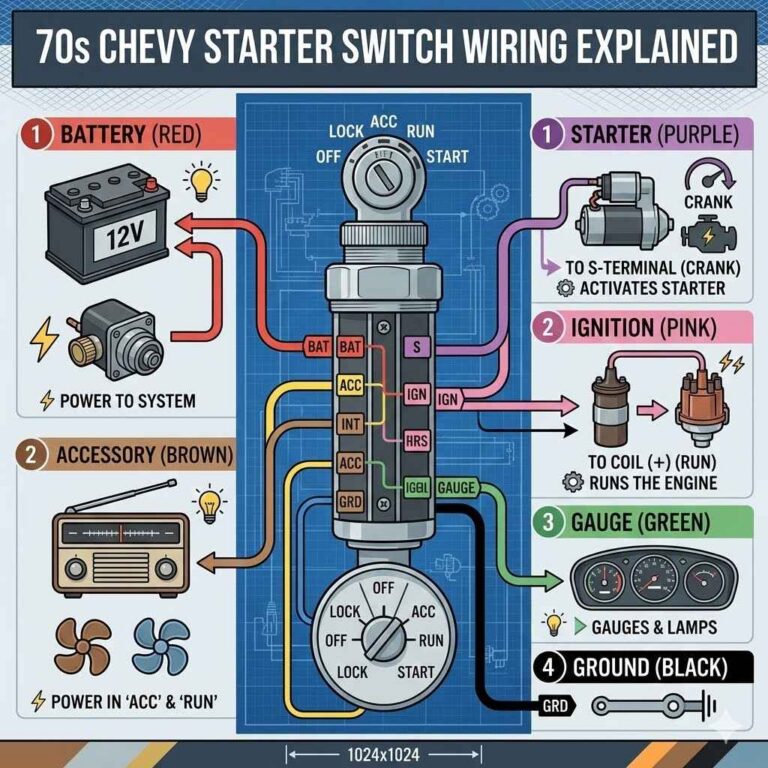
This is a convenience connector for add-on equipment on those trucks, not the ignition switch harness. It does show that yellow can mean a switched accessory feed, which contradicts charts that treat yellow as a constant battery wire. For starter circuits, our Chevy starter solenoid wiring guide covers the terminals, and the ignition switch wiring diagram, starter ignition switch diagram and 70s starter switch explainer pages take specific eras one at a time.
Radio and Stereo Wiring Colors
We did not read a GM or ACDelco page that lists radio speaker, memory and illumination colors, so we are not publishing a Chevy radio color table. Aftermarket radios use their own harness colors, so match by the diagram that ships with the adapter and radio. GM’s 2009 manual warns, in its trailer brake controller instructions, that the color of wires that are joined together may not match. Our wiring connectors for cars guide helps with the connector side.
Sensor and Engine Wiring Colors
Sensor wire colors are the least portable of all, because they change with engine, controller and year. The 2006 manual’s engine controller connector tables use the same slash style, such as YEL/BLK for a second color, with a circuit number and function beside every pin. We are not listing oxygen sensor or throttle colors because we read no source that states them for a named engine. Use the pin and circuit number from the service diagram, and treat a color mismatch as a reason to stop and check.
Color Code Comparison by System
Every row names its source and limit. Anything not stated by a document we read is absent on purpose.
| System | Color or abbreviation | Function stated | Source and vehicle line | Caveat |
|---|---|---|---|---|
| Trailer | Yellow / YEL / YE (1618) | Left stop and turn | GM manuals, 2003 to 2006 and 2009 C/K trucks | Pin G |
| Trailer | Dark green / D-GN (1619) | Right stop and turn | Same two manuals | Pin D |
| Trailer | White, BLK or WH (1750 or 22) | Ground | Same two manuals, plus PIT5311B (normally white) | Documents disagree on color and circuit |
| Trailer | Dark blue / DK BLU / D-BU (47) | Brake feed or auxiliary supply | Same two manuals | Function name differs by page |
| Upfitter feed | PNK (739) / YEL (243) | Run and start / accessory and run | 2003 to 2006 C/K manual, C-8 | Add-on connector |
| Radio, sensors, lights | Not stated | None here | No primary page read | Use your VIN diagram |
How to Verify a Wire Before You Splice
Color is a clue, never proof. The last two steps are our own advice, not GM statements.
| Step | What to do | Why, and what supports it |
|---|---|---|
| 1 | Write down year, model, engine and options | The two GM manuals disagree on colors for the same connector, so the exact vehicle matters |
| 2 | Find the circuit number and connector pin in the wiring diagram | Circuit numbers matched across both manuals even when colors did not |
| 3 | Check the trailer-side ground first on trailer faults | PIT5311B ties Check Trailer Wiring messages to poor grounds and connections |
| 4 | When joining two harnesses, match functions, not colors | GM’s 2009 manual says joined wire colors may not match |
| 5 | Confirm with a multimeter before you cut (our advice) | A live reading on the expected pin confirms the diagram |
| 6 | Stop and get a professional for airbag, ABS or fuel-injection circuits (our advice) | Safety systems: do not probe or splice airbag wiring |
Once a wire is positively identified, use a proper strip and crimp, and keep a labeled photo of the connector before you disconnect it. Our connector guide and battery maintenance guide cover related basics. If the cause is a short rather than an identification problem, start with how to fix a wiring short in a car.
Common Chevy Wiring Color Mistakes
| Mistake | Why it fails |
|---|---|
| Trusting one chart for every Chevy | GM’s own manuals list different colors for the same connector part |
| Reading a stripe backward | In the GM guide the base color comes first and the stripe second |
| Matching by color across harnesses | GM notes that joined wires may not match in color |
| Ignoring the trailer ground | Poor trailer grounds can trigger Check Trailer Wiring messages |
| Probing or splicing airbag wiring | Our advice: leave SRS circuits to a professional |
Common Questions About Chevy Wiring Colors
What does a wire with a white stripe mean on a Chevy?
The stripe alone does not give a function. In GM’s notation the base color comes first and the stripe second, so white with a blue stripe differs from blue with a white stripe. The function comes from the circuit in the wiring diagram. Bulletin 20-NA-188 lists white with a blue stripe as the camera negative on one 2019 Silverado 1500 harness.
Do Chevy wiring colors change between model years?
Yes. GM’s 2003 to 2006 and 2009 truck manuals list the same 7-way connector part with different ground colors, different abbreviations and a different circuit number for the ground, so check the diagram for your exact year.
Can I trust wire colors from a forum post?
Treat them as a hint only. A post rarely states year, engine and option. Confirm with the diagram for your VIN and a meter.
Why don’t the colors match between my Chevy and an aftermarket harness?
Aftermarket harnesses and adapters are built to bridge two different color schemes. GM’s 2009 manual notes that the color of wires that are joined together may not match, so match by function using both diagrams.
What color is the brake light wire on a Chevy?
We found no GM page naming the brake light wire for every model. For 2003 to 2006 light duty C/K trailer wiring, GM lists yellow for left stop and turn and dark green for right, but the truck’s own tail lamp harness needs its diagram.
Which wire is ground on a Chevy trailer connector?
Pin B on the 7-way in the two GM manuals. It is white in the 2009 manual and listed BLK in the 2006 connector page, while PIT5311B calls the trailer ground wire normally white.
Sources Read and What We Could Not Verify
Read in full: the GM upfitter electrical manual for 2003 and beyond light duty C/K trucks (revised 04/2006), the GM 2009 light duty full size C/K electrical manual, the GM W-series upfitter guide (EG rev. 12/98), GM bulletin PIT5311B, and GM bulletin 20-NA-188. Not verified: radio, sensor, headlight and gauge colors for any named Chevy, SAE J560 pin colors, and airbag wiring colors. Use the factory service manual for your VIN.
Products related to this article
Sponsored / affiliate links. As an Amazon Associate I earn from qualifying purchases. I may earn additional commission from eligible campaigns.