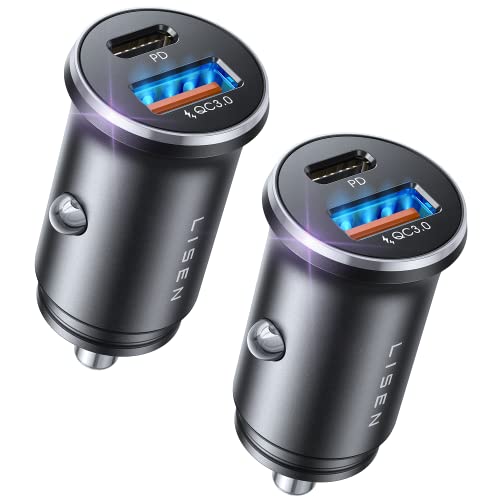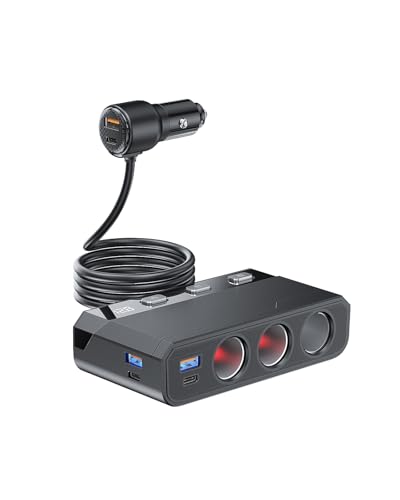
Cigarette Lighter Plug for Car: What It Powers
A cigarette lighter plug for car is best for low- to moderate-power 12V accessories, usually under about 10 amps or 120 watts, unless the vehicle’s fuse rating says less. Use it for chargers, dash cams, tire inflators, and small coolers. Skip high-draw devices. Choose wrong, and you can blow fuses, overheat wiring, or buy the wrong power source. This guide explains what it can run, when it is the right option, and when to use USB, hardwiring, or an inverter instead.
How the 12V socket works and why fit matters


Most modern cars no longer use that socket for lighting a cigarette. They usually provide a 12V power socket instead, and many dashboards label it that way. Older vehicles often had a true lighter with a heating coil, but the same round opening is now commonly used for accessory power.
The plug itself is the cylindrical accessory plug that inserts into the socket and draws 12-volt DC power. The socket’s bottom contact and side contacts complete the circuit. If the plug sits shallow, wobbles, or loses contact on bumps, the issue may be fit rather than the vehicle’s power supply.
From lighter element to 12V outlet
On older vehicles, the lighter element heated up after you pushed it in. On newer vehicles, the outlet is usually meant for chargers and accessories only. That shift matters because a plug that once heated a coil may now need to run a phone charger, a dash cam, or a portable air compressor instead.
How the plug and socket make contact
The plug’s tip touches the bottom contact, while the shell contacts the side wall of the socket. That design is simple, but it is sensitive to socket depth, spring tension, and debris. A loose plug can work for a while and then cut out when the vehicle hits a rough road.
Why fit varies across vehicles
Not every 12V socket is built the same. Some are deep and hold the plug firmly. Others are shallow, angled, or slightly oversized, which can let an accessory plug tilt and interrupt power. Different plugs also fit differently across vehicles, even when both sockets are labeled 12V.
What can you plug into a car socket?
You can run many common accessories from a 12V socket, but the safe choice depends on current draw, run time, and whether the device has a startup surge. Phone chargers and dash cams are easy loads. Tire inflators, portable coolers, vacuums, and inverters need more care.
Common low-draw accessories
Portable charger adapters for smartphones and tablets are the simplest use case. Many include multiple USB ports and convert 12V to the lower charging voltage your device needs. GPS units and dash cams also fit this category, especially when they draw power steadily rather than in bursts.
Devices with higher current demand
A portable air compressor can draw much more current than a basic charger, especially when it first starts. Portable coolers and car vacuums can also load the socket heavily for long periods. Those devices may be fine in one vehicle and a poor fit in another if the socket fuse or wiring is marginal.
When the socket is the wrong choice
If the accessory needs sustained high power, the lighter socket may be the wrong source. That is often true for larger inverters, big compressors, and some coolers. A dedicated inverter, hardwired feed, or a different power outlet may be a better match than forcing the 12V socket to carry the load.
Say your phone charger and dash cam both work fine from the front socket, but a plug-in vacuum trips the fuse after 20 seconds. That does not mean the socket is “bad.” It may simply mean the vacuum’s peak draw is too high for that circuit.
12V plug suitability matrix
This matrix is a quick way to match accessory type to the socket’s practical limits. The numbers are approximate current draws for typical consumer accessories, not exact values for every brand. Always compare them with the vehicle’s fuse rating and the device label.
| Accessory | Estimated current draw | Likely fit risk | Ignition-on requirement | Red-flag symptoms |
|---|---|---|---|---|
| Phone charger | 1A to 3A | Low, unless the plug is bulky or shallow | Sometimes, depending on the vehicle | Charge drops on bumps, adapter feels hot, socket power cuts in and out |
| Dash cam | 0.5A to 2A | Low to moderate, mainly plug retention | Often yes for parking protection or if the socket shuts off with key removal | Camera resets, time/date loss, intermittent recording |
| Tire inflator | 8A to 15A | Moderate to high | Usually yes | Fuse blows, plug gets very hot, motor slows, socket browns or smells hot |
| Portable cooler | 3A to 8A | Moderate | Often yes for long trips | Warm plug, intermittent cooling, socket shuts off with ignition |
| Vacuum | 8A to 12A | Moderate to high | Usually yes | Weak suction, fuse failure, plug slips under load |
| Inverter | Varies widely; often 5A to 20A+ on the 12V side | High | Usually yes | Overheat, buzz, shutdown under load, melted plug, repeated fuse blow |
How many amps can a car cigarette lighter socket handle?
There is no single answer for every vehicle. Many lighter circuits use a 10A fuse, some high-power accessory circuits use 15A, and some vehicles use 20A for multiple sockets. The fuse rating is the hard limit you should work around, not a number to “improve” with a bigger fuse.
A 10A fuse at 12V gives about 120 watts in ideal conditions. A 15A circuit is roughly 180 watts, and 20A is roughly 240 watts. Real-world capacity can be lower because the socket, plug, and wiring all add resistance and heat.
Fuse ratings and what they mean
The fuse protects the lighter circuit. If the accessory draws too much current or if a short develops, the fuse opens before the wiring cooks. Replace it with the same amperage rating only. A larger fuse can let damaged wiring overheat before it blows.
Some cars have more than one fuse for cigarette lighters, so a dead socket is not always fixed by checking only one box. That matters when front and rear outlets behave differently, or when one socket works and another does not.
Continuous draw versus startup surge
Many accessories draw more current at startup than they do once running. Tire inflators and vacuums are common examples. A socket may survive a brief surge but fail if the load stays high for minutes. That is why a device can seem compatible and still blow a fuse later.
Why higher amperage is a warning sign
If a device label calls for more current than the socket’s fuse, treat that as a stop sign. If the label is close to the fuse rating, leave margin for startup surge and heat. A plug that runs hot, smells hot, or discolors is already telling you the circuit is stressed.
Why is my car cigarette lighter plug not working?
The most common reason is a blown fuse. After that, the usual suspects are debris in the socket, corrosion on the contacts, a damaged accessory plug, or wiring behind the outlet. Some sockets only work with the ignition in accessory or on position, so the circuit may be fine.
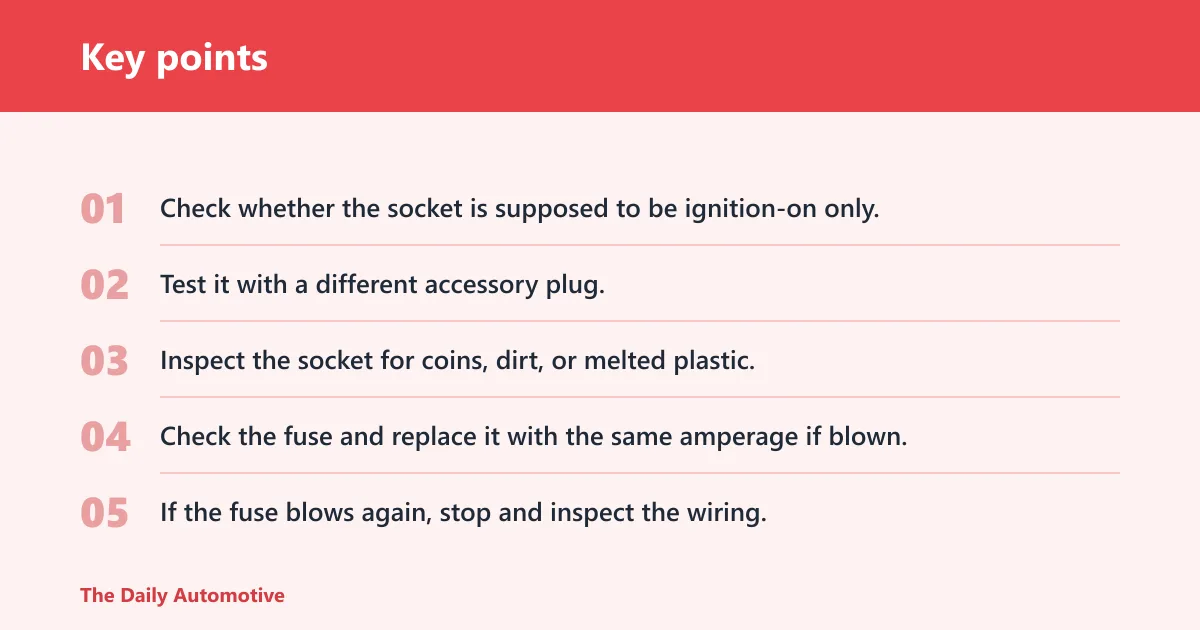
Dead socket checks
Start with the simplest checks. Verify whether the outlet is live only with the key in accessory or on. Then test the socket with another device that you know works. If the second device also fails, the fault is more likely in the outlet, fuse, or wiring.
- Check whether the socket is supposed to be ignition-on only.
- Test it with a different accessory plug.
- Inspect the socket for coins, dirt, or melted plastic.
- Check the fuse and replace it with the same amperage if blown.
- If the fuse blows again, stop and inspect the wiring.
Fuse, debris, and corrosion
A blown fuse is the most common issue when the socket stops working. Debris can block the bottom contact, and corrosion can interrupt the side contact. A small amount of grit is enough to keep the plug from making a solid connection.
Plug faults versus wiring faults
The accessory plug can be the fault instead of the socket. A bent center tip, worn side spring, or poor internal connection can make one plug fail while another works. If a known-good accessory still fails, then the problem may be behind the outlet, where loose wiring or scorch marks point to a larger issue.
Suppose a dash cam works in the rear outlet but not the front one, and the front socket has a faint brown ring inside. That pattern points away from the camera and toward heat damage or contact wear in that specific socket.
When should you choose a different power source?
Choose a different source when the accessory does not match the socket’s current limit, fit, or ignition behavior. USB-C is better for most phone charging. Hardwired power is better for a dash cam that needs stable operation. A dedicated inverter is better for higher AC loads.
USB-C for phone charging
For phones and tablets, a USB-C charger is usually the cleaner option. It avoids a bulky 12V plug, reduces socket wear, and usually provides more predictable charging behavior. If all you need is device charging, the lighter socket is often the longer route.
Hardwired power for dash cams
Dash cams that need parking mode or constant recording are often better on a hardwired kit with proper fuse tapping. That keeps the camera powered without depending on a socket that may shut off with the ignition or get used by another accessory.
Dedicated inverter for higher loads
If you need household-style AC power, use a dedicated inverter sized for the load and the vehicle’s circuit. Do not assume a 12V socket can feed a large inverter safely. The inverter itself may be acceptable, but the socket wiring and fuse still have to carry the input current.
Safety checks before you buy an adapter
Check the adapter’s build quality, heat handling, and fuse protection before you buy it. A cheap adapter can fit the socket yet still run hot, disconnect on bumps, or fail internally. If the plug has no visible fuse or the housing feels flimsy, that is a warning.
Heat, inline fusing, and build quality
Look for an adapter with inline fusing and a solid spring contact. Heat buildup usually means poor contact, too much load, or both. If the plug shell gets hot enough to be uncomfortable, stop using it and inspect the socket and accessory together.
Ignition-on behavior and battery drain
Some 12V sockets stay live all the time. Others shut off with the key. That matters for coolers, dash cams, and chargers left plugged in overnight. An always-live socket can drain the battery if the accessory keeps drawing power after shutdown.
When to stop and get help
Get professional help if the fuse keeps blowing, the socket has burn marks, the plug or outlet is melted, or wiring fault signs appear behind the outlet. Replacement sockets may cost $10–$30, and a fuse replacement is usually less than $2, but repeated failure points to a larger electrical problem.
Some socket repairs are simple. Others are not. If the outlet housing is scorched or the wiring behind it is loose, replacement often requires disconnecting the battery and inspecting the circuit properly. Do not keep forcing power into a damaged outlet.
Frequently asked questions
What is a cigarette lighter plug in a car used for?
It powers 12V accessories such as phone chargers, dash cams, tire inflators, portable coolers, vacuums, and inverters. In older vehicles it also powered a heating element for lighting cigarettes, but that function is less common now.
How does a car cigarette lighter plug work?
The plug’s tip connects to the socket’s bottom contact, and its outer shell connects to the side contacts. That completes the 12-volt DC circuit. Fit matters, because shallow sockets, loose retention, debris, or corrosion can interrupt the connection even when the outlet itself is live.
Can a car cigarette lighter plug charge a phone?
Yes. A portable charger adapter can convert 12V to the voltage a phone needs, often through USB-A or USB-C ports. This is one of the most common uses of the socket. If the adapter runs hot or charges intermittently, test another adapter before assuming the socket is bad.
What is the difference between a cigarette lighter and a 12V power outlet?
A true cigarette lighter has a heating coil and was common in older vehicles. A 12V power outlet is usually just an accessory socket, often labeled that way. The opening may look the same, but the vehicle may no longer include a heating element or support lighter use at all.
Products related to this article
Sponsored / affiliate links. As an Amazon Associate I earn from qualifying purchases. I may earn additional commission from eligible campaigns.