Best Emergency Tire Inflation Kits for Quick Repairs
For a quick seal-and-go emergency, choose a sealant-and-inflator kit; for a tougher roadside repair, choose a plug kit; if you want both, buy a combo kit. A poor match can leave you waiting for a tow. This guide compares emergency tire inflation kits by repair scenario, with clear use cases and tradeoffs.
Top emergency tire repair kit options


The best overall pick for quick puncture repairs is a sealant-and-inflator kit, because it puts air back into the tire fast and seals many small tread punctures long enough to get you to safety. For tread-only damage where cleanup matters less, a plug kit is the stronger roadside choice. If you want one trunk kit that covers more situations, choose a combo package.
Quick picks
- Fastest roadside inflation and sealant kit: Slime 50122. It connects directly to a 12 V car charging socket, includes a 14oz sealant, and is described as repairing and inflating a tire in about 10 minutes.
- Most durable plug kit for tubeless tires: AUTOWN 68-piece tire repair kit. It uses high-quality steel tools and fits the standard tubeless plug approach for tread punctures.
- Combo kit for trunk storage: A kit that pairs a portable air compressor with plug tools and a pressure gauge, especially if you want one package to cover both sealing and plugging needs.
Best for the fastest seal-and-go fix
Slime 50122 is the clearest choice when speed matters most and the puncture is small. It is TPMS safe and non-corrosive, it repairs punctures up to 1/4 inch, and it is sold as an emergency-use-only kit with a 3-day or 100-mile limit. That makes it a temporary roadside fix, not a permanent repair.
Use it for small tread punctures on tubeless tires when you want the least roadside work possible. The tradeoff is cleanup. Sealant can leave a mess in the tire and around the valve stem, and a clogged valve core can complicate later inflation or pressure checks.
Best for a tread plug repair
AUTOWN 68-piece tire repair kit suits drivers who want a cleaner temporary roadside repair for tubeless tread punctures. It uses insertion and probe tools with self-vulcanizing repair plugs, a common setup for punctures that can be plugged from the outside without removing the wheel.
This route takes longer than sealant because you have to find the puncture, ream the hole, insert the plug, and then inflate and check pressure. It also keeps the tire cleaner than sealant-based kits. It is not for shoulder damage, sidewall cuts, or tube tires.
Best combo kit for trunk storage
A combo kit makes sense if you want one package that can handle both inflation and puncture repair. Look for a portable air compressor, plug tools, a pressure gauge, and a storage case, so the kit stays organized in the trunk or trunk-side compartment.
This is the most flexible option for drivers who share a vehicle or travel far from service. It is also the easiest way to cover more than one scenario without carrying separate products. The downside is bulk, plus more cleanup if the kit includes sealant.
Which kit works for tread punctures?
For small tread punctures, sealant-based kits are the fastest stopgap, while self-vulcanizing plug kits are the better call when you want a cleaner temporary roadside fix. Neither option belongs on sidewall damage or shoulder cuts. Those failures need a tow or a spare, not a roadside patch.
When a sealant-based kit makes sense
A sealant-and-inflator kit is best when the tire loses pressure quickly and you need to get moving with minimal roadside exposure. The sealant enters through the valve stem, plugs a small tread puncture, and lets the compressor bring the tire back up. That works best for small holes, not torn rubber.
Say your compact sedan picks up a nail in the tread during a work commute. If the cut is small and the tire is tubeless, a sealant kit can get you to a shop or home without changing the wheel on the shoulder of the road.
When a self-vulcanizing plug is the better call
A plug kit is the stronger choice when you want a cleaner roadside repair and the puncture is in the tread area only. Self-vulcanizing repair plugs are made to seal the hole mechanically, which is why they usually outlast sealant as a temporary fix.
A plug kit also avoids coating the inside of the tire with sealant, which matters if you later want a cleaner shop repair. It still needs a pressure gauge and a compressor or inflator to finish the job correctly.
Why shoulder damage is a stop sign
Shoulder punctures and sidewall damage are not repairable with these kits. The sidewall flexes too much, and the shoulder sits in a high-stress zone. Even a strong plug or sealant can fail there, which is why the safe answer is stop driving and arrange towing or a spare.
Which kit suits SUVs and trucks?
SUVs, trucks, and vans often need more from an inflator than a passenger car does. A compressor with a high max PSI is useful, but airflow matters just as much because larger tires take more volume to refill. For bigger vehicles, a weak compressor can be the bottleneck even if the PSI number looks impressive.
Why airflow matters as much as PSI
Max PSI tells you the ceiling, not the speed. A tire inflator that can reach the number on the sidewall still may struggle if it moves air slowly. That matters on larger tires, where you need practical fill speed more than a high headline number.
The FRIWOLE tire repair kit includes a cordless inflator rated up to 150 PSI, which is the sort of figure buyers look for in a larger-vehicle kit. For smaller cars, that may be more than enough.
What larger tires need from a compressor
For family SUVs and work trucks, look for a compressor that can run long enough to bring the tire from low pressure to drivable pressure without overheating. A pressure gauge is important here because underinflation can stay hidden after the tire appears filled. Overinflation is just as risky.
Slime 50138 Smart Spair Plus is positioned for larger vehicles like trucks, SUVs, and vans.
When a compact kit is enough
For a city crossover, compact SUV, or light van use, a smaller kit can still be enough if it includes a compressor, sealant or plugs, and a readable gauge. The deciding factor is not the badge on the tailgate. It is tire size, load, and how far the compressor has to work to restore usable pressure.
Picture a three-row SUV with a slow tread puncture in cold weather. A compact kit can still help, but the driver should expect a slower fill and should verify pressure before driving farther. In cold conditions, stiff rubber and lower starting pressure make the job slower.
Which kit gives the widest fallback?
A combo kit gives the broadest fallback because it covers two repair paths: sealant for the fastest temporary seal, and plug tools for a more durable roadside patch. That flexibility matters if you want one kit for family trips, commuting, or mixed vehicle use.
What a combo kit adds
The useful pieces are simple: a 12V tire inflator or portable air compressor, plug insertion tools, self-vulcanizing repair plugs, and a pressure gauge. A carrying case is also worth having because it keeps the pieces from rolling around the trunk or getting buried under cargo.
The best kits also include clear instructions. That matters more than it sounds, because roadside repairs happen under time pressure and poor light. A pressure gauge, whether analog or digital, helps you stop at the right inflation level after sealing or plugging the tire.
Tradeoffs in weight, storage, and cleanup
Combo kits weigh more and take more room than a single-method kit. They also create more cleanup if sealant is included. That is the tradeoff for flexibility. If your storage space is tight, a plug kit plus a compact compressor may be the cleaner choice.
One common first-timer mistake is buying a sealant-only kit for a vehicle that sees long highway trips. That can be enough for a small puncture, but it leaves no backup if the puncture needs a plug instead of a sealant fill.
When two repair methods beat one
Choose both methods if you drive long distances, carry family passengers, or depend on the vehicle for work. A sealant-and-inflator kit can buy time fast. A plug kit can give you a tidier roadside fix when the puncture is in the tread and accessible from the outside.
That is the strongest argument for a combo kit: one method for speed, one for control. It is still temporary, but it can reduce the chance that a minor puncture turns into a tow.
Tire repair kit decision table
Use this table to match the kit to the repair you actually face. It separates quick sealant fixes from plug repairs and shows where each one starts to fail.
| Puncture type | Tire type | Vehicle type | Repair speed | Cleanup level | Temporary or longer roadside solution |
|---|---|---|---|---|---|
| Small tread puncture, under 1/4 inch | Tubeless | Compact car, sedan, small crossover | Fastest; sealant-and-inflator kits are the quickest | Messy | Temporary stopgap |
| Small tread puncture that can be reamed and plugged | Tubeless | Any passenger vehicle | Slower than sealant; plug repair takes more steps | Lower cleanup | Longer roadside solution |
| Shoulder puncture | Tubeless | Any vehicle | Not suitable | Not applicable | Neither kit is appropriate |
| Sidewall damage | Tubeless or tube tire | Any vehicle | Not suitable | Not applicable | Neither kit is appropriate |
| Roadside pressure loss with no visible puncture | Tubeless | SUV, truck, van | Fast if sealant is used and the leak is minor | Moderate to messy | Temporary stopgap |
How do you choose the right roadside kit?
Choose by puncture scenario first, then by storage space, climate, and the kind of vehicle you drive. If you want the quickest fix for a small tread puncture, choose sealant plus inflation. If you want less mess and a cleaner roadside patch, choose a plug kit. If you want both, buy a combo kit.
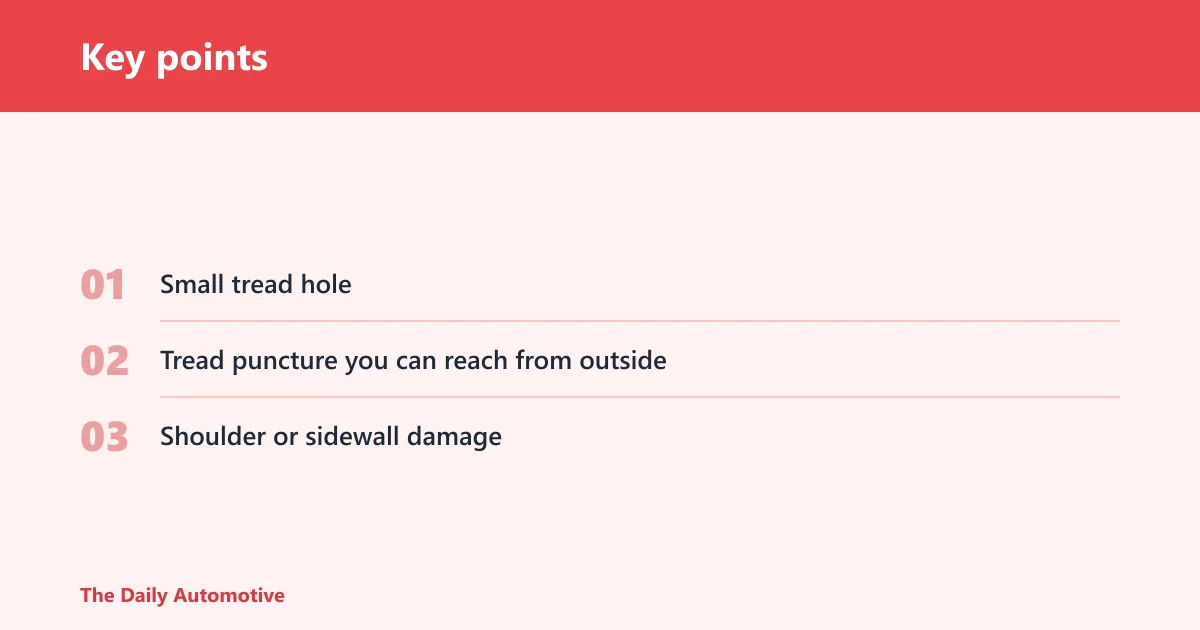
Choose by puncture scenario
- Small tread hole: A sealant-and-inflator kit is the fastest way to get moving.
- Tread puncture you can reach from outside: A tubeless plug kit is the better roadside choice.
- Shoulder or sidewall damage: Stop. These kits are not the fix.
Do not buy by vehicle category alone. A pickup with a small puncture still needs a tread-safe repair. A sedan with limited cargo room still needs a kit that fits in the trunk and can be used in minutes.
Choose by storage space and climate
If trunk space is tight, a compact inflator-plus-sealant kit is easier to store than a full combo package. If you live where temperatures swing hard, cold weather can slow inflation and make sealant flow less predictably. That is another reason to keep a pressure gauge in the kit.
Portable air compressors are often rated up to 150 PSI, but the practical issue is whether the unit can keep moving enough air for your tire size. For larger SUVs and trucks, that matters more than a big PSI label.
Choose by compressor, sealant, and gauge features
A 12V tire inflator plugs into the vehicle’s charging socket and runs from the car’s electrical system, which is why it remains the simplest roadside power source. A portable air compressor may be cordless or 12V-powered. Either way, look for a pressure gauge and a case that keeps the tools together.
When sealant is included, look for TPMS-safe sealant if the product makes that claim. That is the safer marketing term to watch for, because TPMS sensors can be a concern when sealant is introduced through the valve stem. If the product does not say it is TPMS safe, do not assume it is.
Frequently asked questions
What is the best emergency tire inflation kit for quick puncture repairs?
For the fastest fix, choose a sealant-and-inflator kit. Slime 50122 is a strong example because it connects directly to a 12 V car charging socket, includes a 14oz sealant, and is described as repairing and inflating a tire in about 10 minutes. It is a temporary emergency solution.
Are emergency tire inflator kits safe for TPMS sensors?
They can be, but only when the sealant is specifically labeled TPMS safe. Slime 50122 is described that way and is also non-corrosive. If a kit does not make that claim, do not assume sensor safety. A pressure gauge still matters after inflation because TPMS is not a substitute for checking pressure.
Can a tire inflation kit repair a puncture without removing the wheel?
Yes, many sealant and plug kits work without removing the wheel. Sealant goes through the valve stem, and a tubeless plug kit works from the outside on a tread puncture. Neither option is suitable for sidewall damage, shoulder cuts, or tube tires, which need a different repair path.
How long does an emergency tire inflation kit take to work?
Sealant-and-inflator kits are the quickest. Slime 50122 repairs and inflates a tire in about 10 minutes. Plug kits take longer because they need more manual steps.
What size punctures can a sealant-based tire inflation kit fix?
Use sealant kits for small punctures, not large tears. Slime 50122 is described as repairing punctures up to 1/4 inch. That still leaves shoulder damage, sidewall cuts, and larger punctures outside the safe range. If the hole is too large, a tow or spare is the better call.
Do I need a compressor, sealant, or plug kit for roadside tire repair?
If you want the fastest temporary fix, choose sealant plus a compressor. If you want a cleaner roadside patch for a tubeless tread puncture, choose a plug kit. If you want both options in one package, choose a combo kit with a compressor, plugs, and a pressure gauge.
Products related to this article
Sponsored / affiliate links. As an Amazon Associate I earn from qualifying purchases. I may earn additional commission from eligible campaigns.