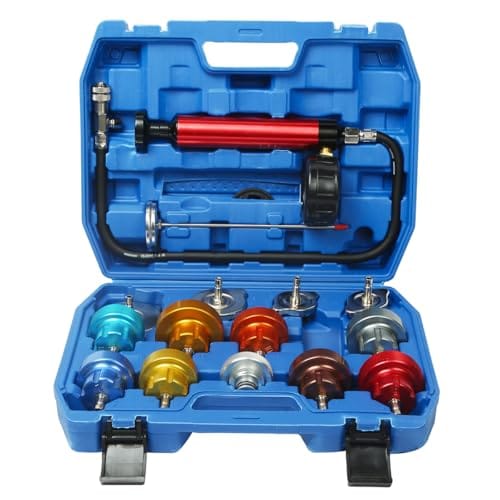
Radiator Pressure Tester Kit: How to Find Leaks and Refill Coolant Without Air Pockets
Coolant puddles under the car are annoying. Worse is the mystery: you top off the reservoir, drive for a week, and it’s low again. The engine never overheats on the highway, but it creeps up in traffic. You suspect a leak, but where? Hoses look fine. The water pump isn’t weeping. The radiator doesn’t show damage.
A radiator pressure tester kit answers that question in about fifteen minutes. It pressurizes the cooling system to a set PSI and holds it there. If pressure drops, you’ve got a leak. The kit also helps you find exactly where, whether it’s a pinhole in the heater core or a bad radiator cap. And the better kits double as vacuum refill tools, which solve a second problem: air pockets after a coolant change.

Orion Motor Tech
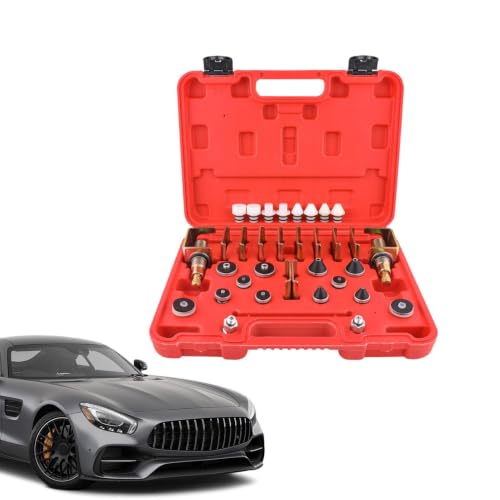
OMT Coolant Pressure Tester Kit, 33pc Master…
- Comprehensive Tool Set: Orion Motor Tech's 33 pcs coolant pressure tester kit includes 22 adapters, a universal adapter, a vacuum…
- Versatile Application: This cooling system pressure tester kit identifies leaks from the header and expansion tanks, head gasket,…
- 23 Adapters for Most Cars: With 23 different radiator adapters, this coolant pressure tester kit is compatible with numerous vehic…
This guide covers what these kits do, how to use them correctly, what to look for when buying one, and answers to the questions people actually ask. You’ll know exactly which kit fits your garage and your cars.
Orion Motor Tech’s 33-piece kit (ASIN B0D3F6M7RC) bundles both functions in one case. It includes 23 adapters to cover most European and Asian makes, a vacuum pump for air-free refills, and a probe thermometer. That combination handles the two most common cooling system jobs without buying separate tools. We’ll get into why that matters below.
What a Radiator Pressure Tester Actually Does
Your cooling system runs at roughly 12 to 16 PSI when the engine is hot. The radiator cap sets that limit. When the system is cold, it sits at zero pressure. A pressure tester replaces the cap and pumps the system up to a controlled pressure, usually 15 PSI for most cars. Then you watch the gauge.
If the needle holds steady for ten minutes, the system is sealed. If it drops, something is leaking. The beauty of this method is that you don’t need the engine running. You can test a cold engine safely, which beats hunting for steam while the car heats up.
The second function matters just as much. After you drain coolant and replace a hose or thermostat, air gets trapped in the block and heater core. That air pocket causes hot spots and erratic temperature readings. A vacuum refill kit pulls a vacuum on the system, then lets coolant flow in to fill every cavity. No burping, no tilting the car, no waiting for the thermostat to open.
Most cheap kits only pressurize. The better ones, like the Orion Motor Tech kit mentioned above, do both. If you plan to do your own cooling system work, the dual-function kit pays for itself the first time you avoid a second trip to the parts store for another gallon of coolant.
How to Pressure Test a Cooling System Properly
Start with a cold engine. Removing a pressurized cap on a hot engine is a trip to the burn unit. Pop the hood and find the radiator cap or the expansion tank cap. Some modern cars only have the expansion tank, and that’s where you test.
Pick the adapter that matches the cap opening. Most kits include a dozen or more, and the color-coding on the Orion Motor Tech set makes this step quick. The adapter screws into the cap neck, then the tester hose connects to it. Pump the handle until the gauge reads the pressure printed on your radiator cap, usually 15 PSI. Watch the needle.
If it holds, your system is sealed. If it drops, start looking. Spray soapy water on hose connections, the radiator seams, the water pump weep hole, and the thermostat housing. Bubbles reveal the leak. For internal leaks, like a head gasket, look for coolant in the oil or white smoke from the exhaust.
One tip: test the cap itself. A bad cap that won’t hold pressure causes overheating and coolant loss even with no visible leak. Most testers have a separate cap adapter. Screw the cap onto it, pump to its rated pressure, and see if it holds. Caps are cheap, so replace it if it fails.
Don’t over-pressurize. The system is designed for a specific range, usually 12 to 16 PSI. Pumping to 25 PSI can burst a weak hose or crack a plastic radiator tank. The gauge on a quality kit has a clear scale, so you won’t accidentally overshoot.
Vacuum Refill: The Part Most People Skip
Pressure testing finds leaks. Vacuum refilling prevents the next problem. After you fix the leak and drain the old coolant, air occupies the block, heater core, and radiator. If you just pour coolant into the filler neck, air pockets stay trapped. The engine runs hot, the heater blows cold, and you scratch your head.
The vacuum method works like this: attach the refill tool to the radiator neck, connect an air compressor to the venturi valve, and pull about 20 inches of mercury of vacuum. The system holds that vacuum briefly. Then you place the pickup tube into a jug of coolant and open the valve. Atmospheric pressure pushes coolant into every passage, displacing the air completely.
This takes about two minutes. The alternative is burping: running the engine with the cap off, squeezing hoses, waiting for the thermostat to open, and hoping the air finds its way out. Sometimes it does. Sometimes you repeat the process three times over a week.
The Orion Motor Tech kit includes the vacuum pump and the refill tool in the same case. You don’t need a separate coolant vacuum filler. That’s a meaningful difference from the basic pressure-only kits that sell for less but leave you short when the job moves from diagnosis to repair.
One caveat: the vacuum refill method needs an air compressor with a regulator. The venturi valve uses compressed air to create the vacuum. If you only have a manual pump, you can still pressure test, but the refill function won’t work without shop air.
Comparing Kit Types: What You’re Actually Buying
Not all radiator pressure tester kits are equal. The differences come down to adapter coverage, build quality, and whether the kit includes vacuum refill capability. Here’s a realistic comparison of what you’ll find.
| Feature | Basic Pressure Tester | Mid-Range with Adapters | Full Kit with Vacuum Refill |
|---|---|---|---|
| Pressure testing | Yes | Yes | Yes |
| Adapter count | 4 to 8 | 10 to 15 | 20 or more |
| Radiator cap testing | Sometimes | Yes | Yes |
| Vacuum refill function | No | No | Yes |
| Vehicle coverage | Domestic only | Domestic plus common imports | Broad European, Asian, domestic |
| Case quality | Basic pouch | Molded insert | Custom molded, color-coded |
| Typical use | One car, one leak | Home mechanic, 2-3 cars | Serious DIY or small shop |
The adapter count matters more than you’d think. A kit with 23 adapters covers BMW, Ford, VW, Mercedes, Nissan, and others. A basic kit with five adapters might not fit your neighbor’s Audi. The molded size markings on the Orion Motor Tech set mean you grab the right adapter the first time, not after trying four that don’t fit.
Build quality shows in the pump and gauge. Aluminum and brass fittings last. Plastic pump bodies crack after a season of use. The hose needs to flex without kinking, and the gauge should read accurately at low pressure, where small leaks are visible.
Price follows capability. A basic pressure-only kit costs less, but you’ll likely buy a separate vacuum filler later. The full kits cost more upfront and bundle both. For anyone who works on more than one vehicle, the full kit is the better value.
Common Questions About Radiator Pressure Tester Kits
Can a radiator pressure tester damage my cooling system?
Only if you over-pressurize it. Match the tester pressure to what’s printed on your radiator cap. Most systems run 12 to 16 PSI. Pumping to 30 PSI can burst old hoses or crack plastic tanks. A quality kit has a gauge with a clear scale, so you can stop at the right number. If you have a known weak spot, like a corroded radiator, start with a lower pressure and watch for leaks before going higher.
How do I know which adapter to use?
Look at the shape and diameter of your radiator cap or expansion tank opening. The adapter should fit snugly and thread on smoothly. Most kits label adapters with size markings or color codes. The Orion Motor Tech kit uses both, so you can match by color or number. If an adapter feels loose, it’s the wrong one. A poor seal gives a false pressure drop and sends you hunting for a leak that isn’t there.
Can I use a pressure tester on a warm engine?
No. Let the engine cool completely first. The system holds pressure when hot, and removing the cap releases boiling coolant. A pressure test on a warm engine is dangerous and gives unreliable results because the coolant expands as it heats. Test cold, and you’ll get a clean reading.
What pressure should I pump to?
Check the number printed on your radiator cap. That’s the system’s designed relief pressure, usually between 12 and 16 PSI. Pump the tester to that exact number. If the cap says 15 PSI, test at 15. Testing lower won’t reveal marginal leaks. Testing higher risks damage.
Is a vacuum refill kit worth the extra money?
If you change coolant or replace cooling components more than once a year, yes. Air pockets cause overheating and poor heater performance. The vacuum method eliminates them in one shot. If you only do an occasional flush on a single car, you can manage with the burp method, but you’ll spend more time and may still have issues. The convenience and reliability justify the cost for most home mechanics.
What to Do With This Information
- Test your cooling system cold, never hot, and always match the pressure to the cap rating.
- Use soapy water to pinpoint external leaks after a pressure drop; check the cap separately before replacing parts.
- Buy a kit with at least 20 adapters if you own multiple makes or plan to help friends and family.
- Choose a dual-function kit with vacuum refill so you can fix leaks and refill coolant correctly with one tool.
- Look for aluminum and brass construction, a clear gauge, and molded case organization for daily use.
- Keep a spare radiator cap on hand; it’s a common failure point that’s cheap to replace.
- Check the current price on Amazon for the Orion Motor Tech kit if the features match your needs.
Cooling system problems don’t have to be guesswork. A pressure tester turns a vague suspicion into a specific diagnosis. Add vacuum refill, and you close the loop on the whole job. That’s the difference between fixing a car and just hoping it’s fixed.
If you’re also tracking tire health while you’re under the hood, a reliable tire pressure gauge belongs in the same toolbox. And if you’re planning a full cooling system overhaul, check the oil pressure explanation to understand the other fluid system that keeps your engine alive. For pressurized cleaning jobs around the shop, a foam cannon guide covers a different kind of pressure, but the same principle of matching tool to task.
Products related to this article
Sponsored / affiliate links. As an Amazon Associate I earn from qualifying purchases. I may earn additional commission from eligible campaigns.