Best Rust Inhibitors for Cars (2026): We Compared
The best rust inhibitor for cars depends on the zone: use a waxy cavity spray for seams and hidden panels, oil film for undercarriages in harsh winter exposure, and dielectric-safe protection for battery terminals and connectors. Ignore that match, and rust creeps into seams, fasteners seize, and electrical connections corrode. This guide compares the best-fit options by car zone, exposure level, and application method, so you can buy the right product the first time.
Quick comparison
| Product | Badge | Best for | Price | ||
|---|---|---|---|---|---|
 |
RustKote Rust Fighter Aerosol | Corrosion Protection, SaltRust Kote Corrosion Protection | Our pick | 15 oz · Aerosol · Pack of 1 | $18.00
Price as of 25 Oct 2026
|
View |
 |
WD 40 300554 Specialist Electrical Contact Aerosol CleanerWD-40 | Pair with it | 11 oz · 6 Pack · Electrical Cleaner | $76.39
Price as of 25 Oct 2026
|
View |
The core trade-off is simple: exposed metal needs wash-off resistance, enclosed spaces need creep, and electrical parts need precise, component-safe application. A product that works well in one zone can be a poor fit in another.
For this guide, base the comparison on published product details and buyer feedback, not hands-on testing. That matters because rust protection fails most often when the format does not match the surface.
How we chose
We compared these picks by zone fit first, then by application control, resistance to wash-off, likely reapplication burden, and compatibility with paint, rubber, and electrical parts. That order matters more than marketing language.
We also favored products with a clear use case. A converter belongs on rust that already exists. A maintenance inhibitor belongs on clean or lightly oxidized metal that needs ongoing protection.
Finally, we looked at practical value. Price matters, but so does how far a can or bottle reaches, how much overspray it creates, and how often you will need to reapply it in salt country or during storage. A larger can that wastes less product can beat a cheaper one that misses half the seam.
Rust Kote Rust Fighter Aerosol: best for seams and underbody touch-ups
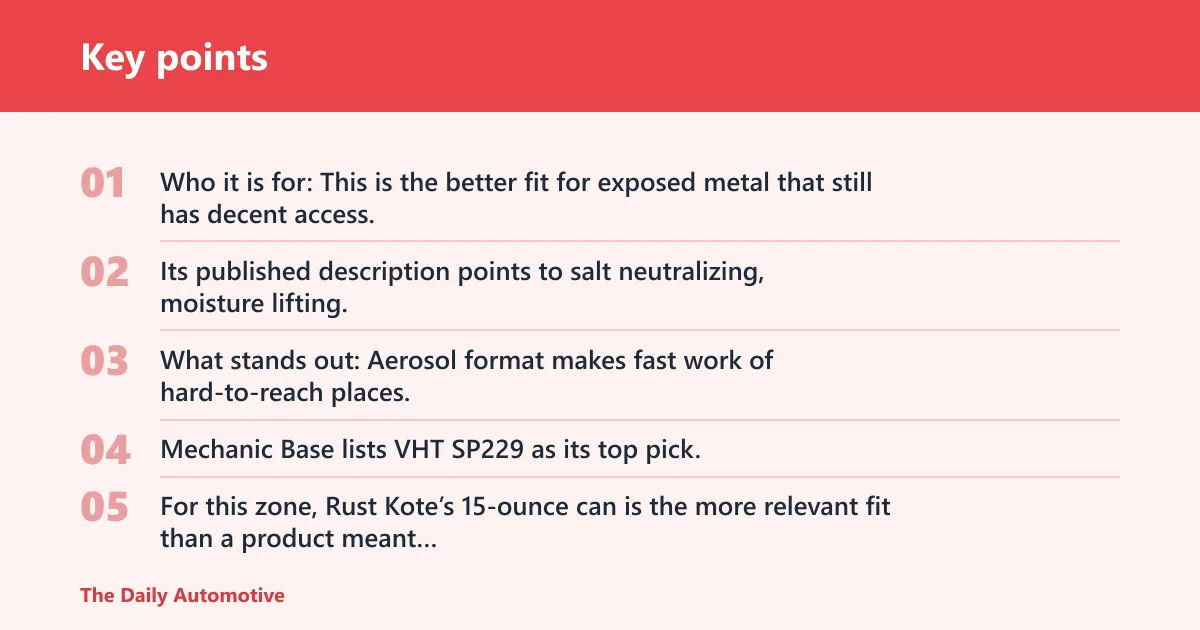
Who it is for: This is the better fit for exposed metal that still has decent access, especially seams, brackets, wheel-well edges, and underbody areas where you want a spray that creeps and coats. Its published description points to salt neutralizing, moisture lifting, and seam penetration, which is the right profile for winter-driven corrosion control.
What stands out: Aerosol format makes fast work of hard-to-reach places, and the stated ability to creep into seams is useful on rockers, pinch welds, and bracket edges. Mechanic Base lists VHT SP229 as its top pick, and Car Care Guy lists Rust-Oleum Rust Reformer as a black aerosol, which shows how often aerosol format is the practical default for touch-up work. For this zone, Rust Kote’s 15-ounce can is the more relevant fit than a product meant for electrical contacts.
Honest drawback: Aerosols bring overspray risk. They are also a weaker match for precision electrical work and are not the right answer for enclosed storage, where VCI packaging does a different job. On heavily caked underbodies, loose rust and road grime still need removal first.
Use it when the zone is exposed
Choose this style for undercarriage spray, seam creep, and seasonal touch-ups on metal that sees road spray. A salt belt truck or daily driver will benefit more from a creeping inhibitor than from a rigid coating in the wrong place.
Say your rocker seam traps brine after a slushy commute. A spray that creeps into the seam and leaves a coating is the right move. A hard coating applied over dirt, by contrast, can bridge over contamination and leave moisture trapped underneath.
Where it falls short
It is not the best fit for battery terminals, connector pins, or other electrical zones. It is also not the right product for stored parts in a box or bag; that job belongs to VCI packaging or a dedicated storage inhibitor. If the target is painted exterior metal, use only a product labeled for that surface and prep the panel carefully.
WD-40 Specialist Electrical Contact Cleaner Spray: best for battery terminals and connectors
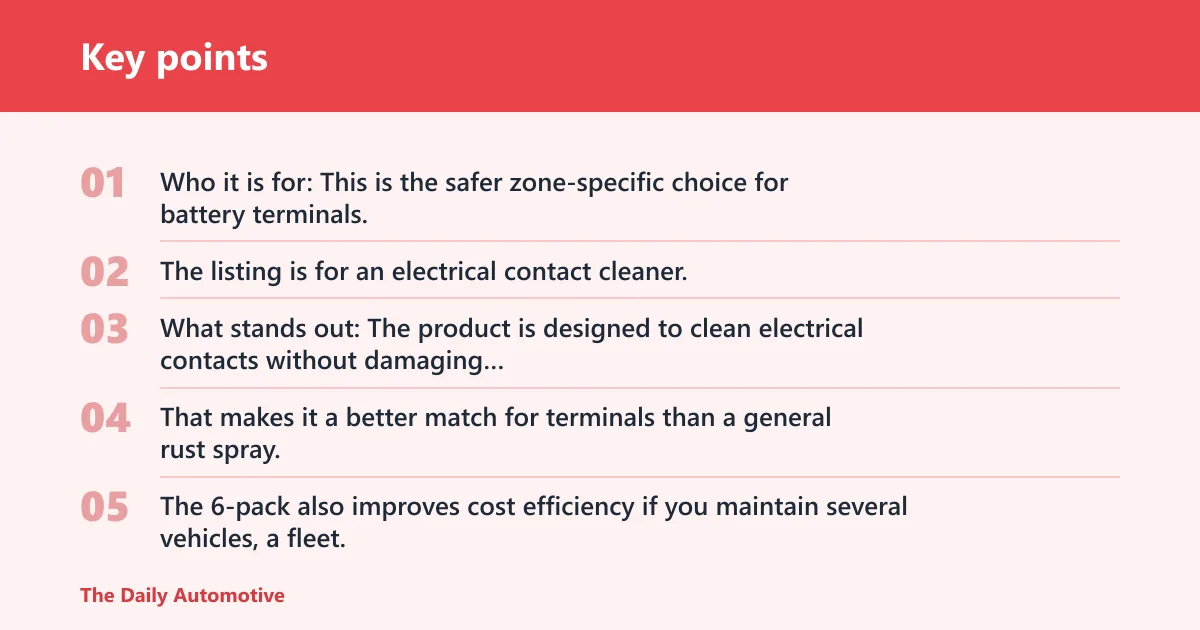
Who it is for: This is the safer zone-specific choice for battery terminals, connector housings, and other electrical parts where control matters more than broad coverage. The listing is for an electrical contact cleaner, and that narrower purpose is exactly why it belongs in an electrical-corrosion discussion rather than a generic underbody guide.
What stands out: The product is designed to clean electrical contacts without damaging components and to remove moisture and corrosion from wiring. That makes it a better match for terminals than a general rust spray. The 6-pack also improves cost efficiency if you maintain several vehicles, a fleet, or multiple battery-equipped tools.
Honest drawback: This is not a rust inhibitor for undercarriage panels, seams, or exterior body metal. It cleans and displaces moisture, but it does not replace a corrosion barrier where road salt, brine, and wash-off are the main problem. For battery terminals, use only component-specific or dielectric-safe protection after cleaning, and avoid coating nearby parts that should remain dry and clean.
Use it when the problem is electrical corrosion
Battery terminals need precise application because electrical zones are unforgiving. Overspray can drift onto painted surfaces, rubber boots, or exposed connectors that should not be heavily coated. A trigger-based application approach is usually easier to control than a wide aerosol blast.
A common first-timer mistake is treating a chalky battery terminal like an underbody seam. That often leaves residue in the wrong places and misses the contact surface that actually needs attention. Clean first, protect second, and keep the layer appropriate for electronics.
Which rust inhibitor for which car zone?
This decision matrix is the fastest way to avoid buying the wrong format. Match the zone first, then choose the tool and reapplication cadence that fit your climate.
| Zone | Exposure | Recommended inhibitor type | Application tool | Reapplication trigger | Common failure mode |
|---|---|---|---|---|---|
| Undercarriage | High-spray corrosion zone; road salt, brine, water blast | Soft self-healing oil or gel for creep; hard wax / cosmoline-style film where wash-off resistance matters more | Aerosol spray or wand-style spray | After winter season, or sooner after repeated underbody washes and salt exposure | Wash-off, thin coverage, dirt trapping if applied over grime |
| Seams / cavities | Hidden metal with capillary rust spread | Soft self-healing oil or cavity wax | Aerosol with straw or cavity wand | Yearly in salt country; every 18-24 months in mild climates | Missed seam edges, overspray, drying out if too light |
| Battery terminals | Electrical corrosion zone; moisture, mixed metals, acid residue | Dielectric film or component-specific electrical protection | Trigger spray or controlled applicator | At cleaning intervals, or after battery service and corrosion cleanup | Overcoating contacts, contamination, incompatibility with adjacent plastics |
| Stored parts | Enclosed or boxed parts, tools, spare hardware | VCI format or storage-specific inhibitor | VCI bag, box liner, or enclosed packaging | When packaging is opened, damaged, or the storage period exceeds the stated protection window | Using a surface spray instead of enclosed-space protection |
| Painted exterior metal | Visible body panels, chips, small rust spots | Maintenance inhibitor on clean metal; rust converter only if rust is already present | Trigger spray for control; brush for converter on rust spots | After washes, seasonal salt, or when film no longer beads water | Staining, incompatible finish, hiding rust instead of treating it |
What is the difference between a rust converter and a rust inhibitor?

A rust converter treats existing rust, often leaving a paintable surface. A rust inhibitor is a maintenance product that slows new corrosion on metal. They are not interchangeable, and using the wrong one can leave active rust under a coating or skip needed protection after cleanup.
If the panel has flaky rust, start with rust removal and a converter if the product is designed for that job. Then use an inhibitor as the final protective layer where the metal stays exposed. That sequence matters most on older vehicles, where cosmetic cleanup and long-term corrosion control are not the same task.
Rust converters are useful when the problem is already visible. Inhibitors are the better choice once you want to keep clean metal from rusting, especially on seams, undercarriages, and stored hardware.
How often should you reapply rust inhibitor?
Reapplication depends on road salt, wash frequency, and how sheltered the metal is. Salt belt vehicles usually need more frequent attention than garage-kept cars, and underbody products wear faster than enclosed-space protectants.
Salt belt driving
In heavy winter exposure, check undercarriage protection after the season and again if the vehicle gets frequent underbody washes. For seams and cavities, a yearly cadence is a practical rule of thumb. If the coating thins, chalks, or gets washed away, reapply sooner.
Mild climate use
In milder climates with little road salt, many owners can stretch underbody and seam protection to an every-18-to-24-month schedule, depending on exposure and product type. Car Care Guy lists Fluid Film as a renewable lanolin-based inhibitor, and that kind of soft film is often renewed more often than a hard barrier coating because it stays active rather than curing into a rigid shell.
Stored vehicles and seasonal parts
For stored parts, protection is tied to the storage period and packaging integrity. tech9autorepair’s VCI listing is a 60-pack, and it says the anti-rust period can reach 24 months. That kind of protection belongs in enclosed storage, not on open bodywork that sees rain, salt, and airflow.
Which one should you buy?
Start with the zone, not the brand. If you want one product for underbody touch-ups and seam creep, choose the aerosol corrosion spray. If the job is battery terminals and electrical connectors, choose the electrical contact product. If the parts are going into storage, choose VCI packaging or a storage-specific inhibitor instead of an open-air spray.
For winter road salt, a creeping underbody spray makes the most sense because it can reach seams and brackets that get blasted by brine. For electrical parts, the cleaner is the better fit because precise application matters more than broad coverage. For long layups, VCI belongs in a sealed bag, box, or bin where vapor protection can actually work.
If you already own an aerosol, use it on seams, wheel wells, and underbody touch-ups. If you already own a trigger bottle, reserve it for controlled electrical or small-area work. That tool-first rule saves money and reduces overspray.
Cost efficiency should be measured by use, not shelf price alone. A $18.00 15-ounce aerosol can be good value if it covers several seams and touch-ups. A multi-pack electrical cleaner can be better value if you service several battery terminals, connectors, or vehicles. The cheapest product per ounce is not always the cheapest product per season.
Frequently asked questions
What is the best rust inhibitor for cars?
The best rust inhibitor for cars depends on the zone. Underbody metal needs a creeping, wash-resistant spray or film. Battery terminals need component-specific or dielectric-safe protection. Stored parts need VCI packaging. The wrong format in the wrong place is why rust keeps coming back.
Which rust inhibitor is best for undercarriage rust?
For undercarriage rust, choose a product that creeps into seams and resists wash-off. A soft oil or gel works well where penetration matters, while a hard wax or cosmoline-style film is stronger for sheltered underside areas. Clean loose rust first, or the coating may fail early.
Can I use rust inhibitor on battery terminals and electrical parts?
Yes, but only a product meant for electrical zones or a dielectric-safe treatment. Battery terminals need precise application because overspray can affect surrounding rubber, paint, or connectors. Clean the terminal first, then apply a light, controlled layer that will not interfere with electrical contact.
Is a spray or brush-on rust inhibitor better for cars?
Neither is universally better. Spray is usually better for seams, cavities, and underbody reach. Brush-on products make more sense when you need control on a small area or want to keep product off surrounding surfaces. Choose the tool that matches the access you already have.
How often should I reapply rust inhibitor on a car?
In salt-belt driving, plan on checking protection after winter and renewing it when the film thins or washes away. In mild climates, many zones can last longer. Stored parts follow the storage period, with VCI protection depending on whether the packaging stays sealed and intact.
What rust inhibitor works best on painted metal and bare metal?
Bare metal usually needs stronger direct protection, especially at seams and chips. Painted metal calls for careful surface compatibility and lighter maintenance protection, not a heavy coating that stains or traps dirt. If rust is already visible, use a converter first where appropriate, then protect the cleaned area.
Which rust inhibitor is best for salty winter roads?
For salty winter roads, choose a product that can creep into seams and stand up to repeated spray and rinse cycles. That usually means an underbody-focused oil, gel, or wax-style film rather than a storage product. Salt, brine, and wash-off are the problems that matter most.
Products related to this article
Sponsored / affiliate links. As an Amazon Associate I earn from qualifying purchases. I may earn additional commission from eligible campaigns.