4 Best Jump Starters for Your Car (2026): We Compared
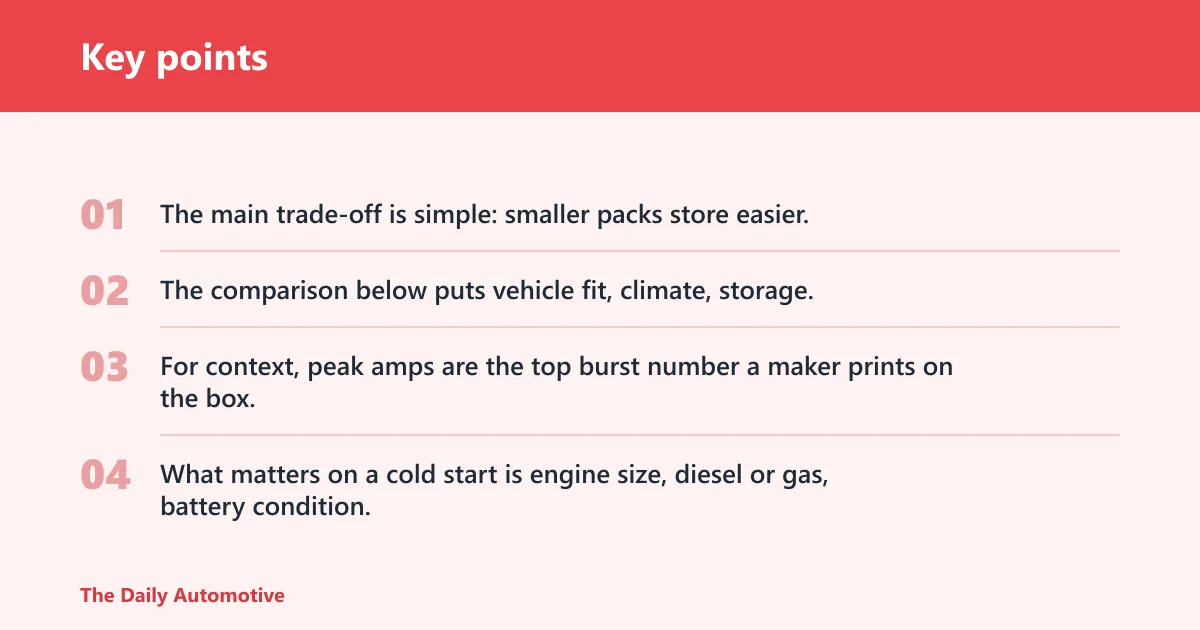
The main trade-off is simple: smaller packs store easier, but bigger engines and colder mornings need more reserve than the peak number on the label suggests. The comparison below puts vehicle fit, climate, storage, and upkeep ahead of headline amp claims.
The best compact jump starter depends on your vehicle: commuter cars can often get by with a small 1,000-1,500-amp pack, SUVs usually need about 1,500-2,000 amps, and trucks or hard winter starts are often safer with 2,000-plus amps. Buy too small, and you get failed starts, stranded mornings, and a pack that looks powerful only on the box. Below, we compare four real jump starters by cold-weather strength, engine size, size, and who each one actually fits.
Quick comparison
| Product | Badge | Best for | Price | ||
|---|---|---|---|---|---|
 |
NOCO Boost GB70 2000A UltraSafe Jump Starter, 12V LithiumNOCO | Our pick | 2000A · UltraSafe · 12V Lithium | $194.99
Price as of 22 Oct 2026
|
View |
 |
Stanley LJ25FC 2500 Amp Lithium Jump Starter with Case |STANLEY | Also great | 2500A · Lithium · USB-C PD | $115.00
Price as of 22 Oct 2026
|
View |
 |
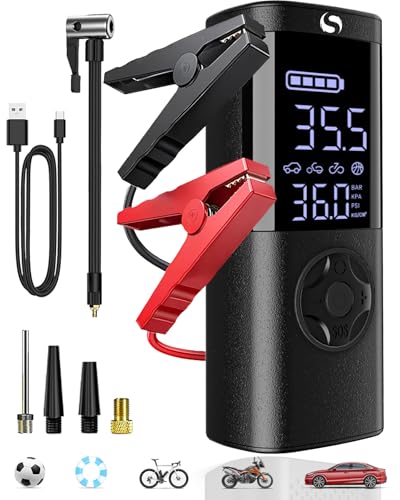
Sharmeal Car Jump Starter 7000A, Jump Starter Battery PackSharmeal | Budget pick | 7000A · Metal Clamps · Compact | $34.97
Price as of 22 Oct 2026
|
View |
 |
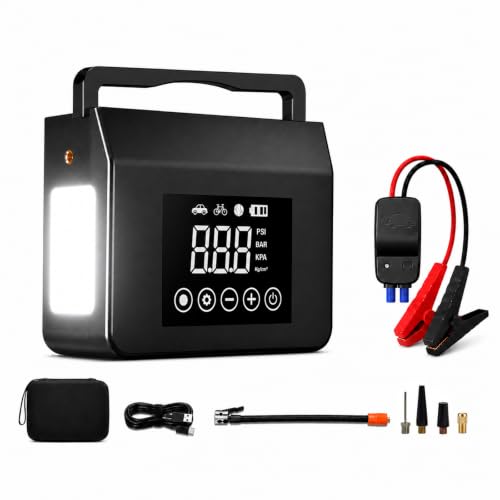
GOOLOO A5 Jump Starter with Air Compressor, 4000A PortableGOOLOO | Upgrade pick | 4000A · Air Compressor · 45W USB-C | $99.99
Price as of 22 Oct 2026
|
View |
For context, peak amps are the top burst number a maker prints on the box. What matters on a cold start is engine size, diesel or gas, battery condition, and the temperature outside.
How we chose
This list favors fit over bragging rights. The main filters were vehicle size, cold-weather margin, storage needs, and safety features such as reverse polarity protection and spark-proof clamps.
We also leaned on published size ratings where available, including the NOCO Boost GB40’s 6.0L gas / 3.0L diesel rating and higher-output units for trucks and diesels. UL2734 certification matters here because it gives safety-minded buyers a verified standard to look for.
One more filter: upkeep. A pack that sits in a trunk for months is not the same as a pack that gets checked weekly in a glovebox.
Jump starter decision table
| Vehicle type | Engine size | Climate | Storage habit | Use frequency | Best jump-starter category | Avoid this if |
|---|---|---|---|---|---|---|
| Commuter car | Gas 2.0L to 3.5L | Mild to cool | Glovebox or small trunk bag | Rare, emergency-only | Compact lithium pack in the 1,000-1,500-amp class | You also need truck, diesel, or deep-winter margin |
| Small SUV or family hauler | Gas 3.0L to 5.0L | Cool to cold | Trunk storage | Occasional | Mid-size lithium pack around 1,500-2,000 amps | You only want the smallest possible glovebox unit |
| Truck or large SUV | Gas V8 or diesel | Cold or variable | Cabin storage or deep trunk | Frequent roadside use | High-output pack with extra headroom, often 2,000-plus amps | You expect a compact commuter pack to cover every start |
| Diesel pickup | Diesel 3.0L and up | Freezing or near-freezing | Truck box or cargo area | Regular winter use | Large jump starter with diesel rating and cold-weather margin | You only start a small gasoline engine once a year |
Small car and commuter fit
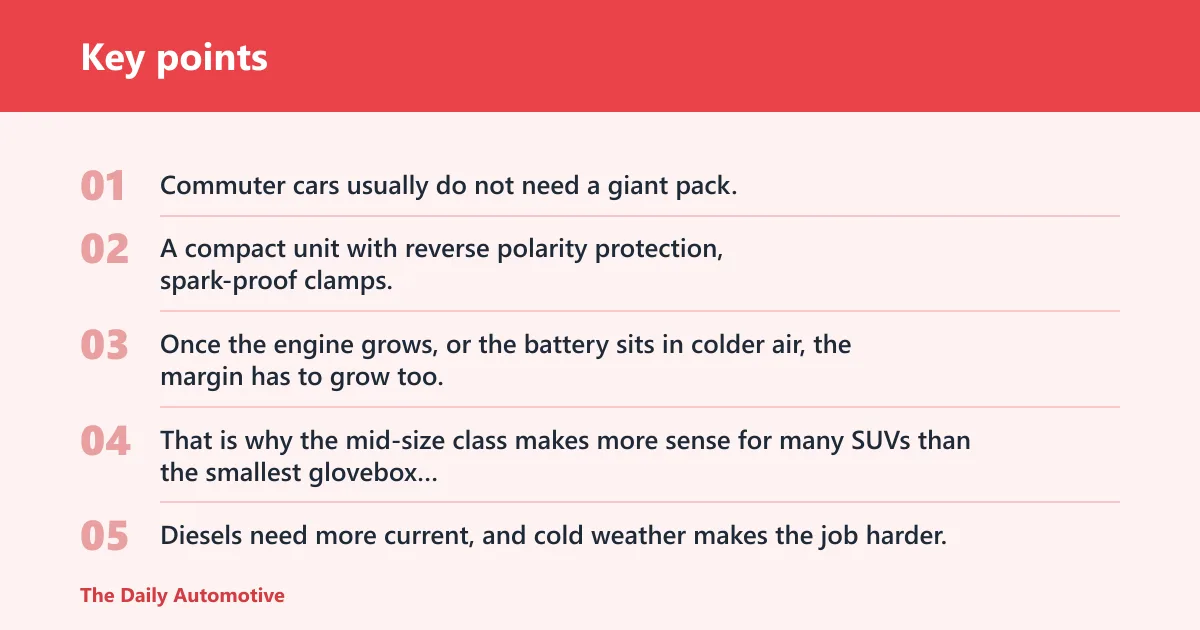
Commuter cars usually do not need a giant pack. A compact unit with reverse polarity protection, spark-proof clamps, and a small battery can do the job if the engine is gasoline and the climate stays moderate.
SUV and family-hauler fit
Once the engine grows, or the battery sits in colder air, the margin has to grow too. That is why the mid-size class makes more sense for many SUVs than the smallest glovebox packs.
Truck and diesel fit
Diesels need more current, and cold weather makes the job harder. The Auto Wire puts diesels in the 1,000 to 3,000+ amp window, which is why a truck owner should look past compact numbers and buy extra headroom.
Avoid this if
If you only want one emergency start a year, skip oversized packs with features you will never use. A built-in air compressor, for example, sounds useful until you realize you are paying for a tool that sits untouched most of the time.
Say your sedan has a 2.5L gas engine and lives in a garage, but you keep the jump starter in the trunk for months. A compact pack can be enough, yet it still needs periodic charging because lithium batteries self-discharge and lose output while sitting idle.
Suppose your diesel pickup is parked outside in January. A pack that looks strong on paper may still struggle if its battery chemistry has been chilled all night, so a larger unit with winter margin is the safer call.
Clore Jump-N-Carry JNC325: best overall
The Clore Jump-N-Carry JNC325 is the best overall pick because it fits the broad middle ground: enough output for real-world emergencies without pushing buyers into oversized, awkward gear. Car and Driver named it the best overall pick, which lines up with the kind of buyer who wants a dependable all-around unit rather than a spec-sheet trophy.
It is the right sort of choice for a commuter driver who wants one pack that can handle a sedan, a small SUV, and occasional cold-weather strain. The drawback is the same one that comes with most best-overall picks: it is not the smallest option, and it is not built to be the “buy once and forget every other category” answer for heavy diesel use.
Who it fits
Choose this if you want the safest all-around answer for a gas car, a crossover, or a household with more than one vehicle type. It is the better fit when you care more about likely success than about shrinking the case to the absolute minimum.
Why it ranks first
The strength of the JNC325 is balance. It avoids the common mistake of treating peak amps as the whole story, and it sits in the zone where a practical buyer should be looking: enough margin for real starts, not a flashy number that may have little meaning across brands.
What to skip if you only need a glovebox unit
If you want the smallest possible pack for a once-a-year emergency, skip this and buy compact. You do not need to pay for broad versatility if the vehicle is a small gas car in a mild climate.
NOCO Boost GB40: best compact
The NOCO Boost GB40 is the compact benchmark. BlackBox Supplies rates it to 6.0L gas and 3.0L diesel, which makes its size easier to justify than a box full of vague peak-amp claims. Car and Driver also named the NOCO Boost Plus GB40 the most compact option, which is the right kind of endorsement for trunk and glovebox storage.
Its main advantage is size. Its main limit is that compact and “covers everything” are not the same thing, especially once the vehicle gets heavier or the weather turns harsh.
Why the 6.0L gas / 3.0L diesel rating matters
Engine-size guidance is more useful than peak amps alone because it maps to the thing that actually matters: whether the pack can turn your engine over. A compact unit can still be right for many drivers, but the rating tells you where the comfort zone ends.
What to skip if you own a truck
If you own a full-size truck, a big diesel, or a V8 that lives outside in winter, skip this compact class. You are better off with more reserve capacity than with the smallest pack that technically fits in the console.
Stanley LJ25FC: best for gas cars
The Stanley LJ25FC is a stronger fit for gas vehicles that need more than a tiny emergency pack, but still want a portable unit. Its 2500A rating gives it a more aggressive headline than most commuter-focused models, and the USB-A and USB-C PD ports make it useful as a power bank too.
The drawback is obvious: once you move into a bigger, feature-rich pack, the storage footprint grows. It is not the first choice for a glovebox slot, and the extra convenience features are not a reason to overspend if you only want one roadside start.
What stands out
The reverse polarity protection is a worthwhile safety feature, and the USB-C PD port adds real utility if you also want a portable charger. That said, extra ports are a bonus, not a reason to buy too much jump starter for your actual engine size.
Honest drawback
The trade-off is storage. A larger pack is harder to tuck away, and if you only need an annual backup, the added bulk can be more annoyance than value.
Sharmeal Car Jump Starter 7000A: best for big claims
The Sharmeal 7000A sits in the high-output camp for buyers who want broad compatibility on paper, including large gasoline engines and diesels. Its 14 safety protections and forced-start button are the kind of features buyers often look for when a battery is fully drained.
The drawback is that huge peak numbers are where marketing gets loudest. That means you should be cautious about assuming the box number tells the whole story, especially if your vehicle is small and your storage space is tight.
Honest drawback: its biggest weakness is overkill
Its biggest weakness is overkill for many cars. If you only need a small gasoline sedan covered once in a while, the extra output and bulk may be money spent on unused capacity.
GOOLOO A5: best for truck extras
The GOOLOO A5 is the most feature-heavy of this group.
The drawback is that the extra hardware cuts both ways. If all you want is a dead-battery restart, the compressor and charging extras can mean more size and more cost than you need.
Why extra headroom matters in cold weather
Cold temperatures reduce lithium output. That is why extra headroom matters more in winter than in summer, and why a unit that seems oversized on a warm afternoon may feel exactly right at 10 degrees on a dark morning.
What to skip if you only drive a small car
Skip this if your vehicle is a compact gasoline car and you already keep a tire inflator elsewhere. The jump function is the reason to buy first; the rest should be bonus, not the main reason.
What size jump starter do you need?
The right size depends on engine type, vehicle mass, and climate. A gas commuter car can often live in the 1,000-1,500-amp range, many SUVs do better around 1,500-2,000 amps, and trucks or diesel engines usually need more reserve, especially in cold weather.
Gas engine vs diesel engine
Gas engines are easier to start than diesels, which is why The Auto Wire’s guidance pushes diesels into the 1,000 to 3,000+ amp window. That does not mean every diesel needs the highest number on the shelf, but it does mean small compact packs are often underbuilt for the job.
Small car vs SUV vs truck
Vehicle size matters because larger engines and heavier electrical loads ask more from the battery pack. The Auto Wire’s 400 to 600 peak amp range for most gas motors is a floor, not a universal answer, while SUVs and larger gas engines live closer to 1,000 to 2,000 amps.
How much cold-weather margin to buy
Buy above the minimum if winters are harsh where you park. A unit that barely meets summer needs can fall short once lithium output drops in the cold, which is why extra capacity is not waste in a January climate.
Are jump starters safe for modern cars and trucks?
Yes, if they include the right protections and you connect them correctly. Reverse polarity protection and spark-proof clamps are the baseline features to look for, and UL2734 certification is useful for buyers who want a verified safety standard rather than a vague marketing claim.
Reverse polarity and spark-proof clamps
These features reduce the chance of user error causing a bad connection. They do not remove the need to read the clamps carefully, but they do make modern jump starters much safer than the old-school guesswork many drivers remember.
Where UL2734 fits in buyer decisions
UL2734 matters most if you prioritize verification. The Auto Wire says the TOPDON JS2000Pro is UL2734-certified, which makes that kind of badge worth noticing when you compare otherwise similar packs.
Built-in USB and flashlight features
USB charging and a flashlight are useful, but they are not the reason to buy the wrong size pack. Treat them as nice extras after you match the unit to your engine and climate.
Which one should you buy?
Buy the Clore Jump-N-Carry JNC325 if you want the safest all-around pick and you value balance over a tiny case. Buy the NOCO Boost GB40 if storage space matters most and your vehicle stays within its 6.0L gas / 3.0L diesel rating.
Buy the GOOLOO GT6000 or the GOOLOO A5-style high-output class if you need truck or diesel headroom, especially in cold weather. Skip oversized units if you only want one emergency start a year, because a compact pack with the right rating is usually the smarter buy.
Choose clore jump-N-Carry JNC325 if…
You want the best all-around answer. You drive more than one vehicle type, you want a practical balance of size and output, or you care more about a dependable fit than about the smallest possible case.
Choose NOCO Boost GB40 if…
You want the compact benchmark. You have a commuter car or small SUV, you need glovebox-friendly storage, and your engine stays within the published 6.0L gas / 3.0L diesel rating.
Choose GOOLOO GT6000 if…
You own a truck, a V8, or a diesel and want extra cold-weather margin. You also want more room to breathe if the pack sits unused between starts or gets used in winter.
Choose a larger feature pack if…
You want a jump starter that also acts as a USB power bank or includes an emergency light, and you will actually use those extras. If not, keep the purchase focused on starting power first.
Frequently asked questions
What size jump starter do I need for my car?
Match the pack to engine size first, not peak amps alone. A small gasoline car can often use a compact unit, SUVs usually need more margin, and trucks or diesels should move up to a higher-output pack, especially if winter starts are part of the picture.
How many peak amps do I need for a jump starter?
Peak amps help narrow the field, but they are not directly comparable across brands.
What is the difference between peak amps and cranking power?
Peak amps is the headline number, while cranking or sustained output is what matters during the actual start. Because brands do not always rate these numbers the same way, engine-size fit and cold-weather margin are more useful than chasing the biggest label.
Do jump starters need to be kept charged?
Yes. If a lithium jump starter sits unused in a trunk or glovebox, it still loses charge over time, so it should be checked and topped up periodically. A pack that has been ignored for months may not be ready when you need it most.
Which jump starter is best for a small SUV or commuter car?
The NOCO Boost GB40 is the best compact-style answer for a small SUV or commuter car, and Car and Driver also named the compact GB40 the most compact option. If you want a broader all-around pick, the Clore Jump-N-Carry JNC325 is the safer general choice.
Products related to this article
Sponsored / affiliate links. As an Amazon Associate I earn from qualifying purchases. I may earn additional commission from eligible campaigns.