Best Car Starters for Ignition (2026): We Compared
The best car starter is the exact-fit unit that matches your engine, rotation, tooth count, mounting pattern, and cranking output. If one spec is off, do not buy it. A wrong starter can mean no-crank failures, gear noise, or damaged flywheel teeth. This guide ranks reliable replacements by fitment, failure symptoms, and starting demand.
Quick comparison
| Product | Badge | Best for | Price | ||
|---|---|---|---|---|---|
 |
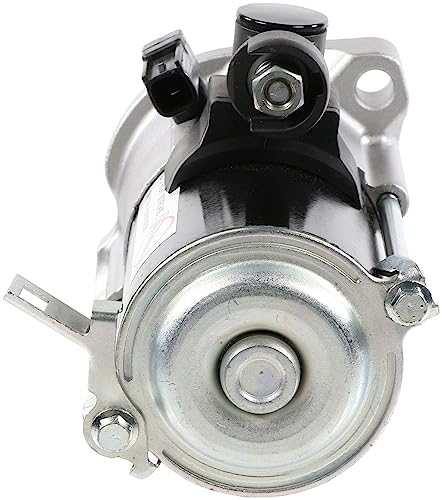
Denso DENSO First Time Fit® Starter Motor – 280-0320 |Denso | Our pick | 280-0320 · vehicle-specific · new replacement | $169.03
Price as of 22 Oct 2026
|
View |
 |
Bosch SR1355X Starter Motor Bosch Premium 100%Bosch | Also great | SR1355X · remanufactured · Bosch Premium | $300.99
Price as of 22 Oct 2026
|
View |
 |
Mopar R6044736AC, Starter MotorMopar | OEM choice | R6044736AC · Mopar OEM · vehicle-specific | $229.13
Price as of 22 Oct 2026
|
View |
Use the comparison table to sort starters by application first, then by tooth count, rotation, and power. That order matters more than brand name when you need the engine to crank cleanly on the first key turn.
How we chose
Fitment came first. Each pick had to line up with a clear vehicle family, OE-number cross-reference, or direct-replacement claim.
Then came the hardware details that stop bad buys: 12V compatibility, pinion tooth count, clockwise or counterclockwise rotation, and starter solenoid layout.
Finally, we weighed cranking output, warranty length, and whether the listing looked like an OEM-style replacement, a remanufactured unit, or a higher-output aftermarket choice.
Denso First Time Fit starter motor: best for exact OE-style replacement
This is the safest fit if you want a vehicle-specific replacement and do not want to gamble on universal claims. Denso’s First Time Fit design and broad OE replacement list make it the strongest choice here for drivers who want direct install compatibility over extra cranking output.
It fits the buyer who is matching an old starter by OE number, mounting shape, and vehicle application rather than chasing a performance upgrade. That matters because a correct starter is not only about bolt pattern; the pinion gear must engage the flywheel cleanly, and the solenoid must line up with the wiring and mounting points.
The drawback is simple: you are paying for exact-fit confidence, not the lowest sticker price. If your engine needs more cranking force in cold weather or has higher compression, a higher-output option may be a better technical match.
Bosch SR1355X starter motor: best remanufactured value
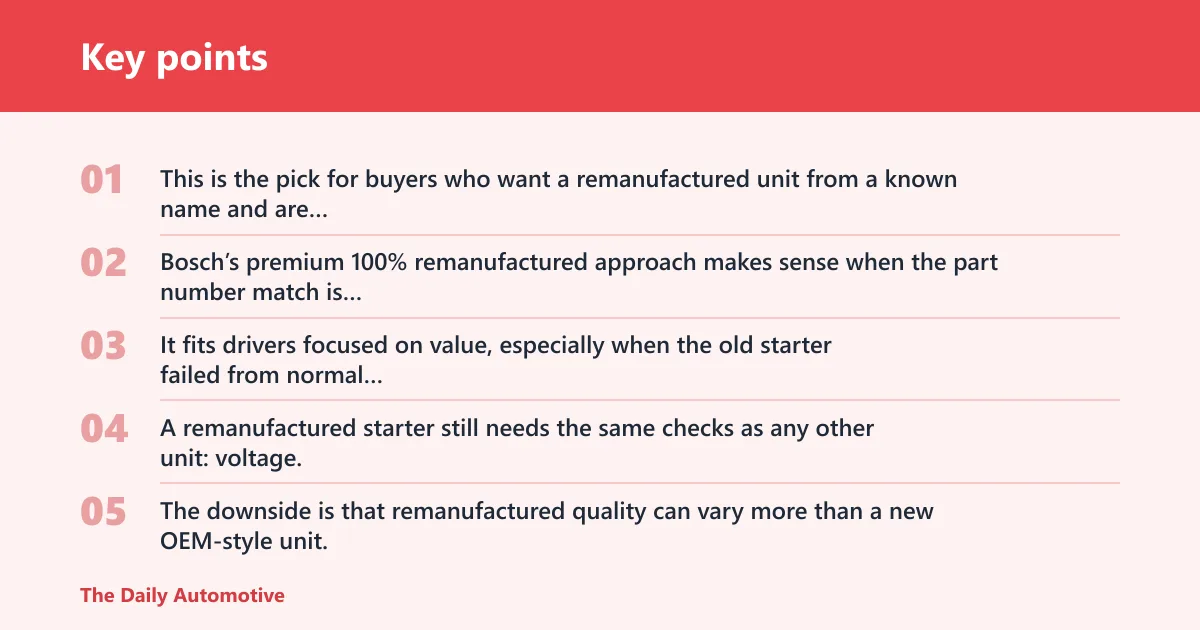
This is the pick for buyers who want a remanufactured unit from a known name and are willing to trade new-unit simplicity for lower net cost. Bosch’s premium 100% remanufactured approach makes sense when the part number match is clear and the buyer wants a trustworthy replacement without paying OEM-new pricing.
It fits drivers focused on value, especially when the old starter failed from normal wear rather than from a damaged flywheel or a wiring problem. A remanufactured starter still needs the same checks as any other unit: voltage, rotation, tooth count, and solenoid mounting have to match the vehicle.
The downside is that remanufactured quality can vary more than a new OEM-style unit, even from a strong brand. If the vehicle is heat-soaked, cold-start prone, or hard on starters, a new direct-replacement unit may be the safer long-term play.
Mopar R6044736AC starter motor: best for factory-fit Mopar applications
This is the clear choice when you want a genuine factory-spec replacement and the vehicle calls for Mopar hardware. For exact-match Chrysler, Dodge, Jeep, or Ram applications, OEM fitment lowers the risk of connector mismatch, mounting issues, or a pinion gear that does not engage the flywheel correctly.
It is the best fit for buyers who put factory compatibility ahead of shopping around. The main advantage is that the OE-number path is simpler: year, make, model, engine, and OE reference all point in the same direction.
The tradeoff is cost. OEM parts usually cost more than comparable aftermarket units, and that premium only makes sense if your goal is the least uncertain replacement path.
Starter selection matrix
| Vehicle family | OE-number match | Voltage | Rotation | Tooth count | kW rating | Warranty length | Best use case notes |
|---|---|---|---|---|---|---|---|
| Honda / 2.4L family | OEM-style replacement cross-reference | 12V | Match the original listing exactly | Verify against the removed unit | Use the OE-style output for stock engines | Check listing coverage before purchase | Best when the old starter is original and the goal is direct replacement fitment |
| Hyundai Elantra family | Application-specific part number | 12V | Match the engine/application | 11-tooth design | Confirm output against the engine spec | Varies by seller | Use only if the vehicle and pinion count align with the 11-tooth listing |
| Honda / Acura family | Cross-reference exact OE number | 12V | Match the original starter direction | 9-tooth design | 1.6 kW | Varies by seller | Good for larger-demand applications where higher cranking output helps |
| Nissan four-cylinder family | Vehicle-year-engine match | 12V | CW listing | 12 teeth | 1 kW | 2-year warranty | Useful when you want a warranty cushion on a daily-driver replacement |
| Ford F-Series and SUVs | Application-specific cross-reference | 12V | Confirm direction before ordering | Verify by old starter and OE number | 1.4 kW | Varies by seller | Better for heavier vehicles and higher cranking demand |
| Chevy V8 performance | Performance-specific fitment | 12V | Check the engine family carefully | Match the flywheel | Higher-output performance starter | Varies by seller | Best when the stock starter struggles with compression or heat soak |
| Marine / GM 4.3L and 5.0/5.7L | Marine-specific replacement listing | 12V | Counterclockwise | 9-tooth option appears on listings | Match the marine application | Varies by seller | Use only if the engine and direction match exactly; marine starters are not generic auto swaps |
What the best car starter for your engine looks like
The best starter is not the strongest one on paper. It is the one that matches the engine family, OE number, voltage, rotation, pinion tooth count, and mounting style with no guesswork.
For many stock passenger cars, a direct-replacement 12V starter with the right tooth count is enough. For larger V6 and V8 engines, or for cold-weather use, a higher-output unit in the 1.0 kW to 1.6 kW range may crank more confidently, especially when battery voltage sags in low temperatures.
A common mistake is choosing a car starter just because it has a familiar logo, even if it lacks the cranking power and cold-weather performance your engine needs. If a sedan needs a 9-tooth starter and the replacement has the right bolt pattern but the wrong pinion count, the starter may grind, fail to mesh, or spin without cranking the engine.
How do you know the starter is failing?
Start with the battery and charging system, because weak voltage often mimics a bad starter. If the battery is low, the alternator is not charging, or the cables have high resistance, the starter may sound weak even when it is still usable.
Battery and charging checks first
Check for dim lights, slow dash power-up, or a battery that drops hard under load. If the battery tests weak or the charging system is off, fix that before ordering a starter.
Starter-specific symptoms to watch
Repeated single clicks, no-crank with full battery voltage, intermittent starts, or a starter that only works after tapping are more starter-specific clues. Grinding on engagement points more toward a tooth-count mismatch, worn pinion gear, or flywheel damage.
When to suspect flywheel damage
If the starter spins but does not crank, or if there is repeated metal-on-metal noise, inspect the flywheel teeth. A damaged flywheel can ruin a new starter fast, so do not replace the motor alone if the engagement face is already worn.
How do I know which starter fits my exact vehicle?
Match year, make, model, and engine first, then confirm OE-number cross-reference, voltage, rotation, tooth count, and mounting pattern. That order catches the fitment misses that cause no-start problems after installation, especially on vehicles with multiple starter variants across the same model range.
Match year, make, model, and engine
Do not stop at the trim level. The same vehicle line can use different starters across engine options, emissions packages, or drivetrain combinations, so the engine code matters as much as the badge on the tailgate.
Verify tooth count and rotation
Count the pinion teeth on the removed starter and compare the listed direction. Clockwise is often marked CW; counterclockwise starters, including some GM, Ford, and marine applications, must match the engine/application exactly.
Keep in mind that a 12-tooth starter in CW form is not interchangeable with a 9-tooth counterclockwise unit just because both fit the block pattern.
Check mounting and solenoid layout
Look at the starter solenoid location, terminal orientation, and nose housing shape. The wiring can be correct while the mounting ears or cable position still make the part unusable.
Starter buying checklist
Use this list before you order anything. It catches most avoidable fitment mistakes and helps separate a true starter fault from a battery or charging issue.
- Confirm the OE number against the vehicle-year-engine combination.
- Compare the removed starter’s voltage, rotation, and pinion tooth count.
- Check the mounting pattern, nose shape, and solenoid terminal layout.
- Verify the starter is 12V if the vehicle uses a standard 12-volt electrical system.
- Look for clear warranty terms; 2-year coverage is a useful risk filter when the listing offers it.
- Use ISO/TS16949 as a quality-control signal when the seller cites it.
- Choose OEM-style or direct-replacement units first when the vehicle is sensitive to fitment.
Say your truck cranks slowly only on cold mornings, but a battery load test is clean and the cables are good. A higher-output starter can help if the vehicle is within the listed application and the OE-number match is correct; it should not be used as a substitute for a bad battery.
If a car has repeated grinding after a starter swap, that usually means the tooth count, rotation, or flywheel engagement is wrong, and replacing another starter without checking the removed unit will likely repeat the failure.
What warranty should I look for on a replacement starter?
Look for at least clear written coverage, and treat 2-year warranty examples as a useful baseline when you are comparing similar fitments. Warranty does not prove the part is perfect, but it lowers the risk if the starter fails early or if the installation exposes an underlying issue.
Longer coverage matters most on daily drivers, cold-climate vehicles, and higher-demand engines. If two starters fit equally well, the one with better warranty terms and clearer OE-number support is usually the safer buy.
Which one should you buy?
If you want the least risky exact match, start with the Denso First Time Fit unit. It is the best answer when the original starter’s OE number and vehicle application are known and you want direct replacement confidence.
If you want lower cost and can live with remanufactured hardware, the Bosch SR1355X is the value play. If you need genuine factory-spec fitment for a Mopar application, the Mopar R6044736AC is the cleanest path.
Choose higher-output starters only when the engine actually needs them. A 1.4 kW or 1.6 kW unit can help with larger engines, compression, cold starts, or heat soak, but it still has to match the OE number, tooth count, and rotation.
For marine or mixed-application buyers, do not treat clockwise and counterclockwise units as close enough. That is where starter shopping turns into a failure-diagnosis problem, not a price-comparison problem.
Frequently asked questions
What is the best starter motor for my car?
The best starter motor is the exact-fit unit for your year, make, model, and engine, with the correct rotation, tooth count, voltage, and mounting pattern. If the listing does not line up on those points, it is not the best choice, even if the price or brand looks attractive.
What tooth count should a car starter have?
Your starter should have the same pinion tooth count as the original unit or the OE-listed replacement for that engine family. A mismatch can cause grinding, incomplete engagement, or a no-crank condition because the pinion and flywheel teeth do not mesh correctly.
Does starter power in kW matter for my engine?
Yes. Higher kW output usually helps with larger V6 and V8 engines, cold-weather starts, or engines that suffer from heat soak. For a stock small-displacement car, extra output is not automatically better if the fitment is wrong or the charging system is weak.
What does clockwise or counterclockwise starter rotation mean?
It describes the direction the starter’s pinion turns. Many listings mark clockwise as CW, and counterclockwise units are common in marine and some GM or Ford applications. The direction has to match the engine and application exactly or the starter may not engage properly.
Are OEM-style starters better than cheap aftermarket ones?
OEM-style starters are usually the safer choice when exact fitment matters, because they are built around the original application and OE-number cross-reference. Cheap aftermarket units can work, but they raise the risk of tooth-count, rotation, or solenoid mismatch unless the listing is very specific.
How do I tell if my starter motor is failing?
First rule out battery and charging-system problems. If those check out, repeated clicking, intermittent no-crank, grinding, or a starter that only works after repeated attempts points toward starter failure, pinion wear, or flywheel damage rather than a simple low-voltage issue.
Products related to this article
Sponsored / affiliate links. As an Amazon Associate I earn from qualifying purchases. I may earn additional commission from eligible campaigns.