Bank of America Auto Loan Review: Is It Worth It?
Bank of America auto financing is worth considering if its APR is better than your dealer offer by about 1 percentage point, or if you prefer one lender for banking and loan servicing. Skip that comparison, and you can end up paying more interest and fees over the loan term. This review breaks down Bank of America’s auto loan fit, where dealer financing wins, and which other lenders make the strongest fallback.
Bottom line on where it fits
Bank of America makes the most sense for borrowers with solid credit, a straightforward purchase, and enough time to compare a bank quote against the dealer’s financing desk. It works best when you want a fixed-rate auto loan and predictable monthly payments. If the dealer can beat the bank on APR, incentives, or fees, the dealer route may cost less.
The lender is worth a look for people who already bank there and want one place for payment management, statements, and alerts. It is a weaker fit if your deal depends on fast turnaround, an unusual vehicle, or a special promotion tied to a captive lender. In those cases, a credit union or dealer subsidy may win on cost.
Pros and cons
Pros
- Familiar national bank brand with standard loan administration.
- Good comparison point when you are rate shopping.
- Useful if you want to keep banking and loan servicing in one place.
- Can be a clean choice for borrowers who want a plain purchase loan or refinance.
Cons
- You still need to compare it with dealer financing and credit union offers.
- Dealer incentives can beat a bank rate on some new cars.
- A longer term can lower the payment while increasing total interest.
- Used-car eligibility, mileage, and age limits can narrow your options.
Who it’s for
Bank of America fits shoppers who want a conventional auto loan, can qualify on credit strength, and plan to keep the car long enough that the payment structure matters more than a short sale incentive. It also fits existing customers who prefer online payment management and statement access under one login.
Borrowers should look elsewhere if they need a very low APR tied to a new-car incentive, want a dealer-arranged same-day close with heavy promotion money, or need a lender that is more willing to work with a thin credit file. A credit union or online lender can be the stronger fallback when the bank quote is close but not best.
Auto loan comparison table
| Scenario | Bank of America fit | Better alternative | Why it wins | What to verify before applying |
|---|---|---|---|---|
| New car, strong credit, standard term | Good if the quoted APR is competitive | Dealer financing with a promo APR | Manufacturer-backed rate cuts can beat a bank offer on the same car | Compare APR, dealer fees, and whether the promo requires a shorter term |
| Used car from a dealer | Good if the vehicle fits age and mileage limits | Credit union | Credit unions often price used-car risk more sharply for members | Confirm model-year limits, mileage limits, and loan-to-value rules |
| Private-party purchase | Possible only if the lender allows that channel | Online lender that supports private-party sales | Some lenders handle title checks and seller payoffs more cleanly | Verify private-party eligibility, title transfer steps, and inspection rules |
| Need lower payment, not cash out | Can work if refinance pricing improves the rate | Refinance specialist or credit union | More aggressive refinance pricing can shorten the path to savings | Check whether the new term raises total interest even as payment falls |
| Existing customer who wants simple servicing | Strong fit for routine payment management | Any lender with better APR | A lower rate can matter more than portal convenience | Confirm autopay, statement access, alerts, and payoff procedures |
Does Bank of America offer auto loans?
Yes, Bank of America does auto financing, and you should treat it as a real shopping option rather than a last resort. The key question is not whether it lends at all, but whether the quote you receive is better than dealer financing, a credit union offer, or another bank’s refinance deal.
Purchase financing channel
For most shoppers, the practical question is where the loan gets originated and how the paperwork moves. Dealer-arranged financing can be fast, but direct bank financing often works better when you want to compare terms before you sit down at the finance office. That comparison matters because dealer markups can change the final APR.
New and used vehicle support
Bank auto loans commonly cover new and used vehicles, but used-car eligibility can bring age, mileage, and loan-to-value limits. Those constraints matter more than the badge on the hood. A late-model used sedan can be easy to finance, while an older high-mileage SUV may be harder to place.
Say your target is a 2021 compact SUV with about 42,000 miles. That may fit comfortably under many lenders’ used-car rules. Now change only the age to a much older model with high miles, and the lender may tighten the loan amount or decline the deal entirely.
Refinance and lease buyout availability
Refinancing is a separate product from a purchase loan. It makes sense when your goal is a lower APR or a lower payment on an existing balance, not when you want cash out for another purpose. Lease buyout support, if available, should be confirmed before you assume the lender will handle it.
Eligibility and vehicle limits
Eligibility depends on credit strength, income, debt load, vehicle age, mileage, and the loan amount relative to the car’s value. That is why there is no single credit-score cutoff that fits every borrower. Better credit usually means better pricing, but loan structure still matters.
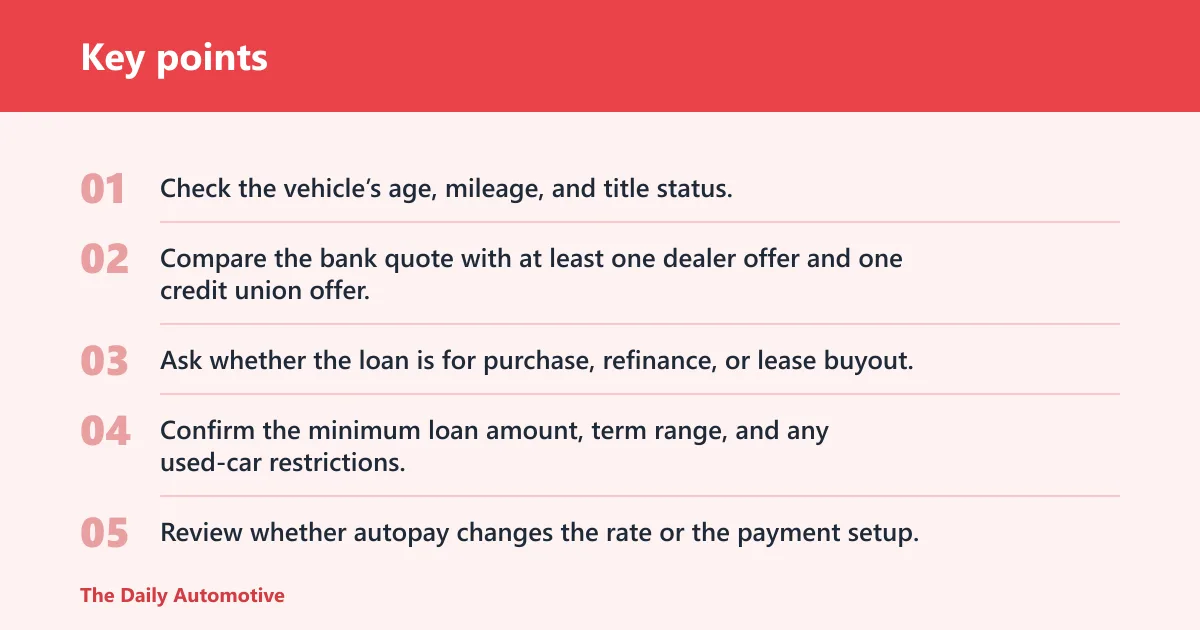
- Check the vehicle’s age, mileage, and title status.
- Compare the bank quote with at least one dealer offer and one credit union offer.
- Ask whether the loan is for purchase, refinance, or lease buyout.
- Confirm the minimum loan amount, term range, and any used-car restrictions.
- Review whether autopay changes the rate or the payment setup.
What should you know about rates, terms, and fees?
Auto loan APR is the number that matters most because it sets the borrowing cost across the full term. For a fixed-rate loan, the rate stays put for the life of the contract; variable-rate auto loans are less common in the mainstream market. Credit score, term length, vehicle age, and dealer markup all affect the final cost.
APR, credit, and term length
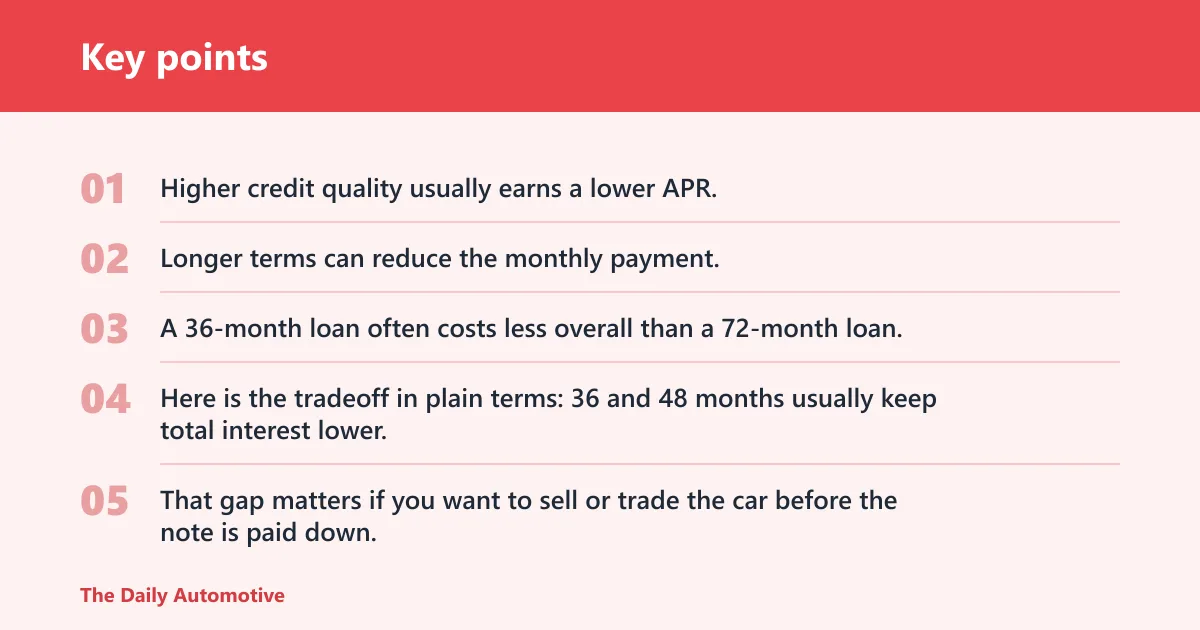
Higher credit quality usually earns a lower APR. Longer terms can reduce the monthly payment, but they usually increase total interest paid and make negative equity more likely, especially on a new car that loses value quickly. A 36-month loan often costs less overall than a 72-month loan, even though the payment is higher.
Here is the tradeoff in plain terms: 36 and 48 months usually keep total interest lower; 60 months is a middle ground; 72 and 84 months can make the payment easier to handle but can stretch the loan past the steepest depreciation period. That gap matters if you want to sell or trade the car before the note is paid down.
Fee disclosure and total interest cost
Read the loan estimate and contract carefully for any origination fee, documentation fee, or dealer add-on that increases the amount financed. Even when a rate looks competitive, extra fees can push the real borrowing cost higher. Monthly payment is not the same as total cost.
Suppose two loans both fit your budget, but one uses a lower payment because it stretches to 84 months. The lower payment can hide a larger total interest bill. That is why the shorter loan is often the cleaner choice if your budget can handle it.
Prepayment and payment management
Before you sign, verify whether there is a prepayment penalty. Many modern auto loans allow extra principal payments without penalty, but you should not assume it. If the lender lets you manage payments online, that usually includes statement access, payment history, and alerts tied to due dates.
Can dealer financing beat Bank of America?
Dealer financing can sometimes beat Bank of America when the dealer offers a subsidized APR, a rebate that applies only with dealer financing, or a lender match that lowers the rate after you negotiate. It can also be the faster route when you need same-day documentation and funding on a straightforward purchase.
When dealer-arranged financing wins
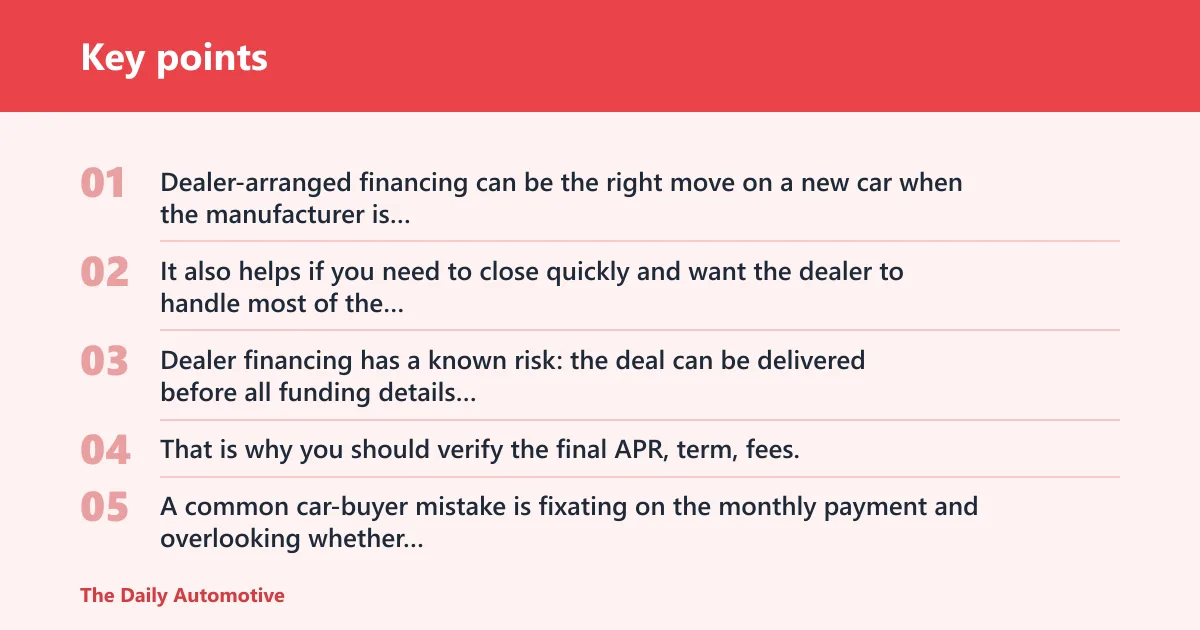
Dealer-arranged financing can be the right move on a new car when the manufacturer is subsidizing the rate or when the dealer’s lender lineup is stronger for your specific credit profile. It also helps if you need to close quickly and want the dealer to handle most of the back-and-forth.
Spot delivery and paperwork timing
Dealer financing has a known risk: the deal can be delivered before all funding details are fully locked, then changed later if the lender declines or re-prices the file. That is why you should verify the final APR, term, fees, and any conditional approval language before you leave with the car.
A common car-buyer mistake is fixating on the monthly payment and overlooking whether the loan term will keep the total cost manageable. If the finance office revises the rate after delivery, the payment can rise even though the car is already in your driveway.
When a bank quote is safer
A bank quote is safer when you want to compare the loan on its own merits before the dealer mixes it with add-ons, warranty products, or payment extensions. It is also safer if you are buying used and want a cleaner read on the total cost before the purchase order is final.
Frequently asked questions
What is bank of america auto loan rates?
Bank of America auto loan rates depend on credit profile, vehicle type, term length, and whether the loan is for a purchase or refinance. The useful benchmark is not a universal sticker rate. Ask for a personalized APR and compare it against the dealer’s offer, because a small spread can change total interest materially.
Are bank of america car loans good?
They can be good for borrowers with solid credit who want a standard bank loan and simple servicing. They are less compelling if a dealer promotion, credit union offer, or refinance specialist can undercut the APR. The loan is only “good” if the total cost and terms hold up against those alternatives.
Does bank of america do car loans?
Bank of America offers car loans, including purchase financing and refinance options in many cases. The details still matter: the vehicle must meet lender rules, the borrower must qualify, and the quote should be checked against dealer financing. Treat the bank as one bidder in a wider rate-shopping process.
What fees come with a bank of america auto loan
The key fees to check are origination, documentation, and any dealer-imposed charges that end up in the amount financed. Also verify whether there is a prepayment penalty or any payoff-related cost. A lower APR can be offset if fees raise the loan balance or if the dealer adds products you do not want.
Can I refinance a car loan with bank of america?
Refinancing can make sense if you can lower the APR, reduce the monthly payment, or move from an unfavorable contract into a better one. It is not worth it if the remaining balance is small, the term resets too long, or the fee savings do not outweigh the new interest. Rate-and-term refinance is different from cash-out.
Is bank of america auto financing available for used cars?
Used-car financing is commonly available, but the vehicle must meet age, mileage, and value limits. Private-party sales can be harder than dealer sales because title transfer, inspection, and payoff handling take more coordination. Verify those rules before you put down a deposit, because a lender can approve one type of used purchase and reject another.
Products related to this article
Sponsored / affiliate links. As an Amazon Associate I earn from qualifying purchases. I may earn additional commission from eligible campaigns.