Why Are Car Rental Reviews So Bad?
Car rental reviews are often bad because the low advertised price is only the first layer. The trouble usually shows up in fees, counter delays, damage disputes, and surprise charges. If you miss that pattern, you can book the cheapest rate and still pay more, lose time, or end up in a billing dispute after drop-off. This guide separates pricing noise from real service failures and shows you how to read reviews before you book.
Price surprises versus operational friction
Price shock versus service failure
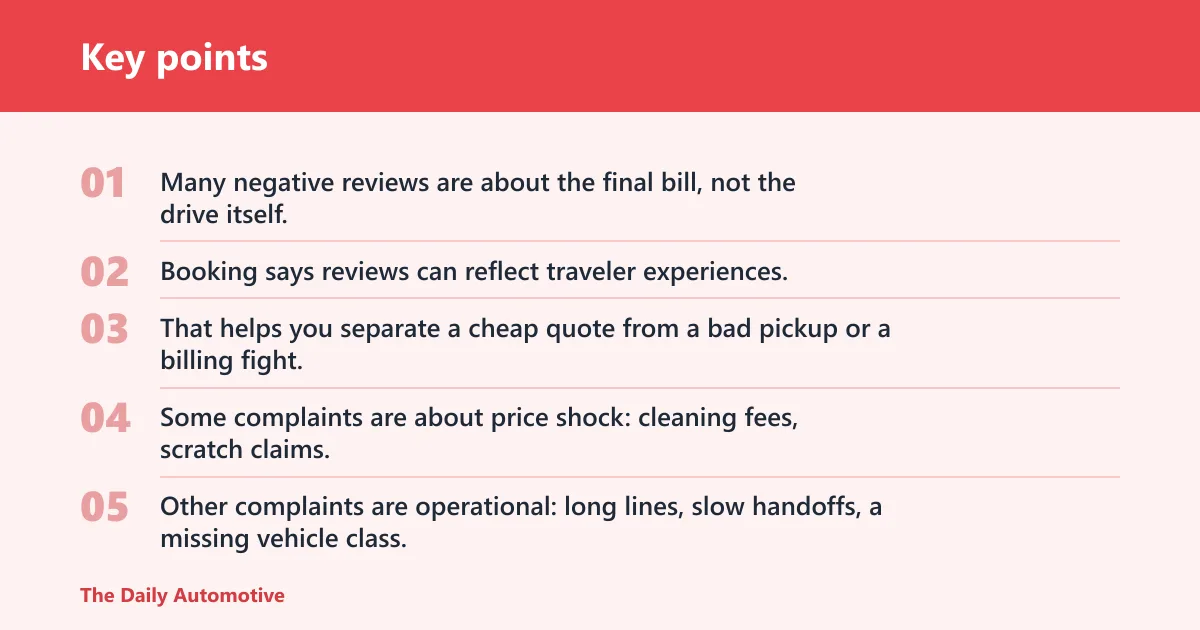
Many negative reviews are about the final bill, not the drive itself. Booking says reviews can reflect traveler experiences, and it recommends recent reviews from the last few months because the details may matter more than the star score. That helps you separate a cheap quote from a bad pickup or a billing fight.
Some complaints are about price shock: cleaning fees, scratch claims, late-return charges, deposit deductions, fuel rules, or a higher total at the counter than the price shown online. Other complaints are operational: long lines, slow handoffs, a missing vehicle class, or a rushed damage walkaround. Those are different failures.
Why one bad pickup can dominate a review
A single rough pickup can shape the entire review because it happens before the trip starts. If the desk is slow, the car is not ready, or the agent adds charges without a clear explanation, the renter feels friction at the exact moment trust should be building. That is why a review can read angry even if the car itself was fine.
How expectations differ at airports and downtown locations
Airport rentals face flight delays, late arrivals, heavier demand, and more pressure at the counter. Downtown locations can be slower for a different reason: fewer staff, limited inventory, and narrower hours. A review that complains about a long airport line may point to peak demand, while the same complaint downtown may signal understaffing.
Bad review decoder table
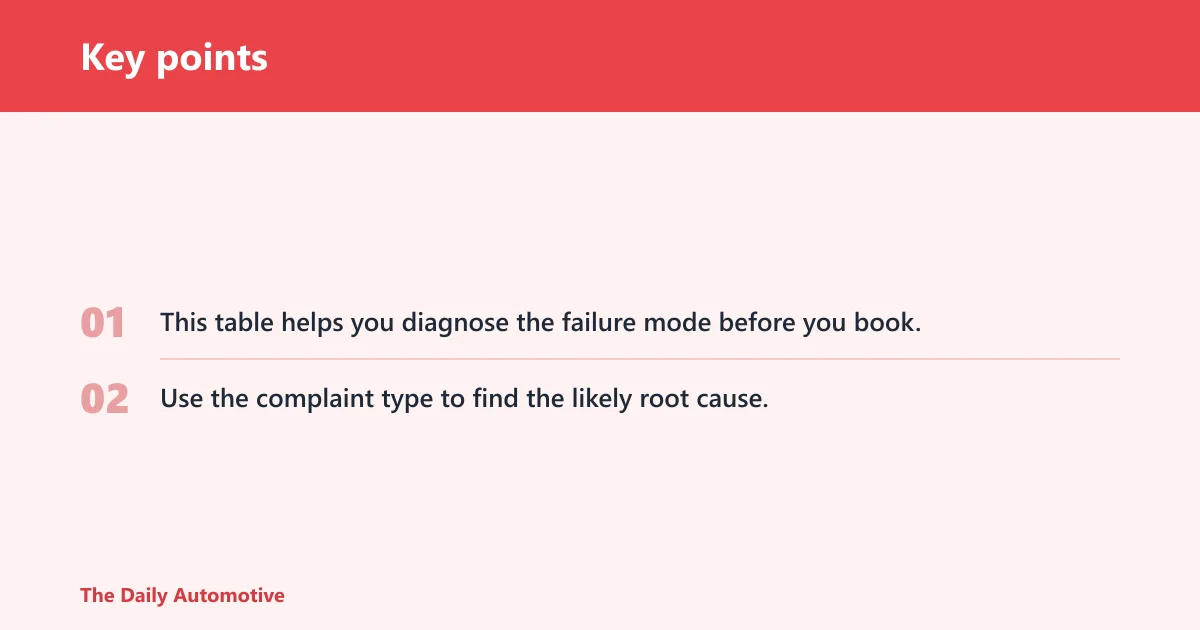
This table helps you diagnose the failure mode before you book. Use the complaint type to find the likely root cause, then look for the matching signal across several reviews, not one angry comment.
| Complaint type | Likely root cause | Confirmation signal to look for in reviews | Booking-time workaround |
|---|---|---|---|
| Hidden fees | Final bill does not match the initial quote; add-ons appear at pickup or return | Repeated mentions of cleaning fees, scratch claims, late returns, fuel charges, or deposit deductions | Compare the total, not the headline rate; read the fee and damage sections before booking |
| Long pickup lines | Peak-time staffing shortage, slow ID checks, or handoff friction | Multiple recent reviews mention waits of about 30 minutes, 45 minutes, or longer at the counter or shuttle stop. | Choose off-airport pickup when possible, or book a time with lower traffic and clearer staffing |
| Damage claims | Poor inspection process, weak photo records, or disputed pre-existing damage | Reviewers mention dents, tire marks, windshield chips, or claims filed after return | Photograph the car at pickup and return; ask staff to note visible damage on the contract |
| Poor vehicle condition | Weak maintenance, rushed cleaning, or inventory pressure | Cleanliness complaints, warning lights, worn tires, low fluid, smells, or missing equipment show up again and again | Read recent reviews for condition, and switch brands if the same issues keep appearing |
| Deposit delays | Security hold not released quickly, or a claim is applied after return | Recent reviews mention holds lasting days, refund timing problems, or surprise deductions after drop-off | Use a card with enough room for the hold, and confirm the refund policy before you reserve |
What to look for in rental reviews
Focus on recent reviews, repeated patterns, and concrete detail. The same source says specific review details matter more than the overall star score, and it lists vehicle condition, customer service, pickup and drop-off process, and unexpected charges as key signals. Repeated complaints should make you think twice.
Recent review patterns and seasonality
Recent reviews matter because staffing, fleet age, and policies can change fast. A location that looked fine some months ago may be struggling now, especially during holidays, summer travel, or major events. If the latest complaints all cluster in the same period, that matters more than older praise.
Say your trip is in July at a busy airport. If the most recent reviews all mention 40-minute lines and cars not being cleaned between returns, that is a current operational problem, not a one-off gripe from last year.
Repeated complaints across multiple reviewers
One bad review can be noise. Three or four recent reviews saying the same thing are usually not just noise. Look for the same issue appearing in different wording: hidden cleaning fees, unexplained damage claims, or staff who refuse to fix a booking error. That pattern tells you more than a high star average.
Details that sound specific versus generic
Specific reviews mention the desk, the shuttle, the return lane, the model class, or the charge that appeared later on the card. Generic reviews often stay vague, with lines like “great service” or “terrible experience” and little else. Taggart says fake reviews are often short and generic, which makes detail a useful filter.
How do you spot fake or misleading reviews?
Look for sudden five-star spikes, repetitive phrasing, and profiles with little believable history. Fake or misleading reviews are harder to spot when they are positive, because company pages can look polished. Independent platforms are more useful than company websites for checking reviews, according to Taggart.
Sudden five-star spikes
A burst of near-identical praise over a short period can signal manipulation or review prompting. If a company moves from mixed feedback to a wall of short five-star comments in the same week, treat that as a warning sign rather than proof that the operation changed overnight.
Generic wording and copy-paste phrasing
Watch for reviews that read like templates: “excellent service,” “best experience,” “highly recommend,” with no location detail or trip context. A real rental review usually contains something concrete about the car class, the counter, the return process, or the bill. Short and generic is the pattern to question.
Profile history and reviewer consistency
Profiles with only one review, no history, or inconsistent writing style deserve a closer look. That does not prove a review is fake, but it lowers confidence. Cross-check the same location on Google Business Profile, Trustpilot, and an independent review site before you rely on a company-owned testimonial page.
Why are car rentals so expensive now?
Car rentals feel expensive when the headline rate is low but the total booking is not. Extra charges for age, airport location, fuel policy, mileage, insurance, or one-way use can push the real price up fast. Shortages also reduce availability, which gives the remaining inventory more pricing power.
Low headline rates versus actual booking totals
Some comparison sites lead with low daily rates that do not reflect the final total. The same source says some companies use unrealistically low daily rates, and KAYAK shows car rentals in Reno from $35/day. That kind of headline can still hide taxes, fees, and location charges that make the booking much pricier.
Extra fees tied to age, location, fuel, and mileage rules
Unexpected costs often come from policy details. Younger drivers may face surcharges. Airport pick-up can cost more than downtown. Fuel rules can add a bill if the tank is not returned the way the contract requires. Mileage caps and one-way drops can also change the total.
How shortages affect price and availability
When inventory is tight, cars disappear faster and rates rise. That is one reason travelers see both “too expensive” and “no cars available” at the same time. If several brands are sold out for your dates, the review problem may be a supply problem, not only a service problem.
What should you check before booking?
Check the platform, the location, and the fine print before you reserve. The most useful review pages are the ones with recent, specific, third-party feedback. The least useful are brand testimonials that only show polished praise and no real dispute history.
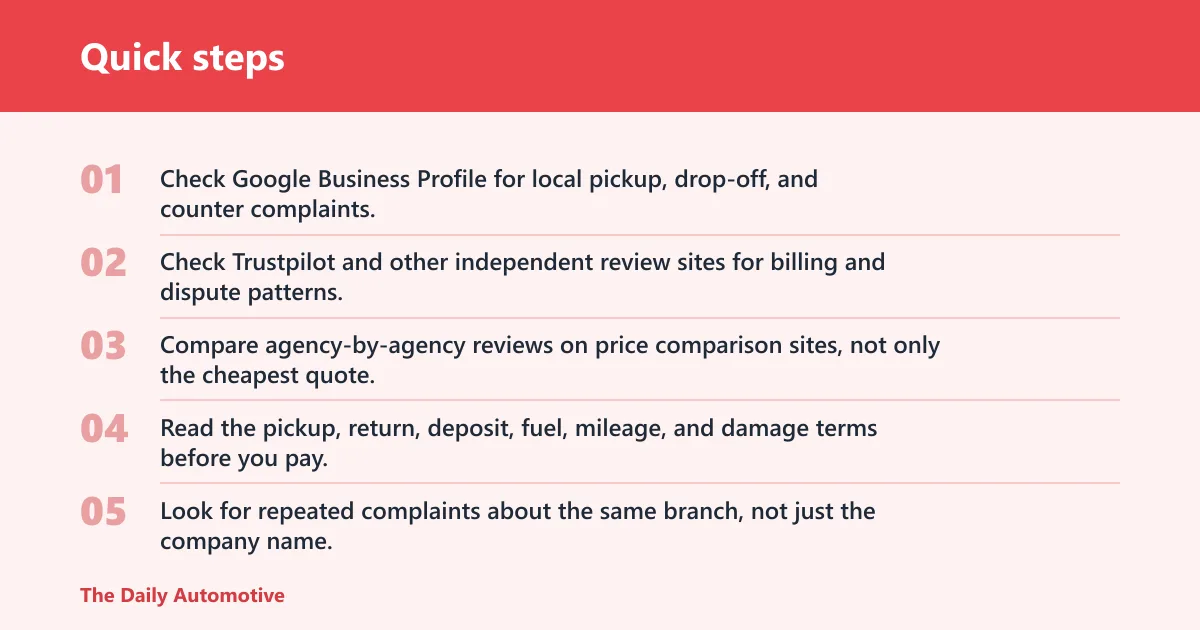
- Check Google Business Profile for local pickup, drop-off, and counter complaints.
- Check Trustpilot and other independent review sites for billing and dispute patterns.
- Compare agency-by-agency reviews on price comparison sites, not only the cheapest quote.
- Read the pickup, return, deposit, fuel, mileage, and damage terms before you pay.
- Look for repeated complaints about the same branch, not just the company name.
Google Business Profile versus trustpilot
Google Business Profile is useful for location-level issues such as lines, staff response, and shuttle handling. Trustpilot can surface broader billing and dispute patterns. Together, they give you two different views: one tied to the branch, the other tied to the brand’s overall behavior.
Independent platforms versus company testimonials
Company-owned testimonials are the weakest proof because the business controls what appears there. Independent platforms are better for checking whether complaints repeat across unrelated travelers. If the company page is glowing but outside reviews mention the same fee or claim over and over, trust the outside pattern.
Agency-by-agency checks on comparison sites
Price comparison sites are useful only if you filter by agency, not just by rate. A cheap listing may come from a branch with long lines, aggressive add-ons, or slow deposit releases. Sorting by price alone can hide the exact location that causes the bad reviews.
Pickup, return, deposit, and damage terms
Read the contract sections that control the final bill. Security deposit timing, card holds, inspection rules, after-hours return procedure, and damage documentation matter more than glossy photos on the booking page. Those terms are where many bad reviews begin.
Suppose a family books a midsize SUV for a beach trip and the listing looks cheap. At pickup, the car is smaller than expected, the third-row space is missing, and the desk adds a cleaning charge plus a larger deposit hold. The review is not about one problem; it is about a mismatch between the booking page and the real handoff.
Why are there no car rentals available?
Availability can vanish because demand is high, the branch is short on inventory, or the booking site is filtering too narrowly. Airport shortages are common during peak travel periods. One-way trips, under-25 rentals, and large vehicle classes can disappear first because they are harder to reassign.
Search filters can hide inventory
Filters on price comparison sites can make cars seem unavailable when the issue may be a narrow search. If you filter by exact class, transmission, agency, and pickup time, the list can shrink fast. Broaden the filters and recheck agency by agency before assuming the market is sold out.
What are the worst things about renting a car?
The worst parts are usually surprise charges, slow pickup, damage disputes, and a weak return process. Those issues hit when time is tight and the renter cannot easily leave. A rental can look fine on price and still become a problem if the branch mishandles the handoff or the bill.
Unexpected charges and damage claims
Unexpected charges are one of the clearest warning signs in reviews. Watch for cleaning fees, scratch claims, late-return penalties, and deposit deductions that appear after the trip. If the same charge appears in several recent reviews, treat it as a branch habit, not a one-off billing error.
Pickup and drop-off friction
Long lines, slow handoffs, and after-hours return confusion generate a lot of frustration. A branch may look cheap online but waste an hour at pickup or leave the renter unsure how to document the return. That is the kind of friction reviews capture better than a star score.
Customer service response
Customer service matters most when something goes wrong. Look for reviews that describe whether staff helped fix a wrong charge, a damaged-car note, or a missed reservation. The same source says companies that respond to reviews are a better sign, because response behavior can show whether the branch handles disputes or avoids them.
How do I get good car rental reviews before booking?
Start with recent, specific, third-party reviews and use them to check the exact branch you plan to use. Then compare the quote with the policies that affect the final bill. A good review page should tell you about the counter, the return process, the vehicle condition, and whether hidden fees keep appearing.
Use a simple booking-time checklist
- Read reviews from the last few months.
- Look for repeated complaints about fees, lines, or damage claims.
- Check Google Business Profile, Trustpilot, and one independent review site.
- Compare the full price, not only the headline rate.
- Confirm deposit hold amount, refund timing, and after-hours return rules.
Frequently asked questions
Why are car rental reviews so bad?
They are often bad because renters remember the sharpest failure: a price that changes, a line that drags on, a car that looks rough, or a damage claim that lands after return. Those complaints are common because they affect time, money, and trust all at once.
How do I tell if car rental reviews are fake?
Look for short, generic praise, sudden five-star bursts, and profiles with little history. Fake or misleading reviews often sound interchangeable. Real reviews usually include a location, a vehicle class, a charge, or a specific step in the pickup or return process.
Is buying a rental car bad?
Buying a former rental is not automatically bad, but the condition depends on maintenance records, inspection history, and how the car was used. A fleet car can be a reasonable purchase if the paperwork is clean and the vehicle has been serviced on schedule.
Products related to this article
Sponsored / affiliate links. As an Amazon Associate I earn from qualifying purchases. I may earn additional commission from eligible campaigns.